
Opus Issue: August, 1965. Special Collections and Archives.
Pranksters of the year, 1965
By Davina Pellatt – Archives Engagement Officer – Special Collections and Archives
In the grand tradition of Autonomy Day, where mayhem and mischief have long been part of the celebration, a recent enquiry prompted me to explore the motivations behind the University of Newcastle’s renowned Autonomy Day pranks.
The prank of the year in 1965, involved two supposed Lithuanian swimmers, Miss Juno Plentovich and Mr Herculoid Cazy, who were advertised as attempting a swim from Stockton to Queen’s Wharf through the shark-infested waters of Newcastle Harbour. Hundreds of spectators gathered along the foreshore to cheer on the international athletes.
In reality, “Juno Plentovich” was Jeanne (Woodlands) Raper, who recently recalled the event:
“Photos of us were taken in full diver’s wetsuits at the Bogey Hole, and an article was published in the Newcastle Herald. I think there was also a five-minute interview segment shown before the evening news. On the day, Nock & Kirby sponsored the event, and NBN filmed it from an accompanying boat. During the swim I accidentally spoke English, and the people in the boats realised I wasn’t authentic. I think they were hoping that Herculoid Cazy was at least Lithuanian! I swam very fast after that—I thought I’d be arrested.
Godfrey Tanner, the Classics Professor, was waiting at the Queen’s Wharf jetty at the finish. As he helped us ashore, he wanted to marry me to the water or perform some sort of ceremony in Latin. I refused and made a quick escape!”
Did it work?
The hoax proved a huge success, attracting widespread public attention and demonstrating the playful spirit that characterised Newcastle’s early Autonomy Day celebrations. Like many of the pranks associated with the event, it relied on a blend of theatre, humour, and public participation, ensuring it was remembered long after the swimmers had reached the shore.

At the finish line! Lithuanian swimmers, Juno and Herculoid aka Jeanne Woodlands and Michael White, are being pulled out of the water by Professor Godfrey Tanner in Latin. NBN footage, 1965.
Do pranks have a deeper meaning?
In 1963, former Alderman Edwards dismissed the festivities as “skylarking, jackassing and billygoating,” a sentiment shared by many members of the public who viewed the student celebrations as little more than unruly antics. Yet beneath the humour and spectacle lay a deeper purpose. From the campaign for autonomy in 1951 onwards, students used satire, lampooning and public stunts to challenge authority, question convention and draw attention to contemporary issues. While some years proved more controversial than others, the pranks became an enduring expression of student voice and identity, firmly woven into the fabric of Autonomy Day celebrations.

Autonomy Day pranks. NBN footage – 500 students make their way through David Jones, 1965.
What else did they get up to?
The celebrations attracted large crowds, with students hanging from buses, marching down the centre of city streets, and filing through department stores and onto escalators, creating scenes of organised chaos. A regatta at Carrington was a regular feature of the festivities, alongside a range of other events and activities that filled the day. Yet it was often the pranks—equal parts humour, spectacle and social commentary—that left the most enduring impression and became synonymous with the spirit of Autonomy Day.
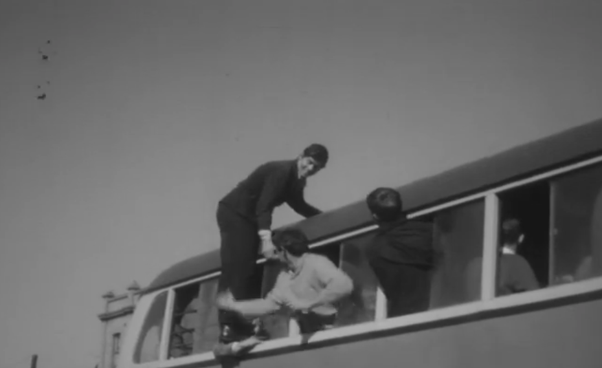
Autonomy Day pranks. NBN footage – students crowding buses, 1965
https://www.youtube.com/watch?v=5YSiy-b4ZXc
Love not hate
The street processions were often the highlight of Autonomy Day. Brightly decorated floats made their way along Hunter Street, offering satirical commentary on contemporary issues such as the Vietnam War, censorship, political protest and student fees. Other floats reflected the social trends of the day, from drug culture to the rise of the hippie movement.
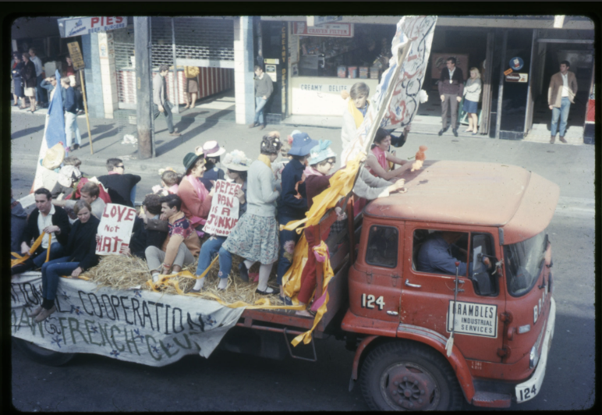
Procession through Newcastle on Autonomy Day, 19th July 1967. Living Histories, Special Collections and Archives

Procession through Newcastle on Autonomy Day, 19th July 1967. Living Histories, Special Collections and Archives

Autonomy Day ” We Need An International House” 19th July 1967. Living Histories, Special Collections and Archives

Procession through Newcastle on Autonomy Day, 19th July 1967. Living Histories, Special Collections and Archives
When pranks go to far
On 1st July 1965, the first official Autonomy Day celebrations were overshadowed by an incident in which a yellow stripe was painted down the back of the memorial statue outside the main post office. The act provoked a public outcry, and Lord Mayor Alderman Purdue threatened to cancel Autonomy Day activities altogether.
In response, art students and Professor Godfrey Tanner volunteered their time to clean the statue. Ironically, they endured continued heckling from passers-by, as though they had been responsible for painting the stripe themselves.
Eventually, a 20-year-old student confessed to the act and was fined £20 in court. He had only a hazy recollection of the incident, having been drinking earlier that evening. Although he expressed regret for his actions, he maintained that the gesture was not intended as a slur against returned servicemen, but rather as a protest against what he saw as the RSL’s criticism of students.

A volunteer art student scrubs paint from the back of the soldier monument at Newcastle post office during Autonomy Day Celebrations. NBN 1st July, 1965. https://www.youtube.com/watch?v=5YSiy-b4ZXc
Find out more…
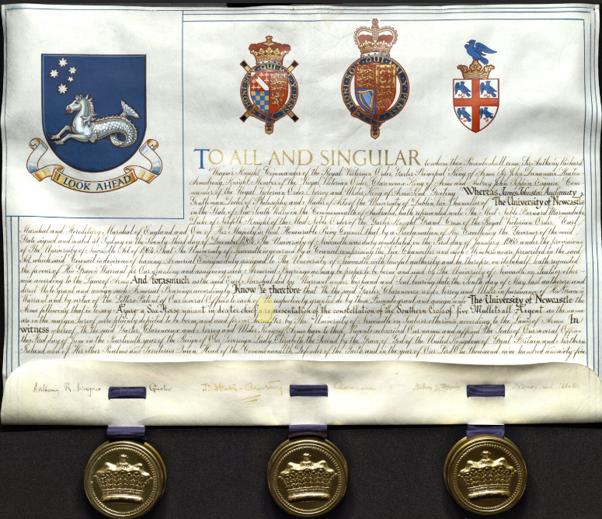
Grant of Arms. Special Collections and Archives
Davina Pellatt
Archives Engagement Officer – Special Collections and Archives
One thought on “What Lies Behind the Autonomy Day Pranksters”