Sessions on the Early History of Books in Australia
Dr Amir Moghadam, Special Collections

Last week, I and my colleague Davina Pellatt did run five Object-Based Learning sessions on the topic of the” beginnings of literature in Australia” with HAS1000, first-year students. It was one of those weeks that remind you why our expertise and collections matter. The rooms were lively, the questions were thoughtful, and by the end of each class, you could see students leaving with ideas in mind and new perspectives on how to use our collections in their future studies and beyond.
Each session followed the same structure to keep things consistent. We began with a short introduction on how to use special collections, then gave a brief history of books and libraries, and continued with Australian print history, including some local examples. Students then had the chance to handle old books, ask questions, and explore them.
We emphasised how we can research books from different perspectives and tried to identify areas that might slip readers’ minds. The most encouraging part was the students’ feedback. Across all five sessions, they repeatedly described the classes as useful, and we had requests for them to continue their further studies with us.
We have received strong student engagement and a very positive response from the course lecturer, Professor Catharine Colebourne. Professor Coleborne noted that she was delighted with the level of engagement and thanked us for the energy and careful planning that went into the sessions. She also expressed appreciation for the collaborative approach we took and commented positively on our approach with students. Thank you to everyone, and special thanks to Davina, who helped make the week run smoothly. The following is a snapshot of students’ feedback to our sessions:
Feedback overview (HAS1000 Sessions)
| Item | Details |
| Number of sessions | Five teaching sessions were delivered. |
| Survey population | The total survey population was 112 students. |
| Respondents | Thirteen students responded to the survey. |
| Response rate | The response rate was 11.6% (13/112). |
| Instrument | The survey contained three questions. |
| Questions | Q1 used a 5-point Likert scale (Strongly disagree to Strongly agree). |
| Q2 was an open-ended question focused on improvements. | |
| Q3 was an open-ended question focused on future objects/books. |

Question 1
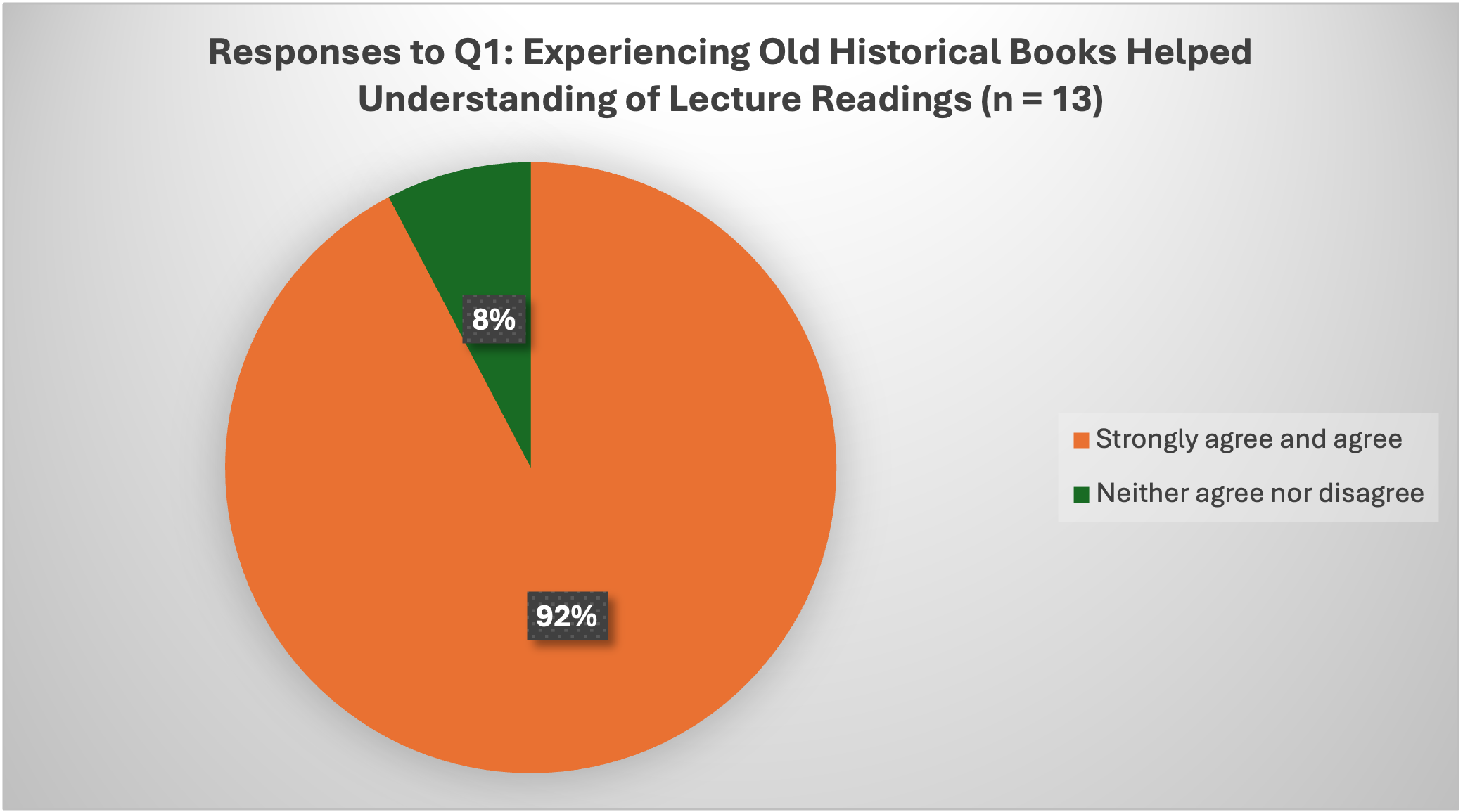
While the number of respondents was not large enough, the results imply a positive agreement with the statement that the session has improved their understanding of the lecture readings.
Responses to Q1: Experiencing Old Historical Books Helped Understanding of Lecture Readings (n = 13)
| Response option | n | % |
| Strongly agree | 11 | 84.6 |
| Agree | 1 | 7.7 |
| Neither agree nor disagree | 1 | 7.7 |
| Disagree / Strongly disagree | 0 | 0.0 |
Note. Percentages are based on the total number of respondents (n = 13) and may not sum to 100.0 due to rounding.
Question 2
In response to the question that “Which aspect would you improve for having a better session?”, across responses, suggestions clustered into a two major requests:
- Space and comfort suggesting better room space and better ventilation and A/C for larger groups (“Less students so it’d be easier to access all the books…”; “Just a bit packed and sweaty…”).
- And more diverse in high quality manuscripts (“Book illustrations… imagery is good…”; “Earliest collections… small pamphlets… from the 1800s.”)
Question 3
In response to the question of “What type of objects and books would you like to visit in future sessions?” The strongest signals were hinting to high interest on the following:
- Classics / canonical literature (Greek/Roman classics; Homer, Dante; older editions like Paradise Lost)
- Mythology (Greek and Norse mythology appears repeatedly)
- Religious texts & foreign-language books (including a request mentioning the Quran, and “religious texts… in foreign languages”)
- Archives / records / cataloguing
- Poetry (romantic/metaphysical; poetry as a category)
- Natural history (flora/fauna)
One thought on “Collection Update: Lively sessions, Thoughtful Questions”