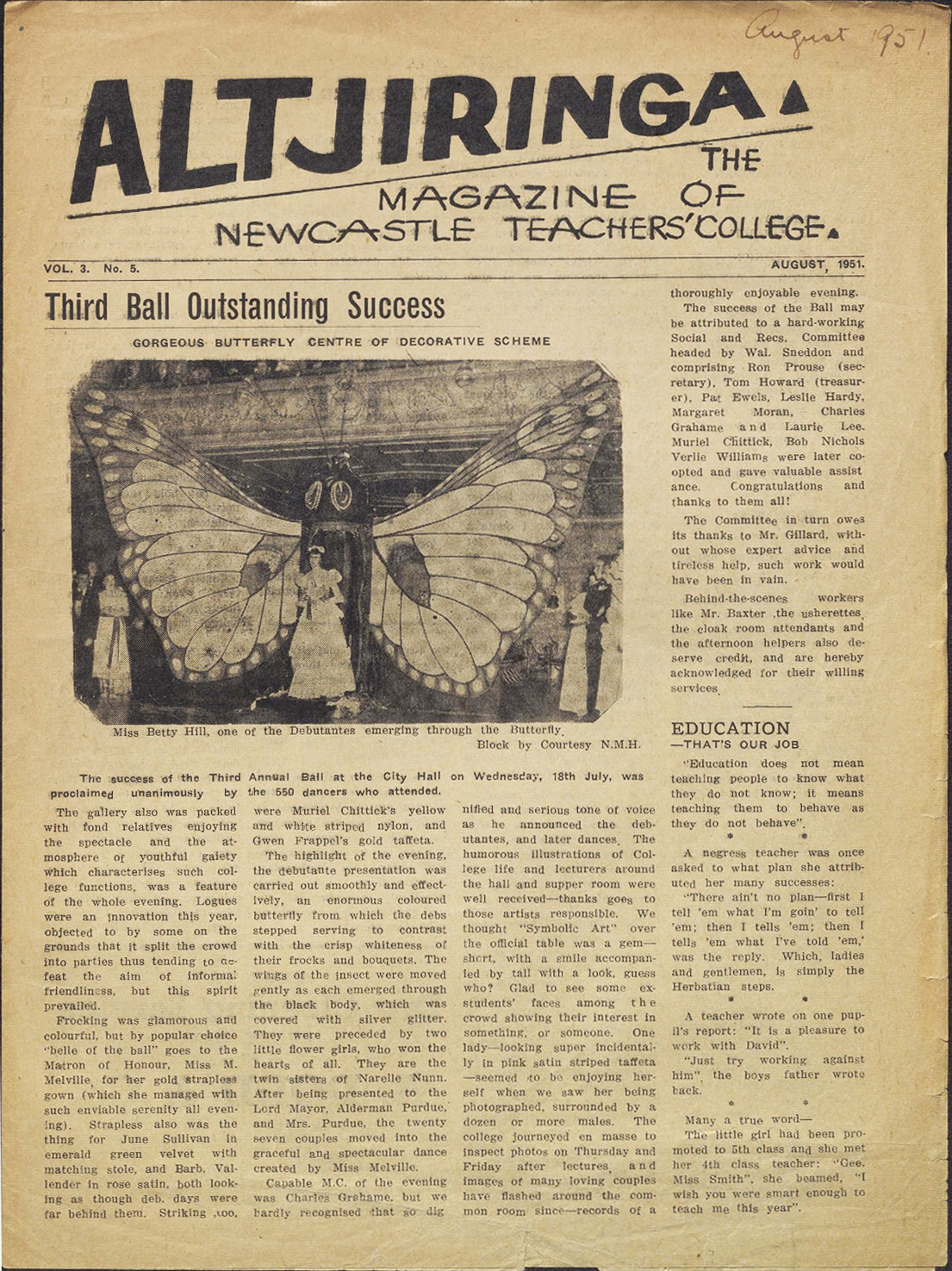
What Is Altjiringa?
How Long Did It Last?
The University Archives holds copies from its very first issue published June 1949 to the last issue published in March 1985.
Is it a complete Set?
We don’t think so. We suspect we are missing issues everywhere, in particular from 1952, 1970, and each year of the 1980s. If you know of one we are missing let us know. Check out the list of copies here: https://livinghistories.newcastle.edu.au/nodes/view/81168
What Does “Altjiringa” Mean?
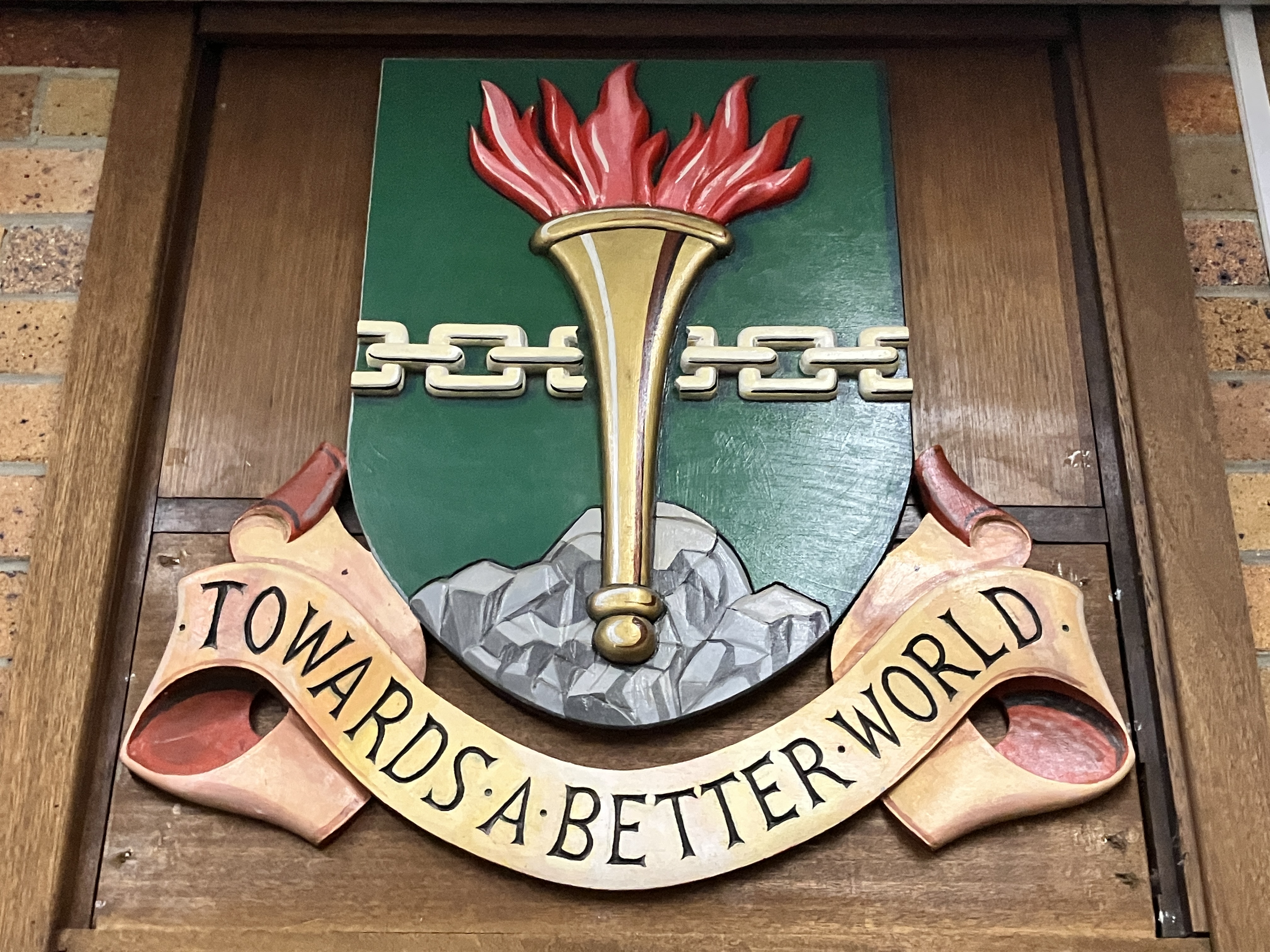
“Altjiringa” is an Aboriginal sound word from the Aranda Tribe of the Northern Territory. It was chosen by the first student editors due to their understanding of its meaning as “dream time” and therefore its resonance to the motto of the Newcastle Teachers’ College; Ad Meliorem Mundum (Towards A Better World).
Is That What “Altjiringa” Really Means?
While we can applaud the progressive forward thinking of our first fledgling student teachers; finding connection and resonance between Aboriginal and European culture from 1949, we also now fully understand how difficult it is to translate a concept from an Aboriginal language with thousands of years of experience and nuance in it, with a relatively “young” language such as English.
Noel Rutherford, Altjiringa’s first editor, explained its meaning in the first issue (Volume 1, Number 1, 1949) thus:
“Altjiringa? A strange name no doubt. It is aboriginal language from the Aranda tribe and it is a free translation of our own motto.
Our conception of a “better world ” is the aboriginal “dreamtime”. It embodies all that is best in the future and includes that general philosophic and religious consciousness which guarantees the social cohesion of the tribe. As such it is an order, with rigorously trained initiates, which keeps alive tribal traditions, records the mythical exploits of the cult heroes and generally strives to raise the levels of thought of the tribe.
In choosing “Altjiringa” as the name of our magazine we have keep these points in mind. We hope that “Altjiringa” will will assist in making a “better world” by the indirect method of broadening the outlook of the future teachers of the world’s children. We know that it will make a better college.
The “initiates” to our altjiringa, the members of the editorial staff, have the same duty as the initiates of the old altjiringa. They will strive ‘to elevate the levels of thought at College, to carry the spirit of the College to future generations of students, and to record and praise the acts of collegiates which are considered worthy of attention.” (Altjiringa Vol.1 No.1 1949 p 2)
The Class of 1960 Wanted To Learn More About “Altjiringa”
Dawn Brown, one of the student editors for the 1960 Altjiringa Annual wanted to learn more about the meaning and significance of the word, so she contacted the Lake Macquarie poet and collector of Aboriginal stories Roland Robinson, as well as South Australian based linguist and anthropologist Mr T.G.H. Strehlow, who had spent decades living, learning and recording the language and lore of the Aranda Tribe. (see “The Story Behind Altjiringa” Altjiringa Annual pp. 19-20 https://livinghistories.newcastle.edu.au/nodes/view/56317)
Mr T. G. H. Strehlow provided an in depth authoritative view of the sound’s meanings in Aranda Culture:
“My own spelling of this Aranda word would be “Altjiranga” rather than “Altjiringa”, though this may not be an important difference.
The world “altjirana” (phonetic spelling) is the ablative case of the word “altjira”, which is one of the most difficult words in the Aranda language as far as a suitable translation is concerned. For it occurs only in certain phrases, all of which have traditional explanations, covering a wide range of meanings.
Thus
- pmara altjira (literally, the altjira place) means ” the totemic centre of the [speaker’s] mother”
- altjira rama (literally, to see altjira) means “to dream”
- altjira inkanama (literally, to set up altjira) means “to set up gum leaves” (this is a popular girls’ game).
Then there is “altjirana nambakala” (sometimes abbreviated to “altjirana”) which is undoubtedly the phrase to which the title of your magazine refers. This means literally – “having originated out of altjira”. It is a phrase used only about the earth-born supernatural beings, and can perhaps be translated best as “having originated out of altjira”. Altjirama in this phrase would therefore mean “out of all eternity”, “from all eternity”. The only beings to whom this phrase can be applied would therefore be the supernatural totemic ancestors and culture heroes celebrated in the aboriginal sacred myths and songs. These are honoured artistically also in the aboriginal rock and cave paintings.
“Altjirana” is also given as an answer to the question about the origin of the world, i.e., according to the Aranda, the earth and the sky have existed “altjirana” (lit. out of altjira, ever since altjira) and this is explained as meaning “eternally”, “without having been made by anyone”. This could be expressed in another way ny saying that the earth and the sky existed in the very beginning – that nothing preceded them.
My suggestion would therefore be that “aljirana” could be translated into English either as “in the [very] beginning”, or “from all eternity”.
The popular “alcheringa”, which has been mistranslated as “dream time”, owes its origin to a white Australian mixing up of altjira rama and altjirana nambakala, and is a vague and sentimental phrase which has little meaning for the natives.
Mr Roland Robinson writes:
“To answer your question about the term “altjiringa”, it comes from the language of the Central Australia tribe, the Aranda. (Albert Namatjira belonged to this tribe.)
Strictly the term refers to a pre-creation time, a state of chaos. Out of this state the Aranda world was created. Out of this time sprang the creative ancestral beings.
The creation time is ever present with the tribal aborigines. Observance of ritual, laws, customs (religion, in short) constantly renews this state and time.”
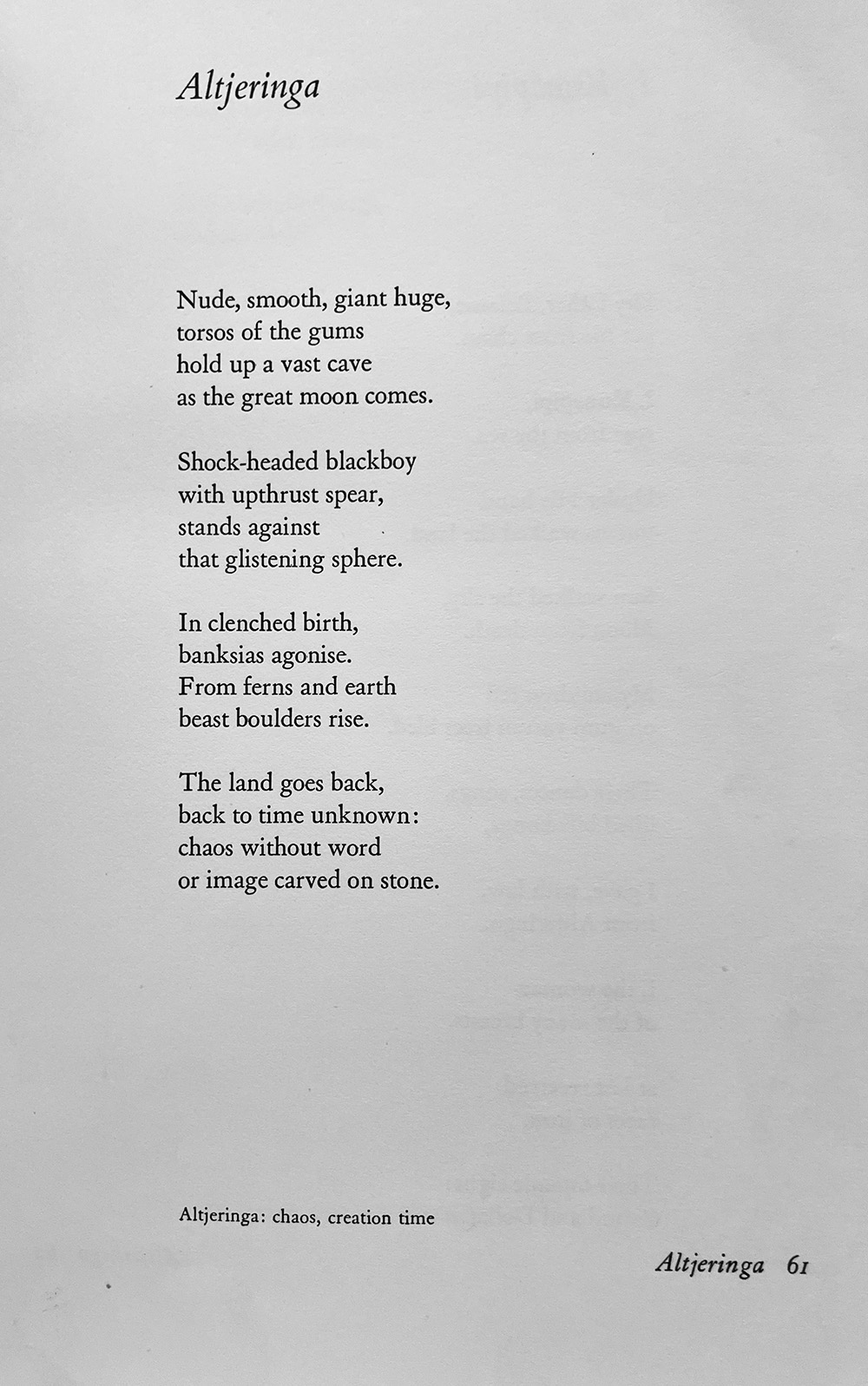
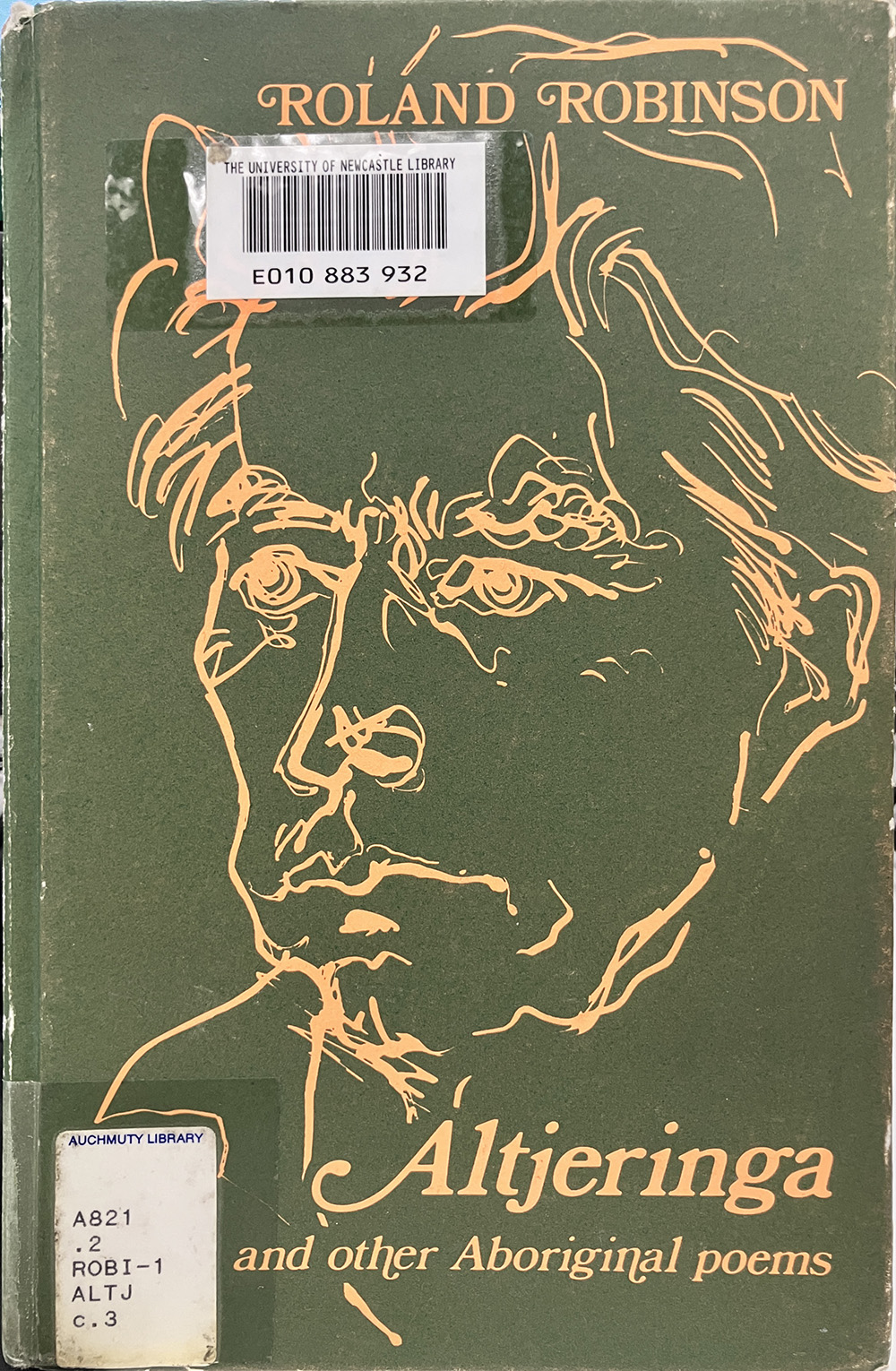
The 1960 Altjiringa Annual also featured a poem by Roland Robinson on its frontispiece ALTJIRINGA
It was later published with slight amendments in Robinson’s Altjeringa and other Aboriginal Poems published in 1970.
We Noticed It Was Also Called “Altjiringa Annual”?
During its life, Altjiringa was referred to as a “magazine”, a “newspaper” and a “journal”.
Besides Altjiringa Itself, What Is Something That Existed Then, But Not Now?
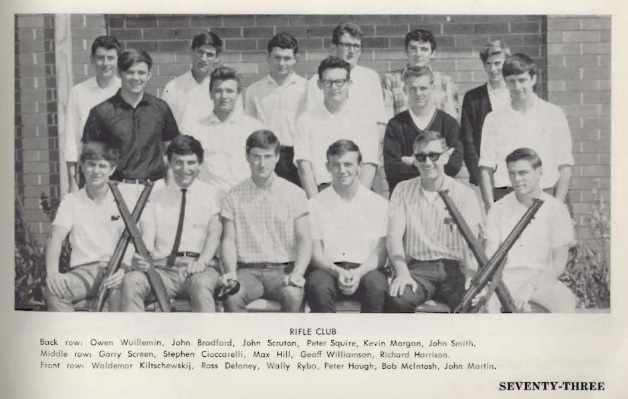
The Newcastle Teachers’ College Rifle Club.
There Was Also A Ghost?
Yes, not one but two! Joe Fanatomy (or Joe Fanatamy) and Hogan’s Ghost
“Newcastle Teachers’ College has a “ghost”- Joe Fanatamy, a student who ever existed. The legend arose at the start of a college year when a teacher who was new to a group of students called the roll. On it was a smudge where a name had been obliterated, but was added further down the roll. She asked what the smudge stood for, and a student quickly thought up a fictitious name, Joe Fanatamy. After that whenever she called the roll one of the men students answered to Fanatamy. On occasions when it was dangerous to do so Fanatamy was “sick.” It was not till the end of the term that she discovered that Fanatamy did not exist. He then became the college “ghost.” Whenever anything was lost or mislaid it was Joe Fanatamy’s fault. Last night his name even intruded into a folk song. In an “Evening of Music by the college at the Newcastle Technical High School’s assembly hall, much to the delight of the students.” (Ref: Altjiringa Annual. Magazine of the Newcastle Teachers’ College. Vol. 5. No. 8. 1953 p.56)
The female teacher mentioned above was Hulda Turner, who recorded her memories of Joe in “Speaking of Union Street… Reminiscences of Newcastle Teachers’ College 1949-1973” p.10
“JOE FANATOMY
It could have been Ted Crago with his impish sense of humour who perpetrated the hoax, or it could have been Mr. Duncan.
In the ‘good old days‘ when the non—academic staff numbered three – the Caretaker, the Registrar, and the Principal’s Secretary – the staff had to compile their own Section rolls and keep their own records of attendance. In one Section, having listed all those present, I asked for the names of absentees. One name was offered – Joe something-or—other.
How do you spell it? FANATOMY. So I entered him on the Section roll.
Week after week this character failed to appear, and, in the end, waxing wrath, I sent Mr. Fanatomy a scathing and threatening message. Then it all came out – someone had invented him.
How this student was translated to saint-hood I do not know; but for several years Saint Fanatomy, halo and all, was carried in high honour to all College Festivals – Sports Days, Intercollegiates, etc. Enter a lecture room, and it was more than odds on that on the black-board, windows, desks, or even floor, would be scrawled in chalk, “Joe Fanatomy was here”. Assignments and even examination papers sometimes carried the sign.
Fanatomy was never allowed to graduate; however he was accorded a (vacant) seat-of-honour at the Annual Graduation Dinners and was duly toasted. Once, as a punishment, I suppose, for my gullibility, I was called upon to reply to the toast.
Somewhere in the College archives there is a “Ballad of Joe Fanatomy” and at this late stage I suppose I can admit that I helped him write the thing.
Joe had a satellite – Hogan’s Ghost — and I always suspected Charles Grahame of creating him. The ‘portrait’ of Hogan’s Ghost would appear on documents, notice-boards etc., but no one seems to have known where he came from; but someone must have had fun keeping us guessing. Both phantoms have long since left their haunts. Where are they now?
Huldah Turner.”
What Made Altjiringa So Special?
The passion and drive of the students from the earliest days of the Newcastle Teachers’ College, to fulfil the motto of their institution, to make the world a better place. Summed up perfectly well right here from the editorial ALTJIRINGA. 1st Edition. April 1958 p. 4
“There is often wonder expressed among some students over the meaning of the word “Altjiringa”, the name of the College paper. It is an aboriginal word meaning “dream world”.
It is directly related to our college motto of “towards a better world”. We are going to be the teachers of tomorrow responsible for shaping the minds of the girls and boys who will make up the citizens of this “better world”.
At present it is to some extent a dream world but it is the responsibility of all of us to strive to make it a reality, to make the world a better place through education and enlightenment.”
Gionni Di Gravio OAM
University Archivist & Chair, Hunter Living Histories