The Lost 1882 Journal of John Fraser (1834-1904)
by Leigh Budden
Warning to Aboriginal and Torres Strait Islander People
This paper contains historical references to Aboriginal cultural practices ‒ but does not provide secret details about those ceremonies.
It mentions reference to historical articles that contain terms or views that were considered appropriate at the time in mainstream Australian Colonial culture and in the period that they were written but are no longer considered acceptable. These articles do not reflect the views of the author or of the University of Newcastle.
It also contains names of Aboriginal People who are deceased.
The author pays respect to all Aboriginal Elders, past, present, and emerging, and fully recognises and honours their intellectual property, knowledge, and traditions.
Who was John Fraser?
There is not a lot is known about John Fraser besides being the Maitland school teacher responsible for bringing together all the the extant Aboriginal language works of the Reverend Lancelot Threlkeld into a landmark 1892 book called “An Australian Language as Spoken by the Awabakal..“
Although he does have a short Wikipedia entry:
https://en.wikipedia.org/wiki/John_Fraser_(ethnologist)
He is also a member of Maitland City Council’s ‘Hall of Fame’:
https://www.maitland.nsw.gov.au/john-fraser
And has a very short entry on the University of Newcastle’s ‘AWABA Database’
But it seems that he has had a rather large impact in history. Particularly that of the Hunter Valley and surrounding area of east coast New South Wales. And finding his lost notebook from 1882 might have an even bigger impact than his legacy to date.
What Have We Been Able To Discover About John Fraser?
John Fraser was born in Perth Scotland in 1834 and educated at the University of Edinburgh where he studied Classics and gained a B.A.
John and wife Elizabeth (maiden name Tait) emigrated to Maitland N.S.W. in 1861 where he took up the headmaster position of the Presbyterian ‘Maitland High School’ in Free Church Street. This position bore the title ‘Rector” although there is no evidence of John being an ordained minister of the Presbyterian Church. But it might explain the ‘Reverend’ title used two of the online entries above.
He remained in this role until 1864 when he opened his own private school in Church Street Maitland known as ‘Sauchie House’.
The advertisement boasted that the school room was big enough to accommodate 100 students. (see Maitland Mercury and Hunter River General Advertiser 16.6.1864 and 24.9.1864)
Personal Life’s Tragedy
John and Elisabeth lost their eight-month-old daughter prior to emigrating, and in 1862 both Elisabeth and their second young daughter passed away. Elisabeth and their unnamed daughter were buried in what is now known as the East Maitland Cemetery.
John sold ‘Sauchie House’ private school the New South Wales Colonial Government in 1884 and it became the first home of Maitland Boys High School. However, while still teaching, he became active in the local Maitland branch of the Royal Society of N.S.W. and had his first book on ancient languages, ethnography and inductive philology published in Edinburgh in 1879.
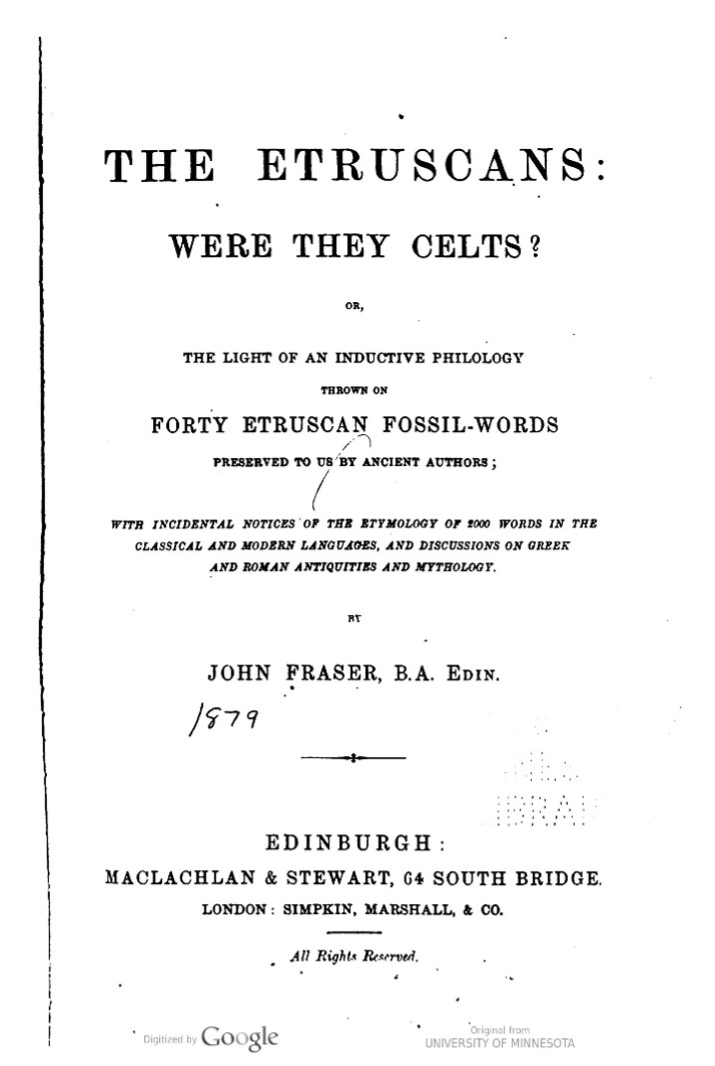
The Etruscans: Were They Celts?
Titled The Etruscans: were they Celts? Or In Light of An Inductive Philology thrown on Forty Etruscan Fossil Words – this book must have been so well received in Europe and North America that it resulted in John being appointed by Professor Campbell of Montreal Canada as the ‘Le Delegue General Pour l’Oceanie Institution Ethnographique of Paris’ in 1880.
This was reported as:
‘the first appointment of its kind to the Australian colonies, and it will at once bring him (John Fraser) prominently before the scientific men of Europe, and indeed the world” – (Maitland Mercury and Hunter River General Advertiser 10.6.1880; Newcastle Morning Herald and Miners Advocate 12.6.1880).
In 1882 Fraser was awarded the “Grand Medal of Honour’ by the Paris Institution Ethnographique for his articles on the Australian Aborigines published in the Maitland Mercury and Hunter River General Advertiser newspaper in three parts in 1881. (Maitland Mercury and Hunter River Advocate 7.12.1882)
Fraser’s Work on the Ethnography and Philology of Aboriginal People
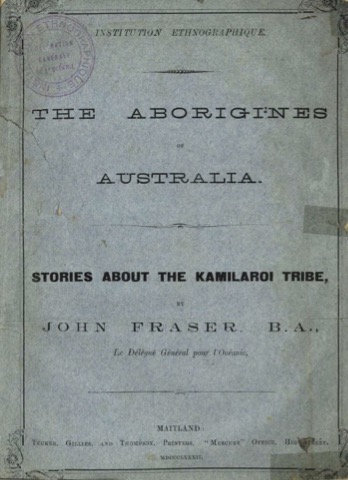
Titled ‘The Aborigines. Anecdotes about the Kamilaroi Aborigines communicated by Mr C Naseby’ it was published in three parts in the Maitland Mercury and Hunter River General Advertiser in December 1881.
It must have been something of a success locally because Fraser organised it to be published again in book form by a local Maitland printer in 1882.
Both the newspaper article in 1881 and the book in 1882 included a series of questions composed by Alfred William Howitt (a fellow member of the Institution Ethnographique of Paris) asking any of the readers who had information on Aboriginal Language or Culture to reply to John Fraser at Maitland.
This led to a very interesting response, and to Fraser publishing a paper in the Journal of the Proceedings of the Royal Society of New South Wales in 1882 that he received a special award for – which I will come back to.
Fraser’s Historical Legacy
Following the sale of his private school, Sauchie House, to the Colonial Government John retired from teaching and concentrated on publishing in his chosen fields of ethnology, linguistics and philology.
This included work on the Languages and Folklore of Pacific Islander People where Fraser visited, with the support of the Presbyterian South Seas Missionaries in the New Hebrides (now Vanuatu).
In 1883 Fraser received the honours of membership to the Royal Society of New South Wales as well as membership to the ‘Victorian Institute of the Philosophical Society of Great Britain’ who’s aims are to ‘investigate fully and impartially the important questions of philosophy and science, but more especially those that bear upon the great truths revealed in the Holy Scripture, with the view of reconciling any apparent discrepancies between Christianity and Science” (Maitland Mercury and Hunter River General Advertiser 25.9.1883)
Fraser’s awards included an honorary degree of L.L.D from Queen’s University Kingston, Canada in April 1887. Following this award, he went by the title “Dr.” (Sydney Morning Herald 16.4.1887 page 14)
The Colombian Exposition (1893)
Sometime in early 1890’s Fraser was engaged by the N.S.W. Colonial Government to write two books for the New South Wales Commissioner for the World’s Columbian Exposition that was to be held in Chicago in 1893.
The two volumes published in 1892 were The Aborigines of New South Wales and An Australian Language as Spoken by the Awabakal. The People of Awaba or Lake Macquarie near Newcastle NSW.
These two works were to be ‘sent to the chief learned societies at home and abroad’ and were ‘give aways’ at the NSW Colonial Governments exhibition stand at the Chicago World’s Columbian Exposition – which was the first world trade fair it seems.
The book titled “The Aborigines of New South Wales” was a rework of his 1882 journal paper accompanied by cranial measurements and reports on anthropometric examinations by University of Sydney Professor of Anatomy – Dr J. T. Wilson.
The second book titled An Australian Language as Spoken by The Awabakal… was Fraser’s rearrangement, condensing and editing of the work of the Lake Macquarie Missionary Reverend Lancelot Threlkeld, which Threlkeld first published in 1834.
It’s in this book that he leaves a series of historical legacies including creating a name for the Language of Aboriginal People of Lake Macquarie.
John Fraser’s Work on Threlkeld
Earlier in the 19th century Threlkeld had written that the local Aboriginal People of the Hunter River and Lake Macquarie region didn’t appear to have a name for their Language.
Fraser called it Awabakal based on what he described as the native name for Lake Macquarie – Awaba.
The Meaning of Awaba
But where did he get this native name Awaba? And what could Awaba possibly mean?
Well, it didn’t come from the works of Reverend Threlkeld. He wrote some 60 years earlier that the local Aboriginal name for Lake Macquarie was ‘Nik-kin-ba’ which meant ‘place of coal’. That is, nikin = coal; ba = place and nikin-ba = place of coal
Fraser included the word ‘Awaba’ in his list of geographical names on page 50 in his 1892 rearranged, condensed and edited work of Rev Threlkeld. It appears to be the only Aboriginal Language word to begin with the letter ‘a’ in the whole book – and John wrote that its meaning was “a plain surface”.
Threlkeld recorded ‘nga-ra-wan’ as ‘a plain, flat place’ and Fraser also included this word on page 52 of his edited works.
So where did Fraser get the word Awaba from?
The only record I could locate where the word ‘Awaba’ seems to refer to lake Macquarie (as opposed to the parish and [now] township of Awaba on the western shores of Lake Macquarie) is from Procter’s 1841 chart where the name for Lake Macquarie is written as ‘Awaaba”
Remembering Lost Lives & Legacies: W. S. Procter and the 1841 Procter Chart
Awaa-ba? Could this be interpreted as ba = place + awaa = a plain surface?
Or is the suffix ‘ba’ a verbal suffix, creating an intransitive verb from the nominal root ‘Awaa’?

Speculations on the Meaning of Awaba
Is this the definition that John knew and shared in his 1892 book? I guess we will never know for sure, but there has been some speculation on the words meaning and origin.
For example, in the 1980’s Perc Haslam (who described himself as Convocation Scholar for Aboriginal Studies at the University of Newcastle N.S.W.) claimed that the word “Awaba’ was a sacred word meaning flat or calm surface, signifying Lake Macquarie.
In his story “The Making of Coal” he wrote:
“This is a sacred word with a deep and significant meaning. If a member of the tribe wanted to speak in ordinary terms of a plain flat place, he would use the word ‘ngarawan’”. (Reference: Perc Haslam Archives: A5410 page 1 “UMULLI-TA NIKKIN KOBA – The making of Coal; A6708(ii) radio Lesson 35 dated 21.11.82 Special Collections UON)
This theme was repeated in Booklet 1 of the Department of Education ‘Aborigines of the Hunter Region ‘(1983) school resource where on page 68 it states that Awaba should be pronounced ar-wah-bah, and that it “is one of the important sacred words of the Awabakal tongue. It belongs to a group of words in the ‘aw’ prefix.” It appears that Perc Haslam was a significant contributor to this school resource.
And more recently in 2017 Dr Jim Wafer hypothesised that the word Awaba might be the mis-recording by the annotator of the chart in 1841 of the word ‘Wawaypa’ or ‘place of Waway’ which Threlkeld recorded as ‘wau-wai’ meaning a monster fish much larger than a shark. (See https://www.elpublishing.org/docs/6/01/Chapter-20-Wafer.pdf)
However, ‘wau-wai’ was more likely pronounced much more like the word woy-woy and is probably the origin of the name of the town of Woy Woy on the central coast (see Smith and Ridgeway 2023 https://www.anps.org.au/upload/Dec_2023.pdf)
Back to Dr John Fraser’s 1882 Missing Journal
John died on 2nd May 1904 after a short illness on the New Hebrides (now Vanuatu) Island of Ambrym.
He was visiting the Presbyterian South Seas missionaries at Dillion Bay settlement in Eromanga. He left no family and the location of the archives of his life’s work is unknown.

Why Is Finding Fraser’s Lost 1882 Journal So Important?
Well, unlike the rest of his published works, I think there might be something of importance in his first journal paper published in 1882.
Remember his 1881 three-part article in the Maitland Mercury asking for readers to write to him with historical information of the Aboriginal People that they or their family encountered as early colonists and settlers?
Well, he had received three written responses – all from men of the Hunter Valley!
One was from James William Boydell (1843-1908) of ‘Camyrallyn’ property near Gresford
One was from Augustus Hooke (1831-1906) of the Dungog property ‘Wirragulla’ and the New England property “Tia Tia”
One was from a C. F. Holmes of Clarence Town.
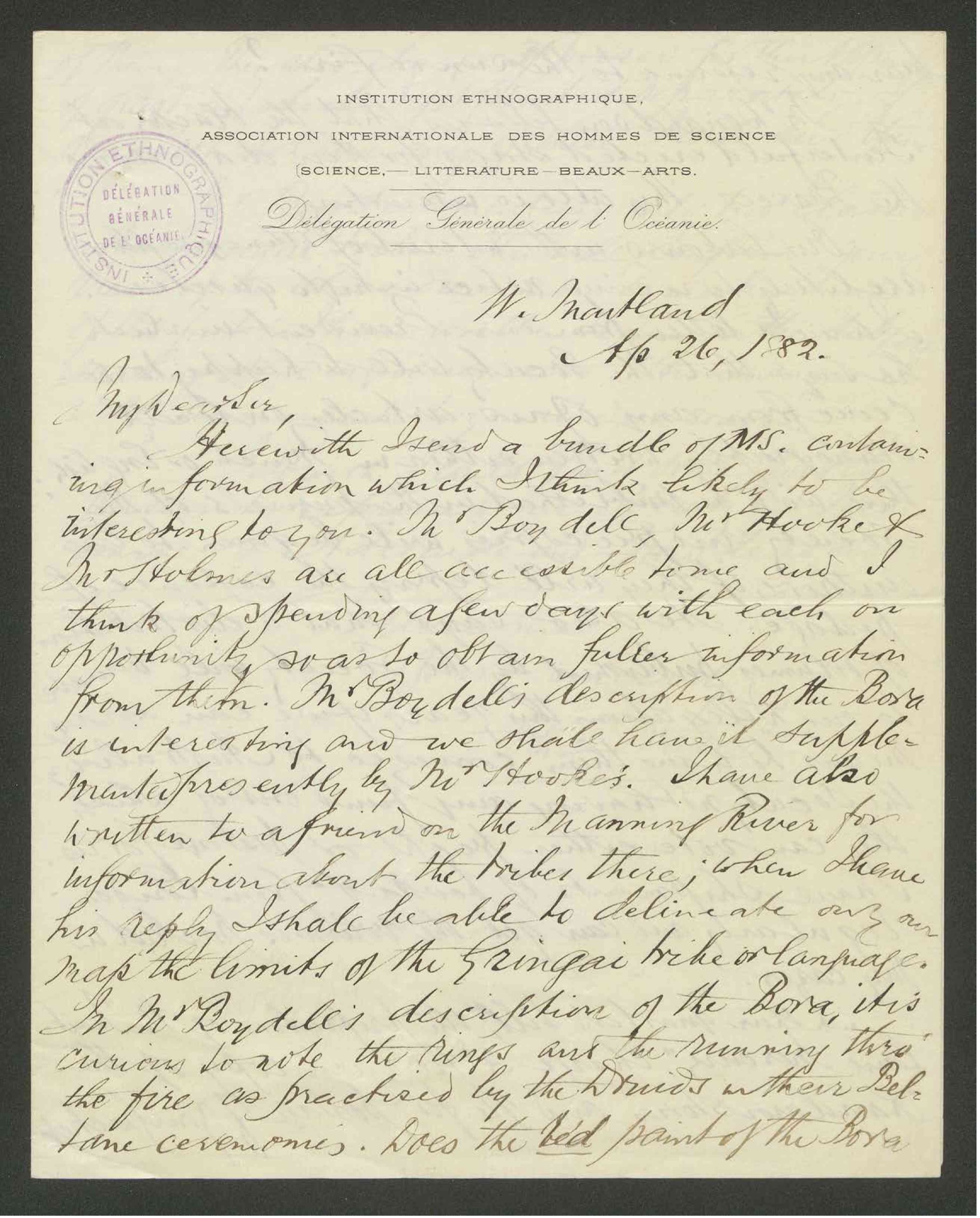
On the 26th of April 1882 Fraser writes to his colleague of the Institution Ethnographique in Victoria – Mr Alfred William Howitt (see https://adb.anu.edu.au/biography/howitt-alfred-william-510) and shares the information these three men have provided. A. W. Howitt includes this shared information and acknowledges their contributions in his 1904 book The Native Tribes of Southeast Australia.
Fraser to Visit All Three Men: Boydell, Hooke and Holmes
In this letter (copy below) Fraser states that he will organise a visit to each of them to gather more information.

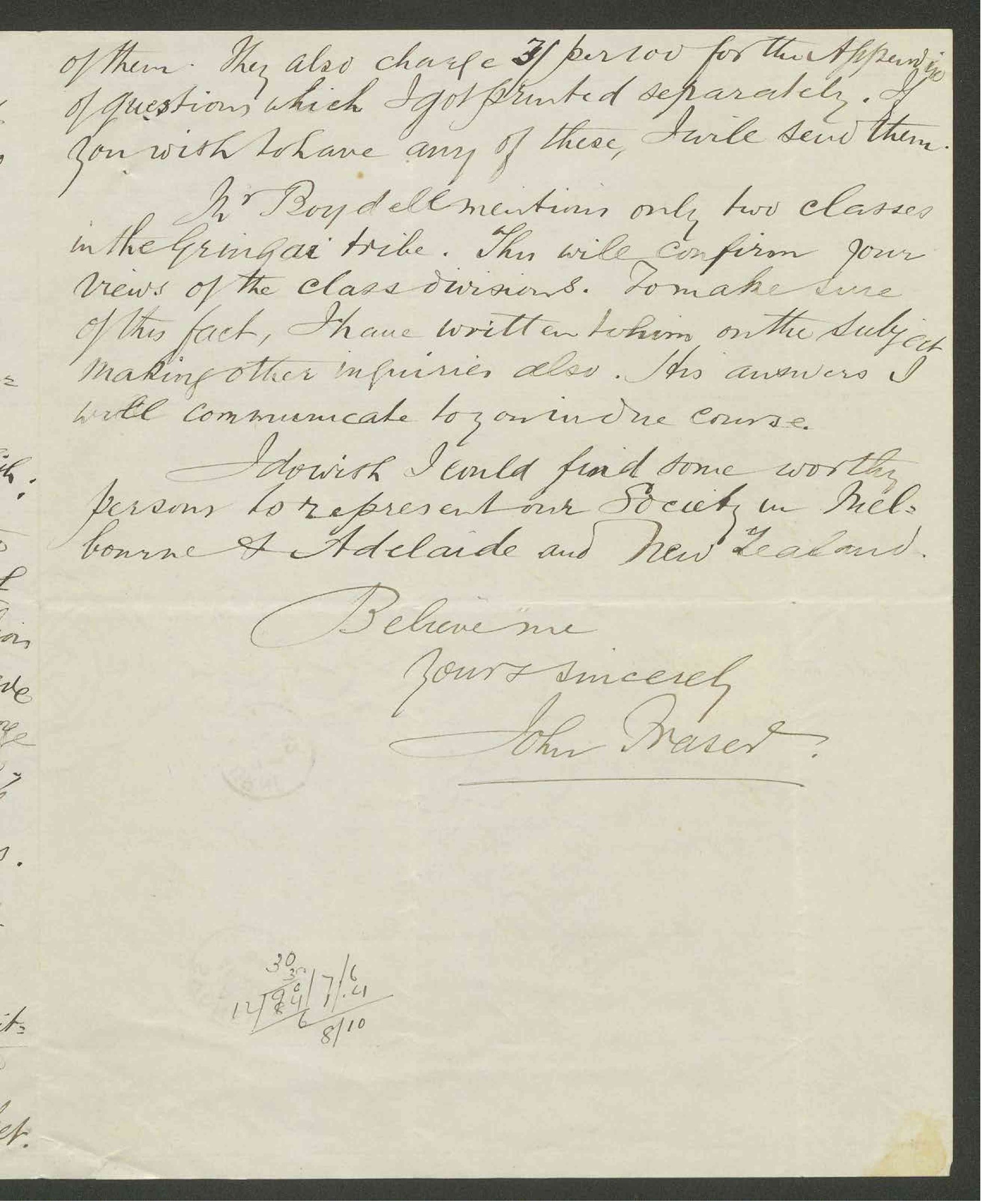
John Fraser’s 1882 Paper
In August of 1882 John Fraser has his first (and only) paper published in volume 16 of the Journal of the Proceedings of the Royal Society of New South Wales.
(https://downloads.newcastle.edu.au/library/cultural%20collections/pdf/fraser.pdf)
In this paper he acknowledges Mr C. Naseby of Maitland for information on the Kamilaroi People, and Mr J. W. Boydell of Camyrallyn Gresford for information on the Gringai People.
The information on the Kamilaroi People is a repeat of that which he published in his three-part newspaper article a year earlier (and later in his 1882 book), but the information on the Gringai People appears to be that contained in J. W. Boydell’s fathers’ diary from 1830 (See: https://www.sl.nsw.gov.au/charles-boydell-journal-1830-1835-7)
Except for a couple of brief paragraphs at the end of the paper where Fraser introduces what he describes as “two specimens of aboriginal mythology which, I believe, are entirely new” (see ibid, page 231).
He goes on to quote “the old men of the Gringai tribe say” and recounts the stories of the great men “Menee” and “Garaboong” who are described as skeletons in the sky.
This information is not from the Boydell diary.
Questions Relating to J. W. Boydell and Fraser’s Supposed Visit
Did Fraser visit J. W. Boydell at his Gresford property?
And did John meet and speak with members of the Gringai People living on Boydell’s Camyr Allyn property on the Allyn River of the Hunter Valley?
Did the Gringai People share other cultural knowledge with Fraser during this visit to the Boydell property in 1882?
I wonder if a record of this visit and conversation with the Gringai People is in John Fraser’s missing journals and papers?
I only wish to find his notebook/journal from 1882!
If anyone knows the whereabouts of Dr John Fraser’s archives please get in touch, or leave a comment below.
Thank you.
Leigh Budden
November 2024
Very interesting Leigh.
I was interested that Fraser was commissioned to write the books for Chicago.
Did you come across any clue as to the origin of the photo of Margaret included in the Australian Language book?
Did it have any connection to the work you quote of measurement by Wilson of Sydney University?
I’m still puzzled as to who took this photo and why. It is listed elsewhere as part of the Chicago Exhibition under the name of the Government photographer Charles Potter. Did Fraser get the photo from Potter? or Wilson? or did he have it from another source?
Thank you for your comments and questions Stephen. These two books by John Fraser were both commissioned by the Office of the Executive Commissioner of NSW – the Hon Arthur Renwick MLC – and published by the Government Printer in Sydney. The books were then provided ‘with the compliments’ of Arthur Renwick at the Chicago Exposition. In fact you can see the ‘with compliments’ slip in the inside cover of many of the on-line copies of these books.
As Margaret’s photo was taken by the NSW government photographer, I presume (but don’t know) that it was arranged for inclusion in the language book , and for display at the NSW exhibit in Chicago in 1893. Regards Leigh
Great piece of detective work, Leigh. Could you circulate your article around the historical societies of the Hunter/Newcastle area. Someone might have the missing information. Cheers, Bob