What Ever Happened to Margaret and Ned’s Land at Lake Macquarie?
This work is undertaken in support of the Awabakal family descendants of Margaret and Ned of Lake Macquarie. This work is conducted in memory and respectfully honours the First Australian People, the Aboriginal People of this land. Warning to Aboriginal and Torres Straight Islander Peoples: This paper contains the names and likenesses of Aboriginal People who are deceased.
What’s Happening?:
We are trying to locate the actual portions of land occupied by Aboriginal Ned and Margaret for their home and gardens, and surviving documentary evidence that the land was reserved for them and their children by the then Minister for Lands (circa 1871), (circa 1875) and Premier of New South Wales in circa 1880-1881, Sir Henry Parkes.
The Detail:
From the news reports (see details below in the Deep Dive) we know:
-
On 5 September 1871 it was reported that “Old Ned” was “threatened with expulsion from his little holding on the south side of Lake Macquarie, by a person who has made a free selection of the land on which this aboriginal has his habitation.” (Ref)
-
That according to the Rev. John Shaw (9 September 1871): “The house they live in is divided into rooms. Margaret acts as dress-maker and is an excellent needlewoman. All her family are clad in clothes made by her own hands, and she works for people in the neighbourhood. She is a skilful cabbage-tree hat maker, and her hats realise from £2 to £4 each, according to order. Ned grows a little corn, a few vegetables, a little tobacco, attends sporting parties on the lake, and maintains his aged mother. His home is everything to him. It is on the Lake side, close to the honey, close to the fish, close to the cabbage-tree, and close to fresh water. Without his home he will be something like a ruined man.” (Ref)
-
That on 20 September 1871 the Minister for Lands, W. Stephens “With regard to your letter of the 13th instant, representing that a certain person has selected, or was about to select, a portion of land at Lake Macquarie, which an aboriginal named Ned has from early life occupied and cultivated, I am directed to inform you that this or any other aboriginal, living on and cultivating land, will be protected in his holding, to which effect the local surveyor has been advised.” (Ref)
-
That on the 19 October 1871 it was reported that “Mr Nainby says in his note, which is before us : “I am sure you will agree with me that Ned’s title in equity (I do not mean legal equity) is valid, and viewed from a humane and christian point of view, it would seem not only hard, but cruelly wrong to dispossess him. Of course I know nothing of the case personally, and have, as, you must be aware, no interest in it whatever.” Mr. Dodds laid Mr Nainby’s letter before the Minister for Lands, from whose office a letter was sent to Mr Dodds on the 6th instant, in which the following passage occurs – ” The matter has been brought under the notice of the Minister for Lands, who has issued instructions that Old Ned is not to be disturbed in his occupation, and that the surveyor is to measure twenty or thirty acres for him, to be notified as a reserve, which will render him and his family secure from all intrusion“. ” (Ref)
-
That Old Ned passed away around 2 May 1872 (Ref)
-
On 5 June 1875, the Margaret and Ned’s land is described during a Steam Launch Pioneer Visit to Lake Macquarie that: “The well-known Belmont Estate faces Fennell’s (Mr. Williamson’s) and is the favourite resort for spring and summer pleasure seekers. Cardiff adjoins this,—another old colliery. Pelican Island is then passed. It divides the entrance of the river running out to the ocean. Healey’s estate; Old Ebenezer Coal Mine; big Wanzey Wanzey (the property of the late Mr. Frank White, M.L.A.), and island called Borrow-your-own; the government land just granted to “Old Margaret,” “Ned,” and their offspring; Boyd’s selection; and an old colliery belonging to the late David Broadfoot, Murray, and party,—were then passed..” (Ref)
-
On 18 April 1879 It was reported that a Mr. R. Talbot of Catherine Hill Bay had taken up a selection including Margaret’s hut and garden which his men threatened with demolishing the fence and fruit trees.(Ref) This claim was later refuted by Mr Robert F. Talbot who stated on 21 April 1878 that, contrary to the accusation, he got on well with Margaret as a friend and confirmed that: “I selected certain land on Lake Macquarie, and which I believe takes in Margaret’s location. Since then parties claim it as a portion of their mineral lease. No doubt a few days more will decide who is the rightful owner, and should the land prove to be my property, it is, and always has been my intention not to interfere with Margaret or her family in any way, and I fully intended so to tell her, first opportunity, in order to quiet any uneasiness she might feel in the matter.” He then went on to provide personal information about Margaret’s family: “Let me inform you old Margaret does not, and never did, belong to the Lake Macquarie tribe; but the Brisbane Water tribe of aboriginals, having been born near Wyong, where a powerful tribe of blacks located some 40 years ago. Ned, Margaret’s late husband, brought her some twenty years ago from her native place Wyong, to Lake Macquarie, where she has resided ever since, but not all the time in her present abode. Margaret is between 40 and 50 years of age, has two children by Ned—Ellen, aged about 22, and Willie, about 10. Old Ned died about six years ago, and lays buried near Margaret’s present abode. Ned’s father went by the name of Flathead, his mother Mullity, and there was Kitty a relative. Margaret’s father is said by some to have been a white man—she is evidently above the common caste of aboriginals. No doubt Margaret remembers in her youthful days at Wyong such names as Molly, Hobby, Billy Boy, Buker, Little Jack, and old Major, or Cherabout, all relatives of Margaret, and a distinct tribe from the Lake Macquarie tribe, and in those days very often at variance with each other.”(Ref)
-
On 6 February 1880 it was reported that on a visit to Lake Macquarie, Alderman Fleming of Wickham introduced Mr Hungerford M.L.A. to “a well-known resident of Pelican Flat, “Old Margaret,” as she is termed, and her two children. “Margaret” is the last living representative of the original tribe of aboriginals in that district, and has for two years resided on the spot referred to. With her own hands assisted by her son, aged about 20, and daughter aged about 26, she erected a good four-roomed house, and earns a living by garden produce, poultry, etc. Both her children are baptized Christians, the old lady being much respected. At the instance of Mr. Fleming, Mr. Hungerford laid a written statement of her case before the Premier, asking that the land she resides on be dedicated to her and her children for life. Sir Henry Parkes said he did not see that there would be the slightest objection, and promised to have the matter immediately attended to. It may be mentioned that this is not the first time “Old Margaret” has had cause to be thankful to Mr. Fleming. Some time ago that gentleman, together with Mrs. Fleming, had a boat constructed for the old widow, at a cost of thirteen guineas or so, which has greatly assisted her to secure fish for sale.” (Ref)
Why Is It Important?:
The descendants of Margaret and Ned would like to know what became of the land occupied by their ancestors, and whether any formal documentation and evidence of the reserve survives in the NSW State Archives. From all accounts they were highly respected, and surrounded by people in the wider communities of the Hunter Region who watched out for them, and protected their land, which is an affirmation of the good will and love that exists within human relationships.
!["Margarets Lake Macquarie" Intaglio Print Etching by Newcastle born artist Bruce Robertson (1872-1943). Photo Credit: Courtesy of Carol Duncan]](https://hunterlivinghistories.com/wp-content/uploads/2024/09/MARGARETS-LAKE-MACQUARIE.jpg)
![The site of "Margaret's Lake Macquarie" in the year 2024. Looking across to Galgabba [Photo Credit: Gionni Di Gravio 28 September 2024]](https://hunterlivinghistories.com/wp-content/uploads/2024/09/Looking-Across-to-Galgabba-Point-2014-09-28.jpg)

The Deep Dive: A Chronological List of All Mentions of Margaret and Ned in the Historical Sources
In her declining years Margaret had a magpie and wallaby to keep her company. The bird could speak in both Awabakal and English. Miss Boone recalled that some of the Australians could sing a few “raw” ditties in Awabakal, but Margaret made sure that these vocal efforts did not reach the ears of her magpie. Eventually, the magpie was dragged, sqwarking, under the house by the cat. Margaret often related the incident to her white friends, emphasising that the bird’s last despairing words were: “Margaret, the cat’s got me.” – From “Old Margaret” Percy Haslam University Archives Box A6712A(i)
1864, September 7. Page 2. A Patronising First Mention of “Old Ned”
TUESDAY, SEPTEMBER 6. (1864, September 7). The Newcastle Chronicle and Hunter River District News (NSW : 1859 – 1866), p. 2.
Retrieved July 30, 2024, from http://nla.gov.au/nla.news-article128919963
Crinoline — Our sable brethren delight in following the Parisian fashions. Poor old Ned, of Lake Macquarie, the sole survivor, of the once numerous tribe located in that favoured district, lamented to us the prevailing esprit de corps, of the Australian young ladies, and asserted as a fact that he had invested two half crowns in the purchase of crinoline wherewith to bedeck and adorn his only daughter. Expensive luxuries these for a black fellow, but taking into consideration the absence of other garments, a bird-cage, or what is termed la-drapery parlance an extender, cannot be grudged to the aboriginal, only in case if too close proximity to the camp fire, perhaps it might strike a light.
1871, September 5. Page 3. “Old Ned” Threatened With Expulsion From His Holding on the “South Side of Lake Macquarie”
NEWCASTLE. (1871, September 5). The Maitland Mercury and Hunter River General Advertiser (NSW : 1843 – 1893), p. 3.
Retrieved July 30, 2024, from http://nla.gov.au/nla.news-article18756984
It is said the aboriginal known as “Old Ned,” the last of his tribe in the district, is threatened with expulsion from his little holding on the south side of Lake Macquarie, by a person who has made a free selection of the land on which this aboriginal has his habitation. It seems that Old Ned, who is the only native ever known to have adopted civilised and domestic habits, has long resided on this spot, his household consisting of his wife-who bears an irreproachable character, and, strange to say of her race, has never been known to taste liquor-his four or five children, and his blind mother. His possessions embrace a nice little garden plot, securely enclosed, a pig or two, and a few fowls, ducks, etc. about his door. This is the man, one of the original inhabitants and owners of the soil, who is now threatened, under liberal land act, with banishment from his squattage, that a free selector may reap the benefit of his labors.
1871, September 9. Page 5. Description of Ned, Margaret and Family
NABOTH’S VINEYARD AT LAKE MACQUARIE (1871, September 9). The Newcastle Chronicle (NSW : 1866 – 1876), p. 5.
Retrieved August 14, 2024, from http://nla.gov.au/nla.news-article111143599
NABOTH’S VINEYARD AT LAKE MACQUARIE
To the Editor of the Newcastle Chronicle.
Sir — I perceive in your issue of the 2nd instant, a reference to an aboriginal named Ned, well known, I believe, in Newcastle and in the district of Brisbane Water. Every word in that well-expressed paragraph I can guarantee to be perfectly true. As former clergyman at Gosford, I am acquainted with the circumstances of the family mentioned, and have feared that some one would play Ahab by selecting their little plot. The dwelling and situation are better than those of many selections, and are as the event has proved, a tempting bait to anyone without either bowels or conscience. Ned is a hard-working, inoffensive old man. He maintains himself by getting honey and beeswax. Margaret, his wife, is an ornament to her sex, as your paragraph says, perfectly irreproachable in morals though she has been a fine-looking woman. She has had some Christian instruction, and her daughter did, at one time, know the Lord’s Prayer and the Creed. Some of the family are baptized. The house they live in is divided into rooms. Margaret acts as dress-maker and is an excellent needlewoman. All her family arc clad in clothes made by her own hands, and she works for people in the neighbourhood. She is a skilful cabbage-tree hat maker, and her hats realise from £2 to £4 each, according to order. Ned grows a little corn, a few vegetables, a little tobacco, attends sporting parties on the lake, and maintains his aged mother. His home is everything to him. It is on the Lake side, close to the honey, close to the fish, close to the cabbage-tree, and close to fresh water. Without his home he will be something like a ruined man. There is another instance in the above district of the same kind as Ned’s, but that Aboriginal is a bachelor, and belongs to another tribe. Moreover he is a man of violent temper and perhaps it would not be quite safe to despoil him. But Ned is a peaceable, inoffensive, hard-working old fellow. If any subscription could be started to help Ned I will willingly forward £1. But I think the Governor could interfere, for if I recollect right, a portion of his oath of office expresses that he will protect tho Aboriginal inhabitants of the country, and here is a case where such protection clearly is required. — I am, sir, yours,
Note 1: We have been unable to locate the reference to the “aboriginal named Ned” mentioned by John Shaw in the letter above as appearing in the 2 September 1871 edition of the Newcastle Chronicle.
Note 2: John Shaw references “Naboth”, as does Threlkeld in his Instalment, Christian Herald, 14 April 1855, 69-70:
HOW MANY ERRONEOUS IMPRESSIONS were cherished by the colonists in 1825, partly arising from sheer ignorance of the habits and customs of the aborigines, partly from self-interest, and partly from mere prejudice. It has always been the custom of those who determine to effect a purpose, disregarding the righteousness, or injustice of the measure when they wish determinately to carry a point, first to brand with obloquy their intended victim and then destroy him. “Thou didst blaspheme God and the King,” wrote the wicked Jezebel, and they stoned the innocent Naboth to death and took his coveted vineyard, as a possession for the king.” “He hath a devil and is mad,” was said of “Him,” who “spake as never man spake,” and “these are the men who tum the world upside down” was slanderously affirmed of the Apostles of peace and good will to men. “Men-stealers” endeavour to cover their iniquity by glossing over their crime under the specious term of “Involuntary Servitude,” and the murderers of the blacks boldly maintained that the blacks were only a species of the baboon, that might be shot down with impunity, like an Ourang Outang!
1871, September 16. Page 4. Aboriginal Ned’s Ousting Reaches Wallsend, and a Letter sent to the Minister for Lands.
WALLSEND. (1871, September 16). The Newcastle Chronicle (NSW : 1866 – 1876), p. 4.
Retrieved July 30, 2024, from http://nla.gov.au/nla.news-article111141154
THE ABORIGINAL NED. — The letter of the Rev. Mr. Shaw, published in your issue of last Saturday, relating to the aboriginal ‘Poor Old Ned,’ at Lake Macquarie, being about to be ousted from his homestead, has created quite a sensation at Wallsend, where the poor old fellow is well known and respected. A very respectful but energetic letter has been sent to the Minister for Lands on the subject, an answer to which is anxiously awaited ; and should any harm be meditated against Ned, and should the Minister allow it to succeed public indignation will be seriously and, I think, properly aroused ; and the Rev. Mr. Shaw is heartily thankful for having drawn attention to the matter. It will not be lost sight of, and I will not fail to make the issue public when more is known about it.
1871, September 30. Page 6. Answer from the Minister for Lands(20 September 1871)
District News. (1871, September 30). The Newcastle Chronicle (NSW : 1866 – 1876), p. 6.
Retrieved July 30, 2024, from http://nla.gov.au/nla.news-article111140918
Writing of Lake Macquarie reminds me of poor Old Ned, the aboriginal, whom some covetous free-selector was about to dispossess of the little plot of ground he has so long cultivated and maintained his interesting family by. It will be remembered that a letter had been sent to the Minister for Lands regarding the matter, news of which was anxiously awaited. The following is the answer, and will shew that the Minister has taken a right view of the subject, and deserves credit for his humane feelings : —
Department of Lands,
20th September, 1871.
Sir— With regard to your letter of the 13th instant, representing that a certain person has selected, or was about to select, a portion of land at Lake Macquarie, which an aboriginal named Ned has from early life occupied and cultivated, I am directed to inform you that this or any other aboriginal, living on and cultivating land, will be protected in his holding, to which effect the local surveyor has been advised.
I have the honor to be, &c,
- W. Stephens,
Mr, –
So that the matter is now set at rest, arid your kind correspondent at Scone, the Rev. Mr. Shaw, will be as glad as we are ourselves with the promptitude and humanity displayed in this instance by the Honorable the Minister for Lands, in thus giving poor Old Ned such a title deed to his plot of ground. We hope when the next excursion to Coorumbung takes place from Wallsend, the party will not forget to take with them some of their horticultural seeds, and cuttings, to, help to stock and beautify it.
1871, October 2 Page 2. Response from the Minister for Lands Published Across the Press
No title (1871, October 2). Evening News (Sydney, NSW : 1869 – 1931), p. 2.
Retrieved July 30, 2024, from http://nla.gov.au/nla.news-article129972060
AN INDUSTRIOUS ABORIGINAL. —The Waratah correspondent of the Newcastle Chronicle says : —I am reminded of poor Old Ned, the aboriginal, whom some covetous free-selector was about to dispossess of the little plot of ground at Lake Macquarie he has so long cultivated and maintained his interesting family by. It will be remembered that a letter had been sent to the Minister for Lands regarding the matter, news of which was anxiously awaited. The following is the answer, and will show that the Minister has taken a right view of the subject, and deserves credit for his humane feelings “Department of Lands, 20th September, 1871. Sir, — With regard to your letter of the 13th instant, representing that a certain person has selected, or was about to select, a portion of land at Lake Macquarie, which an aboriginal named ‘Ned has from early life occupied and cultivated, I am directed to inform you that this or any other aboriginal, living on and cultivating land, will be protected in his holding, to which effect the local surveyor has been advised. I have the honour to be, &c., W. W. Stephens.
Note: A copy of this was also published:
- In the Empire, but with the error of “Port Macquarie” instead of “Lake Macquarie” See: The Empire. (1871, October 2). Empire (Sydney, NSW : 1850 – 1875), p. 2. Retrieved July 30, 2024, from http://nla.gov.au/nla.news-article60876720
- Maitland Mercury NEWCASTLE. (1871, October 3). The Maitland Mercury and Hunter River General Advertiser (NSW : 1843 – 1893), p. 4. Retrieved July 30, 2024, from http://nla.gov.au/nla.news-article18757705
- Death of the Double Baby. (1871, October 7). The Manning River News and Advocate for the Northern Coast Districts of New South Wales (Tinonee, NSW : 1865 – 1873), p. 2. Retrieved July 30, 2024, from http://nla.gov.au/nla.news-article266395161
- Local & General News. (1871, October 14). The Shoalhaven News, Ulladulla and Southern Coast Districts Advertiser (NSW : 1871 – 1873), p. 2. Retrieved July 30, 2024, from http://nla.gov.au/nla.news-article258451327
1871, October 19. Page 2. The People Who Helped Old Ned: Mr Nainby and Mr Dodds
LOCAL NEWS. (1871, October 19). The Maitland Mercury and Hunter River General Advertiser (NSW : 1843 – 1893), p. 2.
Retrieved July 30, 2024, from http://nla.gov.au/nla.news-article18758120
THE ABORIGINAL FARMER AT LAKE MACQUARIE.
Our readers will remember that in a recent issue of this journal we reprinted from one of the Newcastle papers a statement that an aboriginal named Old Ned who farmed a piece of land at Lake Macquarie, was threatened with the loss of his holding, in consequence of some white man having free selected the land so occupied by Old Ned. Subsequently, we informed our readers from the same source, that Old Ned was to remain in undisturbed possession of his land, but were not aware at that time of the manner in which his claim for consideration had been presented to the Minister for Lands. We have just been informed that Old Ned is indebted to the thoughtful kindness of Mr F Nainby, of Phoenix Park, opposite Morpeth, for the present tenure on which he is to hold the plot of ground which his industry had rendered valuable to him Mr Nainby saw the paragraph in the Mercury, and he cut it out, and forwarded it with a note to Mr Alexander Dodds, the member for East Maitland, asking him to see Mr J B Wilson, the Minister for Lands, and obtain justice for the aboriginal. Mr Nainby says in his note, which is before us : “I am sure you will agree with me that Ned’s title in equity (I do not mean legal equity) is valid, and viewed from a humane and christian point of view, it would seem not only hard, but cruelly wrong to dispossess him. Of course I know nothing of the case personally, and have, as, you must be aware, no interest in it whatever.” Mr. Dodds laid Mr Nainby’s letter before the Minister for Lands, from whose office a letter was sent to Mr Dodds on the 6th instant, in which the following passage occurs – ” The matter has been brought under the notice of the Minister for Lands, who has issued instructions that Old Ned is not to be disturbed in his occupation, and that the surveyor is to measure twenty or thirty acres for him, to be notified as a reserve, which will render him and his family secure from all intrusion”. We are glad to publish all the particulars about this matter both because they deserve to be known, and because the action taken by Mr Nainby and the success it met with may serve as an inducement to others sometimes to exert themselves under similar circumstances, even though the person to be benefited does not reside in their district or neighbourhood. If Mr Nainby had stayed his hand, probably old Ned would have been thrown upon the world.
1871, October 21. Page 4. More People Who Helped: Mr James Hannell, Mayor of Newcastle
LOCAL NEWS. (1871, October 21). The Newcastle Chronicle (NSW : 1866 – 1876), p. 4.
Retrieved July 30, 2024, from http://nla.gov.au/nla.news-article111138594
LOCAL NEWS.
HONOR TO WHOM HONOR IS DUE. — In the matter of Old Ned’s holding, on the shores of Lake Macquarie, whatever credit attaches belongs of right to Mr. James Hannell, the Mayor of Newcastle. That gentleman first brought the particulars of Ned’s case under the notice of this journal, and subsequently forwarded to the Minister for Lands, and drew his attention to two copies of the Chronicle, the one containing the original paragraph, the matter for which Mr. Hannell furnished, and the other the letter from the Rev. J. Shaw on the subject. In a paragraph in its issue of Thursday, the Mercury attributes to Mr. F. Nainby the whole of the credit of saving Old Ned’s little homestead from the grasp of the covetous free-selector. Our contemporary says :— Mr. Dodds laid Mr. Nainby’s letter before the Minister for Lands, from whose office a letter was sent to Mr. Dodds on the 6th instant, in which the following passage occurs — ‘ The matter has been brought under the notice of the Minister for Lands, who has issued instructions that Old Ned is not to be disturbed in his occupation, and that the surveyor is to measure twenty or thirty acres for him, to be notified as a reserve, which will render him and his family secure from all intrusion.’ We are glad to publish all the particulars about this matter, both because they deserve to be known, and because the action taken by Mr. Nainby, and the success it met with, may serve as an inducement to others sometimes to exert themselves under similar circumstances, even though the person to be benefited does not reside in their district or neighbourhood. If Mr. Nainby had stayed his hand, probably Old Ned would have been thrown upon the world.’ Careful reading of this letter from the office of the Minister for Lands most clearly shows that all action in the matter had been taken prior to the receipt of Mr. Nainby’s communication, so that it would have mattered but little had Mr. Nainby “stayed his hand.”
1872, May 4. Page 3 – Death of “Old Ned”
DISTRICT NEWS. NEWCASTLE. (1872, May 4). The Maitland Mercury and Hunter River General Advertiser (NSW : 1843 – 1893), p. 3.
Retrieved July 30, 2024, from http://nla.gov.au/nla.news-article18763266
DEATH OF ABORIGINAL NED. – We regretfully record the death, from natural causes, only a day or two since, of poor old Ned the aboriginal, the native squatter on the banks of Lake Macquarie. It will be in the recollection of our readers that some short time since we drew attention to the fact of a hungry free-selector having cast an Ahabite eye on deceased’s little holding. Some considerable stir was made about the matter, and the result was the reservation of the site for the occupation of the native holder and his family Ned, who was one of the few blacks to whom the habits and customs of the whites have ever presented any attraction, leaves a widow, of whom it were impossible to speak too highly, and a boy and a girl, both able to read and write, possessing fair average talents and habits of order and industry. The family, whose wants are few, are tolerably well provided for, many of our people having found a pleasure in assisting them and adding to their little store of conveniences and comforts. Amongst the many we may mention Mr Peter Fleming who most generously presented Ned with an excellent boat m which the old man was used to cross the lake and go fishing or seeking honey and game, instead of as theretofore, having to take to the water and swim over a narrow part whenever he wished to come to Newcastle
1873, August 19. Page 5. Letter Writer under name of “OLD NED”
LAKE MACQUARIE AND THE COAL-FIELDS. (1873, August 19). The Sydney Morning Herald (NSW : 1842 – 1954), p. 5.
Retrieved July 30, 2024, from http://nla.gov.au/nla.news-article13322926
TO THE EDITOR OF THE HERALD
SIR – My attention has been drawn to two letters on the above subject one signed ” New South Wales,” the other “Veritas,” which appeared in recent numbers of your valuable paper – by a friend who requested me to offer a few remarks on the matter. I see nothing in the letter of “New South Wales” calculated to make the “erroneous impressions on the public mind which “Veritas” seems so anxious to prevent, save only his blunder about the extent of the coal measures coastwise; but I do see a great deal of misstatement and absurdity in that of the latter, all the more dangerous because there is just enough truth lived with them to make them calculated, us, if I mistake not, they are intended to mislead and I shall, therefore, endeavour to show, with your kind assistance, to that public whose interests ” Veritas ” professes to be so solicitous to guard, what reliance they may place on his assertions. I will try to be as brief as possible, and will, therefore, commence with his first glaring misstatement He says: ‘.. It (i. e., Lake Macquarie is connected with the ocean by a “narrow, tortuous, and shallow creek” – from this down to the note of interrogation his letter convinces me that ‘”Veritas” never saw the inside of the Lake in his life, and that he, not “New South Wales,” has been misled by his informant, one or both of whom are enthusiastic in preserving the monoply of the coal trade for the only legitimate coal port in the Southern Hemisphere ; indeed, any unbiassed reader may discern the cloven-foot pretty plainly, though, of course, he only desires to prevent unprofitable, perhaps ruinous, speculation. I have lived at Lake Macquarie off and on for over forty years, six of which on the very banks of that tortuous and shallow creek characterised by ” Veritas” as devoid of ” tidal influence,” and I should like to see him placed down near the Heads in any fair boat pulling a pair of paddles at about half-ebb tide, and if he did not pull for dear life he would be whisked out on the bar in spite of himself. I have pulled in the place I speak of for twenty minutes without gaining three boats lengths headway, yet he says sufficient scour would never occur; plainly either he or I must mistake. This narrow creek of “Veritas” is a fine river of about three miles long, winding truly, but with fine open reaches, up and down which the timber vessels now beat in or out on their trips to or from Sydney. This river is in many places 800 yards wide and nowhere less than 400, and except at the Bluff South Head there is not a vestige of rock to be seen on its banks from end to end, save the Sydney ballast left there formerly by coal vessels and often thrown overboard, causing some of those obstructions which now exist by accumulating sand. “Veritas” speaks of the difficulty, expense, and uselessness of dredging. Now I assert and can prove to the satisfaction of any competent civil engineer other than “Veritas” himself, that the passage between the lake and the ocean can be cleared to a uniform depth of twenty feet, and all sand drift removed from and kept off the bar without any dredge at all, but simply by the judicious disposition of ballast, so as to concentrate and direct the force of that tidal influence which “Veritas” ignores, and the cost of building and maintaining a dredge would go far to pay the expense, at all events the £15,000 spoken of would be more than sufficient. The bed of the river I know to be twenty feet, because a sandspit once existed where I and others used to cross 2 1/2 feet of water, which has been completely cut out by laying ballast longitudinally near the bank, and there are twenty feet there now and has been for twenty years. I know a master mariner yet living who sailed the Thompson cutter for the late L. E. Threlkeld many times to and from the lake to Sydney when there has been 14 feet water on the bar at high tide. True, it is sanded up now, but that is its depth when bare : The deepest channel is more north than the present one. A few submarine shots would soon dislodge the’ rock and underlying coal, and give the respectable depth of 20 or 21 feet. There is a shallow obstruction at the inner end of this river or estuary, where it opens into the lake, called Pelican Flats, which would also he easily removed in the same way by laying ballast to cause the flood-tide to pass through the boat passage, where the depth suddenly changes from 18 inches to 4 1/2 fathoms, the average depth of the lake; and so great is the tidal scour here that a whaleboat broke away up the river and grounded on Pelican, her bow in 6 inches, and in three days there was 12 feet water under her stern. Lake Macquarie is, as “Veritas” truly says, a fine sheet of water. Its length from north to south is over 30 miles, its width varying from 1 1/2 to 7, and even 10 miles in one place and its depth, except in shallow bays from 4 to 6 fathoms. It is for scenery rarely equalled; and coal of different sorts and immense quantities is to he seen cropping out at nearly every point. This being the case, I would ask “Veritas” where he would determine that his pet railway should start from for Newcastle, so as to be of any use to more than one of the many mines that will some day be opened, in spite of his age warnings, round this immense extent of lake coast. The late Mr. Ralf, Government surveyor, computed the distance round from head to head, taking all bays and inlets, to be 300 miles. Of course, coal proprietors would have to bring their commodity in barges to the point of the rails, which would effectually preclude them from successfully competing with Newcastle – the very thing “Veritas” is evidently aiming to effect. As to what he says of the difficulties of entering after the obstructions were removed, steam-tugs would easily obviate that; and what, I ask, would Newcastle be to-day without them?And a vessel, once inside, would be far more sheltered, and have somewhat more room, than there-not wishing to detract from that place at all.
Allow me to ask ” Veritas,” in conclusion, where he got his information as to the ” capabilities and accommodation of the lake.” ‘ Yours, &c.
OLD NED.
1875, June 5. Page 4. Steam Launch Pioneer Visit to Lake Macquarie Passes by Margaret and Ned’s Granted Land
THE STEAM LAUNCH PIONEER. VISIT TO Lake Macquarie, Cooranbong, Catherine Hill Bay, &c. (1875, June 5). Miners’ Advocate and Northumberland Recorder (Newcastle, NSW : 1873 – 1876), p. 4 (MORNING.). Retrieved August 3, 2024, from http://nla.gov.au/nla.news-article142009968
THE STEAM LAUNCH PIONEER VISIT TO Lake Macquarie, Cooranbong, Catherine Hill Bay, &c.
A few days back one of our staff availed himself of the opportunity afforded of visiting the above places in company with several other gentlemen, and below gives a brief outline of the beautiful tract of country passed through and the Lake in particular. He says:—We left Wallsend about 9 a.m., well mounted, and after a brisk ride of about fifty minutes (after passing through the Wallsend Company’s estate) reached Mr. W. Spear’s estate, facing the magnificent waters of the Lake. It was here we expected to find the steamer. After waiting about an hour, however, and there being no sign of it, we determined to put off in a boat, and the suggestion was no sooner mooted than put into effect; and after pulling vigorously against a head wind for some [six?] miles, we had the satisfaction of seeing the little craft steaming rapidly towards us, its whistle starting the echoes from the various banks, and floating along for miles. We were soon on board, and heartily glad of being relieved. The Pioneer itself is a fine little boat. She was built expressly for the waters of the Lake to the order of Mr. Thomas Russell, of Cooranbong, and is intended chiefly for the convenience of passengers desiring to make a creating and healthful excursion on the most beautiful Lake in Australia. The vessel is about 10 horse-power, draws three feet of water, and is capable of comfortably carrying some hundred passengers.
Lake Macquarie is a splendid sheet of water, some 360 miles in circumference, and excepting at the entrance and along a few flats, the depth of water is from 30 to 40 feet—in fact it is deep enough to accommodate the largest vessels that visit these colonies. It is surrounded by about 35*,000 acres of Crown lands of the richest description, valuable not only for agricultural purposes but rich in minerals. On the country maps published by the government it is officially shown that there are 60,000 acres of coal land, of which about 21,000 have been taken up by private individuals. The coal crops out along the shores of the
Lake, and some of the seams are fourteen feet thick. Two vessels were specially built for carrying coal some years ago. Owing to the shallow entrance there are millions and millions of tons of coal which cannot be approached. The ranges around Lake Macquarie are covered with the most magnificent timber in New South Wales, and there are *00,000 acres of timber land which could be worked if the Lake were made navigable.
However a the * points on the Lake have been repeatedly alluded to in the Advocate, and the principal places described, it is unnecessary for me to dwell upon these now, and will content myself with merely mentioning them as we passed. The first estate was Warner’s, where there are a few acres of fine land, some of which are cultivated, and many orange trees, well freighted with their golden burdens, could be distinguished. Yawson’s Point came next, then the old Hartley coal mine, —long since abandoned: Fennell’s Bay fronts this place, and although somewhat out of the way, is an agreeable locality to live in. The well-known Belmont Estate faces Fennell’s (Mr. Williamson’s) and is the favourite resort for spring and summer pleasure seekers. Cardiff adjoins this,—another old colliery. Pelican Island is then passed. It divides the entrance of the river running out to the ocean. Healey’s estate; Old Ebenezer Coal Mine; big Wanzey Wanzey (the property of the late Mr. Frank White, M.L.A.), and island called Borrow-your-own; the government land just granted to “Old Margaret,” “Ned,” and their offspring; Boyd’s selection; and an old colliery belonging to the late David Broadfoot, Murray, and party,—were then passed and came in for a due share of observation; and, after being steaming for some two hours Cranney (Mr. Reece’s wharf) was reached, and all the party disembarked with the intention of tramping it to New Wallsend, two miles distance,—and some 25 miles from Mr. Spear’s jetty. I wanted to see more of the Lake than the others, so the boat put about and made for Cooranbong. The entrance on the water to the latter place is guarded by Little Wanzey on the South and Borrow-your-own on the North. The latter is a very elevated island, completely surrounded by water, some two miles square, and is inhabited with goats and rabbits in large numbers. While running in we passed the ketch Village Maid (H. Jackson, captain) going to load timber at Mr. J. Lancaster’s mill at Wyee; the ketch Sea Gull (Ed. Coulter; [Patrick Owens]* owner) bound for Newcastle with a cargo of hardwood; and the ketch Rose (captain W. Forbes) bound for Sydney with a cargo of oak shingles. We then entered what is popularly known as Dora Creek, but why it is called a creek I am at a loss to understand. The entrance from the mouth to Cooranbong is about eight miles,—deep water the whole distance, and not less than 100 yards wide in any place. We also passed a couple of small craft after entering this creek, viz.: the Maggie Scott, (Captain Henry Beech) at anchor and loading girders at Dora wharf, for Newcastle, and the Queen, ketch (Captain S. Coulter), at the extreme end of the creek, loading timber for Newcastle. On each side of the creek we passed numbers of comfortable little farms and cottages, and reached the end of our journey for the night at about 7 o’clock. At the end of the creek a ketch is in the course of erection to the order of Messrs. Tobin Brothers of Cooranbong, by the well-known and skilful shipbuilder, Mr. Mat Karnard, who has several ship-wrights employed, and is vigorously pushing the work forward. This is the making of a really fine craft; it is to be 50 feet keel, 16 feet beam, and 5 feet hold, and being intended for the Lake trade, will prove a valuable addition to the present fleet running and carrying timber, &c., between Newcastle and Sydney. The timber used for the purpose was got about the locality and is admirably suited for it.
But now for a slight glance at the
TOWN OF COORANBONG.
It is not an incorporated town, but a Court of Petty Sessions is held periodically, and there is a police magistrate stationed in the district (Mr. Elliott) besides two or three local J.’sP. There are about fifty houses within the town itself, also police quarters, although only one officer, viz., Constable Robert Gamble, who is likewise Crown Lands’ Bailiff and acting Clerk of Petty Sessions. The quarters used, however, are merely rented, but this gives dissatisfaction, and the inhabitants consider the Government should see about the construction of these without delay. There are two churches—Church of England and Roman Catholic,—service being held about once a month. The Rev. John Dixon generally officiates at the former place, and the Rev. Father O’Tighe at the latter. There is also a public school, with an average of about seventy. The teacher is Mrs. Geo. Taylor, a lady of great merit, and whose ability as an instructor of young is greatly spoken of. The number of hotels correspond with the churches,—there being two, viz., Mr. Jas. O’Neal’s “Cricketer’s Arms,” and Mr. O’Leary’s “Welcome Inn,”—The Landlord of which informed us that it was open to all,—shut to none. There are four stores in the town, the principal belonging to one of the most enterprising and energetic men in the district ; and who is also the postmaster. I allude to Mr. Thos. Russell, referred to above in connection with the steam launch Pioneer. The remaining storekeepers are Mr. Thos. Healey, Mr. Edward Coulter, and Mr. John Blackford. The latter gentleman has only been carrying on in rather a miniature way, but is now making extensive improvements, and will soon have a commodious building erected. His brother, Mr. Adolphus Blackford, has just completed the construction of a fine little craft by Mr. Mat Carnard and Mr. John Braid,—also intended for the coasting trade.
Another important enterprise was recently started at Cooranbong in an extensive way,—the Steam Saw Mills of the energetic firm of Messrs. King and Co., of Melbourne,—which are under the able management ofMr. J.C. Henery. The mill is now in full working operations, and there are sufficient logs lying on the ground to cut about 150,000 feet of timber straight away. There are about 40 men employed and it is estimated that from 35,000 to 40,000 feet will be cut weekly, and as the work extends, a number of other hands will be required. The machinery and all appurtenances are of a first-class description,—no expense having been spared at the outset to procure good articles.
While alluding to saw mills, I must not omit mentioning Mr. Joseph Lancaster’s situated at Wyee, three miles from the town. These mills are the property of Mr. Wakefield, the successful railway contractor (who is at present engaged on the Northern extension), and do a large trade. The timber used is got from the Lake and surrounding district, and altogether some sixty men are employed—squaring, felling, and at the mill. When in full work from 40,000 to 50,000 feet weekly is cut. To increase further what I might term their ‘output’, another steamer is being built for their use, which will be finished in about two months; also, a large punt to lighter their timber over the flats, which it is impossible for vessels to cross.
A propos of saw mills, the timber trade, and the flats, I might mention another instance of neglect committed by the late government, at which the public “out there” are very wroth. From what I could glean it appears the money for the construction of a dredge to be used exclusively on the Lake was voted when Mr. Eckford was a member five years ago, and the Minister in power at that time promised that the petitions of the people on the matter should attended to. Judge of the surprise of the Cooranbongites, however, to find that the dredge was put on to deepen the Parramater River ; and upon representations being made they were shuffled off with the reply that she would be in the Lake in a month. This was twelve months ago, and she is now at Gosford, clearing out the creek. The idea of sending her to this place is absurd, as there is comparatively speaking no trade at all, as timber is all shipped from the Cooranbong side,—or should be, as the most convenient place, if the facilities were available. Gosford itself is lamentably played out. there is no timber there, and the inhabitants are abandoning it, and it will soon be similar to Goldsmith’s “Deserted Village,”—and yet the government are blindly expending money in deepening the river or creek when it is totally unnecessary. Even five or six years back the place was retrogressing, as the saw mills of a most influential firm (Messrs. Scott and Jolly) had to close up about that time, simply because there was no timber to saw, and which latter is the stable commodity. Every praise is due to the member, Mr. CUNNEEN, for his efforts to get the dredge, and who, in conjunction with Mr. John Booth (member for Argyle), and Mr. Wm. Spears, have repeatedly agitated for its removal to the waters of the Lake, where it should be in common justice.
(To be continued)
1879, April 18. Page 2. – Margaret’s Hut and Garden included in a selection of Mr R. Talbot’s of Catherine Hill Bay.
The Last of Her Race. (1879, April 18). Newcastle Morning Herald and Miners’ Advocate (NSW : 1876 – 1954), p. 2.
Retrieved August 3, 2024, from http://nla.gov.au/nla.news-article136005380
The Last of Her Race
Fifty years ago, what is now known as Newcastle, the second city of New South Wales, was little better than an unattractive and dreary-looking scrubby country. Then it was that the aborigines were to be seen in numbers in their native wilds; then it was that the withering blight of the white man’s presence had not come upon them, at least the effects of his presence had not yet begun to show themselves. The tribes were numerous and happy. They had frequent disputes, often ending in pitched battles, where the boomerang, the spear, and the nullah, not seldom sent the poor darkies to their last homes. The present site of the Victoria Theatre was the favourite battle ground of the Port Stephens and Lake Macquarie tribes; and there is a gentleman in this city (Mr. C. H. Hannell), who remembers well witnessing a pitched battle between these tribes, when he was a boy. With the approach of the white man, however, the black has disappeared. Of the once famous Port Stephens tribe only a few remain, while the Lake Macquarie Tribe has but one representative left, in the person of “old Margaret,” wife of old Ned. Some years ago the late Mr. James Hannell, with several other gentlemen, interested himself in the welfare of “Margaret;” and with that object in view waited upon Mr. J. S. Farnell, then Minister for Lands, to secure to her for life the land upon which she had established a home. The Minister promised that Margaret should not be disturbed, even if the land were selected. Since that time Mr. R. Talbot has taken up a selection at Catherine Hill Bay, which includes “Margaret’s hut and little garden; she, however, was not disturbed until lately, when, it is said, men went into the yard, pulled the fence down, and were going to destroy the fruit trees, at the instance of Mr. Talbot. Upon hearing of this, Mr. C. H. Hannell dispatched a letter to Mr. Farnell, stating the circumstances of the case, reminding him of his promise, and asking him to protect the poor old creature. It would be an act of wanton cruelty to dispossess her of the small block of land she now occupies, especially when it is considered that the whole of it was at one time the patrimony of her tribe; and we therefore hope that Mr. Hannell’s kindly intervention will result in the way desired.
Also reprinted: THE LAST OF HER RACE. (1879, May 10). Warwick Examiner and Times (Qld. : 1867 – 1919), p. 5. Retrieved August 3, 2024, from http://nla.gov.au/nla.news-article82114890
1879, April 19. Page 5. – Robert Harwood comes to the defence of Mr. Talbot.
“THE LAST OF HER RACE.” (1879, April 19). Newcastle Morning Herald and Miners’ Advocate (NSW : 1876 – 1954), p. 5.
Retrieved August 3, 2024, from http://nla.gov.au/nla.news-article136002353
“THE LAST OF HER RACE.”
(To the Editor of herald and Advocate.)
SIR,—Under the above heading you have given currency to a report that Mr. Talbot, of Catherine Hill Bay, who has recently selected certain land situate on the shores of Lake Macquarie, on which is a hut and a small portion of garden ground in the occupation of, an aboriginal known as “‘Old Margaret,” has attempted to dispossess said Margaret, by instructing men to pull down her fence and destroy the fruit trees. That you accept this statement as Gospel appears later on when you remark, “It would be wanton cruelty to dispossess her of the small block of land she now occupies ;” but I can assure you that you have been misled. Those who know Mr. Talbot will not be likely to misjudge him in the matter. But to prevent misconception in other quarters, I feel it my duty to vindicate an absent friend, I was at Margaret’s location on Monday last, in Mr. Talbot’s company, he having volunteered to show me, as a stranger, the last of the Lake aboriginals. Mr. Talbot uttered a kindly “good day” to Margaret as we rode by, and I had full opportunity of observing that neither “stick or stone” of the little holding had been disturbed. Besides this, Mr. Talbot spoke in the kindest terms of Margaret, and informed me that although his deposit money for the 80 acres of selected land had been taken, the alleged holder of a mineral lease disputed his right, and he awaited the decision of the Minister of Lands. That Mr. Talbot would be the last man to instruct any one to interfere with Margaret, I am sure, and the probable explanation of the report referred too, is that some mischievous or interested parties have sought to alarm the poor woman by making unauthorized use of Mr. Talbot’s name; hence her appeal to Mr. Peter Fleming, who has always stood her friend, and the taking up of the matter by Mr. C. H. Hannell, who, I believe, now intends making further enquiry before moving.
Yours, &c.,
ROBERT HARWOOD.
Newcastle, April 18.
1879, April 24. Page 3. Robert F. Talbot’s Response to the Accusations
CORRESPONDENCE. (1879, April 24). Newcastle Morning Herald and Miners’ Advocate (NSW : 1876 – 1954), p. 3.
Retrieved August 3, 2024, from http://nla.gov.au/nla.news-article136005476
CORRESPONDENCE.
THE LAST OF HER RACE.
(To the Editor of the Herald and Advocate.)
SIR,—I never felt so much astounded and taken aback in my life, as when I read in your issue of Friday last, an account of where I am accused of trying to dispossess poor old “Margaret,” who you state to be one of the last of the Lake Macquarie aboriginals. I at once proceeded to Margaret’s abode, who received me in her usual friendly manner, by asking after my wife and the little ones. I read her what appeared in your paper, which upset the poor old soul terribly. She said, ” It wasn’t you at all, Mr. Talbot; you are always good and kind to me, and I cannot understand what could induce any one to invent such an assertion.” I selected certain land on Lake Macquarie, and which I believe takes in Margaret’s location. Since then parties claim it as a portion of their mineral lease. No doubt a few days more will decide who is the rightful owner, and should the land prove to be my property, it is, and always has been my intention not to interfere with Margaret or her family in any way, and I fully intended so to tell her, first opportunity, in order to quiet any uneasiness she might feel in the matter.
I have no conception who the persons can be who invented such an assertion, as I always endeavoured to be on good terms with every one; but it seems very evident I have an enemy somewhere; however, truth and honesty will always proclaim itself. At the same time I cannot help feeling excessively hurt, as the matter, having such an interesting heading, is bound to be proclaimed to the whole world, and would, if true, be an act of the most wanton cruelty. I have always felt a deep interest in old Margaret, and would be very sorry indeed to injure her by word or action.
I have made it my interesting study in all my travels,which have extended over 15 years, and in every part of the world, to inquire into the habits and antecedents of the aboriginal race, particularly where they have become extinct, or nearly so, by the introduction of the white race, the last of my aboriginal friends being the late poor old “Lalla Rookh” of Tasmania, whom I used to visit frequently when in Hobart Town, in H.M.S. “Clio” some eight years ago, her native name being Trugannini, meaning sea-weed. And comes Margaret. It seems strange to me that gentlemen of Mr. Hannell and Mr. Fleming’s experience, should be so hasty in maligning a man’s character, and that probably, upon very doubtful authority. Why not weigh and consider the matter carefully—find out who the Mr. Talbot really is, and if still uncertain, have occular demonstration by visiting Margaret’s home, and make enquiries of her who is her persecutor? But no, they appear ready to malign a man upon hearsay, or the yarn of some doubtful character, without the least enquiry as to its truthfulness. I have friends in the old country who receive our local newspapers. What will they think when they read last Friday’s, besides the pain and amount of trouble it will cost me in vindicating my character of such a foul stigma. For the information of those interested in Margaret, but evidently not sufficiently as to have a knowledge of her former life, &c., I will give you the following brief account :—In your issue of Friday you state, “While the Lake Macquarie tribe has but one representative left in the person of old Margaret.” Let me inform you old Margaret does not, and never did, belong to the Lake Macquarie tribe; but the Brisbane Water tribe of aboriginals, having been born near Wyong, where a powerful tribe of blacks located some 40 years ago. Ned, Margaret’s late husband, brought her some twenty years ago from her native place Wyong, to Lake Macquarie, where she has resided ever since, but not all the time in her present abode. Margaret is between 40 and 50 years of age, has two children by Ned—Ellen, aged about 22, and Willie, about 10. Old Ned died about six years ago, and lays buried near Margaret’s present abode. Ned’s father went by the name of Flathead, his mother Mullity, and there was Kitty a relative. Margaret’s father is said by some to have been a white man—she is evidently above the common caste of aboriginals. No doubt Margaret remembers in her youthful days at Wyong such names as Molly, Hobby, Billy Boy, Buker, Little Jack, and old Major, or Cherabout, all relatives of Margaret, and a distinct tribe from the Lake Macquarie tribe, and in those days very often at variance with each other.
It was a very fortunate circumstance for me that brought Mr. Harwood, of the Daily Pilot, to Lake Macquarie and Catherine Hill Bay, and, singular to say, I took him past Margaret’s home, wishing her good day as we rode along. I would have stayed for a yarn, only that Mr. Harwood was pressed for time. I scarcely know how to express my gratitude to that gentleman for his promptness and genuine good nature in vindicating my character by his letter in your issue of Saturday last of such a foul charge, and I feel confident all my friends are of the same opinion as Mr. Harwood.
Trusting you will in justice find a spare place in your valuable paper for the above,
I remain, Sir, yours faithfully,
ROBT. F. TALBOT.
Catherine Hill Bay, April 21, 1878.
[We have received a document from ” Margaret,” signed by the good lady herself, and also letters from Messrs. James Mason and James Freeman, all of which corroborate Mr. Talbot’s statements. We now devoutly trust that ” the Last of Her Race” has by this time regained her usual equanimity, and that she will live happy ever after.- Ed. H. and A.]
1880, February 6. Page 2. Visit to Margaret Assuring Her the Premier, Sir Henry Parkes, Will Protect Her Land for her and her Children.
The Last of Her Race. (1880, February 6). Newcastle Morning Herald and Miners’ Advocate (NSW : 1876 – 1954), p. 2.
Retrieved July 30, 2024, from http://nla.gov.au/nla.news-article133859104
The Last of Her Race.
DURING the recent visit of Mr. Hungerford, M.L.A., to Lake Macquarie, Mr. Alderman Fleming, of Wickham, who accompanied, introduced to the member a well-known resident of Pelican Flat, “Old Margaret,”, as she is termed, and her two children. ‘”Margaret” is the last living representative of the original tribe of aboriginals in that district, and has for years resided on the spot referred to. With her own hands, assisted by her son, aged about 20, and daughter, aged about 26, she erected a good four-roomed house, and earns a living by garden produce, poultry,. etc. Both her children are baptized as Christians, the old lady being much respected. At the instance of Mr. Fleming, Mr. Hungerford laid a written statement of her case before the Premier, asking that the land she resides on be dedicated to her and her children for life. Sir Henry Parkes said he did not see that there would be the slightest objection, and promised to have the matter immediately attended to. It may be mentioned that this is not the first time “Old Margaret “has had cause to be thankful to Mr. Fleming. Some time ago that gentleman, together with Mrs. Fleming, had a boat constructed for the old widow, at a cost of thirteen guineas or so, which has greatly assisted her to secure fish for sale.
1880, February 7. Page 6.
NEWCASTLE. (1880, February 7). The Maitland Mercury and Hunter River General Advertiser (NSW : 1843 – 1893), p. 6.
Retrieved July 30, 2024, from http://nla.gov.au/nla.news-article18945159
“During a recent visit of Mr Hungerford M.L.A. to Lake Macquarie Mr. Alderman Fleming, of Wickham, who accompanied him, introduced to the member a well-known resident of Pelican Flat, “Old Margaret,” as she is termed, and her two children. “Margaret” is the last living representative of the original tribe of aboriginals in that district, and has for two years resided on the spot referred to. With her own hands assisted by her son, aged about 20, and daughter aged about 26, she erected a good four-roomed house, and earns a living by garden produce, poultry, etc. Both her children are baptized Christians, the old lady being much respected. At the instance of Mr. Fleming, Mr. Hungerford laid a written statement of her case before the Premier, asking that the land she resides on be dedicated to her and her children for life. Sir Henry Parkes said he did not see that there would be the slightest objection, and promised to have the matter immediately attended to. It may be mentioned that this is not the first time “Old Margaret” has had cause to be thankful to Mr. Fleming. Some time ago that gentleman, together with Mrs. Fleming, had a boat constructed for the old widow, at a cost of thirteen guineas or so, which has greatly assisted her to secure fish for sale.”
1880, February 7. Page 7.
NEWCASTLE. (1880, February 7). The Sydney Daily Telegraph (NSW : 1879 -1883), p. 7.
Retrieved July 30, 2024, from http://nla.gov.au/nla.news-article238481583
NEWCASTLE
(FROM OUR OWN CORRESPONDENT)
During the recent visit of Mr. Hungerford M.L.A., to Lake Macquarie, Mr. Alderman Fleming, of Wickham, who accompanied him, introduced to the member a well-known resident of Pelican Flat, ” Old Margaret,” as she is termed, and her two children. ” Margaret is the last living representative of the original tribe of aboriginals in that district, and has for years resided on the spot referred to. With her own hands, assisted by her son, aged about 20, and daughter, aged about 26, she erected a good four-roomed house, and earns a living by selling garden produce, poultry, &c. Both her children are baptised as Christians, the old lady being much respected. At the instance of Mr. Fleming, Mr. Hungerford laid a written statement of her case before the Premier, asking that the land she resides on should be dedicated to her and her children for life. Sir Henry Parkes said he did not see that there would be the slightest objection, and promised to have the matter immediately attended to.
1880, February 13. Page 3.
EPITOME OF NEWS. (1880, February 13). The Armidale Express and New England General Advertiser (NSW : 1856 – 1861; 1863 – 1889; 1891 – 1954), p. 3.
Retrieved July 30, 2024, from http://nla.gov.au/nla.news-article192876589
The ‘ Newcastle Herald’ says :— During the recent visit of Mr. Hungerford, M.L.A., to Lake Macquarie, Mr. Alderman Fleming, of Wickham, who accompanied, introduced to the member a well known resident of Pelican Flat, ” Old Margaret,” as she is termed, and her two children. ” Margaret” is the last living representative of the original tribe of aboriginals in that district, and has for years resided on the spot referred to. With her own hands, assisted by her son, aged about 20, and daughter, aged about 26, she erected a good four-roomed house, and earns a living by garden produce, poultry, etc. Both her children are baptized as Christians, the old lady being much respected. At the instance of Mr. Fleming, Mr. Hungerford laid a written statement of her case before the Premier, asking that the land she resides on be dedicated to her and her children for life. Sir Henry Parkes said he did not see that there would be the slightest objection, and promised to have the matter immediately attended to. It may be mentioned that this is not the first time ” Old Margaret” has had cause to be thankful to Mr. Fleming. Some time ago that gentleman, together with Mrs. Fleming, had a boat constructed for the old widow, at a cost of thirteen guineas or so, which has greatly assisted her to secure fish for sale.
1880, February 20. Page 2. Formal Consent Regarding Grant Will Be Made Shortly; Sir Henry Parkes has Ordered a Report on Margaret
The Old Aboriginal “Margaret.” (1880, February 20). Newcastle Morning Herald and Miners’ Advocate (NSW : 1876 – 1954), p. 2. Retrieved August 3, 2024, from http://nla.gov.au/nla.news-article133862913
The Old Aboriginal ” Margaret.”
With reference to the effort to secure for “Old Margaret ” and her children (the last surviving aboriginals of the Lake Macquarie district) a grant of the land on which they have for years resided, a formal consent will probably be made shortly. Mr. Hungerford, M.L.A., writes to Mr. Fleming (who originated the movement) that he had seen the Colonial Secretary again on the matter, and Sir H. Parkes had ordered a report to be furnished in reference to her. When this report comes in from the police, the matter is to be dealt with immediately. A couple of officers left yesterday for the purpose of making the necessary report.
1881, April 23. Page 3-4 Possible Illustration of Margaret’s Hut from the Illustrated Sydney News
Lake Macquarie and its Neighbourhood. (1881, April 23). Illustrated Sydney News and New South Wales Agriculturalist and Grazier (NSW : 1872 – 1881), p. 4. Retrieved September 21, 2024, from http://nla.gov.au/nla.news-article64974228

Thanks to Dr Jude Conway, who brought to our attention the work of Dr Laurence Paul Allen, and his thesis A history of the Aboriginal People of the Central Coast of New South Wales to 1874. Research Doctorate – Doctor of Philosophy (PhD). University of Newcastle (Australia), which identifies the middle portion of the engraving as:
“Lake Macquarie looking from present day Galgabba Point, Swansea (1881). Pulbah Island (left) and Wangi Wangi Point (right) can be seen in the distance. One of the buildings in the foreground could be Margaret’s slab hut; alternatively, both may merely be representations of local dwellings.”
According to Canon Carlos Stretch’s Toponomy – “Galgabba” means “a place far away“.
Lake Macquarie and its Neighbourhood. (1881, April 23).ALTHOUGH familiar to experienced sportsman who are not afraid of fatigue, the large inlet of the Pacific Ocean, known as Lake Macquarie, is a locality of which the general public know very little save by name; yet those in search of invigorating recreation, or longing for new scenes of open air enjoyment, may find much to gratify their tastes in a neighbourhood, which at some future date is destined to become one of the great pleasure resorts of Australia.
The Lake, which forms portion of the eastern boundary of the Great Northern Coal District, is about twenty miles in length, averaging about three miles in width, and is connected with the sea by a narrow passage called ” Reid’s Mistake,” from its having been mistaken by a captain for the entrance to the Hunter at Newcastle, to which it bears some resemblance, although on a smaller scale. The difference between the two is, however, readily perceptible to those acquainted with the coast, and the error of the unlucky mariner is not likely to be repeated. The entrance to the Lake is somewhat difficult at times, in consequence of the shifting sand-banks ; but a sum of £30,000 is to be expended by the Government in deepening the channel and constructing a breakwater, which will render the Lake more accessible for vessels desirous of entering. The opening to the Lake lies about twelve miles south of Newcastle, but visitors desirous of reaching the shores of the inlet will find it best to proceed by steamer direct to Newcastle, and riding from thence by Hubbard’s coach to Belmont, on the eastern side of Cockle Creek. Mr. Hubbard will always be found ready to accommodate intending visitors ; but at present the road is a mere track, and about half-way the ascent becomes extremely steep, the passengers generally being compelled to dismount, and continue their way on foot to the summit. This part of the journey is called Drag Hill, and forms the subject of one of our illustrations. On arriving at Belmont, the visitor will find superior accommodation at the establishment of Mrs. Williamson. From Belmont boating excursions can be made to various parts of the Lake, which is of irregular form, not unlike, in many of its features, Sydney Harbour, although its larger size, there being 350 miles of coast line, causes the shores to appear somewhat lower and less precipitous. The resemblance is further increased by the large numbers of bays and reaches, the principal of which are Cockle, Awaba, Village, Erraring, Wallarah, and Mannering Bays. There are also numerous points of land jutting into the Lake, the more important being Kahibah, Landelf, Skye, Wangi Wangi, Wolstoncroft, Morrisset, Stockdale, Shingle Splitters, and Stingaree Points. Cockle Creek, running into the Bay of that name, is fed by the extensive swamps at Hexham, which it assists in draining. There are likewise several islands, the largest being Pulbah, in the southern portion of the Lake, which abounds in fish and water-fowls of different descriptions. The greater part of the land surrounding the Lake has been taken up, the settlers being engaged principally in fishing, cutting timber, fruit growing, and so forth ; but when the breakwater is commenced, large numbers will be employed in the various works connected with the construction of the same, numerous wooden buildings having already been erected for the use of the men to be employed at Pelican Flat (the native name of which is Kahibah), on the southern side of the entrance to the Lake, Messrs. Amos Brothers, the well-known contractors, have a large quantity of plant and machinery for use in the cont[s]ruction of the new breakwater, the stone for which is obtained from a quarry, situate about half a mile from the township; a tramway being laid down for the purpose of conveying the stone from the quarry to the works. The mineral richness of the district is shown by the fact that the quarrying operations have exposed in the face of the solid rock an immense bed of coal, 19½ feet thick, merely awaiting the labour of hewing, to be ready for conveyance to Sydney. Pelican Flat may be regarded as the seedling of a second Newcastle, and when once the industries of the district become fairly developed, it will be found one of the busiest and most thriving township in the colony. On the shores of the lake is a mineral spring, the waters of which appear to be fully equal to the best chalybeates in England, there being a large quantity of iron present, and there can be no question that a proper analysis would demonstrate the value of the spring for medicinal purposes. Mr. R. Talbot, who acts as Postmaster at Pelican Flat, may be regarded as one of the leading men in the district, in the industrial development and prosperity of which he takes great interest. At Belmont there are several saw-mills, the timber in the neighbourhood being of very good quality ; but we must leave for a future article a more detailed account of the character of the district and its resources, of which there is much to be said that is new, the neighbourhood being one which appears to have been undeservedly overlooked by those in search of materials for interesting and instructive works on the topography and industrial characteristics of the colony.
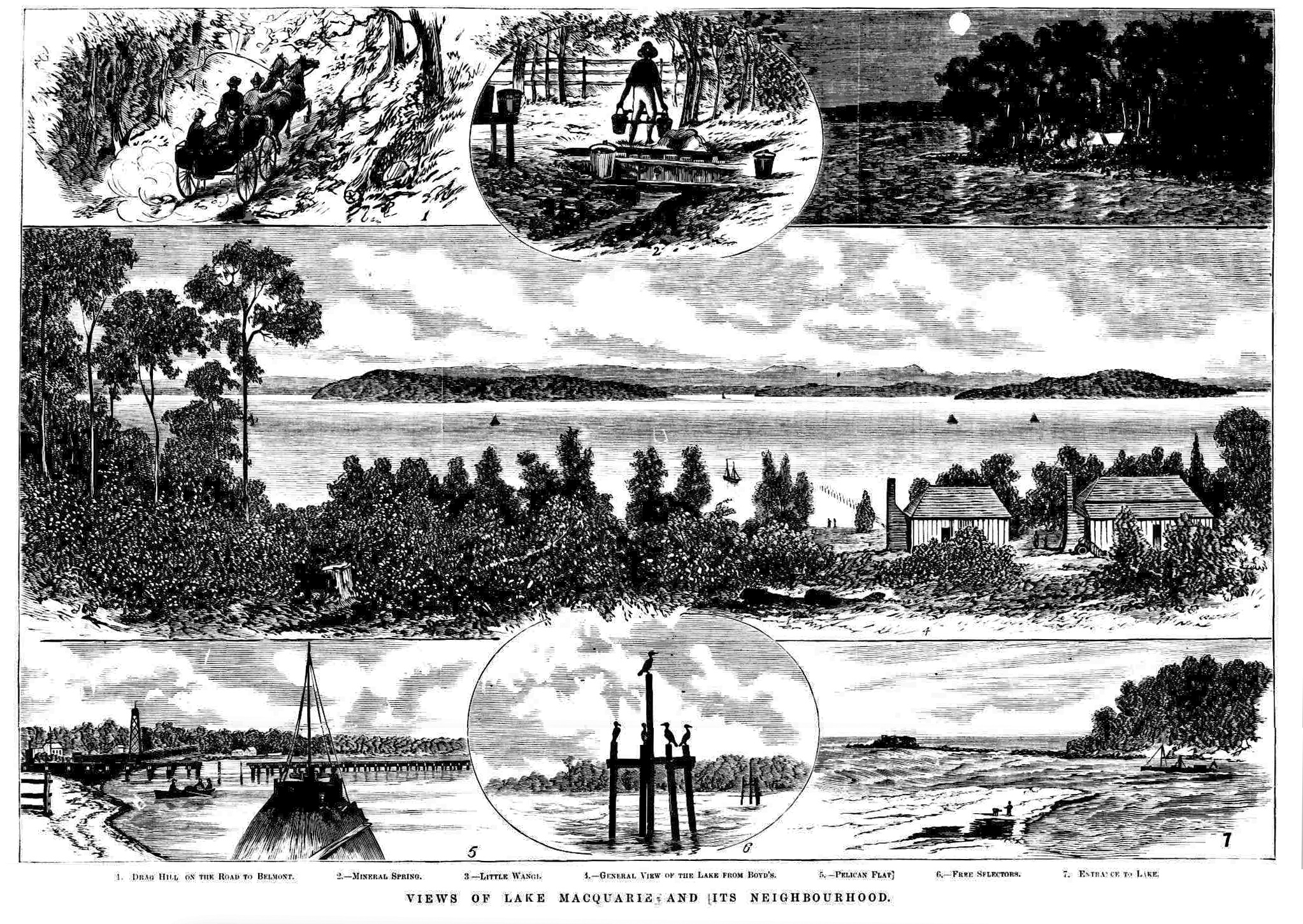
1. Drag Hill on the Road to Belmont
2. Mineral Spring
3. Little Wangi
4. General View of the Lake from Boyd’s
5. Pelican Flat
6. Free Selectors
7. Entrance to Lake
1881, June 16. Page 2. Land Was Granted
“Old Margaret” of Lake Macquarie. (1881, June 16). Newcastle Morning Herald and Miners’ Advocate (NSW : 1876 – 1954), p. 2.
Retrieved July 30, 2024, from http://nla.gov.au/nla.news-article137191514
“Old Margaret” of Lake Macquarie
AN old identity among the original blacks in this district is reported to be in a very feeble state–so much so that she is unable to travel into Newcastle for her usual yearly “blanket dole.” The aged personage in question is “old Margaret” of Lake Macquarie, the last remaining representative of the Lake aboriginals. It will be recollected that some time ago, from representations made to Sir Henry Parkes, a portion of ground on which she and some of her children resided, near the Lake entrance, was granted to her for her lifetime.
1883, August 20. “Queen Margaret” Greets A Visiting Delegation to Lake Macquarie.
VISIT TO LAKE MACQUARIE. (1883, August 20). The Sydney Morning Herald (NSW : 1842 – 1954), p. 5.
Retrieved September 24, 2024, from http://nla.gov.au/nla.news-article13542471
…At the bridge, “Queen Margaret,” the last of the Macquarie Lake tribe of aboriginals made known her rank to the visitors, and received royalty in the shape of a handful of small silver. A second lunch was then partaken of, the viands being set out in a shed near the residence of the sub-inspector of fisheries. The Shed had been turned into a perfect little arbour, being completely lined with leaves and flowers and looked as pretty as could be. All the poultry of Pelican Flatt appeared to have been sacrificed for the occasion, and the visitors, with keen appetite received from the sweet pure air, did ample justice to the bountiful supply of good things. Sir Edward Strickland occupied the chair, and at the conclusion of the lunch, the toast of “The Queen” having been drunk. The Chairman proposed the toast of “Success to Lake Macquarie and a speedy Opening of the Channell”…
1883, August 25.”Out to the Lake” by “Maori” Recollection of Queen Margaret at Pelican Flat
COUNTRY SKETCHES. (1883, August 25). The Sydney Mail and New South Wales Advertiser (NSW : 1871 – 1912), p. 342-343.
Retrieved September 24, 2024, from http://nla.gov.au/nla.news-article162028002
“…Outside the heads lies Green Island basking in the sun, and a fringe of crested foam showing the unceasing attentions of the placid Pacific. There is a considerable current ontward just now, the tide being at extreme ebb ; but the rise and fall of tbe lake does not vary more than 12 inches.
More bunting, trophies, triumphal arches and welcomes here. The whole inhabitants of Pelican Flat, led by Mr. Boyd, a hale old veteran, and the oldest settler on the lake, approach us with beaming signs of welcome, and we are introduced to a dusky representative of royalty in the person of Queen Margaret, the last scion of a royal stock, and the only living representative of the old Lake Macquarie tribe of aboriginals. Margaret is a very pleasing representative of the beet of her race — clean, quiet, self-respecting, sober, frugal, and with a quiet dignity which is rather touching. She is a well-deserved favourite with all who know her. We yield her tribnte iu a shower of silver, which fairly overcomes tbe gravity of her majesty, and her chuckle of satisfaction as the shillings rapidly rained upon her was really an intense treat.
All thie time the ‘ nap ‘ players have kept at their game, and now, as we mount the high quarry waggons, upon which boards have been nailed as seats, the deal still goes on…”- p. 343.
1892, November 25. Page 2. – Photograph of “Old Margaret” for inclusion in Chicago Exhibition to World’s Fair
Scrap Notes and Comments. (1892, November 25). Bathurst Free Press and Mining Journal (NSW : 1851 – 1862; 1872; 1882; 1885 – 1897; 1899 – 1904), p. 2. Retrieved August 3, 2024, from http://nla.gov.au/nla.news-article62723099
… The catalogue for exhibits, prepared by Mr. Charles Potter, Government Printer for transmission to the World’s Fair, is very well got up; and the photographs, etc , are productions any city would be proud to own…..
Very characteristic too, of the country; are the pictures : — “A miner’s hut, Lithgow Valley,” “Bush Scene,” “Mickey,” an Australian aboriginal, photographed from life ; “Old Margaret,” the last of the Lake Macquarie tribe of aborigines, “ native implements, and navigation,” “corroborees,” also “emu,” “ female kangaroo, and young in pouch,” “the lyre bird,” “laughing jackass,” “native cat,” etc.
See additional information by researcher Stephen Ticehurst in the Comments Section below.

Of this portrait John Fraser (1892) says:
‘Old Margaret ‘ is the last survivor of the Awabakal. She is now living in her slab-hut on a piece of land near Lake Macquarie Heads, and supports herself by her own industry. She had the advantage of early training in an English home in the district ; she is respectable and respected. Her features, as compared with those of other natives, show how much the type varies ; and yet she is an Australian of pure origin. She was born at Waiong, near the Hawkesbury River, and is now about 65 years of age.
1893, August 12. Page 12.”Old Margaret” in Creative Fiction
The Story of Bury-your-own. (1893, August 12). Newcastle Morning Herald and Miners’ Advocate (NSW : 1876 – 1954), p. 12.
Retrieved August 3, 2024, from http://nla.gov.au/nla.news-article136405479
The Story of Bury-your-own.
(BY JANE.)
THE island in Lake Macquarie, called on the maps ‘Pulbah,’ is known locally as ‘Bury-your-own.’ On the authority of old Margaret, philologists assert that this is merely a corruption of a native name – ‘Boorayurroon’ – while numerous stories are told, all more or less improbable, of the origin of the name. There are few who know the true story of the tragedy that gave to the island its peculiar title.
Late one evening many years ago a woman stood on tile shore of Wangi Point. A stiff southerly was blowing, and overhead the trees swayed and creaked ominously. She heard a step, and muttering, ‘ He has beached the boat and walked home,’ she turned and ran up the path to the hut. ‘ What a long time you’ve been,’ she said, as she entered. She started ‘back. ‘ You?’
The intruder quietly barred the door. ‘Yes! rather a long time,’ he said. ‘Five years, isn’t it, since you bolted? Just five years. Did you really think I wouldn’t find you? Oh, you innocent! Did you really think you could escape me ? Oh, you confiding little dear!’ His mocking tone changed to one of deadly hate, and, seizing her wrist, he said, ‘I gave my honour into your keeping – where Is it? It went with your virtue; I trusted you and him. Another man’s wife living with another woman’s husband !’
She stood as though petrified, until at last her lover’s name formed upon her lips.
‘Oh, yes! call for him, my dear wife; you’ll want his assistance before I have done with you. But he won’t come; he’s gone to settle with my fellow victim the woman he abandoned. He has left you, dear.’
‘You lie!’ He would not leave me for the best woman on earth. He is mine! What do I care for your threats while I have him? Did you wonder I left you ? I was forced to marry you, when you knew I loved him with the full force of my heart’s best love. I was his, and he was my own.’
He laughed sneeringly. ‘Quite dramatic; living in the wilds has evidently developed your artistic nature. But he’s gone, you know never to return. He has reversed the order of things-left his mistress for his wife.’
With jealous strength she sprang at his throat, and for a few moments they struggled. At last he disengaged her arm, and smote her on the forehead with his full force. He carried her to a dingy drawn up on the beach, threw her senseless form across the thwart, and as her head fell, it rested on the lips of a man lying in the boat. The husband noticed it, and sneering, ‘Loving even in death!’ he spurned them apart with his foot. He pulled to the island, and running the boat ashore, lifted out the two bodies. With a cord he lashed her securely to a tree, and laid her companion in sin at her feet.
With the cold grey dawning of the morning, with a shiver the woman regained consciousness, and as the light grew stronger she saw the figure at her feet, its cold staring eyes fixed on her face. A ray of light streamed on a clot of blood on his temple, and. with its glow the scene of the night flashed upon her, and again she lost consciousness.
She awoke. The body had been stripped, and with the heat of the day the flies swarmed upon it. ‘Oh God! Let me die with mu love’ she moaned. She looked and saw the husband she had betrayed smiling upon her. The sun glared upon the corpse – the flies polluted it – the ants began to gather. ‘Oh, have mercy. Kill me, if you will but save his body from the shame! See! Bury him for the sake of your mother. Of God! That our love should have ended thus! And still he smiles, and as the sun set he left her.
She blessed God for the night – the insects had gone. The hours dragged on. He came with the sunrise, and stood gloating on her agony. The sun beat its pitiless rays upon her, and as the light of madness dawned in her eyes he drew his knife across the cords,
and she fell prostrate on the corpse. The husband forced food between her teeth, and chafed her numbed limbs that the agony might be prolonged. She regained a little of her strength, and with it the power of movement.
‘He is yours, is he? Well, do what you like with your own! If I were you, though, I would bury it. Don’t wait for the undertaker, dear.
Bury your own; bury your own.”
A light breeze stirred the leaves, and to her wandering mind their song was ever the one strain, “Bury your own.” ‘In frenzy she began tearing the ground with her hands. Her nails wore to the quick, drops of blood oozed from her finger tips, but still she toiled on and on and on. Concentrating her energies in one last despairing effort she heaped the earth she had scraped over the corpse, she shook her hair over the still uncovered face, her hands clutched the ground, and with “Bury your own” on her lips she died.
1894 – Death of Margaret White – 14 October 1894
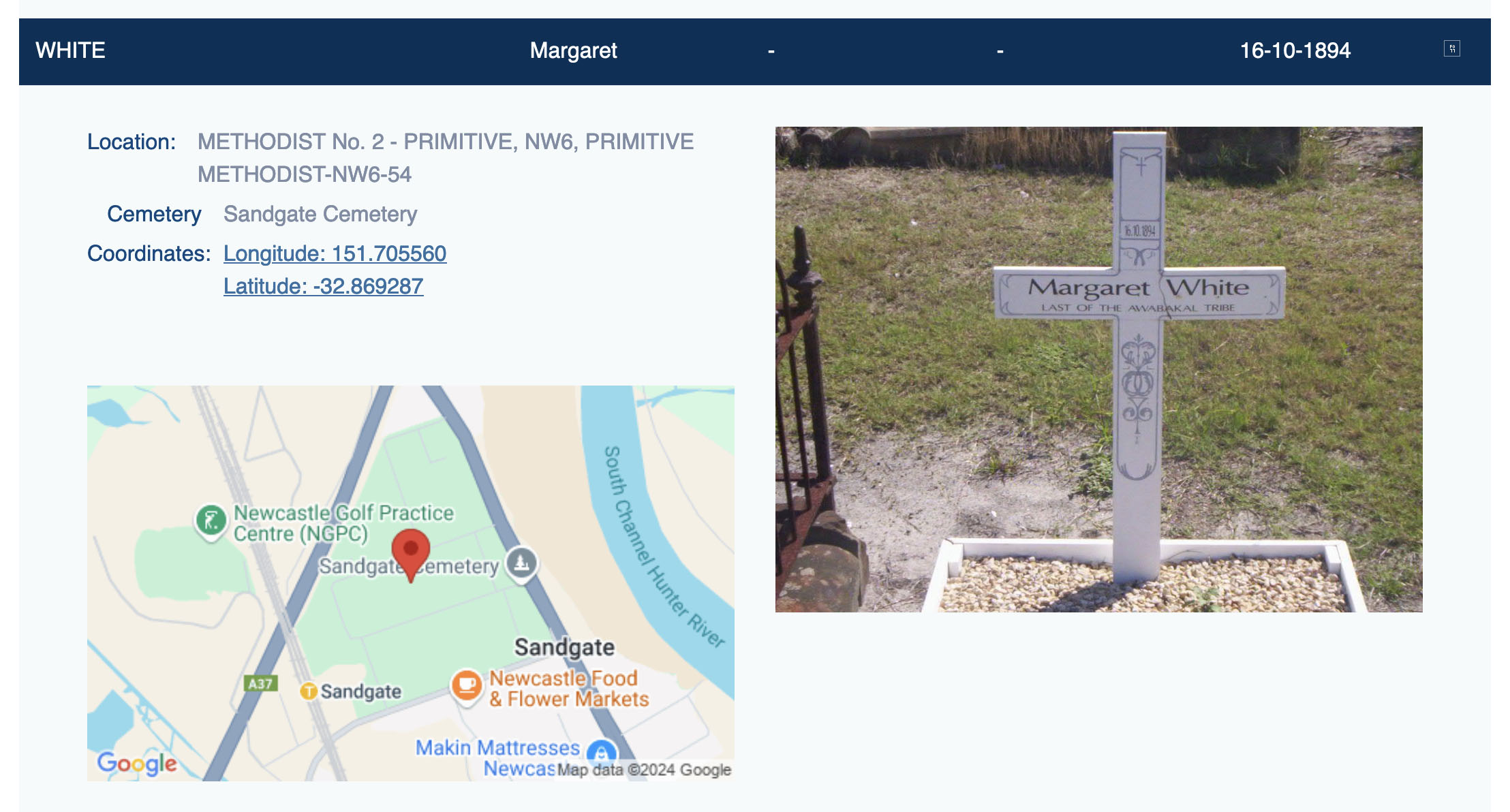
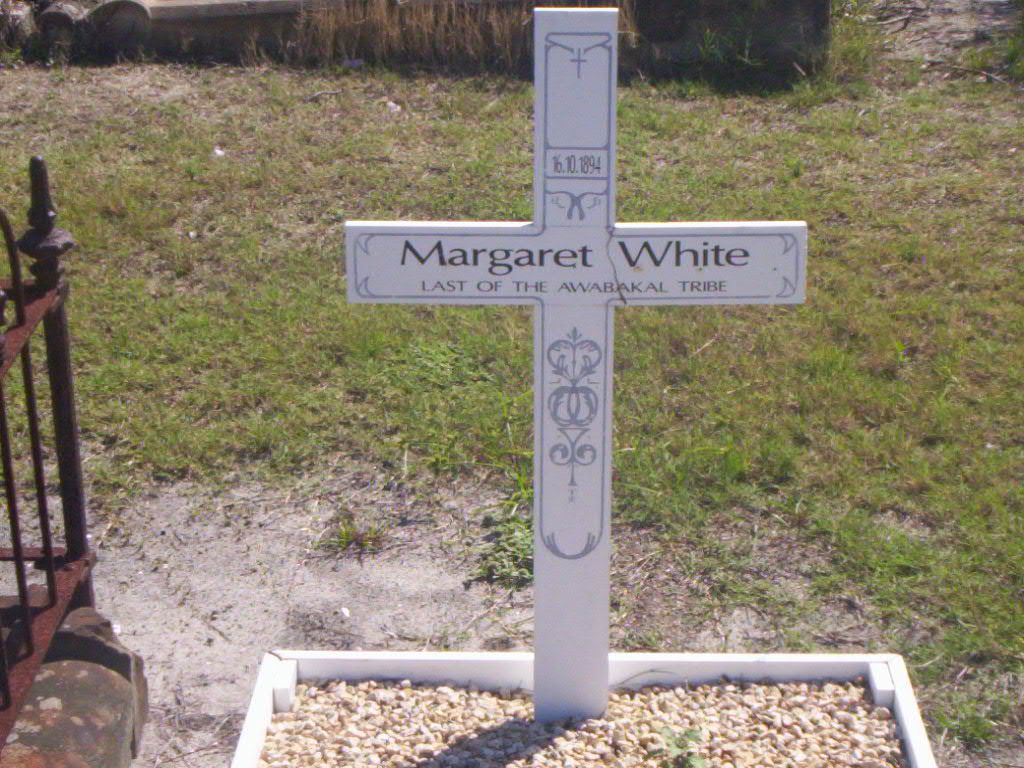
1900s? Lake Macquarie Land Allotments

Source:
https://livinghistories.newcastle.edu.au/nodes/view/77695
1911, October 25. Page 20.
Princess Spinaway’s Department. (1911, October 25). Australian Town and Country Journal (Sydney, NSW : 1870 – 1919), p. 20.
Retrieved August 3, 2024, from http://nla.gov.au/nla.news-article263725587
Princess Spinaway’s Department.
HOW THE TABLES WERE TURNED.
By Mary Cleaver (aged 15), Swansea, Lake Macquarie.SECOND PRIZE STORY.
Betty and Therest Morton were girls of 13 and 15 years of age. They were both mischief loving girls, especially Betty, the elder. Their house was about half a mile away from any other house, except their cousin Jack’s. One day, after their father had been burning and clearing the land around, Bett and Tess, as Theresa was called, were, down playing among the fallen trees. They rubbed some of the charred, burnt, bark against their faces, and soon had them quite black.
“Tess,” said Bett, suddenly, “wouldn’t it be fun to blacken our faces again and put on men’s clothes, and go and frighten Jack and Phyllis?”
“Oh! Wouldn’t it!” agreed Tess. So they sent Tom and Jeff, the twins, who were with them, up to the house for some old clothes.
“Don’t let. father or mother see you,” said Bett.. “Hurry up.”
The boys were soon back, and the girls arrayed themselves in the clothes.
“Come on,” said Bett. “They’ll think we are blacks.”
So they set out for their cousin’s place. However, he saw them coming, and after gazing a moment at. them, he hit on the truth.
Stepping inside, he got his gun, and laughing to himself, levelled it at the would-be blacks. “Oh!” screamed they, “don’t shoot.” Then they turned and ran like mad. Jack and Phyllis, his wife, sat on the verandah and laughed aloud. Presently he shouted to the girls to some back. When they appeared, breathless, he said —
“Bett, if I lend you this gun, would you be game to go up and frighten old Margaret ?- Buccan is away.”
Margaret was an old black Queen who lived with her son and daughter, Prince Buccan and Princess Helen, and their piccaninnies. They lived a little way away from the tribe.
Bett and Tess looked at. each other.
“Will we?” said Tess.
Yes. Come on!” So they set out for Queen Margaret’s camp, Bett carrying the gun, and Tess with a hoe handle, which had a bundle tied to the end of it. When they got near the camp they shouted out something in blackfellow language, which Jack had told them to say.
Margaret, Princess Helen, and the piccaninnies came running out, and when they saw the two formidable-looking blacks, Margaret yelled to the little blackboys —
“Quick; go an’ fetch Tom. Tell him Coorie (blackfellow) come. Tell Tom to fetch gun!”
The piccaninnies hurried off for the old blackfellow, and Bett and Tess began to get frightened. They knew that old Tom would mistake them for blacks of another tribe, and shoot them. Queen Margaret was yelling to the little boys to go quicker.
“Tess,” gasped Bess, “let us run our hardest.” So the two brave blacks turned and fled. Every minute Tess would trip over, a monkey rope, and start to cry. Bett would help her up and pull her along, and all the time they could hear Her Majesty’s shrill old voice hurrying the piccaninnies along.
At last, gasping and panting, they reached Jack’s fence, ready to drop, while that worthy was lying on the grass roaring with laughter. He could see right through the bush to the black’s camp, and watched the whole happening. The girls rushed into the house, washed their faces, kicked off the men’s clothes which they had on over their others, and were sitting in the verandah when old Tom and some more men came up. Jack explained to them, and they went away laughing to think how the joke had been turned on the girls.
When their parent heard about it, they only laughed, and said they ought not to have frightened the old woman, and that it served them right to get such a fright themselves.
1921 Swansea Land Sale Poster Adjacent to Black Ned’s Bay
1923, March 12. Page 6. Talbot’s Reminiscences of Margaret and Ned, and Having Driven Her to Newcastle Hospital
PULBA NOT BULBA. (1923, March 12). Newcastle Morning Herald and Miners’ Advocate (NSW : 1876 – 1954), p. 6.
Retrieved August 3, 2024, from http://nla.gov.au/nla.news-article139352022
PULBA NOT BULBA
Sir.–I notice where some of your correspondents make a mistake in the name of the island in the centre of Lake Macquarie, situated between big and little Wangi Points. There have been many changes round the Lake since I first came to reside there in 1877, but the progress has not been what I anticipated, owing to the bungling of the harbour entrance. The geographical name of the Island is “Pulba” not “Bulba.” The aboriginal name being “Boorooyaroo,” (near as I can put it), meaning land surrounded by water. These particulars I got from old black Margaret, the last of her race, or to give her proper title, Queen Margaret, a fine, stately, Intelligent old lady, fairly well educated by a good Christian family in Sydney, with whom she remained until Black Ned, or King Ned claimed her as his affianced bride, and brought her, in 1868, to his wigwam on Lake Macquarie. “Bury your own,” is a corruption of the aboriginal name “Boorooyaroo.” There is a story told that In the old convict days, a number of convicts escaped from Newcastle, making their way through the bush, struck Lake Macquarie from big Wangi Point, swam across to Pulba Island where, no doubt, they considered themselves safe for the time being, until betrayed by one of the gang, whom they caught, stripped naked, stunned, and tied across a soldier ants’ nest. We can only imagine what followed. His skeleton was found by some bushmen and buried on the Island. Old Jack Taaffe, or “Jack the Native,” one of the first residents of that Lake, whose selection is right opposite Pulba Island on its eastern side, told me the Island was haunted by the ghost of the murdered man. So the story goes as near as I can remember. King Ned and his son “Buckam” are buried right opposite the old aboriginal settlement south of Swansea, then known as “Pelican Flat,” on account of the number of pelicans swarming there. Round the entrance and Ned’s Bay, in the old days, swarms of pelicans, swans and ducks could be seen. Poor old Margaret, I drove into Newcastle Hospital, where she died, in about 1893, the last of her race. The late Clarence Hannell, old Peter Fleming, as he was known, Jem Fletcher, M.P.. Harwood of the “Newcastle Pilot” newspaper, and other gentlemen, including the writer, saw that the last of the tribe wanted for nothing. While I think of it, and on the Job, I notice what I take to be an error in the report of the evidence on the proposed Newcastle Harbour Trust. Mr. King said to Captain Haakon: “You know Durban Harbour well, and have seen Newcastle. At Durban the general trend of the sand is from south to the north. On this Coast it is from the north to the south.” ‘Well. I will not say what the trend of the sand is on our coast, but, I do know there is a strong southerly current off the coast causing a strong northerly eddy in shore. I sailed for some years in a 4-ton boat between Lake Macquarie and Newcastle. At first, I used to take long boards when the wind was north-east, away out to sea. This would take me a whole day’s good sailing to reach Newcastle. Old Billy Boyd, in his time one of the most experienced men on the coast, said to me: “What do you stand away out to sea for, me boy when going round to Newcastle?” I said, “I believe in making long boards, saves way and labour.” “But you get into a strong southerly current me boy out there. “Now you just make short boards an close to the shore as you can, and see where you will be.” I did this on my next trip, and found myself off Nobby’s in no time. I left the lake against a strong north easterly fully twelve hours after one of our coasters, got into Newcastle, loaded, and out again before the coaster arrived (Captain Russell), a proof of the strong inshore eddy. How, therefore, could the trend of the sand be southerly against this eddy, or current? Poor old Billy Boyd, a real good old sort, sadly missed by his many fishing friends. On one occasion Billy, at this time inspector of fisheries, Tom Boyd, his brother. who was pilot at Lake Macquarie Heads, Dr. Cory, of Catherine Hill Bay and the scribbler arranged for a morning’s schnapper fishing outside of Lake Macquarie Heads . Our fishing equipment consisted of shark and schnapper lines, four kerosene tins to hold the shark’s livers, a straight, sharp, long sword which Billy would never go out without, plenty of burley, and of course a bottle of good old Jamaica, as Billy said, “Fish will not bite without it. We hung on for over an hour, being annoyed by leatherjackets and other small fry. At last the schnapper came, and what sport! As fast as we could haul them in ranging from 5 to 20lb in weight . I was hauling in a beauty (Billy declared it must have been fully 20lb), when suddenly the line came in free. “Oh, hang it all. he’s gone. No, something on the line.” Billy said. “Haul in your line, me boy, Mr. Shark has got your fish.” And sure enough, all he left was the head and shoulders. Billy said: “Haul in your lines, boys. No more schnapper here. Well, let us have a go at the sharks.” I hooked the first, a huge wabbygong, about 8ft long, a cruel. ugly-looking brute: came in like a log. I hauled him up to the gunwale of the boat for Billy to give the coup de grace with his long sword, when Dr, Cory, a fine strapping young fellow, shouted, “Oh, let me kill him, Bill. I have never killed a shark in my life.” Billy handed him the sword, saying, “Be careful, me boy, he don’t have you.” The doctor drove the sword into the shark right up to the hilt, Before he had time to withdraw it the shark, with a sudden turn, as near as possible had his arm. The morning’s catch was over 50 fine schnapper, a quantity of cod, one blue pointer, and seven grey nurse sharks, and one wabbygong. I have many, many happy memories of Lake Macquarie and the dear old friends now nearly all passed over the bar.
ROBT F. TALBOT.
1926, May 15. Excursion to Galgabba
Excursion to Galgabba (1926, May 15). The Newcastle Sun (NSW : 1918 – 1954), p. 10.
Retrieved September 23, 2024, from http://nla.gov.au/nla.news-article163390580
Excursion to Galgabba
The Australasian Society will conduct an excursion to Galgabba, on the shores of Lake Macquarie, tomorrow. It was in this locality that the Awabakil people finally disappeared from their native haunts and the purpose of the present visit is to mark in some suitable manner the last resting place of a most interesting tribe.
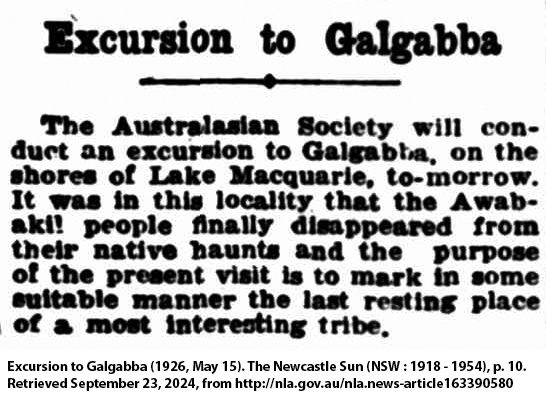
1926, July 12. p.18 Report of the Excursion to Galgabba – By Dorothy Moloney
Young Australia. (1926, July 12). The Voice of the North (NSW : 1918 – 1933), p. 18.
Retrieved September 26, 2024, from http://nla.gov.au/nla.news-article112244910
Young Australia.
Dear Comrades,
I had the good fortune to be included in the party representing the Australasian Society which recently visited Swansea in order to locate the exact position of the aboriginal cemetery wherein the last of the Awabakil people take their rest. The guide and narrator was Mr. John Taaffe. who was born at Gosford in 1855, and who came to Swansea sixty-four years ago, when there was not a single habitation at the crossing. The Taaffe family came by a small ketch from Brisbane Water, and were marooned for a night on Nirritiba Island at the entrance of the channel, where the ketch drifted ashore. The vessel was safely floated on the succeeding tide, and proceeded up the channel with its miscellaneous cargo, and the first home was erected adjacent to the site of the present town. The name of Swansea was bestowed upon the settlement at a much later date by Captain John Talbot, who is still living at Berowra, and who is remembranced by Talbot Park in the centre of Swansea. The most suitable name in the native language would have been Tulkaba (the place of the titree) as there is a forest of this timber in the vicinity, but this euphonious title can be reserved for some other locality in the Lake Macquarie district, as should the name of Swansea be removed at any later period it will probably be replaced by Galgabba (Awabakil-Kalogkaba, meaning afar off) and applied to the camp formed at the angle of the road about half a mile south of Swansea by the aborigines, who probably at an earlier date were portion of the community attached to the mission station where the township of Toronto is now located. The mission was established by the London Missionary Society in 1824, and continued until 1841, when it was abandoned owing to the number of aborigines having dwindled very considerably. Mr. Taaffe has recollections of the blacks travelling in large parties, generally working in a circular fashion from Gosford via Wollombi and Newcastle. The camp at Galgabba was of a permanent character, and was ruled by “King” Ned, after whom “Black Ned’s Bay” was named. He was surnamed White, but for what reason I was unable to ascertain. His mother’s name was Nullity, and she lived with her son at Galgabba and is buried beside him on the hill overlooking the site of the old camp. Mr. Taaffe pointed out the position of the several graves of the most recently buried aboriginals, and these include “King” Ned (who died at the age of 55 years), Nullity (the King’s mother), Buckan (nick-name), the King’s son, whose proper name was William Henry Manumurra White, Lizzie Tessiere White, great granddaughter of King Ned, who was burnt to death when 8 years old, Mally Morgan (an aboriginal who was accidentally shot), Kitty (a gin with one eye), who had always resided at the camp, and Moona (a Wollombi gin). The King’s wife (Margaret White), who survived him for many years, died in Newcastle Hospital and is buried at Sandgate. She is regarded as the last typical full-blood of the Awabakil people. The site of this cemetery is of considerable national interest from the historic point of view, and the owners of the land have been asked to present it to the people in order that it may be suitably enclosed and a monument erected to record the facts connected with the exit of this remarkable branch of the Australian people.
Mr. Taaffe is an excellent historian regarding settlement in the Lake Macquarie area, and he states that in those early clays the visiting Clergyman was the Rev. Mr. Glennie, who resided at the Church of England Rectory, Gosford, and made his periodical visits on horseback. In later years the district was under the care of the Rev. W. Fenton James (still happily in evidence), who took a keen personal interest in the welfare of the aboriginals, and with whom he was a firm favourite. When the Taaffs family took up residence at Swansea, kangaroos, red wallabies, native bears, opossums, swans, pelicans and ducks were numbered in thousands, whereas at present not a single specimen remains. The work of the vandal (man) is complete. Mr. Taaffe relates the traffic in swans which took place between the Lake and Sydney. During the brooding period the birds, being unable to fly, were easily captured and held in captivity until a schooner was leaving for Sydney, when they were placed below hatches and on arrival sold at fancy prices to the officers of the numerous sailing ships then trading to that port. Decimation was the natural result. The same fate befel the curlews. These birds were killed without stint, and their characteristic call would now be a novelty to the modern invaders of the hamlet. Mr. John Taaffe was the original licensee of the Swansea Hotel, and has been continuously associated with the locality from early boyhood. He is an authority on all questions relating to the timber and fishing industries, and a pioneer in the making of many of the roads leading northward from the Gosford district. His first-hand knowledge concerning the original in habitants with whom he was on such close terms of friendship is deserving of preservation, and the position is one which should enlist the sympathy of the Minister for Education, who could possibly detail an experienced journalist to make the necessary record.
…
Your faithful Comrade,
DOROTHY MOLONEY.
1931, June 20. Page 5.
LEAVES FROM OLD FILES (1931, June 20). Newcastle Morning Herald and Miners’ Advocate (NSW : 1876 – 1954), p. 5.
Retrieved August 3, 2024, from http://nla.gov.au/nla.news-article139613347
LEAVES FROM OLD FILES
“NEWCASTLE MORNING HERALD” FOR WEEK’ ENDING JUNE 20.
50 YEARS AGO
“Old Margaret.”- An old identity among the original blacks is the Lake Macquarie district is reported to be in a feeble state-so much so. that she is unable to travel into Newcastle for her usual yearly blanket dole. The aged person in question is known as “Old Margaret,” of Lake Macquarie, the original remaining representative of the Lake Macquarie tribe. Some time ago following the representations made to Sir Henry Parkes, the portion of the ground on which site and her children lived, near the Lake entrance, was granted to her for her lifetime.
1933, October. J.J. Moloney on Queen Margaret and Kalog-gabba (“Far Away”)
“The Awabakal” by J. J. Moloney, Newcastle (Reprinted from BANK NOTES, October 1933 p. 43). Kindly sourced and provided by Jim Smith
“The dwindling of the nation commenced on contact with the British, and for some years the bulk of the people were settled at Puntel (Toronto). After 1841 the remnant crossed over to Tulkaba (Swansea), and at a spot known as Kalog-gabba (“Far Away”) the exit was made. Queen Margaret, recognised as the last full-blood of the Awabakal nation, died in Newcastle Hospital, and was interred at Sandgate (Newcastle District General Cemetery).”
For the full transcription of the article and extra notes on J.J. Moloney please see the following post on Hunter Living Histories:
1935, May 16. Queen Margaret referred to by J.J. Moloney as “last full-blooded aborigine”
TWO MORE HUMAN SKULLS FOUND (1935, May 16). The Newcastle Sun (NSW : 1918 – 1954), p. 10.
Retrieved September 24, 2024, from http://nla.gov.au/nla.news-article166097532
TWO MORE HUMAN SKULLS FOUND NEAR NEWCASTLE TOWN HALL
On the side of the hill near the Town Hall, where human bones were found two days ago, workmen engaged in excavating for foundations to-day unearthed two more skills and a thigh bone.
The remains are believed to be those of aborigines, and the probabilities are that the site was once a native burial ground.
The secretary of the Newcastle branch of the Australian Society of Patriots (Mr J. J. Moloney) said that there were many skeletons of aborigines to be found under suburban streets. The bones found to-day, however, were of a prior date to those unearthed on the flat.
The gaps in the row of molars in the skulls might, he thought, be evidences of the ceremonies which accompanied the initiation of young aborigines into the dignity of manhood. It was Impossible to express a definite opinion about this, however, as each tribe had its own particular rites.
Mr. Moloney recalled the time when the Hunter River separated two different tribes of aborigines.The tribe on the Newcastle side, which extended as far as the Wyong River, was known as the Awaabakil (still water), the name being taken from Lake Macquarie, which was the central point of its domain.
The natives in the Newcastle district, he said, were a fine upstanding race, owing to the wide variety of vegetables, game and fish which was procurable. Aborigines from distant tribes often travelled to Newcastle to rather foodstuffs.
The last full-blooded aborigine in this district, Mr Moloney stated was Queen Margaret, who died In the ‘nineties She earned her living by making shell baskets and selling them near where the Swansea bridge now stands.
1936, April 30. Queen Margaret and King Ned of Kalogkabba, meaning “far away”
WHEN THE BLACK MAN RULED (1936, April 20). The Newcastle Sun (NSW : 1918 – 1954), p. 6.
Retrieved September 24, 2024, from http://nla.gov.au/nla.news-article166569275
When The Black Man Ruled
Towards the close of the last century in Newcastle the last links with a once mighty tribe inhabiting the Lake Macquarie district disappeared.
The Awabakil tribe was one of the greatest in Australia. The men were larger in stature and more intelligent than their less favored countrymen. They lived in an area which was stocked with vegetable food and abounded in game. They did not have to scratch for a living on the arid plains as did the natives living around Broken Hill, for instance.
The headquarters of the tribe originally were at Toronto, where the Hotel Toronto now stands. In 1841, when the London Missionary Society abandoned its mission in the Lake Macquarie district, the tribe shifted its headquarters to Swansea.
THEY called the locality of the new headquarters Kalogkabba, meaning far away. Awabakil, the name of the tribe, was derived from Awaba, meaning smooth water. This referred to the lake. As we pronounce Awaba to-day, however, we have not succeeded in capturing the beautiful intonation which the blacks gave to it. They spoke the word softly and smoothly (phonetically ‘Awa-a-ba’), reminiscent of the gentle music made by water softly lapping rocks and foreshores.
Because the blacks respected natural boundaries, such as creeks and rivers the various tribes had definite characteristics, and separate languages. The people of Stockton spoke a different language to those of Newcastle or Lake Macquarle. The Awabakil nation’s territory extended to Wyong, or more correctly, Waiong, the place of the yam.
The native vocabulary was much more extensive than that of the white man. Where any kind of a leaf was just a leaf to a white man, whether is was the leaf of a gum or a rose the native had a separate name for each. He also had names for each of the tiny veins, the saw edge of the leaf, the leaf stem, and other portions. No one word covered two things. Children were often called after birds and animals, and there was no paucity of ideas in names. The same name was not used again and again as the whites have standardised Christian names. There was generally a reason for a name, as, for instance, the flying of a hawk overhead might provide the name Hawk for a child.
The last king of the Awabakil nation, Ned, and his excellent wife Margaret, resided on the cleared patch of ground about half a mile south of Swansea bridge on the western side of the road. They had two children, Buckham and Ellen.
King Ned is buried in the ground marked off by the Australasian Society of Patriots in the aboriginal reserve on the opposite side of the road from their old home. He died about 1877. Prince Buckham died about 1881, and is buried in close proximity to his father.
Queen Margaret died some years later, about 1893 in Newcastle Hospital, and is buried at Sandgate. Princess Ellen had two families, the first comprising Fred, Sarah, and Albert Milton. She later became Mrs. Williams, and no record has been kept of the children of that marriage. She died at Merewether and is buried at Sandgate. All the children of Ellen were half-castes and may be omitted from history of the full bloods.
The other full bloods living at this period, 1878 to 1880 were Kitty, Nullity and another old gin. These three women were buried on the banks of the channel on the southern side opposite the Police Reserve, and to-day their graves are in danger from erosion.
To prevent confusion, as Queen Margaret was buried as ‘Mrs. White,’ it must be stated that she was not married to the selector, White. This man came to Swansea with a full-blooded woman from Quirindi District, and his three half-caste children were Adam, Ike and Tom.
This family had no connection with the Awabakil tribe. How Margaret came to be styled ‘Mrs. White’ is not known. She was Ned’s true wife, and possessed a beautiful character and clean record. In her early days she lived with family of Edward Hammond Hargreaves at Bungaree, and possessed many accomplishments. Her home was spotlessly clean, and she was most courteous to visitors. She was an artist in shell work and maintained herself by her industry.
The bay on the ocean side of Swansea is called Black Ned’s Bay in memory of the King, and the bay in Lake Macquarle at the rear of the old home is Margaret’s Bay to commemorate the grand old and last queen of the Awabakil nation.
The Australasian Society of Patriots some time ago approached the Parbury Estate for a gift of the land containing the graves of Ned and Buckham, with a view to erecting a suitable monument.
1936, May 23. Mr Johnston Remembers Queen Margaret Who Resided on 40 Acre Government Grant
80 TO-MORROW (1936, May 23). Newcastle Morning Herald and Miners’ Advocate (NSW : 1876 – 1954), p. 4.
Retrieved September 24, 2024, from http://nla.gov.au/nla.news-article139228993
A NATIVE QUEEN.
Mr. Johnston recalled that “Queen Margaret,” her son and daughter, the last of the aboriginal tribe on the lake, resided on 40-acre Government grant at Coral Tree Flat at Swansea. Some of the early settlers on the lake were Mr. Speers of Speers Point, Mr. Fennells, of Toronto Bay, Mr Geo. Marks, of Marks Point, Messrs John and Maurice Marks, of Belmont Bay, the Warners, of Warner’s Bay, the Youstons, of Rocky Point, Captain Johnston, of Wangi Bay, George Henderson, of Nord’s Wharf, Tom and Will Boyd, and another man called “Billy Mischevious” who lived at Galgabbi, the Taafe family, of Nord’s Wharf, and Jim Mewett, of Mewett’s Flat…
1939, December 4. “Queen Margaret” as one of those Blazing the Lake Trail
BLAZING THE LAKE TRAIL 60 YEARS AGO (1939, December 4). The Newcastle Sun (NSW : 1918 – 1954), p. 4.
Retrieved September 24, 2024, from http://nla.gov.au/nla.news-article167510145
“..‘QueenMargaret,’ her son Bucken and daughter Ellen, the last of the Aboriginal tribe on the Lake, resided on a 40-acre Government grant at Adams’s Flat, Swansea. Harry Boon, Bill Fox. the Masseys and Dedmonds also lived in the Swansea area. Messrs. Peter and Dave Murray worked a small mine on Galgabba Pt. Chinese fishermen carried on their activities on the Swansea channel and sun-dried their catches of fish and shrimps and exported them to China, via Sydney…”
1939 – Dr Ben Champion on Margaret and Ned (in a piece on Threlkeld pages 323-324)
Another reminiscence of this old lakeside identity which is of passing interest in this paper is that of Black Ned, an aboriginal of the locality (Black Ned’s Bay, Swansea, is named after him) ; and Margaret White, a full-blooded aboriginal woman who lived at Swansea for many years. She had worked for the White family, was quite handsome for an aboriginal, and was also very intelligent. Dr John Frazer, B.A., LL.D., in his book on the language of the aborigines, to which we shall refer later, shows an actual photograph of this woman, whose features are somewhat different from those of the average aboriginal woman. She had an orchard, and was therefore very popular with the small boys of Swansea. Latterly she lived at the southern end of the town, near the turn-off to the Caves Beach. A few years ago, a tunnel mine was commenced at the entrance to the lake, on the southern bank of the channel not far from the old Forbes home. It was subsequently abandoned for certain reasons, and only the tunnel entrance, some old skips, and an unsightly mullock heap remain to tell the tale of this mining venture. –
1954, April 17. Page 5.
LEAVES FROM OLD FILES (1954, April 17). Newcastle Morning Herald and Miners’ Advocate (NSW : 1876 – 1954), p. 5.
Retrieved August 3, 2024, from http://nla.gov.au/nla.news-article134912363
75 YEARS AGO
Fifty years ago what is now known as Newcastle, the second city of New South Wales, was little better than an unattractive and dreary looking scrubby country. Then it was that the aborigines were to be seen in their numbers in their native wilds. Then it was that the withering blight of the white man’s presence had not come upon them, at least the effects of his presence had not yet begun to show themselves. With the approach of the white man, the black has disappeared. Of the once famous Port Stephens tribe only a few remain, while the Lake Macquarie tribe has but one representative left, in the person of “old Margaret,” wife of “old Ned.” Some years ago the late Mr. James Hannell, with several other gentlemen, interested himself in the welfare of Margaret and with that object in view waited on Mr. J. S. Farnell, then Minister for Lands, to secure to her for life the land upon which she had established a home. The Minister promised that Margaret should not be disturbed. Since that time Mr. R. Talbot has taken up a selection at Catherine Hill Bay, which includes “Margarets hut and little garden;'” she, however, was not disturbed till lately when, it is said men went into the yard and pulled the fence down and were going to destroy the fruit trees at the instance of Mr. Talbot. Upon hearing of this Mr. C. H. Hannell dispatched a letter to Mr. Farnell stating the circumstances of the case, reminding him of his promise and asking him to protect the poor old creature. (April 18, 1879).

1980s – Works of Percy Haslam on Margaret & Ned and the Awabakal people of Lake Macquarie
In her declining years Margaret had a magpie and wallaby to keep her company. The bird could speak in both Awabakal and English. Miss Boone recalled that some of the Australians could sing a few “raw” ditties in Awabakal, but Margaret made sure that these vocal efforts did not reach the ears of her magpie. Eventually, the magpie was dragged, sqwarking, under the house by the cat. Margaret often related the incident to her white friends, emphasising that the bird’s last despairing words were: “Margaret, the cat’s got me.” – From “Old Margaret” Percy Haslam Archives Box A6712A(i)
Among the archival papers of the late Percy Haslam held at the University of Newcastle (Australia) are a number of pieces he prepared relating to Margaret. They are located Archives box A6712A and in two files relating to “Awabakal History and Old Margaret”.
Lake Macquarie Aboriginal History [University of Newcastle Archives A6712A(i) Awabakal History]
A6712A(i) Percy Haslam Awabakal History Files on Old Margaret
Unsung, Unwanted. [University of Newcastle Archives A6712A(i) Haslam “Awabakal+Old Margaret” File]
2003 – GENEALOGY: THE TRUE DESCENDANTS FROM THE AWABAKAL TRIBE
by Nola, Leah and Kerrie (nee Powell)
From the Awaba Site: https://downloads.newcastle.edu.au/library/cultural%20collections/awaba/people/genealogy.html
To think that it takes a death in the family to show you the way to the beginning and makes you hunger for more. That’s where it started for us. When our Uncle Cyril passed away in 1994 we had to acquire some death certificates. Can you imagine the information we found on those certificates! Now we were able to piece this together with the stories that our Mother, Uncles and Aunts had told us and we were led on a wonderful journey.
We decided to attain more information, which started our family tree. We have been most fortunate to discover that our great-great-grandparents, Margaret and Ned, were very well known Aboriginal people from the Swansea area. This discovery put all the pieces in place, the stories that we were told, the quiet information dropped here and there and the strong family belief that we belonged to the land we have always felt so tied to. To our amazement and delight the lives of Margaret and Ned have been well-documented in books, journals, archives and newspaper articles.
This is our story from our research. All documents or copies, are held by members of our family. Some are available from the Awaba Bibliography.
Margaret and Ned had two children, Ellen and William Henry (Buckham). Ned and his son Buckham died in the 1800s. We now have a definite date for Margaret’s death, 14 October 1894 in Newcastle Hospital. We were lucky enough to find this information in a very large old hospital book in the Archives at Newcastle University. Margaret is buried at Sandgate Cemetery, Newcastle NSW. What a moment that was, with the three sisters Nola, Leah and Kerrie and a niece, we came across another entry which was of our Great Grandmother Ellen.
It has been a hard struggle to put all our documents together to complete the family lineage but very rewarding. We have achieved something which is very special to us. We have been up and down a lot of avenues to find photos of Ned, Ellen and Buckham but to no avail. So we keep going forward to the very end until we exhaust all possibilities of photos of them and any other members of our family.
Our Great Grandmother Ellen had two families, from her first partner were the children Fred, Sarah, Albert and Emily Milton. Ellen partnered John Joeby Williams. They had two children William Henry and Selina, Selina died in January 1910 giving birth to a daughter who lived only 8 hours and was named Selina May. Our Grandfather William Henry Williams died in September 1946, his wife’s name was Lilly (Lily) Phillips, and they had 10 children two are still living. Thelma Elizabeth and Ronald Sidney Abraham. Thelma Williams was born January 1916 married James Eric Edward Powell; they had 7 children who are all living. Ronald Williams married Joan Noaks, they had 5 girls, and 4 are still living.
Margaret was a remarkable woman who has been the subject of many books and newspaper articles without much reference to the hardships that she and her family have had to endure as dispossessed first nations people in their own land. We have had few family photos and were lucky enough to come across one of Margaret, also a sketch that had been done of her, in Newcastle Library. It is a beautiful black and white sketch, quite large, can you imagine what a fabulous find? And boy, what an emotional day for us.
People are always saying history repeats itself. We found that all down our lineage that all the family took an interest in birds. Margaret had a magpie and taught it to speak two languages, English and Awabakal. Her Grandson did the same. Also his sons and our family carried on the family trait, teaching a young Galah to talk.
Finding L.E. Threlkeld’s journals and Alfred Glenee’s journals (Alfred Glenee baptised Ellen and Buckham) opened many doors and roads to travel along.
We now look back to days of traipsing to libraries, national archives, state records and Kingswood, the Land Titles Office, reading of articles, journals and books, we could never get over how so much was written about our ancestors. Even if we didn’t find anything that day, naturally we felt let down, then we always said, “ Tomorrow was another day.” We have discovered many places and met so many people that have helped us, some doors we couldn’t get through. We will keep on with our research until we can find nothing else, because all the records must be kept for our future generations. Who knows, maybe someone out there will come forth with more documentation, then we can build from that, more for our future, as so much has been lost through greed.
What we want to keep in mind is that we are all human beings, whatever the colour, we all have rights and as fellow human beings we all need to be treated with respect and courtesy. We want to bring together the story of Ned and Margaret and their family to share with others as this is a unique story of the Awabakal people and a fitting way to honour them.
Nola, Leah and Kerrie (nee Powell)
2003 MARGARET of the AWABAKAL (c.1829-1894) by Vicki Grieves
https://downloads.newcastle.edu.au/library/cultural%20collections/awaba/people/margaret.html

2021, May 21. Consideration of Lake Macquarie to add Galgabba, a name for the area used by the Awabakal people.
The right thing to do’: restoring Aboriginal place names key to recognising Indigenous histories. C. Wahlquist – The Guardian, 2021 – gooriweb.org
2022 Biography of Margaret White (ca.1827-1894)
Allen, Laurence Paul. (2022) A history of the Aboriginal People of the Central Coast of New South Wales to 1874. Research Doctorate – Doctor of Philosophy (PhD). University of Newcastle (Australia). See biography by Dr Allen in Appendix 1 pages 329-335.
A Personal Note
I was mystified by Moloney’s reference to “Kalog-gabba” as the “exit” and what it actually meant.
In compiling this post for the descendants of Margaret and Ned I now know that “Kalog-gabba” is Moloney’s rendering of Galgabba, (Percy Haslam says that it was pronounced by the Awabakal as Ngarl-gar-bah) the last place Old Margaret lived before she died.
At the time the Australasian Society of Patriots, of whom Moloney was secretary, believed this was the location where the last of the Aboriginal race vanished from the earth.
They visited the site in 1926 and during the excursion:
“The Australasian Society will conduct an excursion to Galgabba, on the shores of Lake Macquarie, tomorrow. It was in this locality that the Awabakil people finally disappeared from their native haunts and the purpose of the present visit is to mark in some suitable manner the last resting place of a most interesting tribe.”
So, the Bank Notes article provided the place where Aboriginal people were created, and entered the world (i.e. Kurri Kurri) and the place where they exited the world (Kalog-gabba or Galgabba/Ngarl-gar-bah)
It’s amazing how the Aboriginal world continues to live in the most beautiful ways.
I have described this exercise akin to the creation of a Pollock painting. The spodges are hitting the canvas in seeming random ways, from all directions, and in the end all people will see is a dense mass/mess of text and imagery, in a chronological form, but created in a haphazard and seemingly random way.

Compiled for the descendants of Margaret and Ned of the Awabakal People of LAKE MACQUARIE (AWABA)
by Gionni Di Gravio OAM
University Archivist & Chair, Hunter Living Histories
This is an important issue, so glad you are researching this.
Just for interest, in Laurence Paul Allen’s thesis “A History of the Aboriginal People of the Central Coast of New South Wales to 1874” on p335 he includes an image (which I can’t post) with the following details
Figure 57 – Lake Macquarie looking from present day Galgabba Point, Swansea (1881). Pulbah Island (left) and Wangi Wangi Point (right) can be seen in the distance. One of the buildings in the foreground could be Margaret’s slab hut; alternatively, both may merely be representations of local dwellings.
‘Views of Lake Macquarie and its Neighbourhood: General View of the Lake from Boyds’,’ Illustrated Sydney News, 23 Apr. 1881, 4.
Thanks Jude, this is fab!
Thanks so much for putting this together and sharing your family’s work.
I have wondered when, where and why the photo of Margaret was taken, as its source is not revealed in Fraser’s book. The fascinating reference from the Bathurst paper by Bohemian led me down a rabbit hole seeing whether there was any attribution in the catalogues of the 1892 exhibition in the Prince Alfred Exhibition building or the later Chicago World Fair. Sadly no luck beyond attribution to Potter the Government printer. She certainly had a huge potential audience as 750,000 went to the world fair. Interestingly, the Chicago Fair was celebrating Columbus’s journey and the Prince Alfred building was built to commemorate 100 years after Cook. I wonder what her thoughts would have been, (and if she was told).
I will include my note if anyone is interested.
The image was in Fraser’s 1892 ‘Australian Language’, published by Charles Potter, Government Printer 1892. It was also referred to as being one of the images in a 600 image exhibition in the Prince Alfred Park exhibition building each made by the “bromide’ techniques and measuring 40 by 30 inches. The piece was written by ‘Bohemian’ on November 24 1892 and published the next day in the Bathurst Free Press and Mining Journal. A catalogue of the free exhibition was prepared by Charles Potter, Government printer for transmission to the 1983 Worlds Columban Exhibition in Chicago where NSW was an exhibiter. 751,026 people attended the fair.
It seems that the photos collected by Potter were broken up and distributed with the most likely spot for Margaret’s photograph being in Section M on Ethnography. There was a separate building for anthropology. A NSW Government project https://dxlab.sl.nsw.gov.au/art-index/work/16368/ documents an exhibition including a ‘series of enlarged photographs illustrating the aborigines…” collected by Charles Potter for the Chicago Exhibition 1893—This is referenced as “Catalogue of the New South Wales Courts of the World’s Columbian Exposition, Chicago, 1893”. The DX Lab gives the address of the exhibition it documents as King Street, Sydney. This would be the address of the Court.
Of note is that Fraser’s ‘Australian Language” is included, as is A.W. Scott’s Lepidoptera book, in NSW’s exhibits. There were also numerous views of Newcastle and its buildings, often by unknown photographers. A Sydney Morning Herald article in anticipation of the Chicago Exhibition https://trove.nla.gov.au/newspaper/article/13896463?browse=ndp%3Abrowse%2Ftitle%2FS%2Ftitle%2F35%2F1893%2F02%2F06%2Fpage%2F1374194%2Farticle%2F13896463 SMH Feb 6 1893.
said..
“Department M is devoted to ethnology. The aboriginal natives of the colony will be exceedingly well represented by a collection exhibited by the Commission and by about half a dozen collections shown by private individuals. -every section of classification in the exhibition buildings erected for the reception of exhibits according to their character there will be displayed a number of the splendid photographs which have been prepared to
the order of the Commission by the Government Printer Mr. Potter, by Messrs. Kerry and Co., Mr. H. S. King, and Messrs. Farquhar and Co. In all there will be some 800 or 900 photographs enlarged by the bromide process, and representing special features in the various departments.”
Thanks Stephen for this addition. Much appreciated.