
MIN 355 State Library of New South Wales.
Presents, crafts, art, and collecting in the extended Rusden family.
By Dr Paula Jane Byrne
‘Presents sent by Mrs Mangles 17 July 1837
Mr Rusden – Memorandum Book
Mrs Rusden – Chalice.
Miss Rusden – Chalice.
Mrs Scott – Basket.
Mr F J R – Card case.
Miss Amelia – Abbott.
Miss Grace – Work Box.
Miss Georgiana – Scarf silk.
Miss E. J – Silver knife.
Miss Rose – Emery Cushion
Mr T J – Housewife (knife and stiletto take out another knife to be put in – a bad knife).
Mr G.W – Holy Wars.
Mr H.K -Original Tales
Mr A.W – Red Book.
Received in the Box February 2 1838 with various elegant presents. Mrs Rusden answered and acknowledged.’
This was a ‘parcel’ sent from England to Maitland New South Wales. Each present was labelled with the name of its recipient. The Reverend George Keylock Rusden received a memorandum book. His wife Ann received along with his sister a chalice – representative perhaps of emerging High Church Anglican beliefs. Saranna Scott their eldest daughter received a basket and Frank, originally in New South Wales as a surveyor, received a card case for visiting cards. The rest of the children, listed under Frank – Grace, Georgiana, Emily, Rose, Tom, George William, Henry, and Alfred, received gifts particularly chosen for them by Mary Mangles, Ann Rusden’s old friend, wife of the Whig MP James Mangles and sister to Lady Stirling, wife of the Governor of Western Australia. Mary Mangles had to explain how to use the knife sharpener or stiletto.
Baskets

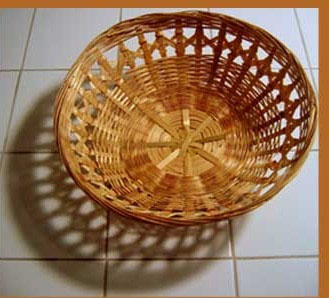
‘sending…a little work basket I made for you… Thank you for the bag and basket you sent me so prettily made and painted – I never saw my initials so beautifully adorned before, they are delicately executed.’ – Elizabeth Cristall to Georgiana Rusden, 24 October 1829 writing from East India College to Leith Hill, the school where the Rusden’s lived.
Elizabeth Cristall, godmother to Georgiana Rusden was the sister of the artist Joshua Cristall and an artist in her own right. Reciprocal handmade gifts appear throughout the correspondence of the Rusden family and they, like the baskets are of exactly the same kind of items. In the 1850s all of the Rusden women were engaged in crotchet, making cuffs for each other. These were worn at the end of sleeves and were detachable. To give exactly the same kind of present as one received would be unusual today, perhaps ill mannered, we must look closely at the relationship of the family to objects produced and given.
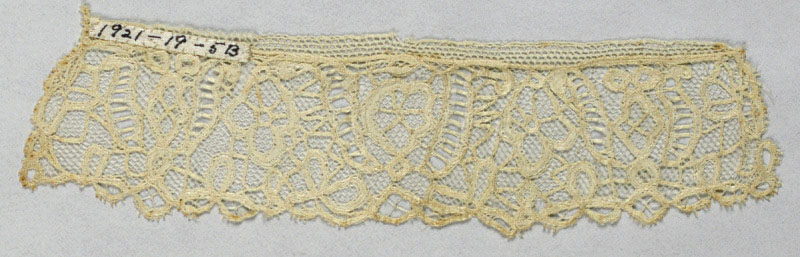
Netting and Fringing
‘I last night finished putting on the fringe to the little coverlet that I hope you like.’ – Ann Rusden to Saranna Scott, 25 March 1837.
‘I am netting fringes to scarfs for dear Amelia and for Amy Gilman to whom she is to take it when they return to England.’ – Ann Rusden to Saranna Scott, 30 December 1846.
‘I wanted to have at least netted a pair of mittens for you ‘ere this, but my fingers grow daily more thumby fied and I have not yet finished netting a purse which I began before summer commenced.’ – Scrap undated. Ann Rusden Maitland to Saranna Scott, Glendon, near Singleton.
‘Dear Mrs Mitchell wanted a pattern of a thumb of the netted mittens I make – it is so long since I made any mittens, I had forgotten my pattern and lost my card so I was very glad of Mrs Mitchell’s inquiry of it – set me upon trying to recover my knowledge. I have just succeeded or am about to prove my success in making Mrs Mitchell not a thumb only, but a pair of mittens.’ – Scrap undated, Ann Rusden to Saranna Scott.
Dried Flowers and Ferns
![Ferns, 1855-1872 / [sketchbook of drawings by Louisa Atkinson] Courtesy: State Library of New South Wales, FL1052813.](https://hunterlivinghistories.com/wp-content/uploads/2024/06/Ferns.jpg)
‘I went into the garden yesterday I gathered all of the very full- blown roses to make scent of them, I mention it because I think you would like to do the same with Glendon Roses before they fade. After you have separated the leaves from the stem, scatter them lightly on some white paper and then put pepper, salt and Allspice ground them again once or twice, add more leaves with pepper etc, between as before, after exposing them on paper to the sun for two or three days, turn the whole from the paper into a jar and keep it covered close’ – Georgiana or Rose Rusden to Saranna Scott, unsigned, 21 July 1846 [‘leaves’ are petals here]
“Splash work – Material required Indian ink, pins, dried ferns and grasses, a new comb and a tooth brush.
Take the material you wish to have the ferns on ribbon, muslin or jean, pin it on a soft board or table. Arrange your ferns in this way: Take the lightest most delicate and put them on first according to your fancy, then arrange some heavier ones over them again, leaving all their points clear from those ferns on the material if you can – then put one or two still longer or heavier ferns on top of these again. Pin them down now you have arranged the bouquet -as flat as they can be. Then tip the saucer with the ink in it slightly so that you only wet up the mesh in the thickest part of the ink.
Hold the comb in your left hand, rub the toothbrush on the teeth of the comb – if it splashes dark and fine all is well – but it is better when splashing it shows your ink is working.
Splash all over the ferns if you do not see when it is dark enough lift up a tiny leaf and see the effect – the darker it is the better it will show out – when dark enough remove your top ferns, remove none that cross over the impression of the ferns you remove, until you have splashed all over and darkened the impressions made by them – they at once appear to be at the bottom, and the least removed ferns the light ones will be at the top of your wreath, or bouquet when finished – remove the next layer of ferns and darken them also slightly, not enough to allow the last layer of the ferns you remove to show brightly at the top – it is better not to darken a fern except where it is crossed by another – so that the points of all the ferns are generally left tight and standing out on the material –
When you remove the first ferns you will find that the ferns below require a few more pins before you commence shading – if a piece of splash work is properly shaded and darkened every fern will show out distinctively whether it is shaded or light.
It requires practice – sometimes it is better you splash to protect the points or some part of the fern if it is not crossed by another fern by little pieces of paper torn off – but care must be taken not to darken so you have the impression of the paper!
I think this is all, but if anything should puzzle Mrs Dumaresq shall be very glad to try and explain it better. When you take the ferns off, dry them with a cloth and put them to press again, they will be quite nice to use again. This work looks nicer if, after it is done, you can put in the veinings of the ferns or leaves used, with a pen. Couretts mode of white or green muslin in this way are very pretty.” – Rose Selwyn, nee Rusden, papers Mitchell Library.
This is indeed difficult to follow and the ink, the toothbrush and the comb are not properly connected in the instructions. The ‘mesh’ is the toothbrush, made dark with the thickest part of the ink. The ‘points’ are the tips of the ferns. The purpose of such a production is unclear to the 21st century reader – it resembles early forms of screen printing and is not for clothing as the final fabric cannot be washed. The ‘wreath’ shows Rose’s interest in death, apparent throughout her life. These may have been church decorations.
Cabinets
![Plate 44. Mostly from Nature & on Stone by Helena Forde. [diagrams of shells] Allan & Wigley Printers, Sydney. Courtesy: State Library of New South Wales, SAFE/PX*D 5.](https://hunterlivinghistories.com/wp-content/uploads/2024/06/Shells-Collected.jpg)
Helena Forde was Augusta Scott’s granddaughter and this printed illustration of shells from the Newcastle region forms part of collections of naturalist and scientific illustration by Forde and her sister, part of the archive of materials relating to Ash Island, belonging to Walker Scott, Augusta’s son.. Note the four corners of the illustration, decorative rather than scientific.
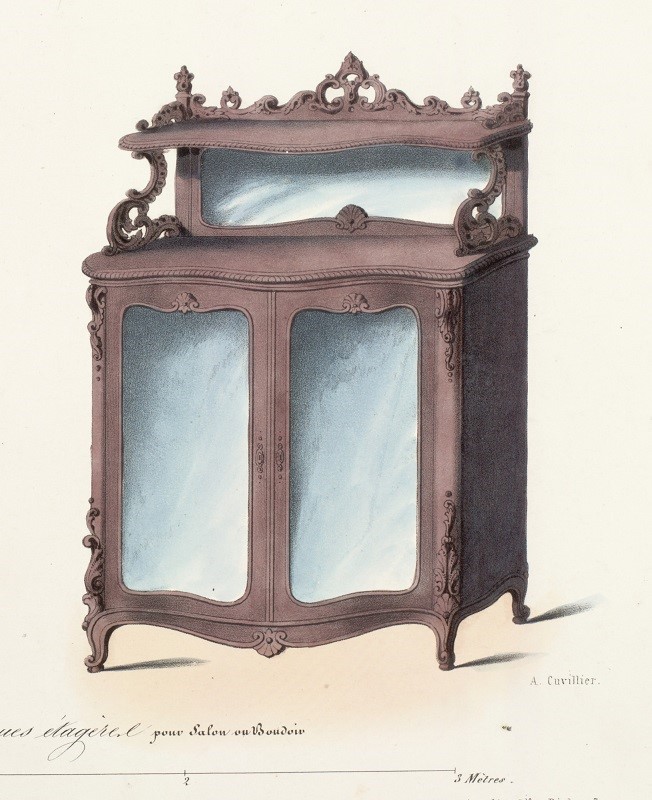
‘I shall want a receptacle for works of art as well as a cabinet for those of nature.’ – Elizabeth Cristall to Georgiana Rusden, 24 October 1829.
Elizabeth Cristall’s cabinet in 1843
‘the abundance with which my collection is now supplied will oblige me from the want of room to make periodical changes on the shelves which are glazed that all may be seen, though not all at once – there are several stones which seem crystallized but they have no labels – I shall endeavour to obtain information from a geologist who I sometimes though rarely see on the fossils, they are subjects much entered on at present and those from Australia particularly sought after to compare with those of other parts of the world to settle the question of if there are any recent creations. I have never entered into this study but the arrival of these treasures may induce one to read on it – the shells, corals, seaweeds, mosses and the beautiful vegetable world have perhaps stronger attractions, but the mineral kingdom exceeds all in its use, beauty and variety.’ – 13 Feb 1843 Lewisham, England to Georgiana Rusden at Maitland New South Wales.
Augusta Scott, senior, also owned a cabinet
‘I have got from Miss Jones some shells for you – she says they are rare and valuable. I can only say they look anything but pretty.’ – Helenus Scott senior, London, to Augusta Scott, Bath, 15 December 1817.
‘I am very obliged to Miss Jones for the shells. I beg you will take great care of them and lock them up in some drawer, as I suppose they are English, I make no doubt you find some valuable ones amongst them. If you know I have not any of this country so will be glad of them.’ – Augusta Scott, undated scrap.
‘I am much obliged to you for thinking of my minerals. Sir Korne can send me some beautiful shells if he chuses it, I do not know what the minerals are in that part of the world but I suppose they must have some. Miss Hill has got me some very fine coal marks which I had not before. I do believe I shall collect a nice cabinet in time though I do not wish for the head you mention to adorn it.’ – Augusta Scott senior, Bath to Helenus Scott Senior, London, 18 December 1817.
One can see in these accounts the importance of displaying these collected objects in order that they might be discussed by visitors. Elizabeth Cristall wanted to label her contents scientifically and sought advice on how to do so, but Augusta Scott was less concerned with accurate taxonomy. The gifts of shells, stones all described as ‘minerals’ were both exotic and English in these accounts. Articles from New South Wales would be important evidence in debates over ‘new creations’ according to Elizabeth Cristall. ‘The head’ rejected by Augusta Scott may relate to similar remains to tsantsa from Ecuador, though these were collected after 1884, Shrunken heads | Pitt Rivers Museum (ox.ac.uk)
There were exchanges of contents between cabinets:
‘Mrs Scott…has been so indulgent and liberal to offer to send me more duplicates from her cabinet.’ – Elizabeth Cristall to Georgiana Rusden, 26 July 1837. These duplicates were sent from New South Wales to England.
Collecting for the Augusta Scott’s cabinet was undertaken by family members
‘We have made a collection of the different minerals, especially rocks.’ – Helenus Scott Diary of a Journey to Bathurst.1822.
‘The Box of minerals did not come by the Brinton and from what I know of Dr Modula myself I think it will be a long time before I get it.’ – Augusta Scott, London to her son Helenus, 24 October 1823.
‘I do not know when I shall be able to get mother any minerals from Valparaiso as Mr Hill who promised them to me was about to move from where he lived.’ – Helenus Scott the younger to Patrick Scott, 26 December 1825.
‘I send you a few small shells with a yellow epidermis. I found them alive in their thousands in the gravel under huge rocks.’ – Walker Scott at Newcastle to Augusta Scott in Sydney 31 May 1837.
‘Should you wish to send your Mama some Minerals which are bulky put them into a strong made box, and plant some curious plants on top of them in earth so as to disguise it…to…have more chance of coming safe to Europe recommend the Box or chest of plants to some Medical person or some person of respectability on board ship with information they be sparingly watered.’ – Unsigned note to Helenus Scott marked ‘Private’ 1824. Women gained reputations from their collecting and specimens were highly valued.
Augusta Scott’s possessions at the time of her death included ‘Indian drawers with shelves,’ Scott Family Papers, this may have been her cabinet.
Drawing and Sketching

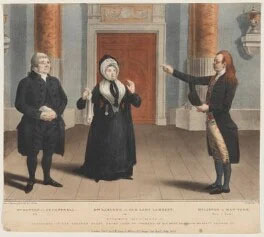
Mrs Waldron was George Keylock Rusden’s mother, ‘grandmama’ to the Rusden family.
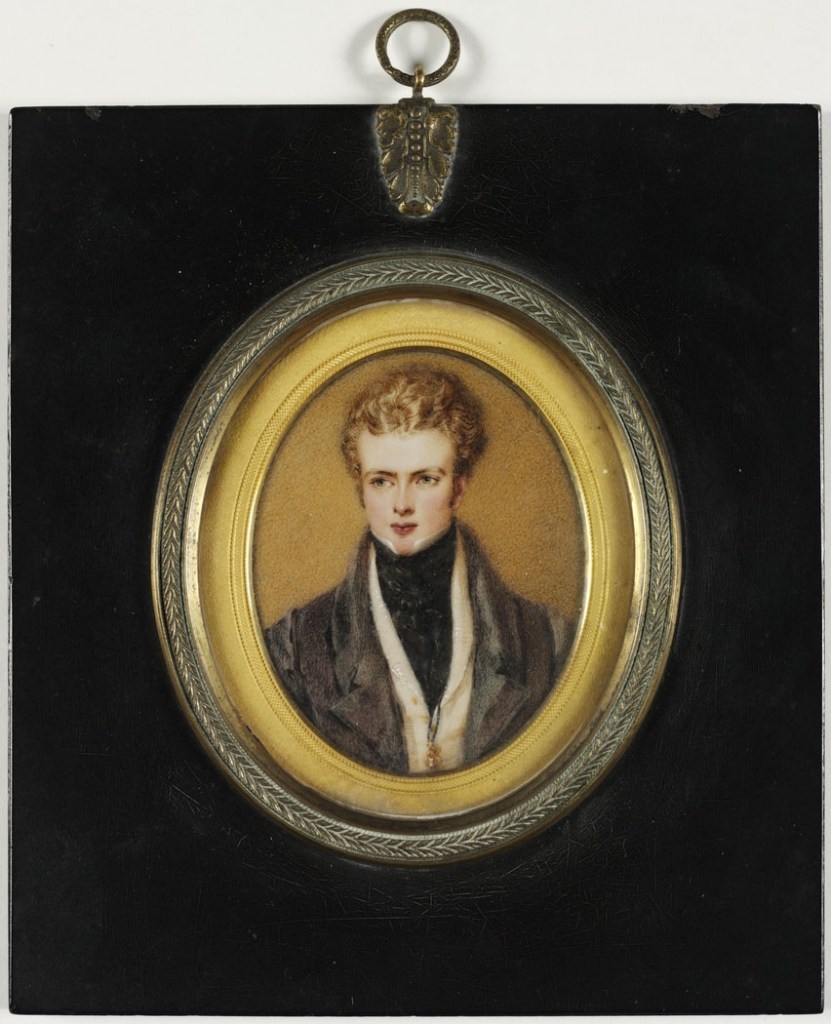
Curators note this may not be Robert, but another Scott brother. These miniatures are the ‘all of you’ above the chimney piece Augusta Scott refers to.
MIN 355 State Library of New South Wales.
This may not be Helenus but another Scott brother.
‘I have sent a table easel which I had, as I consider it to be an important point that the figure should be erect in drawing, as the health depends on the openness of the chest and I should not like to request a drawing from each of you, if it were necessary, you should not be stooped to execute it.’ – Elizabeth Cristall to Georgiana Rusden, August 1832 writing from Lewisham Hill to Leith Hill.
This gift was linked to the health of the female recipients and health was a major subject in the letters of both families, the sign of a chill or cold in men or women would result in panicked paragraphs of letters.
Sketches and portraits were also gifts. Saranna’s baby stayed with the Rusden’s ‘the drawing Grace made of baby for Mrs Mitchell was so pretty that I should have liked to deliver it.’ Ann Rusden to Saranna Scott 2 November 1837.
‘Papa [Rev G.K. Rusden] desires his best love and acknowledgements for Mr Patrick’s [Scott’s] picture, he has put it in his album till a frame is made for it.’ – Ann Rusden to Saranna Scott, 2 November 1837.
Augusta Scott initially remained in London while her husband and eldest sons travelled to New South Wales.
‘You cannot see how handsome you all look over the Chimney piece. I talk to you every day but though you look intelligent not one of you will answer me and Papa looks as cunning as ever.’ – Augusta Scott senior to her son Helenus, 7 October 1821.
The link with sentiment was expressed also by Ann Rusden when viewing a picture of Mr Laidley, ‘it is a most just and accurate representation of him – it is present to my mind’s eye as I write, and brings forcibly to my mind that benevolent countenance which beamed upon us on our first arrival in Sydney.’ Ann Rusden to Saranna Scott 15 August 1836.
Countenance and character were valued in portraits of acquaintances and family.
‘There is a portraitist in Maitland. His name is Beckles. Papa’s portrait is being taken to send to Grandmama’ Georgiana Rusden to Saranna Scott 27 March 1847.’I wrote to dear Grandmama thanking her for the picture, but I told her it was too unfavourable to be liked at first – still I’m thankful to get it – the upright figure is well given but the eyes, mouth and expression…not like her – Oh! No! for it looks cross – that she never does.’ – Ann Rusden to Saranna Scott, 1 December 1849.
‘The Bishop of New Zealand – you saw his picture when here? At first he did not strike me as like his picture – not years only, but his pious labours have made his face look thinner and older – but by degrees, as he spoke I saw the likeness to the picture – his manner is entirely simple and unpretending, that you are not prepared to expect the superior character which beams in his countenance when it is called forth by the subject on which he speaks- there is great benevolence in the expression of his mouth, as in the picture – but it was not till I heard him preach yesterday that the eye or brow evinced the force, talent and zeal which…I had been led to expect.’ – Ann Rusden to Saranna Scott, 11 November 1850. When one looked at a picture one was looking for far more than an accurate portrait, it was a kind of communion.
Drawing or sketching was also a social occasion.
‘Last night the Sanders drank tea with our friends who were much amused by their oddities, they both undertook [to sketch Augusta’s son] Walker. Edwin succeeded in a very magic sketch, though not a flattering likeness it is so much in character and countenance that everybody knows it, the others were not so good. I gave her some Chinese pencils…’ – Augusta Scott senior in London to her son Helenus in New South Wales 23 April 1823.
The Sanders were a family of artists the Scott’s called on, taking presents of pencils and paints.
‘She is quite enchanted with her China colour and she has never been able to get any of it before. She pointed at the geraniums which had been done with it.’ – Augusta to Helenus senior, 7 October 1821.
Dr Paul Jane Byrne
February 2024
Rose Selwyn – Women and Intellectual Life in New South Wales
2 thoughts on “Presents, crafts, art, and collecting in the extended Rusden family by Dr Paula Jane Byrne”