I had to date the photos myself and thanks to a few lucky coincidences I succeeded.
The State Library of Victoria and NSW photos were taken in July 1871 with one exception.
The State Library of Victoria “View of Newcastle, N.S.W. Looking S.W. from Queen’s Wharf” photo was created after the N.S.W photo of the same title.
At a guess there would only be a matter of no more than a few weeks, or a couple of months, difference between them as there is a new building near the railway station, amongst other evidence.
The clouds in the State Library of Victoria photos are different to the clouds in the State Library of NSW copies.
The clouds are just plain weird in regards to the Victorian photos.
There are another two photos in existance that are apparently not in the State Libraries collections.
Long story as to how all of the above came together.
Thanks Graeme. Do we have any idea who the photographer was that took the images? With regards to the clouds, it’s a shame we don’t have higher resolution images of the NSW photographs to compare in greater detail with the ones in Victorian custody. The images on the National Trust site were taken on an ipad or iphone from the look of them, so they are not the best quality to compare with the Victorian scans.
You also provided a list of photographers somewhere in your information posted in your website.
I do not have the time to relocate it so I will provide my notes based on newspaper adverts.
A. Smithers – 18 March 1868, 15 September 1868, 19 September 1868, 20 March 1869.
Mr. Audet – 18 March 1868
Knaggs Advertisements – 1870
American and Australian Photographic Company – 15 October 1870, 22 October 1870, 01 Novemeber 1870, 05 Novemebr 1870, 01 December 1870
J. Davies – 28 November 1871
Mr Paine – 20 September 1873
J. Leibinger – 02 April 1874, 18 March 1880
Newcastle City Council ran a photographic Competion seeking submissions of new photos.
26 November 1923, 05 January 1924.
I could have missed some articles but I did start at the first chronological Trove listing and finished at the last.
There are some very talented people in the Hunter area who seem to think history is only a hobby.
While history can be a hobby it sometimes becomes something more serious when an historic site is under threat.
Shame we could not combine these peoples gifts to present to the public our history in a more accessible form for a more “adult” purpose rather than personal recreation.
You have to admit that you posted your information 2 years ago and that I am the only person to comment to date.
Unbelievable.
Maybe you need a marketing or publicity advisor as ultimately you have to look forwards rather than being stuck looking back with no future direction.
After 34 years of studying, being part of and creating local history (when I can spare the time) there is not enough time for a tea or coffee to stop me from being tired.
My Great, Great Grandfather Jacob Audet Photographer worked in Maitland, Newcastle and Sydney.
The Newcastle Chronicle Tuesday 17 May 1870 page 3 District news.
Quote PEN-AND-INK Sketches.
We have been shown several remarkable well-executed pen and ink sketches, just executed by Mr Spong, landscape artist – the most of whose productions we have had occasion to notice lately One of the sketches is a view of the city of Newcastle, and harbour, as far up as Bullock Island, taken from the top of Nobby’s and is certainly a marvellously correct one.
This view has been photographed by Mr Audet of Hunter-street, who has produced an excellent likeness of it. Another view is that of St. John’s church and parsonage, Lake Macquarie Road, to which the artist has also done ample justice.
Unquote
Jacob Audet born 1832 died 1901
Photographer – Artist worked Maitland, Newcastle, and Sydney.
I believe these photographs the beautiful images of Newcastle are his work.
Merlin came to Newcastle in October 1870 I have no doubt that he secured the services of photographers from Newcastle and Maitland to help on the Holtermann collection at Hill End in 1872. Jacob standing to the left of Merlin and Bayliss outside the AA photographic store.
Jacob left Newcastle in 1874 after going out of business. He went to Sydney by 1879 he was at 328 George St. working or agent for the A.A. photographic company their address was 324 George St the same building. He was put out of business in 1879 and I believe his photographic work end up in the Holtermann Collection. These photographic collection sold to the state Library in 1982 bought from Harry Holtermann.
Jacob returned to Newcastle in 1880 form some years then he went back to Sydney to Live and worked at Surry Hills. Jacob’s career mentor and friend was John Rae, also an artist and photographer whom captured Newcastle scenery.
Jacob is mentioned in the Newcastle Chronicle, 18 March 1868 page 03.
“PHOTOGRAPHIC VIEWS OF THE COAL TROPHY,- We have been favoured with a sight of some views taken by our local photographers of the coal trophy at the foot of Bolton-street.
Mr Smithers has taken three distinct pictures, one giving a front view of the structure with an excellent glimpse of Stockton in the background; and the other two pictures were taken from the rear of the arch, and, in addition to the trophy itself, give a good view of the city in the back ground. These pictures are well executed and highly creditable to the operator.
Mr. Audet has also taken a capital view of the arch from the front embracing likenesses of about twenty well known gentlemen which any person acquainted with their features can immediately recognise.
At the rear of the arch the shipping is to be seen, giving the picture a very pleasing effect. This is a very clear photograph and does Mr. Audet credit as a photographic artist.
Besides this view Mr. Audit has taken pictures of the public landing of the Prince in Newcastle, in which his Royal Highness is seen just on the point of stepping into his carriage.”
Colin, if you did not already know Jacobs photograph of the Coal Trophy, taken on the 4th of March 1868, still exists.
It’s a bit rough in quality and, I apologise, I cannot remember the reference details for the copy I have.
Be interesting to see if the photos of the Prince could be found.
Okay I have had time over the weekend to do more research on the Coal Arch photographs. The paper tells us the view Jacob took and it is not the photograph in the UON collection. However there is always another lead. Here is what am thinking Jacobs view is very similar to the sketch in the Sydney illustrated news Coal Arch at Newcastle – Landing of His Royal Highness (Events of the 5th March 1868 from the illustrated Sydney News 20 April 1868 p.349.
Jacob could well have taken a photo had it typeset at the bottom and submitted it to the newspaper via The Newcastle Chronicle. The local paper is commenting on photographs and knows exactly who took what views.
I am certain Jacob’s view would have positioned his camera to show his Newcastle rifle volunteers as he had a close association with them.
Jacob was naturalised at Morpeth in 1860 and joined the Maitland Northumberland rifles, his file in Maitland Library shows he transferred to Newcastle. Jacob took photographs of the volunteers and gave his works at presentation nights 1879 is the last newspaper article in Sydney.
A carte de visite is in the NSW Library collection of Gustavus John Watehouse.
Another collection Jacobs name is a possible for the Black and White Soldiers taken in 1874 at Campbell Field near Campbell town. To date I cannot verify or find reference to him being there.
What I do know is the Newcastle and Hunter volunteers were there and left Newcastle by ship and went to the Volunteer Encampment held after Easter in May 1874.
Jacob’s youngest son Benjamin Audet went to the Boer War 1899. Known as trooper Audet.
Foot note it is a shame I cannot copy photographs to these communications.
Loading...
Colin
Sorry but I beleive you might be wrong, based on your theory, that your “grandfather” created the above photographs.
Roughly speaking the American and Australian Photographic Company (AAPC) was only recorded, by the newspapers, as carrying out its photographic project between October and December 1870.
The problem is that research in regards to the activities shown in some of the above photographs can be dated to July 1871 many months after the AAPC closed shop.
I can go into the technicals of my research if you want as there are many interesting things that can be discussed such as the two different photos (State Library of Victoria vs State Library of New South Wales collections) of the Customs House site.
The latter of the two photos shows a “shed” has been relocated, a new building completed and the foundation work for the Customs House has commenced.
This would date the latter photo to January 1871 yet the earlier photo, of the two, shows no Customs house works or additional buildings.
The strangest part of these photographs are the clouds.
6 of the photos have the same cloud formations so this would imply that the photographs were created at the same time in the photographers studio during developing and preparation for sale.
If all of the photographs were created in the studio, for sale as part of a collection/run of photographs, then the youngest datable(?) photograph would be the indicator as to the creation date/period of the actual “prints” as opposed to the creation of the “negatives”.
Basically what I am saying is the evidence shows that the “prints” were created after the AAPC had left Newcastle as the dates of some of the activities shown in this “collection/series” of prints are post AAPC visit.
I hope this helps Colin.
The following is not directed at you Colin.
Sorry if I might be confusing but I have done my research, I just have trouble getting around the complexities of the evidence.
Have you ever heard of Pandoras Box?
The story goes that everybody wants to know what is in the box but you are not supposed to look into this box as it will send you crazy with what it contains.
These photographs are in the same category as the mythical box.
To say these photos are “beautiful” is not the correct interpretation.
To acknowledge they are minutely detailed in their clarity would be more accurate recognition of the appreciation of the education value of what we see before us.
What’s the old expression … “A picture says a thousand words?”
Do not simply look at the “preety” picture read the picture as it has a story to tell.
Graeme I commend you for Blogging at 1am in the morning.
Correction Jacob ran a studio in Newcastle under the name Great Northern Photographic and Fine Art Company until 1874 in Hunter Street Newcastle.
I am interested as to why these images from both state Libraries are type set describing the pictures?
Who did the typesetting the photographic studio or the newspaper?
I am also interested as to why the local papers ran articles describing photographs when they were unable to publish them. So from a local historical point of view that is amazing. They did not have the technology.
Your appraisal of the photos says that someone with an advance technical ability was able to manipulate these photographs.
The only two people in Newcastle with advance skills were Jacob Audet and John Rae and the latter gentleman did not have a studio.
I am interested what type of camera did the photographer use. Jacob and John Rae both were skilled at sketching cameras and solar cameras?
They did not use a Pandora’s Box the Holtermann collection is a Pandora’s Box, in 1872 it was a photographer’s picnic at Hill End not Newcastle. Beside the gold rush the freelance photographers were there from Newcastle and Maitland.
Keep up the good work. I have the patience I have been doing this for 35 years.
I tried my best to “communicate” in an informed manner the story of the subject of our discussion.
If I was wasting our time “blogging” I can only say sorry for failing to act in a educational an mature manner.
I am not sure what the correct definition of blogging is but I can only assume it is something like Facebook and Twitter where most people, not all, talk about nothing and feel they have contributed to the betterment of society.
I am unaware of what studio Jacob occupied.
As to who did the typesetting, or who arranged or generated the type for text to be printed, I cannot answer that.
If the newspaper printed the text it would have been done by the newspapers “typesetter’s”.
If the photographer used a printing firm it would have been the printing firms typesetter’s.
Why did newspapers describe photographs when they were unable to publish them?
Newspapers sell news and journalists seek out and interpret stories for publishing.
The journalist primarily tells the story through the printed word and not a photograph. The photograph is a visual aid to the story being told.
Someone, with an advanced technical ability, has indeed predated digital manipulation in regards to the Holterman photographs.
Jacob and Rae were not the only photographers at the time, there was also J. Davies based on a Newcastle Chronicle advertisement in November 1871.
As to the skills of Jacob and Rae in the use of solar and sketching cameras I am a bit sketchy on these types of cameras so if you could shed some light on the subject this would remove the need to use some elbow grease in carrying out further unnessary research.
If you beleive Rae did not have a studio then how could he have created his photos without the means of preparing the glass negatives and then developing them?
Was he using a solar camera that utilised the different intensities of light to cause a chemical reaction on the negative to produce a copy of the image before him?
Was he ahead of his time in the use of the digital camera when he created and used his hand operated sketching camera.
You say you have the patience as you have been researching for 35 years but after stating that the above photographs were more than likely created by your great-great grandfather you then state “the short answer is they were not.”
You then raise further questions that have nothing to do with photography such as typesetting.
There is nothing “poetic” in wasting somebody’s time for amusement.
“Painter and professional photographer of Maitland and Newcastle, NSW from the 1860s to the 1880s. Audet’s wife Elizabeth was also a photographer and the two are presumed to have been in business together
painter and professional photographer, began his photographic career at West Maitland, New South Wales. The Maitland Ensign of 6 March 1861 noted that Audet’s Photographic Gallery had just reopened with improvements after being damaged by a storm, so he could have arrived much earlier. At this time Audet was offering ‘Portraits in every style of the Art, including Alabaster Portraits, Stereoscopic Negatives and Positives’. He also produced portraits on cloth which could be sent through the post. In 1864 Audet was advertising from his studio in High Street, Maitland, ‘that having paid a large premium for learning the art of Sennotype, he can produce a Picture for softness, delicacy, beauty and durability surpassing the most elaborately executed Ivory painting’. He also provided plain and coloured cartes-de-visite ‘taken in the newest style’ and offered a mail-order service for ‘parties in the interior’. In the Maitland Ensign of 20 January 1866 Audet claimed (inaccurately) that he was ‘the only sennotype artist in the colony’, adding that his principle was ‘a good likeness or no charge’. Advertising ‘a novelty in photography’, the diamond cameo portrait, he explained that this presented four different views of a sitter’s face and was taken with a camera he had invented himself. By 1869 he was running The Photographic and Fine Arts Gallery in Hunter Street, Newcastle. Here he again produced photographs in a variety of styles and formats: cartes-de-visite, cabinet pictures, glass pictures (ambrotypes) and stereoscopic portraits and views, as well as life-size portraits, either plain or …
Flourished
fl. c.1860 – c.1884
View the full record at Design and Art Australia Online”
Your grandfather also had some interesting opinions about Christianity, so I have read.
I would have to agree with his point in his letter to the editor.
One of my relatives dubbed Jacob “The Mystery Man”
I guess that is being polite, he did have a habit of obfuscation which make it difficult to unravel. Being a photographer he had to be a showman so I am sure some of his statements may have been inaccurate.
I am very pleased that his wife name is mentioned in this article Elizabeth or Betsey as she was known would have worked in the studio. They had a housekeeper and so it is very possible she did art work and other duties in the studios in Maitland and Newcastle. Her last occupation was a shop keeper at Mary Street Surrey hills Sydney.
“He also produced portraits on cloth which could be sent through the post.” this statement is a reference to Solar Camera work he and John Rae. It was a way of enlarging an outline that was painted. I have a sample of their work on one of my Facebook pages. There is a newspaper Advertisement about this technique.
Also the power house museum has Jacobs work a painting of William Six-smith first train driver in NSW. This was done for a presentation night in Sydney 1879.
For your entertainment yes Jacob did stand on his soap box in 1875 in Hyde Park stirring up the locals about religion he was of Jewish faith. He was an intellectual and sometimes got very discombobulated in public. His business skills did not make money and was insolvent on at least three occasions. Hence he was seldom out of the papers.
In 1855 arrived in Sydney he served as an interpreter to over 300 German immigrants on the Commodore Perry he changed his name for the voyage to Jacob Fridox age 23. There is no record of his landing, late in 1885 he was robbed in a Sydney pub and subsequently the paper ran the court proceeding. I think this encouraged his wanting to appear in the papers, because has so many Trove entries. He was robbed again in Northern NSW as a travelling photographer. He was a very self-righteous man and took to the newspaper to air his disputes. He was brilliant by being at the fore front of any new photographic technique so he suffered for his art.
.
There is nothing mysterious about somebody who asks, via a newspaper, why somebody can sell refreshments in Sydney while in Newcastle the seller would be fined under State law.
The Christians seemed to acknowledge the law banning trading on Sunday’s in Newcastle but according to your grandfather the same law was ignored by the authorities in Sydney without protest from the Christain community.
As for insolvency, my great great great grandfather was declared insolvent twice when his private school ventures failed.
He had two earlier schools that had closed but maybe the new locations were not the best choice?
When he was dying his wife basically had to beg for his final wages from the Education Department. The Department would not pay him as he had not submitted the required leave applications when he fell ill.
His eldest son, my great great grandfather died from pneumonia at the teachers residence he was supplied as a teacher. Great great grandfather had informed the Department of the Mold that had covered every wall after a recent flood but the department was a bit slow in resolving the issue.
The solar “camera” is nothing more than basically a horizontal “camera obscura” that as was not a camera but the first type of enlarger invented in the 1850’s, if I understand correctly.
The “modern” enlarger was invented in the 1870’s.
I have some information lying around but I never have the time to read it.
One of my books has the following subjects listed:
Wedgwood, Seebeck, N.de Niepce, Daguerre and Niepce, Daguerreotype process, Fox Talbot process, Calotype, Albumen on glass, Collodion process, Positive collodion process, Moist collodion process, Collodion dry plates, Alkaline developer, Othr dry plate developers, Restrainer in alkaline developer, Collodion emulsion process, Modifications in the process, Gelatin emulsion process, Gelatin emulsions, Coating the plate, Exposure, Development of plate, Intensifying negative, Varnishing negative, Sensitizing bath, Toning and fixing print, Collodiochloride emulsion, Gelatinocitrochloride emulsion, Printing with uranium salts, Worthly type, Printing with chromates, Carbon prints, Carbon tissue, Printing with carbon tissue, Printing with salts of iron, Photomechanical printing, Heliotype, Woodoury type, Photolithography, Southampton method, Papyrotype method, Photoengraving, Photography of colours, Reducing action of light, Spectrum effects on silver compounds, Dyes and sensitive films, Spectrum action on asphaltum, Spectrum action on salts of iron, Light action on uranium.
The camera:
Daguerre’s camera, Ottewill’s camera, Hare’s camera, Meagher’s Camera, Marton and Co’s camera.
These are just titles in an Encyclopedia that I never have time to read.
A bit of information in regards to Jacob being employed by or selling his business to the American Australasian Photgraphic Company. (AAPC)
You have stated that he was employed by the AAPC but you have apparently withdrawn that claim in a previous posting?
You have stated on another website that Jacob sold his photographic business to the AAPC.
I make reference to a newspaper advertisment provided by Jacob Audet on the 18th of October 1870:
“Hurrah Hurrah for native art.
No more sending the money away to Sydney for Drapery.
No more patronising intinerant photographers, who take the money away without doing any good
to the city we live in.
Oh Newcastle Necastle how long wilt thou be in learning this lesson:-
First to thiae own self be true, and, it must needs follow that all thy people will prosper, and their
houses inhabited.
Views views and likenesses likenesses good and true to be had from a citizen for years a
resident of Newcastle.
Six copies for 5s.
In substation of the above, see specimens at
Jacob Audet’s Photgraphic Gallery, Hunter Street.”
The advertisement DIRECTLY BELOW JACOBS was the second advert for the following business:
THE AMERICAN AND AUSTRALIAN PHOTOGRAPHIC COMPANY
Clearly Jacob had not been a fan of any “temporary or intinerant” competitor and clearly by his comments he would not have been employed or accepted an offer of employment by said competitors.
The fact that Jacob is advertising his business above the AAPC advert demonstrates that he had not been bought out be the AAPC.
Colin, you yourself have stated that Jacob was strong willed and this is supported by another newspaper article dated December 1870, just after the AAPC closed shop.
The article states that a Jacob Audet was charged with abusive language, 14th December, directed at a police constable.
If Jacob Audet the photographer is the same Jacob Audet who was charged then it would appear this person meant what they said when so stated.
It would appear that what was said in Jacob’s advert of the 18th of October was clear evidence that he had not sold his business to the AAPC and he would have more than likely told the AAPC to get out of town as he was going to lose business rather than profit from an out of town venture.
Your great great grandfather was a very interesting person who is worthy of being the subject of a book of based on fact not false claims of association.
I am not sure what gives you the impression that Jacob would sell his business to AAPC. you have also correctly found the newspaper article that has Jacob Jousting with the AAPC in the press.
The AAPC appointed office manager in their business such as at Maitland. They did not stay in one location very long.
Jacob worked at Hill End in 1872 he is photographed outside the AAPC office with Bayliss and Merlin. This would indicate he had a business relationship with them in some form. Jacob returned to Newcastle to Hunter street after Hill End. In 1873 Merlin died due ill health. Bayliss continued running the AAPC at what point he left Sydney I do not know.
I first came across Jacobs name associated with the AAPC back in the mid 1980’s in Sydney at the Sydney city library in the Queen Victoria building. Back then before computers you could look up the Sands directories. The Sands listing had Jacob at 328 George Street under the AAPC name. Jacob was in George street until 1879.
He was put out of business in 1879 The AAPC were at 324 George street the same building. I believe that he lost all his photographic work. some how it ended up with the Holtermann family collection.
So are we back to the Pandora’s box.
My wife and I were looking at old photographs on the UON collections and yes we both stopped the same photos and wonder if they were taken by Jacob.
Sorry but this will have to be last entry as my bulldust filter is now no longer working and have to return to real life for clean air.
11 September 2018, 8.29pm this website (HLH) records your statement:
“I am not sure what gives you the impression that Jacob would sell his business to AAPC”
10 September 2018, 8.57pm (HLH) I quote:
“Also the power house museum has Jacobs work a painting of William Sixsmith first train driver in NSW.”
Reference:
Museum of Applied Arts and Sciences website,
Australian and the Industrial Revolution – driving trains, Febuary 13, 2015 by Margarete Simpson.
Comment submitted by Colin Audet 09 June 2015, 4.13pm:
“Jacob came to Australia in 1855 then married 1859 in Sydney York St to Besty Moss.
They settled in Maitland with Jacob eventually setting up his photography studio, he eventually move the studio to Newcastle and was taken over by the American and Australasian Photographic Company. Jacob must have travelled to Hill End as some of his untitled work is in the Holtermann collection.”
Question is was he actually in Hill End?
The following newspaper articles state the following:
24 Febuary 1872 “Mr. Jacob Audet endeavoured to ask the candidate the question, which we were unable to catch, but it had reference to the Police Magistrate, whom he designated as the tyrant of Newcastle”
19 November 1872 there is a reference to arrears of rent owed, so it would appear he was still in the Newcastle area during 1872?
You have provided no reference to him being employed by AAPC at Hill End or even being at Hill End yet records show that he was in Newcastle at the beginning and end of 1872.
In reference to the Holtermann photos displayed on this website (HLH) you supplied the following:
06 September 2018, 6.12pm “Short answer, no Jacob did not take the photo in the UON (HLH) collection.”
Having stated that Jacob had not taken the photo, which was described as being that of Jacob Audet in a newspaper article, you further state:
06 September 2018, 6.12pm HLH “your appraisal of the photos says that someone with an advanced technical ability was able to manipulate these (above photos) photographs. The only two people in Newcastle with advanced skills were Jacob Audet and John Rae and the latter gentleman did not have studio.”
So having denied a photograph described as Jacobs is his you now imply the above photos were Jacobs without supporting evidence.
11 September 2018, 8.29pm HLH “My wife and I were looking at old photographs on the UON collections and yes we both stopped the same photos and wonder if they were taken by Jacob.”
“I first came across Jacob’s associated with the AAPC back in the mid 1980’s in Sydney …” “The Sands listing had Jacob at 328 George Street under the AAPC name” “the AAPC were at 324 George street the same building.” “I beleive that he lost all his photographic work, some how it ended up with the Holtermann family collection.”
So basically you found one reference in the Sands Directory in the 1980’s, pre Internet, and have implied that this is the only information you require to prove your beliefs????
You then basically accuse the Holtermann family of “acquiring” Jacobs “lost” photographs that may or may not of been created by Jacob who was listed as occupying an office, 328, under the AAPC name which is listed as being at 324?
IF Jacob had been employed by AAPC the photos would be Jacobs creations but not be Jacob’s legal property but that of his employer. He could not have lost ownership of something that was never legally his.
It would appear that if he never signed or copyrighted his work than you should stop guessing and stop making claims that you can never substantiate.
If he was employed by a company and not an independent photographer again you will never be able to prove anything as he was just another employee under the copyright or name of the employer.
I do not appreciate being stuffed about and before you ask why I have bothered to involve myself in your affairs I will put this simply.
I have no idea what you aim is but from an historians perspective the role of research is to get to the truth of a record not make it up as you go.
If people such as archeologist and historians did not challenge what they see or hear we would still be wondering how the pyramids were built as there is still no sign of the aliens who were apparently the only party advanced enough to build the pyramids.
Again I agree with some of what Jacob said in the newspapers but your story is confusing as to the apparent truth that Jacob has, based on the current evidence, nothing to do with in regards to the above photos.
Do yourself a favour and research and record Jacobs real story no matter what he did as he was quiet a character.
If you don’t I might!
“Creative writing” such as poetry will only get you so far.
The Maitland Mercury and Hunter River General Advertiser (MM)
The Newcastle Chronicle (NC)
MM 25 May 1861
ARTICLES OF THE PEACE
… Jacob Audet bound over to keep the peace.
… The complainant deposed that the defendant had used threats to him; and he was afraid that unless he were restrained by law he would do him some bodily injury. …
… The defendant was thereupon bound over to keep the peace for twelve months – himself in 20 pounds, and two sureties in 10 pounds each; in default, to be imprisoned for fourteen days.
NC 08 October 1869
ABUSIVE LANGUAGE
… Jacob Audet was convicted of using abusive language in Hunter-street … And fined 10s and 2s 6d costs.
NC 19 November 1868
THREATENING LANGUAGE
… Jacob Audet appeared, on summons, to answer the charge of having used certain threats …
… Mr Scott (judge?) said it was quite clear that the defendant had a very bitter feeling towards the compla tang, and in consequence of the malice he had displayed in court, and which, on his own showing, he had borne for twelve months, he (Mr Scott) should bind him over for a longer period than he should otherwise have done. He then ordered the defendant to find sureties to keep the peace for six months, himself in the sum of 20 pounds, and two other sureties of 10 pounds each.
Several times during the hearing of the case, Mr Scott had to call the defendant to order very sharply for the insulting way in which he refferred to the complainant, and he once threatened to commit him for contempt of court.
NC 24 December 1868
ANOTHER LIBEL ACTION
We yesterday instructed our solicitor, Mr. W. H. Mullen, to issue a Supreme Court summons against the proprietor of the “Newcastle Pilot”, for the publication of the grossly libellous letter signed “Jacob Audet” which appeared in that paper on Saturday last, and in which it is more than insinuated that the private character of the editor of this journal is much worse than that of a man named Colclough, alias “Beauty,” who is now undergoing sentence for vagrancy in Maitland gaol, and who has been repeatedly before the Newcastle Police court for various offences.
Damaged a will be laid at 500 pounds. the writ will, in all probability, be served to-day. At whatever cost, we are determined to put a stop to these unjustifiable attacks on our private character.
NC 04 March 1869
THREATENING LANGUAGE
… Jacob Audet appeared on summons to answer a charge of using profane language …
… The defendant was then bound over in his own recognisance to keep the peace for one month in the sum of 5 pounds.
NC 22 June 1869
… Edward Glaheen was charged, on remand, with assaulting Jacob Audet …
… Case dismissed.
NC 16 July 1870
PROFANE LANGUAGE
… Edmund Henry Simmons was charged with using profane language in King-street, on the 9th instant, to one Jacob Audet. The defendant pleaded not guilty. …
… The Bench dismissed the case, on the ground that no profane language had been used, within the meaning of the Act, …
NC 02 September 1871
ASSAULT.
Jacob Audet, charged with unlawfully assaulting and beating one William Croker, at Newcastle, on the 26th instant, pleaded not guilty . …
The Bench decided to hear the counter charge before coming to any decision.
After hearing the evidence in the counter charge the Bench found defendant guilt, and ordered him to pay a fine of 10s., and the costs of court – 9s. 4 d., and professional costs – 1 pound 1s., or in default seven days imprisonment in Maitland gaol.
ASSAULT
William Croker, charged with unlawfully assaulting and beating one Jacob Audet, at Neecastle, on the 26th instant, pleaded not guilty.
The complainant and the defendant agreed to let the evidence in the previous case be taken as evidence in this, and ultimately the Bench decided to dimiss the case.
INSULTING LANGUAGE
William Croker was charged with using insulting words to one Jacod Audet, in a public thoroughfare,min the 26th instant.
Complainant withdrew the charge.
Australian Town and Country Journal, 05 April 1879
INSOLVANCY COURT
Jacob Audet, of 323 and 651, George-street, photographer.
Cause of sequestration: Seizure under a bill of sale by Mr J. J. Goodwin, of Castlereagh-street, for monies advanced for stock-trade. Liabilities, 429 pounds; assets, 190 pounds. Mr. Se phill, official assignee.
Evening News, 06 January 1876
POLEMICAL GLADIATORS IN HYDE PARK.
The Bench of magistrates at the Central Police Court yesterday (summons side) were called upon to determine the merits of a theological dispute between William Stritch, Jacob Audet and James Ward.
Stritch accused Audet and Ward of using language calculated to provoke a breach of the peace, and Audet took out a summons against Stritch for a like offence.
The affair arose out of one of those theological controversies so common in Hyde Park on Sunday afternoons, and the Bench, after hearing both sides of the polemical fracat, ordered Audet and Stritch each pay a fine of 40s, with court costs, and Ward 20s and cost.
The Daily Telegraph, 22 August 1894
INFLUENZA and Consumption positively and speedily cured by Mr. Jacob Audet’s new cure.
Read what “The Dailey Telegraph” says about it in issue 21st August 94.”
Influenza cured by two inhalings, without charge.
Jacob Audet, 51 Mary-street., Surry Hills.
The Daily Telegraph 22 August 1894
INFLUENZA and Consumption positively and speedily cured by Mr. Jacob Audet’s new cure.
Read what “The Daily Telegraph” says about it in issue 21st August 94.”
Influenza cured in two inhalings, without charge.
Jacob Audet, 51 Mary street., Surry Hills.
The Newcastle Chronicle, 08 October 1869, Page 02
ABUSIVE LANGUAGE
… Jacob Audet appeared, on summons, to answer the charge of having used certain threats. …
… Mr. Scott (Judge) said it was quite clear that the defendant had a very bitter feeling towards the complainant, and in consequence of the malice he had displayed in court, and which, on his own showing,me had borne for twelve months, he (Mr Scott) should bind him over for a longer period than he should otherwise have done.mHe then ordered the defendant to find sureties to keep the peace for six months, himself in the sum of 20 pounds, and two other sureties of 10 pounds each.
Several times during the hearing of the case, Mr Scott had to call the defendant to order very sharply for the insulting way I which he referred to the complainant, and he once threatened to commit him for contempt of court.
The Newcastle Chronicle, 08 October 1869, Page 02
ABUSIVE LANGUAGE
… Jacob Audet appeared, on summons, to answer the charge of having used certain threats. …
… Mr. Scott (Judge) said it was quite clear that the defendant had a very bitter feeling towards the complainant, and in consequence of the malice he had displayed in court, and which, on his own showing,me had borne for twelve months, he (Mr Scott) should bind him over for a longer period than he should otherwise have done.mHe then ordered the defendant to find sureties to keep the peace for six months, himself in the sum of 20 pounds, and two other sureties of 10 pounds each.
Several times during the hearing of the case, Mr Scott had to call the defendant to order very sharply for the insulting way I which he referred to the complainant, and he once threatened to commit him for contempt of court.
Fresh air, free of bulldust, was productive as I compiled some facts.
Your last words!!!!! … The best words you could find, after an apparently exhaustive internet search, to conclude your story are those of Graeme Steinbeck?
You appear to quote me in an attempt to feign victory in wasting my time for amusement rather than carry out research to validate your claims in defence of your heritage.
If you found your family history only worthy of presentation for amusement and not validation then I really do not beleive I have been communicating with a relation of Jacob Audet.
Jacob Audet is not listed (Sands Directory, 1879) as having an office at 323 or 328 George street, Sydney. He is listed as being located down a passage/laneway at 651 George street.
According to a the “Australian Town and Country Journal, 05 April 1879 Jacob Audet became insolvent with liabilities of 429 pounds and assets worth 190 pounds.
Jacob is listed as being (Sands Directory, 1880) at 328 and 651 George street.
The following year (1881) he is not listed as a photographer.
There is no listing for the American and Australasian Photographic Company (AAPC) in the Sands Directories.
Charles Bayliss is listed (1879) as being at 419 and 415/419 George street
Jacob could not have been employed by the AAPC or Bayliss as his business was “not in the same building”, being 74 offices/shops away from Bayliss at 415/419 down a passageway off the street.
IF Jacob was working for Bayliss then Bayliss would have been the party who would have been insolvent in 1879, as Jacobs employer, not Jacob.
The Sands Directories are available via the Internet and only require a word/name search to find information.
Dating of photographs can be difficult and in this case the 1870’s appears reasonable. This can be further revised in the knowledge that the single storey Telegraph office in Hunter Street was built in 1861. The Post Office on the corner of Hunter & Watt Streets was built in 1872, but is not in the photographs.
The same could apply to the James Fletcher Hospital which appears in the photographs still in its military barracks form inclusive of its timber shingle roof. The sites conversion to an Asylum dates from 1871 however the masonry walls to Newcomen and part of Ordnance Streets have been built.
Therefore the photographs are early 1870’s and potentially taken in 1871.

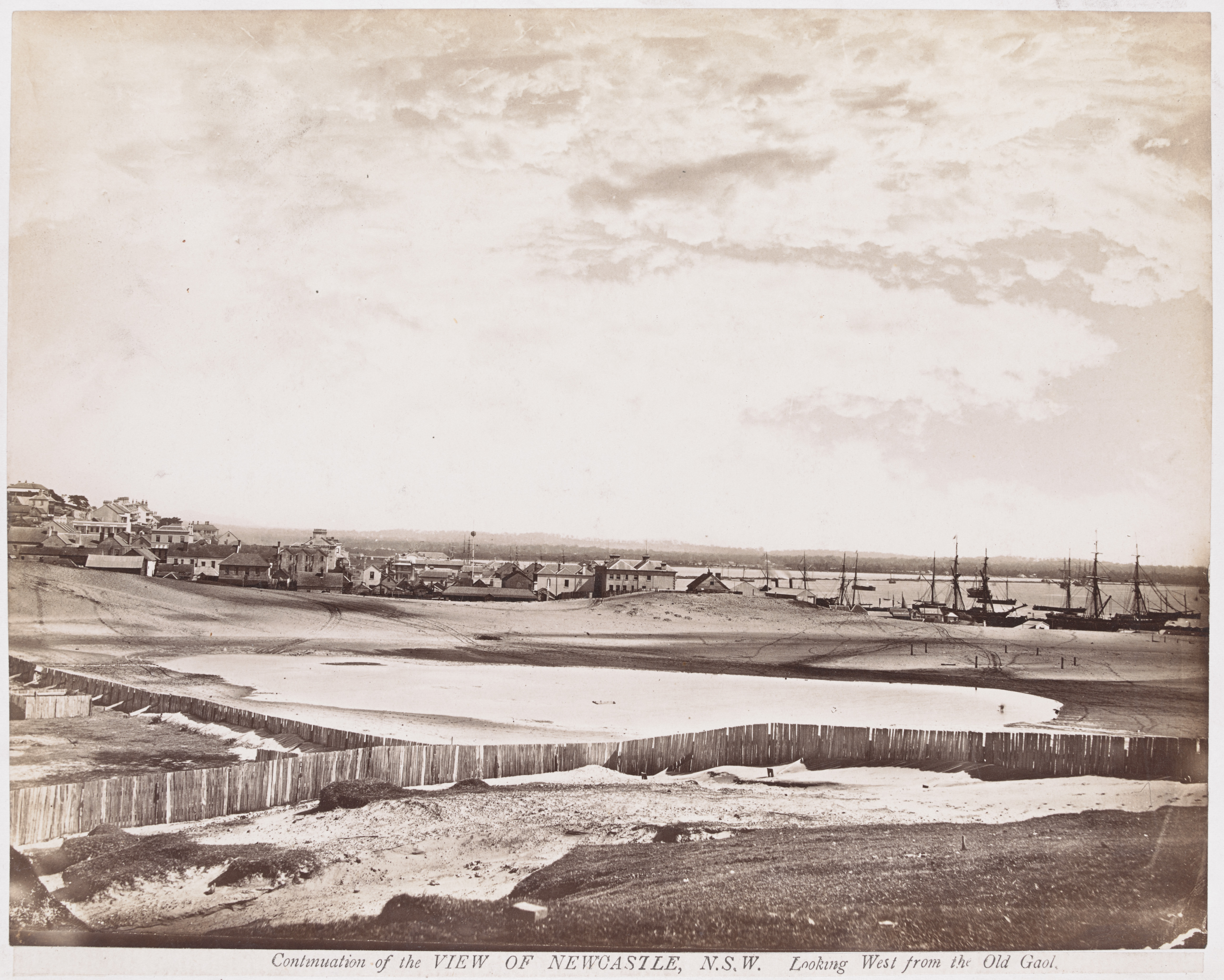

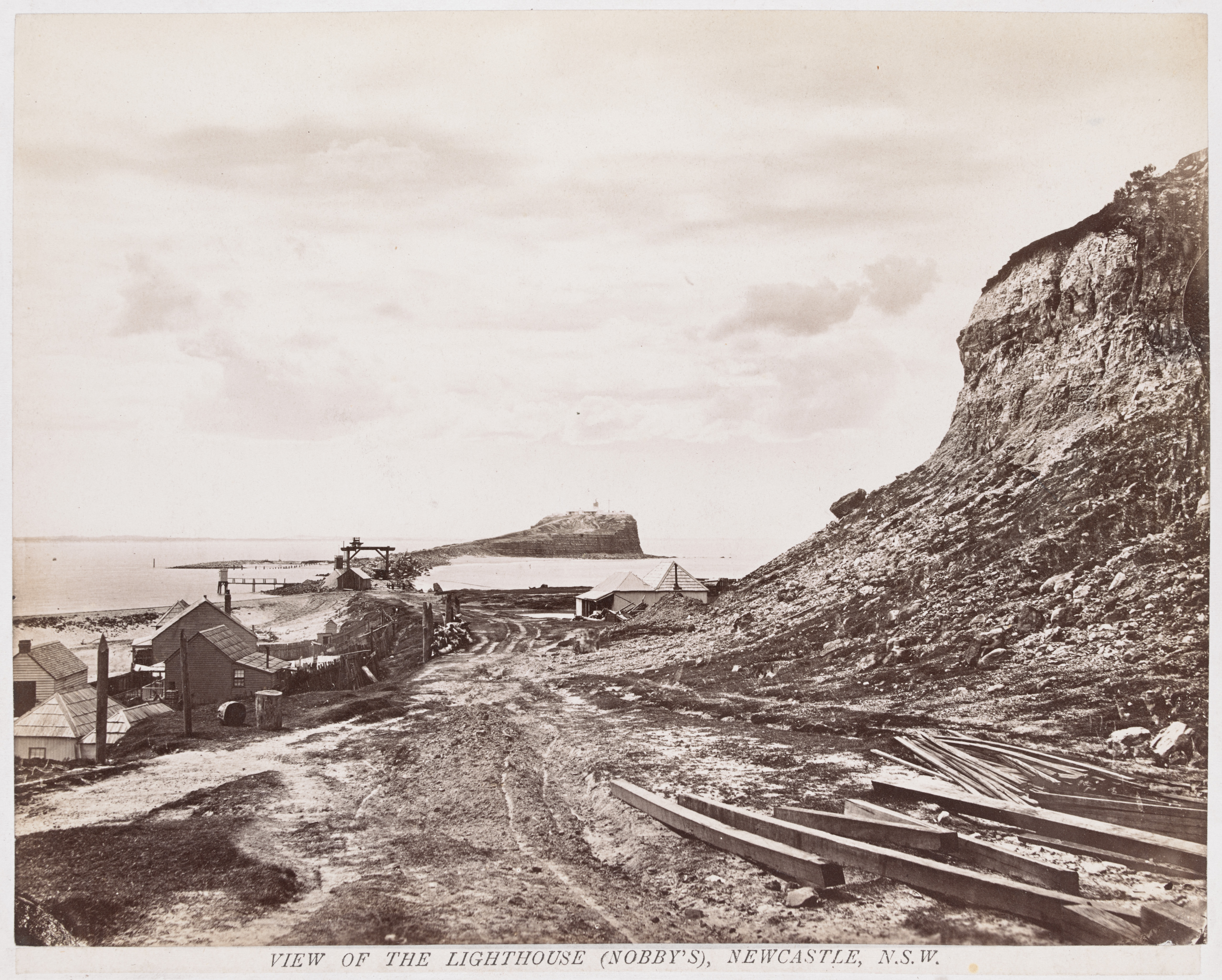
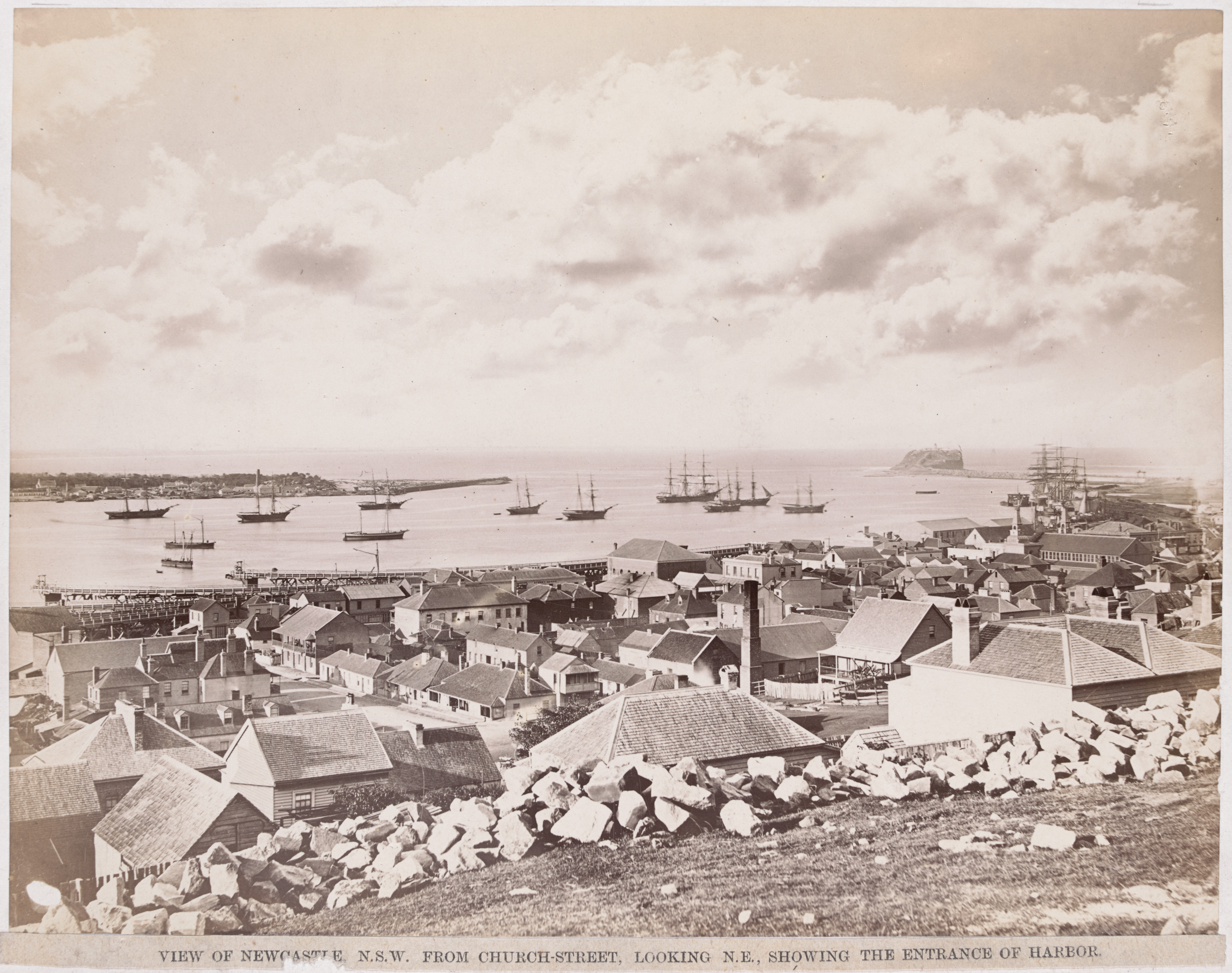


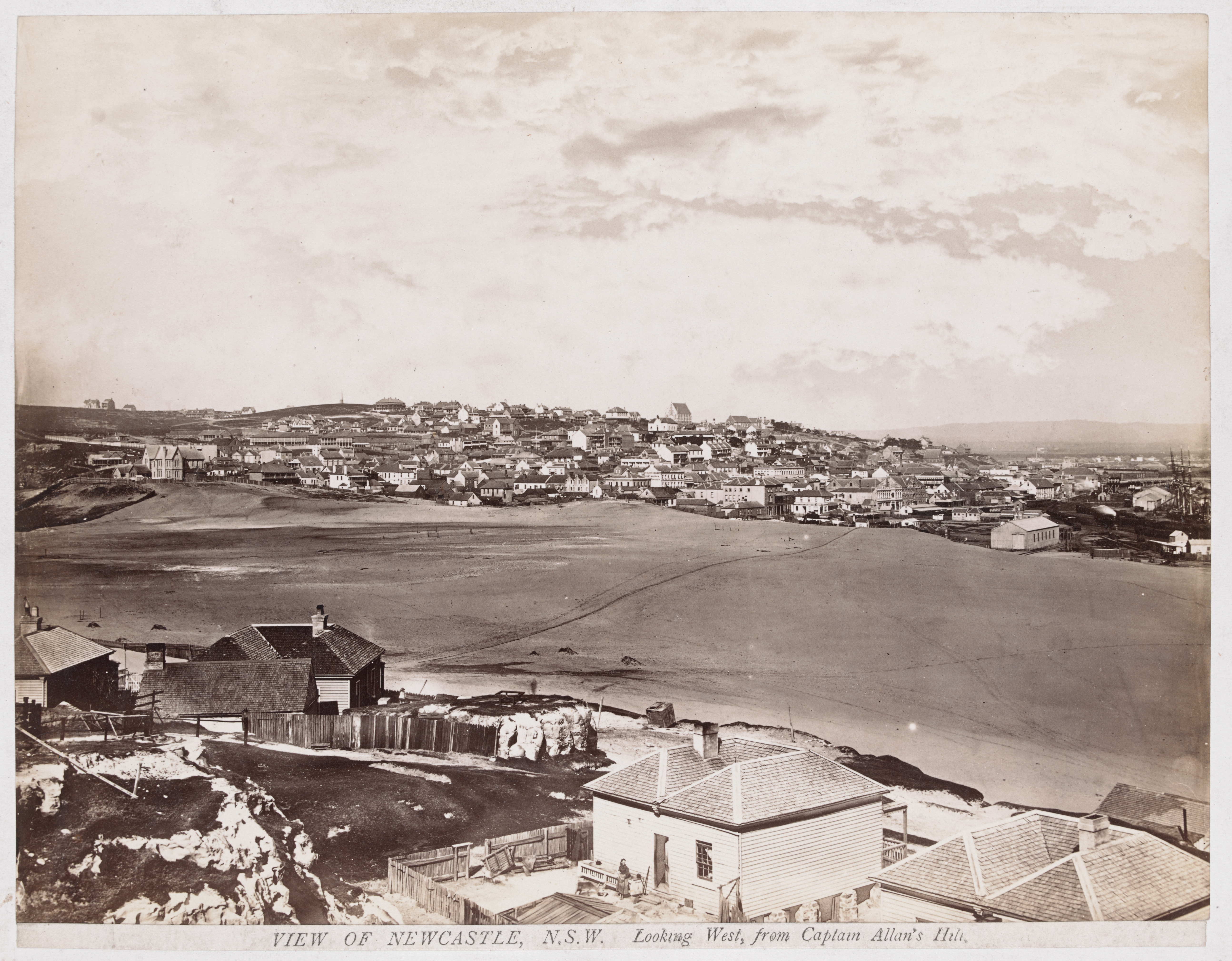

I dated these photos years ago.
Long story though. I shall see if I can find my notes.
In the mean time look at the clouds and consider that image altering computer programs did not exist in the 1870’s.
Weird is a word that you may find useful in describing what you might find.
Found my notes.
I had to date the photos myself and thanks to a few lucky coincidences I succeeded.
The State Library of Victoria and NSW photos were taken in July 1871 with one exception.
The State Library of Victoria “View of Newcastle, N.S.W. Looking S.W. from Queen’s Wharf” photo was created after the N.S.W photo of the same title.
At a guess there would only be a matter of no more than a few weeks, or a couple of months, difference between them as there is a new building near the railway station, amongst other evidence.
The clouds in the State Library of Victoria photos are different to the clouds in the State Library of NSW copies.
The clouds are just plain weird in regards to the Victorian photos.
There are another two photos in existance that are apparently not in the State Libraries collections.
Long story as to how all of the above came together.
Thanks Graeme. Do we have any idea who the photographer was that took the images? With regards to the clouds, it’s a shame we don’t have higher resolution images of the NSW photographs to compare in greater detail with the ones in Victorian custody. The images on the National Trust site were taken on an ipad or iphone from the look of them, so they are not the best quality to compare with the Victorian scans.
Apparently “you” already have some idea as to who the photographer was.
You provided a reference to this information in your posting. Some bloke called Holterman?
https://i2.wp.com/hunterlivinghistories.com/wp-content/uploads/2016/02/1875-view-newcastle-looking-west-old-gaol-h141651-slv.jpg?ssl=1
https://i2.wp.com/hunterlivinghistories.com/wp-content/uploads/2016/02/1875-continuation-of-view-newcastle-looking-w-from-old-gaol-h141653-slv.jpg?ssl=1
Put these two photos side by side and you will see what I mean about the clouds plus see Newcastle in new “panoramic” light.
I have already joined my copies of the two photos and the view is impressive.
Okay, thanks. Probably need a cup of coffee to wake up next time.
You also provided a list of photographers somewhere in your information posted in your website.
I do not have the time to relocate it so I will provide my notes based on newspaper adverts.
A. Smithers – 18 March 1868, 15 September 1868, 19 September 1868, 20 March 1869.
Mr. Audet – 18 March 1868
Knaggs Advertisements – 1870
American and Australian Photographic Company – 15 October 1870, 22 October 1870, 01 Novemeber 1870, 05 Novemebr 1870, 01 December 1870
J. Davies – 28 November 1871
Mr Paine – 20 September 1873
J. Leibinger – 02 April 1874, 18 March 1880
Newcastle City Council ran a photographic Competion seeking submissions of new photos.
26 November 1923, 05 January 1924.
I could have missed some articles but I did start at the first chronological Trove listing and finished at the last.
There are some very talented people in the Hunter area who seem to think history is only a hobby.
While history can be a hobby it sometimes becomes something more serious when an historic site is under threat.
Shame we could not combine these peoples gifts to present to the public our history in a more accessible form for a more “adult” purpose rather than personal recreation.
You have to admit that you posted your information 2 years ago and that I am the only person to comment to date.
Unbelievable.
Maybe you need a marketing or publicity advisor as ultimately you have to look forwards rather than being stuck looking back with no future direction.
After 34 years of studying, being part of and creating local history (when I can spare the time) there is not enough time for a tea or coffee to stop me from being tired.
I forgot George Freeman and his photos of the Susan Gilmore in 1884.
There are other photos by George Freeman but I cannot remember where I found them on the Internet.
Forgot Milton Kent photos from around 1927 that you had posted.
Forgot Harry Charleston, Raplh Snowball.
Just found for 1892:
C. Drinkwater
H.B. Solomon
G.C. Woolston
Eddie
J.B. Hutchinson
This is why research should never be considered final.
Always question.
My Great, Great Grandfather Jacob Audet Photographer worked in Maitland, Newcastle and Sydney.
The Newcastle Chronicle Tuesday 17 May 1870 page 3 District news.
Quote PEN-AND-INK Sketches.
We have been shown several remarkable well-executed pen and ink sketches, just executed by Mr Spong, landscape artist – the most of whose productions we have had occasion to notice lately One of the sketches is a view of the city of Newcastle, and harbour, as far up as Bullock Island, taken from the top of Nobby’s and is certainly a marvellously correct one.
This view has been photographed by Mr Audet of Hunter-street, who has produced an excellent likeness of it. Another view is that of St. John’s church and parsonage, Lake Macquarie Road, to which the artist has also done ample justice.
Unquote
Jacob Audet born 1832 died 1901
Photographer – Artist worked Maitland, Newcastle, and Sydney.
I believe these photographs the beautiful images of Newcastle are his work.
Merlin came to Newcastle in October 1870 I have no doubt that he secured the services of photographers from Newcastle and Maitland to help on the Holtermann collection at Hill End in 1872. Jacob standing to the left of Merlin and Bayliss outside the AA photographic store.
Jacob left Newcastle in 1874 after going out of business. He went to Sydney by 1879 he was at 328 George St. working or agent for the A.A. photographic company their address was 324 George St the same building. He was put out of business in 1879 and I believe his photographic work end up in the Holtermann Collection. These photographic collection sold to the state Library in 1982 bought from Harry Holtermann.
Jacob returned to Newcastle in 1880 form some years then he went back to Sydney to Live and worked at Surry Hills. Jacob’s career mentor and friend was John Rae, also an artist and photographer whom captured Newcastle scenery.
Colin Audet – East Gosford
Colin
Jacob is mentioned in the Newcastle Chronicle, 18 March 1868 page 03.
“PHOTOGRAPHIC VIEWS OF THE COAL TROPHY,- We have been favoured with a sight of some views taken by our local photographers of the coal trophy at the foot of Bolton-street.
Mr Smithers has taken three distinct pictures, one giving a front view of the structure with an excellent glimpse of Stockton in the background; and the other two pictures were taken from the rear of the arch, and, in addition to the trophy itself, give a good view of the city in the back ground. These pictures are well executed and highly creditable to the operator.
Mr. Audet has also taken a capital view of the arch from the front embracing likenesses of about twenty well known gentlemen which any person acquainted with their features can immediately recognise.
At the rear of the arch the shipping is to be seen, giving the picture a very pleasing effect. This is a very clear photograph and does Mr. Audet credit as a photographic artist.
Besides this view Mr. Audit has taken pictures of the public landing of the Prince in Newcastle, in which his Royal Highness is seen just on the point of stepping into his carriage.”
Colin, if you did not already know Jacobs photograph of the Coal Trophy, taken on the 4th of March 1868, still exists.
It’s a bit rough in quality and, I apologise, I cannot remember the reference details for the copy I have.
Be interesting to see if the photos of the Prince could be found.
Graeme the short answer, no Jacob did not take the photo in the UON collection
Hunter living Histories Coal Arch.
Graeme
Okay I have had time over the weekend to do more research on the Coal Arch photographs. The paper tells us the view Jacob took and it is not the photograph in the UON collection. However there is always another lead. Here is what am thinking Jacobs view is very similar to the sketch in the Sydney illustrated news Coal Arch at Newcastle – Landing of His Royal Highness (Events of the 5th March 1868 from the illustrated Sydney News 20 April 1868 p.349.
Jacob could well have taken a photo had it typeset at the bottom and submitted it to the newspaper via The Newcastle Chronicle. The local paper is commenting on photographs and knows exactly who took what views.
I am certain Jacob’s view would have positioned his camera to show his Newcastle rifle volunteers as he had a close association with them.
Jacob was naturalised at Morpeth in 1860 and joined the Maitland Northumberland rifles, his file in Maitland Library shows he transferred to Newcastle. Jacob took photographs of the volunteers and gave his works at presentation nights 1879 is the last newspaper article in Sydney.
A carte de visite is in the NSW Library collection of Gustavus John Watehouse.
Another collection Jacobs name is a possible for the Black and White Soldiers taken in 1874 at Campbell Field near Campbell town. To date I cannot verify or find reference to him being there.
What I do know is the Newcastle and Hunter volunteers were there and left Newcastle by ship and went to the Volunteer Encampment held after Easter in May 1874.
Jacob’s youngest son Benjamin Audet went to the Boer War 1899. Known as trooper Audet.
Foot note it is a shame I cannot copy photographs to these communications.
Colin
Sorry but I beleive you might be wrong, based on your theory, that your “grandfather” created the above photographs.
Roughly speaking the American and Australian Photographic Company (AAPC) was only recorded, by the newspapers, as carrying out its photographic project between October and December 1870.
The problem is that research in regards to the activities shown in some of the above photographs can be dated to July 1871 many months after the AAPC closed shop.
I can go into the technicals of my research if you want as there are many interesting things that can be discussed such as the two different photos (State Library of Victoria vs State Library of New South Wales collections) of the Customs House site.
The latter of the two photos shows a “shed” has been relocated, a new building completed and the foundation work for the Customs House has commenced.
This would date the latter photo to January 1871 yet the earlier photo, of the two, shows no Customs house works or additional buildings.
The strangest part of these photographs are the clouds.
6 of the photos have the same cloud formations so this would imply that the photographs were created at the same time in the photographers studio during developing and preparation for sale.
If all of the photographs were created in the studio, for sale as part of a collection/run of photographs, then the youngest datable(?) photograph would be the indicator as to the creation date/period of the actual “prints” as opposed to the creation of the “negatives”.
Basically what I am saying is the evidence shows that the “prints” were created after the AAPC had left Newcastle as the dates of some of the activities shown in this “collection/series” of prints are post AAPC visit.
I hope this helps Colin.
The following is not directed at you Colin.
Sorry if I might be confusing but I have done my research, I just have trouble getting around the complexities of the evidence.
Have you ever heard of Pandoras Box?
The story goes that everybody wants to know what is in the box but you are not supposed to look into this box as it will send you crazy with what it contains.
These photographs are in the same category as the mythical box.
To say these photos are “beautiful” is not the correct interpretation.
To acknowledge they are minutely detailed in their clarity would be more accurate recognition of the appreciation of the education value of what we see before us.
What’s the old expression … “A picture says a thousand words?”
Do not simply look at the “preety” picture read the picture as it has a story to tell.
Graeme I commend you for Blogging at 1am in the morning.
Correction Jacob ran a studio in Newcastle under the name Great Northern Photographic and Fine Art Company until 1874 in Hunter Street Newcastle.
I am interested as to why these images from both state Libraries are type set describing the pictures?
Who did the typesetting the photographic studio or the newspaper?
I am also interested as to why the local papers ran articles describing photographs when they were unable to publish them. So from a local historical point of view that is amazing. They did not have the technology.
Your appraisal of the photos says that someone with an advance technical ability was able to manipulate these photographs.
The only two people in Newcastle with advance skills were Jacob Audet and John Rae and the latter gentleman did not have a studio.
I am interested what type of camera did the photographer use. Jacob and John Rae both were skilled at sketching cameras and solar cameras?
They did not use a Pandora’s Box the Holtermann collection is a Pandora’s Box, in 1872 it was a photographer’s picnic at Hill End not Newcastle. Beside the gold rush the freelance photographers were there from Newcastle and Maitland.
Keep up the good work. I have the patience I have been doing this for 35 years.
Colin
I was not aware I was “blogging”.
I tried my best to “communicate” in an informed manner the story of the subject of our discussion.
If I was wasting our time “blogging” I can only say sorry for failing to act in a educational an mature manner.
I am not sure what the correct definition of blogging is but I can only assume it is something like Facebook and Twitter where most people, not all, talk about nothing and feel they have contributed to the betterment of society.
I am unaware of what studio Jacob occupied.
As to who did the typesetting, or who arranged or generated the type for text to be printed, I cannot answer that.
If the newspaper printed the text it would have been done by the newspapers “typesetter’s”.
If the photographer used a printing firm it would have been the printing firms typesetter’s.
Why did newspapers describe photographs when they were unable to publish them?
Newspapers sell news and journalists seek out and interpret stories for publishing.
The journalist primarily tells the story through the printed word and not a photograph. The photograph is a visual aid to the story being told.
Someone, with an advanced technical ability, has indeed predated digital manipulation in regards to the Holterman photographs.
Jacob and Rae were not the only photographers at the time, there was also J. Davies based on a Newcastle Chronicle advertisement in November 1871.
As to the skills of Jacob and Rae in the use of solar and sketching cameras I am a bit sketchy on these types of cameras so if you could shed some light on the subject this would remove the need to use some elbow grease in carrying out further unnessary research.
If you beleive Rae did not have a studio then how could he have created his photos without the means of preparing the glass negatives and then developing them?
Was he using a solar camera that utilised the different intensities of light to cause a chemical reaction on the negative to produce a copy of the image before him?
Was he ahead of his time in the use of the digital camera when he created and used his hand operated sketching camera.
You say you have the patience as you have been researching for 35 years but after stating that the above photographs were more than likely created by your great-great grandfather you then state “the short answer is they were not.”
You then raise further questions that have nothing to do with photography such as typesetting.
There is nothing “poetic” in wasting somebody’s time for amusement.
Found this: copied and pasted.
“Painter and professional photographer of Maitland and Newcastle, NSW from the 1860s to the 1880s. Audet’s wife Elizabeth was also a photographer and the two are presumed to have been in business together
painter and professional photographer, began his photographic career at West Maitland, New South Wales. The Maitland Ensign of 6 March 1861 noted that Audet’s Photographic Gallery had just reopened with improvements after being damaged by a storm, so he could have arrived much earlier. At this time Audet was offering ‘Portraits in every style of the Art, including Alabaster Portraits, Stereoscopic Negatives and Positives’. He also produced portraits on cloth which could be sent through the post. In 1864 Audet was advertising from his studio in High Street, Maitland, ‘that having paid a large premium for learning the art of Sennotype, he can produce a Picture for softness, delicacy, beauty and durability surpassing the most elaborately executed Ivory painting’. He also provided plain and coloured cartes-de-visite ‘taken in the newest style’ and offered a mail-order service for ‘parties in the interior’. In the Maitland Ensign of 20 January 1866 Audet claimed (inaccurately) that he was ‘the only sennotype artist in the colony’, adding that his principle was ‘a good likeness or no charge’. Advertising ‘a novelty in photography’, the diamond cameo portrait, he explained that this presented four different views of a sitter’s face and was taken with a camera he had invented himself. By 1869 he was running The Photographic and Fine Arts Gallery in Hunter Street, Newcastle. Here he again produced photographs in a variety of styles and formats: cartes-de-visite, cabinet pictures, glass pictures (ambrotypes) and stereoscopic portraits and views, as well as life-size portraits, either plain or …
Flourished
fl. c.1860 – c.1884
View the full record at Design and Art Australia Online”
Your grandfather also had some interesting opinions about Christianity, so I have read.
I would have to agree with his point in his letter to the editor.
One of my relatives dubbed Jacob “The Mystery Man”
I guess that is being polite, he did have a habit of obfuscation which make it difficult to unravel. Being a photographer he had to be a showman so I am sure some of his statements may have been inaccurate.
I am very pleased that his wife name is mentioned in this article Elizabeth or Betsey as she was known would have worked in the studio. They had a housekeeper and so it is very possible she did art work and other duties in the studios in Maitland and Newcastle. Her last occupation was a shop keeper at Mary Street Surrey hills Sydney.
“He also produced portraits on cloth which could be sent through the post.” this statement is a reference to Solar Camera work he and John Rae. It was a way of enlarging an outline that was painted. I have a sample of their work on one of my Facebook pages. There is a newspaper Advertisement about this technique.
Also the power house museum has Jacobs work a painting of William Six-smith first train driver in NSW. This was done for a presentation night in Sydney 1879.
For your entertainment yes Jacob did stand on his soap box in 1875 in Hyde Park stirring up the locals about religion he was of Jewish faith. He was an intellectual and sometimes got very discombobulated in public. His business skills did not make money and was insolvent on at least three occasions. Hence he was seldom out of the papers.
In 1855 arrived in Sydney he served as an interpreter to over 300 German immigrants on the Commodore Perry he changed his name for the voyage to Jacob Fridox age 23. There is no record of his landing, late in 1885 he was robbed in a Sydney pub and subsequently the paper ran the court proceeding. I think this encouraged his wanting to appear in the papers, because has so many Trove entries. He was robbed again in Northern NSW as a travelling photographer. He was a very self-righteous man and took to the newspaper to air his disputes. He was brilliant by being at the fore front of any new photographic technique so he suffered for his art.
.
There is nothing mysterious about somebody who asks, via a newspaper, why somebody can sell refreshments in Sydney while in Newcastle the seller would be fined under State law.
The Christians seemed to acknowledge the law banning trading on Sunday’s in Newcastle but according to your grandfather the same law was ignored by the authorities in Sydney without protest from the Christain community.
As for insolvency, my great great great grandfather was declared insolvent twice when his private school ventures failed.
He had two earlier schools that had closed but maybe the new locations were not the best choice?
When he was dying his wife basically had to beg for his final wages from the Education Department. The Department would not pay him as he had not submitted the required leave applications when he fell ill.
His eldest son, my great great grandfather died from pneumonia at the teachers residence he was supplied as a teacher. Great great grandfather had informed the Department of the Mold that had covered every wall after a recent flood but the department was a bit slow in resolving the issue.
The solar “camera” is nothing more than basically a horizontal “camera obscura” that as was not a camera but the first type of enlarger invented in the 1850’s, if I understand correctly.
The “modern” enlarger was invented in the 1870’s.
I have some information lying around but I never have the time to read it.
One of my books has the following subjects listed:
Wedgwood, Seebeck, N.de Niepce, Daguerre and Niepce, Daguerreotype process, Fox Talbot process, Calotype, Albumen on glass, Collodion process, Positive collodion process, Moist collodion process, Collodion dry plates, Alkaline developer, Othr dry plate developers, Restrainer in alkaline developer, Collodion emulsion process, Modifications in the process, Gelatin emulsion process, Gelatin emulsions, Coating the plate, Exposure, Development of plate, Intensifying negative, Varnishing negative, Sensitizing bath, Toning and fixing print, Collodiochloride emulsion, Gelatinocitrochloride emulsion, Printing with uranium salts, Worthly type, Printing with chromates, Carbon prints, Carbon tissue, Printing with carbon tissue, Printing with salts of iron, Photomechanical printing, Heliotype, Woodoury type, Photolithography, Southampton method, Papyrotype method, Photoengraving, Photography of colours, Reducing action of light, Spectrum effects on silver compounds, Dyes and sensitive films, Spectrum action on asphaltum, Spectrum action on salts of iron, Light action on uranium.
The camera:
Daguerre’s camera, Ottewill’s camera, Hare’s camera, Meagher’s Camera, Marton and Co’s camera.
These are just titles in an Encyclopedia that I never have time to read.
Colin
A bit of information in regards to Jacob being employed by or selling his business to the American Australasian Photgraphic Company. (AAPC)
You have stated that he was employed by the AAPC but you have apparently withdrawn that claim in a previous posting?
You have stated on another website that Jacob sold his photographic business to the AAPC.
I make reference to a newspaper advertisment provided by Jacob Audet on the 18th of October 1870:
“Hurrah Hurrah for native art.
No more sending the money away to Sydney for Drapery.
No more patronising intinerant photographers, who take the money away without doing any good
to the city we live in.
Oh Newcastle Necastle how long wilt thou be in learning this lesson:-
First to thiae own self be true, and, it must needs follow that all thy people will prosper, and their
houses inhabited.
Views views and likenesses likenesses good and true to be had from a citizen for years a
resident of Newcastle.
Six copies for 5s.
In substation of the above, see specimens at
Jacob Audet’s Photgraphic Gallery, Hunter Street.”
The advertisement DIRECTLY BELOW JACOBS was the second advert for the following business:
THE AMERICAN AND AUSTRALIAN PHOTOGRAPHIC COMPANY
Clearly Jacob had not been a fan of any “temporary or intinerant” competitor and clearly by his comments he would not have been employed or accepted an offer of employment by said competitors.
The fact that Jacob is advertising his business above the AAPC advert demonstrates that he had not been bought out be the AAPC.
Colin, you yourself have stated that Jacob was strong willed and this is supported by another newspaper article dated December 1870, just after the AAPC closed shop.
The article states that a Jacob Audet was charged with abusive language, 14th December, directed at a police constable.
If Jacob Audet the photographer is the same Jacob Audet who was charged then it would appear this person meant what they said when so stated.
It would appear that what was said in Jacob’s advert of the 18th of October was clear evidence that he had not sold his business to the AAPC and he would have more than likely told the AAPC to get out of town as he was going to lose business rather than profit from an out of town venture.
Your great great grandfather was a very interesting person who is worthy of being the subject of a book of based on fact not false claims of association.
Hi Graeme,
I am not sure what gives you the impression that Jacob would sell his business to AAPC. you have also correctly found the newspaper article that has Jacob Jousting with the AAPC in the press.
The AAPC appointed office manager in their business such as at Maitland. They did not stay in one location very long.
Jacob worked at Hill End in 1872 he is photographed outside the AAPC office with Bayliss and Merlin. This would indicate he had a business relationship with them in some form. Jacob returned to Newcastle to Hunter street after Hill End. In 1873 Merlin died due ill health. Bayliss continued running the AAPC at what point he left Sydney I do not know.
I first came across Jacobs name associated with the AAPC back in the mid 1980’s in Sydney at the Sydney city library in the Queen Victoria building. Back then before computers you could look up the Sands directories. The Sands listing had Jacob at 328 George Street under the AAPC name. Jacob was in George street until 1879.
He was put out of business in 1879 The AAPC were at 324 George street the same building. I believe that he lost all his photographic work. some how it ended up with the Holtermann family collection.
So are we back to the Pandora’s box.
My wife and I were looking at old photographs on the UON collections and yes we both stopped the same photos and wonder if they were taken by Jacob.
Sorry but this will have to be last entry as my bulldust filter is now no longer working and have to return to real life for clean air.
11 September 2018, 8.29pm this website (HLH) records your statement:
“I am not sure what gives you the impression that Jacob would sell his business to AAPC”
10 September 2018, 8.57pm (HLH) I quote:
“Also the power house museum has Jacobs work a painting of William Sixsmith first train driver in NSW.”
Reference:
Museum of Applied Arts and Sciences website,
Australian and the Industrial Revolution – driving trains, Febuary 13, 2015 by Margarete Simpson.
Comment submitted by Colin Audet 09 June 2015, 4.13pm:
“Jacob came to Australia in 1855 then married 1859 in Sydney York St to Besty Moss.
They settled in Maitland with Jacob eventually setting up his photography studio, he eventually move the studio to Newcastle and was taken over by the American and Australasian Photographic Company. Jacob must have travelled to Hill End as some of his untitled work is in the Holtermann collection.”
Question is was he actually in Hill End?
The following newspaper articles state the following:
24 Febuary 1872 “Mr. Jacob Audet endeavoured to ask the candidate the question, which we were unable to catch, but it had reference to the Police Magistrate, whom he designated as the tyrant of Newcastle”
19 November 1872 there is a reference to arrears of rent owed, so it would appear he was still in the Newcastle area during 1872?
You have provided no reference to him being employed by AAPC at Hill End or even being at Hill End yet records show that he was in Newcastle at the beginning and end of 1872.
In reference to the Holtermann photos displayed on this website (HLH) you supplied the following:
06 September 2018, 6.12pm “Short answer, no Jacob did not take the photo in the UON (HLH) collection.”
Having stated that Jacob had not taken the photo, which was described as being that of Jacob Audet in a newspaper article, you further state:
06 September 2018, 6.12pm HLH “your appraisal of the photos says that someone with an advanced technical ability was able to manipulate these (above photos) photographs. The only two people in Newcastle with advanced skills were Jacob Audet and John Rae and the latter gentleman did not have studio.”
So having denied a photograph described as Jacobs is his you now imply the above photos were Jacobs without supporting evidence.
11 September 2018, 8.29pm HLH “My wife and I were looking at old photographs on the UON collections and yes we both stopped the same photos and wonder if they were taken by Jacob.”
“I first came across Jacob’s associated with the AAPC back in the mid 1980’s in Sydney …” “The Sands listing had Jacob at 328 George Street under the AAPC name” “the AAPC were at 324 George street the same building.” “I beleive that he lost all his photographic work, some how it ended up with the Holtermann family collection.”
So basically you found one reference in the Sands Directory in the 1980’s, pre Internet, and have implied that this is the only information you require to prove your beliefs????
You then basically accuse the Holtermann family of “acquiring” Jacobs “lost” photographs that may or may not of been created by Jacob who was listed as occupying an office, 328, under the AAPC name which is listed as being at 324?
IF Jacob had been employed by AAPC the photos would be Jacobs creations but not be Jacob’s legal property but that of his employer. He could not have lost ownership of something that was never legally his.
It would appear that if he never signed or copyrighted his work than you should stop guessing and stop making claims that you can never substantiate.
If he was employed by a company and not an independent photographer again you will never be able to prove anything as he was just another employee under the copyright or name of the employer.
I do not appreciate being stuffed about and before you ask why I have bothered to involve myself in your affairs I will put this simply.
I have no idea what you aim is but from an historians perspective the role of research is to get to the truth of a record not make it up as you go.
If people such as archeologist and historians did not challenge what they see or hear we would still be wondering how the pyramids were built as there is still no sign of the aliens who were apparently the only party advanced enough to build the pyramids.
Again I agree with some of what Jacob said in the newspapers but your story is confusing as to the apparent truth that Jacob has, based on the current evidence, nothing to do with in regards to the above photos.
Do yourself a favour and research and record Jacobs real story no matter what he did as he was quiet a character.
If you don’t I might!
“Creative writing” such as poetry will only get you so far.
HI Graeme,
Here is my last words, it has given me such amusement.
New Castle Herald January 14 2014 your say Letters
Author Graeme Steinbeck
“History cannot be taken on face value, it has a soul that needs to be free”.
A painting says a thousand words, poetry is but a kaleidoscope of words. A photograph is the way to the soul and years beyond.
I wish well in all your endeavours.
The Maitland Mercury and Hunter River General Advertiser (MM)
The Newcastle Chronicle (NC)
MM 25 May 1861
ARTICLES OF THE PEACE
… Jacob Audet bound over to keep the peace.
… The complainant deposed that the defendant had used threats to him; and he was afraid that unless he were restrained by law he would do him some bodily injury. …
… The defendant was thereupon bound over to keep the peace for twelve months – himself in 20 pounds, and two sureties in 10 pounds each; in default, to be imprisoned for fourteen days.
NC 08 October 1869
ABUSIVE LANGUAGE
… Jacob Audet was convicted of using abusive language in Hunter-street … And fined 10s and 2s 6d costs.
NC 19 November 1868
THREATENING LANGUAGE
… Jacob Audet appeared, on summons, to answer the charge of having used certain threats …
… Mr Scott (judge?) said it was quite clear that the defendant had a very bitter feeling towards the compla tang, and in consequence of the malice he had displayed in court, and which, on his own showing, he had borne for twelve months, he (Mr Scott) should bind him over for a longer period than he should otherwise have done. He then ordered the defendant to find sureties to keep the peace for six months, himself in the sum of 20 pounds, and two other sureties of 10 pounds each.
Several times during the hearing of the case, Mr Scott had to call the defendant to order very sharply for the insulting way in which he refferred to the complainant, and he once threatened to commit him for contempt of court.
NC 24 December 1868
ANOTHER LIBEL ACTION
We yesterday instructed our solicitor, Mr. W. H. Mullen, to issue a Supreme Court summons against the proprietor of the “Newcastle Pilot”, for the publication of the grossly libellous letter signed “Jacob Audet” which appeared in that paper on Saturday last, and in which it is more than insinuated that the private character of the editor of this journal is much worse than that of a man named Colclough, alias “Beauty,” who is now undergoing sentence for vagrancy in Maitland gaol, and who has been repeatedly before the Newcastle Police court for various offences.
Damaged a will be laid at 500 pounds. the writ will, in all probability, be served to-day. At whatever cost, we are determined to put a stop to these unjustifiable attacks on our private character.
NC 04 March 1869
THREATENING LANGUAGE
… Jacob Audet appeared on summons to answer a charge of using profane language …
… The defendant was then bound over in his own recognisance to keep the peace for one month in the sum of 5 pounds.
NC 22 June 1869
… Edward Glaheen was charged, on remand, with assaulting Jacob Audet …
… Case dismissed.
NC 16 July 1870
PROFANE LANGUAGE
… Edmund Henry Simmons was charged with using profane language in King-street, on the 9th instant, to one Jacob Audet. The defendant pleaded not guilty. …
… The Bench dismissed the case, on the ground that no profane language had been used, within the meaning of the Act, …
NC 02 September 1871
ASSAULT.
Jacob Audet, charged with unlawfully assaulting and beating one William Croker, at Newcastle, on the 26th instant, pleaded not guilty . …
The Bench decided to hear the counter charge before coming to any decision.
After hearing the evidence in the counter charge the Bench found defendant guilt, and ordered him to pay a fine of 10s., and the costs of court – 9s. 4 d., and professional costs – 1 pound 1s., or in default seven days imprisonment in Maitland gaol.
ASSAULT
William Croker, charged with unlawfully assaulting and beating one Jacob Audet, at Neecastle, on the 26th instant, pleaded not guilty.
The complainant and the defendant agreed to let the evidence in the previous case be taken as evidence in this, and ultimately the Bench decided to dimiss the case.
INSULTING LANGUAGE
William Croker was charged with using insulting words to one Jacod Audet, in a public thoroughfare,min the 26th instant.
Complainant withdrew the charge.
Australian Town and Country Journal, 05 April 1879
INSOLVANCY COURT
Jacob Audet, of 323 and 651, George-street, photographer.
Cause of sequestration: Seizure under a bill of sale by Mr J. J. Goodwin, of Castlereagh-street, for monies advanced for stock-trade. Liabilities, 429 pounds; assets, 190 pounds. Mr. Se phill, official assignee.
Evening News, 06 January 1876
POLEMICAL GLADIATORS IN HYDE PARK.
The Bench of magistrates at the Central Police Court yesterday (summons side) were called upon to determine the merits of a theological dispute between William Stritch, Jacob Audet and James Ward.
Stritch accused Audet and Ward of using language calculated to provoke a breach of the peace, and Audet took out a summons against Stritch for a like offence.
The affair arose out of one of those theological controversies so common in Hyde Park on Sunday afternoons, and the Bench, after hearing both sides of the polemical fracat, ordered Audet and Stritch each pay a fine of 40s, with court costs, and Ward 20s and cost.
The Daily Telegraph, 22 August 1894
INFLUENZA and Consumption positively and speedily cured by Mr. Jacob Audet’s new cure.
Read what “The Dailey Telegraph” says about it in issue 21st August 94.”
Influenza cured by two inhalings, without charge.
Jacob Audet, 51 Mary-street., Surry Hills.
“The Daily Telegraph, 21 August 94”
???????????
The Daily Telegraph 22 August 1894
INFLUENZA and Consumption positively and speedily cured by Mr. Jacob Audet’s new cure.
Read what “The Daily Telegraph” says about it in issue 21st August 94.”
Influenza cured in two inhalings, without charge.
Jacob Audet, 51 Mary street., Surry Hills.
The Newcastle Chronicle, 08 October 1869, Page 02
ABUSIVE LANGUAGE
… Jacob Audet appeared, on summons, to answer the charge of having used certain threats. …
… Mr. Scott (Judge) said it was quite clear that the defendant had a very bitter feeling towards the complainant, and in consequence of the malice he had displayed in court, and which, on his own showing,me had borne for twelve months, he (Mr Scott) should bind him over for a longer period than he should otherwise have done.mHe then ordered the defendant to find sureties to keep the peace for six months, himself in the sum of 20 pounds, and two other sureties of 10 pounds each.
Several times during the hearing of the case, Mr Scott had to call the defendant to order very sharply for the insulting way I which he referred to the complainant, and he once threatened to commit him for contempt of court.
The Newcastle Chronicle, 08 October 1869, Page 02
ABUSIVE LANGUAGE
… Jacob Audet appeared, on summons, to answer the charge of having used certain threats. …
… Mr. Scott (Judge) said it was quite clear that the defendant had a very bitter feeling towards the complainant, and in consequence of the malice he had displayed in court, and which, on his own showing,me had borne for twelve months, he (Mr Scott) should bind him over for a longer period than he should otherwise have done.mHe then ordered the defendant to find sureties to keep the peace for six months, himself in the sum of 20 pounds, and two other sureties of 10 pounds each.
Several times during the hearing of the case, Mr Scott had to call the defendant to order very sharply for the insulting way I which he referred to the complainant, and he once threatened to commit him for contempt of court.
Fresh air, free of bulldust, was productive as I compiled some facts.
Your last words!!!!! … The best words you could find, after an apparently exhaustive internet search, to conclude your story are those of Graeme Steinbeck?
You appear to quote me in an attempt to feign victory in wasting my time for amusement rather than carry out research to validate your claims in defence of your heritage.
If you found your family history only worthy of presentation for amusement and not validation then I really do not beleive I have been communicating with a relation of Jacob Audet.
Jacob Audet is not listed (Sands Directory, 1879) as having an office at 323 or 328 George street, Sydney. He is listed as being located down a passage/laneway at 651 George street.
According to a the “Australian Town and Country Journal, 05 April 1879 Jacob Audet became insolvent with liabilities of 429 pounds and assets worth 190 pounds.
Jacob is listed as being (Sands Directory, 1880) at 328 and 651 George street.
The following year (1881) he is not listed as a photographer.
There is no listing for the American and Australasian Photographic Company (AAPC) in the Sands Directories.
Charles Bayliss is listed (1879) as being at 419 and 415/419 George street
Jacob could not have been employed by the AAPC or Bayliss as his business was “not in the same building”, being 74 offices/shops away from Bayliss at 415/419 down a passageway off the street.
IF Jacob was working for Bayliss then Bayliss would have been the party who would have been insolvent in 1879, as Jacobs employer, not Jacob.
The Sands Directories are available via the Internet and only require a word/name search to find information.
Dating of photographs can be difficult and in this case the 1870’s appears reasonable. This can be further revised in the knowledge that the single storey Telegraph office in Hunter Street was built in 1861. The Post Office on the corner of Hunter & Watt Streets was built in 1872, but is not in the photographs.
The same could apply to the James Fletcher Hospital which appears in the photographs still in its military barracks form inclusive of its timber shingle roof. The sites conversion to an Asylum dates from 1871 however the masonry walls to Newcomen and part of Ordnance Streets have been built.
Therefore the photographs are early 1870’s and potentially taken in 1871.