![1934 Singer 9 Sports 4 Seater Car as Constructed in Newcastle (Australia) [Re-visioned from News-clipping using ChatGPT]](https://hunterlivinghistories.com/wp-content/uploads/2026/02/1934-Singer-9-Sports-4-Seater-Car-ChatGPT.jpg)
John Sointu and Singer Car Bodies in Newcastle – a chronology (2026). Compiled by Robert Watson
Read the FREE ebook here:
https://livinghistories.newcastle.edu.au/nodes/view/119001
Introduction
In Newcastle, between 1936 and 1939, a Finnish family were making car bodies for imported British Singer car chassis. This paper presents newspaper content, in chronological order, covering their lives. The single page for March 1937 (see page 14) shows a completed car, standing in front of Newcastle Girls High School.
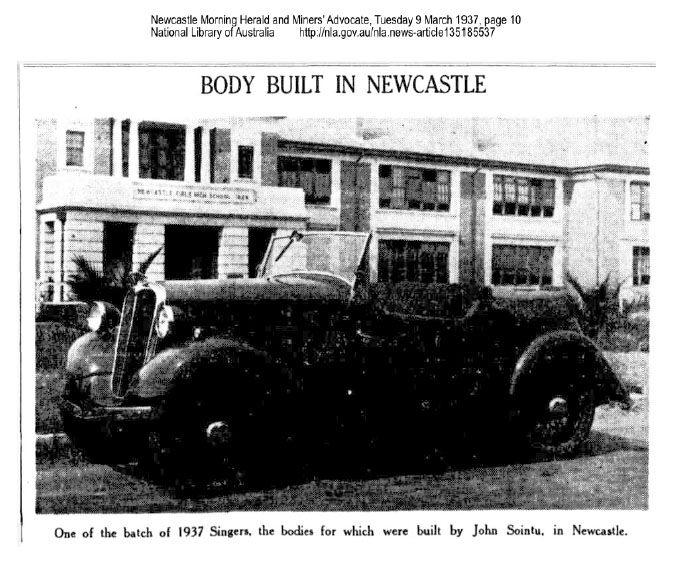
!["Body Built in Newcastle" Newcastle Morning Herald and Miners' Advocate 9 March 1937, p.10. [Re-visioned by ChatGPT]](https://hunterlivinghistories.com/wp-content/uploads/2026/02/Body-Built-In-Newcastle-NMH9March1937-p10ChatGPT.jpg)
Sointu Family Business
John Sointu, brother Veikko and cousin Ida Niemi had left Finland, lived for some years in the U.S.A. and Canada, then arrived in Australia in 1930.
In 1931, they were operating as Superior Auto Metal Works, doing car body repairs. This was in Parry Street, Newcastle, which was also where they lived.
In 1934, they made a sports car body for prominent Newcastle businessman Harry Lord. The Sointus had also achieved a reputation for making quality ambulance bodies for Buick car chassis.
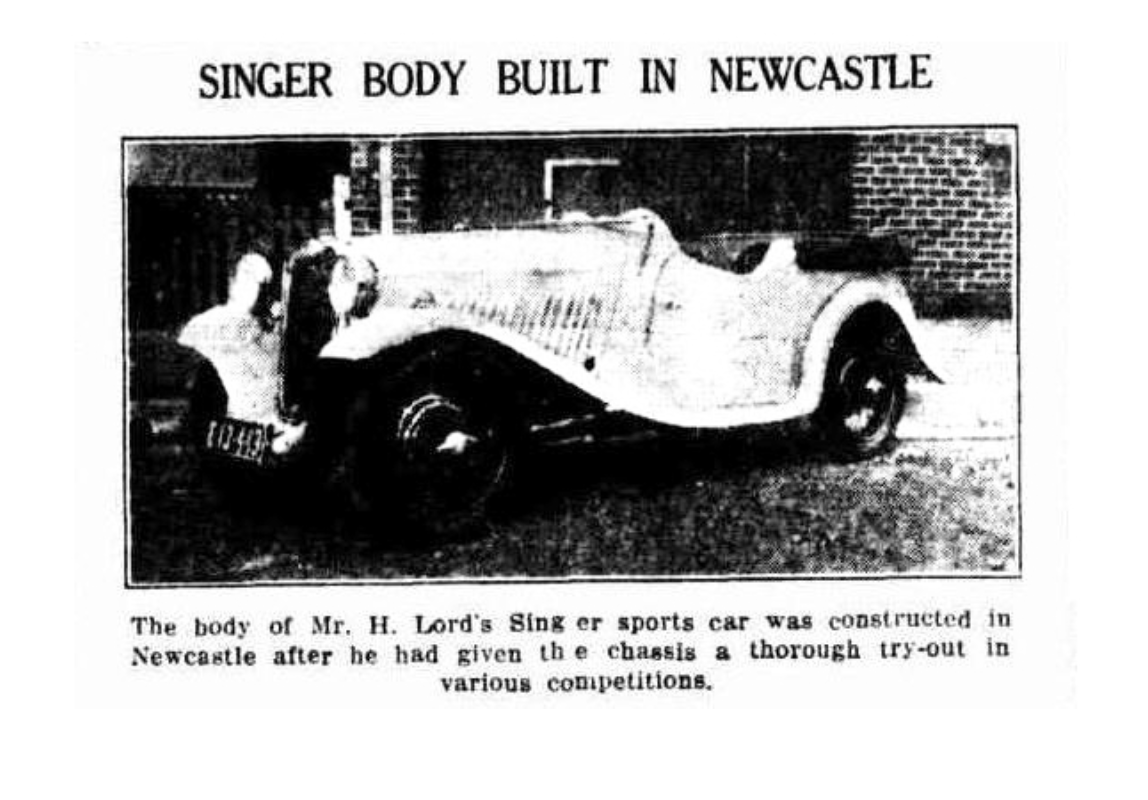
Their operation was probably small, but they had a market through the Sydney car dealer, Garratts Ltd. In 1938 they had a share issue, becoming a new registered company Superior Auto Bodies Ltd. in August 1938.
The Impact of World War 2
From 1939, newspaper references to the company disappear, so it is presumed that the approach of World War 2 impacted the market for motor vehicles.
Down the Many Rabbit Holes
This short report collects a wide variety of associated stories, other than their car body operation.
These include:
- John stole whisky from the Star Hotel
- He built ambulance bodies onto Buick chassis
- He built a sports car body onto a British Singer car for Harry Lord, a prominent businessman who was President of the Show Society, Founding President of National Park Bowling Club and President of Rotary
- Then he went into production putting bodies onto Singer chassis for a Sydney importer of Singer cars
- His young daughter submitted some jokes into the Newcastle Sun
- His wife submitted Finnish recipes into the Herald. She also wrote a piece about how Christmas is spent in Finland
- His brother was an avid racer of motorcycles
- Cousin Ida was the subject of a Women’s Column, with a good description of the work she did in the factory as well are giving insights into Finnish life
- John wrote about the Russian invasion of Finland in 1939
- Then they left Newcastle and built a Finnish-style house (and sauna) on Wallis Island, at Forster. Trove stops in 1954, but Janine Roberts (Great Lakes Shire historian) was able to fill me in of their post-Newcastle life.
Move to Wallis Island
The family group relocated to Wallis Island, near Forster N.S.W., where they built a large house – with its own sauna – which still stands today. Their Wallis Island life is described well in two stories, reproduced in the Appendices.
Read the FREE ebook here:
https://livinghistories.newcastle.edu.au/nodes/view/119001
Compiled by Robert Watson,
Community Historian,
January 2026
rgw2005@optusnet.com.au
I’m not very impressed with the inclusion of the AI images. Sure they look nice, but they give a misleading impression that this is what the cars and background actually looked like, when its just AI imagining what they looked like. The AI can’t even get the name on the building right. I’m glad to see the images clearly captioned as AI generated, but how long before images like these get displayed in a different context and presented as a real photograph? The AI attribution needs to be embedded in the image, not just included in the caption.
Thanks Lachlan and Andrew. I’m glad a discussion has opened up about this, as AI is being used quite a bit right now, and not always disclosed. It is an evolving technology, getting better and better all the time. We have been experimenting all all emerging technologies since I first got here in the archives in 1996 and have never stopped seeing what new digital tech can do for historical worlds. We have been experimenting with AI since 2024, to learn more about it, and understand its shortcomings and potential gifts. We acknowledge all uses of AI imagery, and label the images accordingly. But I’m not sure that we can stop it being used. For us, the use of AI is the latest human created tool in image creation since humans first began painting representations of figures in cave art. Everything we create, either manually through our seeing eyes, or photographically through a our seeing lens, is subject to some manipulation by us. Post processing of images, for instance, using Photoshop is used widely to enhance, and correct flaws. Faking photographs is nothing new, just look at frank Hurley’s diorama images. The rule of thumb with archives is that you always keep a copy of the original image or thing in physical form for as long as the format can be preserved. The digital likewise. Any subsequent altering is okay, as long as it is documented and you let people know what you have done, and where they can see the original if they wish to. When we enter the born digital, now things get very difficult, as we have no baseline we can really trust, especially after the advent of AI. The blockchain has provided some measure of authenticating the digital world, but the energy infrastructure for it, let along what is coming down the pipeline for AI will mean the destruction of our fresh water resources, and horrendous energy demands, not to mention the unpredictability of a machine based entity making its own decisions. So, yes, a public discussion is a good thing about all these things. BTW, the decision to use the AI images was mine, but Robert loved what was created. Our alternative was to use Photoshop to enhance the black and white grainey image from TROVE, or use one of the AI prompts to decorate the post. I was amazed at at the results. It would be good to have a discussion about all this at a future Hunter Living Histories showcase. Regards, Gionni Di Gravio
Fascinating piece of Newy history, but I have to agree with Lachlan. There are already far too many AI generated images and videos published in social media that the general public accepts without question. I think serious writing, especially on what can be gleaned about our history, needs to very clearly identify when AI is used and discuss AI limitations. Ideally, as has been done here, the source image must sit alongside the ‘re-visioned’ version.
Probably all historians manipulate images and documents. Sketching hieroglyphics from the wall of a tomb, restoring the ceiling of the Sistine Chapel, correcting the spelling of great grandmother’s name on a marriage certificate or using software to remove a crease on an old photo. Even writing a report on a newspaper article can introduce bias.
In my opinion, AI (for images) is a tool which can be used to enhance or clarify what might otherwise be something with poor quality. In the case of my Report, the research is about the people and their manufacturing works in Newcastle. The quality of the newspaper photos is of lesser importance.
Having said that, the light coloured car had been photographed in front of Newcastle Girls High School. However, AI has interpreted the pixels as “MSW Table Works Limited”. That has the potential to send a future historian into side project which wastes their time.
What I would like to see is a ‘Burra Charter of AI’. Something along the lines of “The use of AI must be acknowledged on the image” plus “The original source must be stated on the image or in the metadata.”