
Warning to Aboriginal and Torres Strait Islander People: This brief paper contains historical references to Aboriginal cultural practices ‒ but does not provide secret details about those ceremonies.
It references historical articles that contain terms or views that were considered appropriate for Australian Colonial period but no longer considered respectful to Aboriginal First Nations people. These historical articles do not reflect the views of the University or the author.
It also contains names of Aboriginal People who are deceased.
The author pays respect to all Aboriginal Elders, past, present, and emerging, and fully recognises and honours their intellectual property, knowledge, and traditions.
The author also acknowledges and respects contemporary Aboriginal Cultural Knowledge holders. This brief synopsis of historical references is for the purpose of informing discussion about the cultural astronomy and is not to be misinterpreted as a challenge to contemporary cultural belief or practice.
There are some historical records from colonists that describe what the Aboriginal People of the east coast of N.S.W. believed in, and how they viewed the world, and their responsibilities in it.
These are records of what Aboriginal People told British settlers and missionaries from the time of first or early contact in the part of Australia that felt the first full force of colonisation – the part of the east coast from Botany Bay to the Hunter River.
The historical language used by the colonists to describe Aboriginal People and their beliefs and cultural practices was often dehumanising and is difficult to read. It often involves the colonists’ biases and beliefs as well as their English word interpretation of the Aboriginal names.
For example, the British ear would record a word phonetically different than perhaps a Scottish or Irish ear hearing the same Aboriginal sound. Resulting in the same Aboriginal sound or name having a slightly different historical English spelling recorded. This is all true, but in some of these published historical public records are glimpses of a shared cosmology which the reader may find interesting.
– Leigh Budden, November 2025
Koen, Koin, Going, Gowang, Cowan, Guwiyn, Goen, Goowin, Quoin, Kon, Cooin, Koyan, Koun, Kyan:
Variant Colonist spellings of the name of the same Aboriginal Creator Ancestor?
“Kon, Koun or Koin” – Lancelot Edward Threlkeld
The above Hunter Living Histories post of 14 February 2020 titles ‘Kon, Koun or Koin – Supreme Invisible and Unknown Being of the Aboriginal Peoples of Port Stephens, Newcastle and Lake Macquarie’ – https://hunterlivinghistories.com/2020/02/14/kon/ is an excellent summary of the priceless historical account of the information shared by the Aboriginal People of Lake Macquarie with Australia’s first Missionary, the Reverend Lancelot Threlkeld.
“Koyan” – Peter M. Cunningham
It also details Scotsman and surgeon-superintendent on convict ships, Peter M. Cunningham’s recollections. He made five voyages to Port Jackson between 1819 and 1828, and in 1827 he published two volumes of his travels and experiences at Port Jackson, Port Stephens and the Hunter Valley. In it he describes the belief in a good spirit, which they call Koyan, and in an evil spirit named Potoyan, describing Potoyan as the ‘devil- devil’ .
William Scott and Percy Haslam
The HLH post also includes information on the beliefs of the Aboriginal People of Port Stephens from the reminisces of colonist William Scott and researcher Percy Haslam. But are these the only early historical records of the Creator Ancestor and spiritual beliefs of the east coast Aboriginal People? Well, no.
“Koén” – Louis-Claude Freycinet, French Explorer
There wasn’t much recorded by the members of the First Fleet, but there is an early record from the French explorer, Louis-Claude Freycinet, who visited Port Jackson in 1819.
“Knowledge astronomical. – They give a name to the sun, to the moon, to the way Milky Way and a small number of constellations, among of which we will cite the Pleiades, Sirius, and what is especially worth noting, the large and small Clouds. Perhaps in did they have called even more apparent, such as the Southern Cross, Orion; but we are unaware, in that as in many other things, what are the limits of their observations and their knowledge. The full and new moon seem be the only phases of this satellite that they have designated under names particular ; but This What is most surprising , in our opinion , is that they have subdivided the outline of the horizon into parts corresponding to the eight principal winds , namely: North, South, East, West, North-East, North-West, South-West, and the strong wind, which is most probably the South-East.”
And on beliefs of the spirit world –
“They believe even as the souls of their ancestors , in this new state, show themselves sometimes in the midst of them”
“They are convinced that the evil spirit, always willing to their harm , spy constantly the opportunity to remove them , and with them their wives and their children , to kill them . Koén is the name they him give ; and what is very remarkable is that they call the same the sun and the lightning . This one for them , it is Koén who, being in anger , produces storms frightening ; this character , they say , has the figure of a negro”
Ref: Freycinet, Louis-Claude, 1825–1839, Voyage autour du monde, entrepris par ordre du Roi, Exécutésur les corvettes de S.M. l’Uranie et la Physicienne, pendant les années 1817, 1818, 1819 et 1820, Paris, Imprimérie Royale, comprising the following volumes: Historique, tomes 1–3, 1825–1839 – see pages 758-762

“Kyan”/”Tian” – James Dunlop
A little later out at Parramatta, Scotsman James Dunlop, Government Astronomer (at Parramatta from 1821 to1827) was quoted by visiting Missionaries in 1825, who writing in their report said –
“Mr. Dunlop, the government-astronomer, an intelligent gentleman, who has seen much of the aborigines during his residence here, and on his excursions into the country, has given us some curious accounts of their notions and practices. He says that they have a superstitious idea of a being whom they call Tian, who made the sky, and the land, and the black men – who made the whites they know not. Tian appears to be a good genius, since he was the author of all the productions of the earth and sea, animal and vegetable, on which they subsist. But they also believe in the existence of an evil spirit, to whom they pay far more homage, from fear of being harmed by him, than they do to the beneficent Tian from gratitude for all the good he does them. The former, they imagine, is always going about seeking whom he may devour, like his great prototype. If a child is lost, this demon has stolen it; and, whatever calamity happens, nobody hesitates to lay it to his charge.” From James Montgomery (ed.), Journal of Voyages and Travels by the Rev. Daniel Tyerman and George Bennet, Esq. Deputed from the London Missionary Society, to visit their various stations in the South Sea Islands, China, India, &c., between the years 1821 and 1829, London, 1831, Vol. II, chapters XXXVI and XXXVII.
https://archive.org/details/journalofvoyages02tyer/page/280/mode/2up
NB – Fred McCarthy page 475 Volume 3 of ‘Artists of the Sandstone” records Dunlop referring to ‘Kyan” not ‘Tian”. Kyan may be closer to what Dunlop’s Scottish ear heard? and Tian might be a typo in the LMS report? I have been unable to substantiate this reference for Dunlop in McCarthy V3, but on page 477 of the same volume McCarthy states that “ the Kuri tribes between Appin and the Macleay River in New South Wales said that Kon’s (Koin) wife was more powerful than her husband, and she was one of several devil-devils”.
Reference: McCarthy, Frederick D. Artists of the sandstone : a description of the Aboriginal tribes inhabiting the Sydney-Hawkesbury district of New South Wales 1985: 4 volumes; illustrations, maps. Digital version available for access at AIATSIS: Call Number: MS 3495
Access Link: https://aiatsis.gov.au/form/request-collection-access
“Goen” – James Larmer
James Larmer was a government surveyor who recorded Aboriginal vocabulary in the 1830’s as he worked throughout the greater Sydney region, and in the Hunter, Central Coast and south coast of NSW.
In 1834 Larmer recorded ‘Goen’ as the Aboriginal word for ‘Devil’ among the Aboriginal People occupying Brisbane Waters and Tuggerah Beach region.
Interestingly he also recorded ‘Goen’ for the devil in his wordlist for the Language of Batemans Bay in the same year.
https://collection.sl.nsw.gov.au/record/9PQ86Okn
“Quoin” – Paddy Tighe/Henry O’Sullivan White
Paddy Tighe’s Lost Aboriginal Names of the Fixed Stars and Planets of the Hunter Region
As detailed in the excellent HLH post from 2018 titled “Paddy Tighe’s Lost Aboriginal Names of the Fixed Stars and Planets of the Hunter Region.
https://hunterlivinghistories.com/2018/01/25/paddy-tighe/
Henry O’Sullivan White, son of Government Surveyor George Boyle White delivers his recollections from the years 1848 -1850 of travelling with his father and his Aboriginal guide in the Hunter Valley and New England. In his presentation to the Maitland Scientific Society did Paddy share the name of a star ‘Quoin-belong” that literally means ‘Quoin-enters’? now written in contemporary HRLM Language as ‘Kuwiyn-pulung’.
“Paddy Tighe was a very intelligent black; he knew all the fixed stars of any magnitude as well as the planets in our hemisphere, and when to look for them at particular seasons, each having its name, but unfortunately, I cannot find the record. I have it somewhere; when it turns up I will with pleasure give the names to the Society. I remember only two – that of Venus and Antaius: the former called Tyndeema, the later Quoinbelong”
Unless the lost notebook of Henry O’Sullivan White turns up, I guess we will never know?

“Menee” – Reverend John Fraser
Reverend Dr John Fraser (1834-1904) read a paper titled “Aborigines of New South Wales” before the Royal Society in 1882 that was later published in Volume 16 of the Journal of the Proceedings of the Royal Society of N.S.W. It included a reference to the sky world and stars on page 232:
‘But the old men of the Gringai tribe [of the Hunter Valley] say that the regions “ above the sky” are the home of the spirits of the dead, and that there are fig-trees there and many other pleasant things; many men of their race are there, and that the head of them all is a great man, Menee; he is not visible, but they all agree that he is in the sky.
Menee is to them the father and king of the black races, whom he now rules and will rule in spirit-land ; he was once a mortal, but now he is a “ skeleton”—a spiritualized being, without flesh and blood.’
‘Goign’ ‘Gowang’ – Robert Hamilton Mathews
Following the publication of this paper, Rev Dr John Fraser and Robert Hamilton Mathews correspond about the beliefs and cultural practices of the Gathang speaking Gringai People of the Hunter and Manning River valleys (NB now spelt Guringai or Guringay).
And Mathews subsequently visit’s the Boydell’s’ property in the Hunter Valley to obtain information from the Gringai People who are living on their ancestral land. Mathews later publishes ‘The Keeparra ceremony of initiation’ in the Royal Anthropological Institute Journal No. 26 (1896): 320-340.
In this article he describes the male initiation ceremony of the Aboriginal People of the Hunter Valley, and Manning River regions, including the last ceremony held in Gloucester in 1889. Mathews describes ‘Goign’ presiding over the ceremony. And the quartz crystals of the old men, who are leading the ceremony, as being the excrement of Goign. At night the senior men sing ‘Goign’s song’ and the boys’ hair is singed in Goign’s fire.
R.H Mathews also publishes “The Burbung of New England Tribes’ in 1896 in which he describes ‘Goign’ presiding over the male initiation ceremony. And in his 1898 publication ‘Burbung of Koombanggary tribe’ (Gumbaynggir) – ‘Gowang’ presides over the ceremony he describes.
Menee means ‘stars’ in the Gringai Language recorded by Fraser, it is possible that this means that Goign is in the stars?
Well, it might mean this.
‘Goowindia’ – John Frederick Mann
John Frederick Mann was a surveyor and explorer who arrived in Sydney in 1842. Mann recorded Aboriginal Language from Long Dick who was the son of Bungaree and Queen Gooseberry while he was living and working in the Brisbane Waters region. Mann was a contemporary of the Lake Macquarie missionary Rev Threlkeld and owned land at Rathmines on the western side of the Lake. https://history.lakemac.com.au/narrative/4161
In Mann’s transcript “The Aboriginal names and words of the Cammeray Tribe, [between 1884-1907]” he records the word for ‘Stars’ as ‘Goowindia’ .
Goowin-dia was recorded by Reverend Threlkeld in 1855 as ‘Koun-tia’ and this word was used by his informant Biraban to explain “Koun,” the name of the Supreme Being, tia “to me”, meaning look to me, or save me (see Australian Reminiscences & Papers of L E Threlkeld Missionary to the Aborigines 1824-1859 edited by Neil Gunson 1974 V1 & 2 pp. 62-63).
A coincidence ? well maybe, but the information contained in John F Mann’s 1884 book titled “Notes on the Aborigines of Australia” https://catalogue.nla.gov.au/catalog/2239460 indicates that he was privy to the cosmology and astrology of the Aboriginal People who he described as the ‘Cammeray Tribe’. And like Henry O’Sullivan White he had misplaced his notes, but could remember at least one original cultural astronomy legend of the Aboriginal People of the Sydney basin. From page 34 of ‘Notes on the Aborigines of Australia’ by John F Mann.
“All the principal stars are named, and many queer stories or legends are told of them, as well as of the sun and moon. Unfortunately I have lost all memoranda on this subject. The Rev. Mr. McDonald read a most elaborate paper on the astronomy of the blacks before the Royal Society, which is well worthy of perusal.”
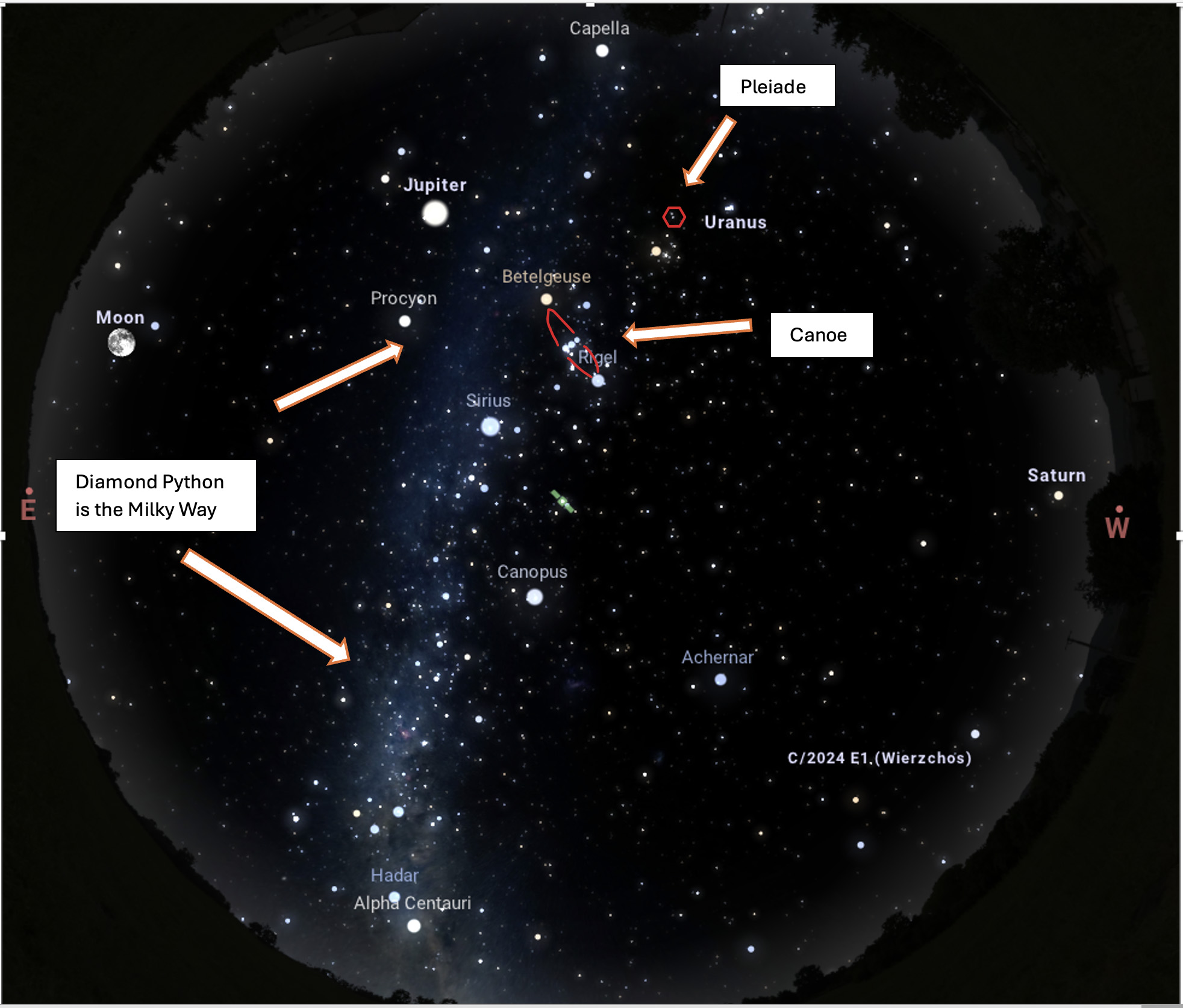
“A koradgee told me that he had a perfect recollection of the first man, who was a very old man when he was quite a boy. The first man, feeling lonely, paddled his canoe to the constellation Pleiades, the seven stars, which are inhabited solely by women, by their belief.* There he secured a wife, but refusing to pay a fee to a large serpent who had charge of these stars the serpent endeavoured to arrest him, but failing in that he hurled a large rock after him and took away the canoe. The canoe is now represented as Orion’s belt. The serpent can be traced in the milky way, and the rock, which was similar to the magellan clouds, is to be seen in the middle of a swamp or open flat somewhere. The old black was credited with having got the best of the squabble, for he retained his wife and built another canoe for himself.”
Search for the Lost Journals – The Milky Way as a Diamond Python
Wouldn’t it be exciting if Henry O’Sullivan’s lost journal, and John Frederick Mann’s lost memoranda could be found?
At least we have these two brief historical records from the Aboriginal People of the east coast of NSW that recorded Koen/Guwyin as their Creator Ancestor.
“I was talking to a young blackfellow onn one occasion, and he discoursed on what is known as the “Milk Way.” The black’s belief was that it was a big “Tonget” (diamond snake), but how it got into the heavens they apparently could not explain.”
From: Fitzpatrick, F. A. (1914) “The early Days on the Manning. Manning River Blacks and their customs in “ Peeps into the past : reminiscences of the blacks ; pioneering days on the Manning”

“The word naoi (see page 10) canoe, is also given to Orion’s belt by the aborigines. The three stars are supposed to be the three rowers who are on their way to the pleiades in search of wives.”
From page 141 of Peter MacPherson, “The Aboriginal names of rivers in Australia philologically examined.” Journal and Proceedings of the Royal Society of New South Wales 20: 113-141, 1886, quoting John F Mann.
Leigh Budden
November 2025
Just an aside. The suburb Cowan, near the Hawkesbury and Kuring-gai is said to be named after an aboriginal word for ‘big water’, or the ‘other side’. Apparently Cowan is also a Scottish word.
Thank you very much Mark for the info on the origin of the name of the Sydney suburb of Cowan. FYI – W A Miles in his 1854 paper seemed to infer that Cowan Creek in the Hawkesbury was named after “Koen”. He also indicated that the near by petroglyphs in the Kuring-gai NP may be related? see page 34 in WA Miles, ‘How did the natives of Australia become acquainted with the demigods and demonia’, Journal of the Ethnology Siciety of London, Vol 111, 1854.