This work is conducted in memory and respectfully honours the First Australian People, the Aboriginal People of this land. Warning to Aboriginal and Torres Straight Islander Peoples: This paper contains the names of Aboriginal People who are deceased.
Material Culture and Exchange at the Australian Agricultural Company Settlement, Port Stephens, 1826-1833
By Eleanor Foster, PhD Student, Trinity College, Cambridge
An interest in material culture and its exchange characterised cross-cultural interactions across many of the earliest colonial settlements. The first Australian Agricultural Company outpost, established at Carrington in Port Stephens in 1826, was no exception.
As the archaeologist and historian Isabel McBryde identified several decades ago, the
‘Exchange or trade of goods, commodities and services … [is a] neglected facet of contact history’ (McBryde, “… To Establish a Commerce of this Sort” – Cross Cultural Exchange at the Port Jackson Settlement,” in Studies from Terra Australis to Australia, 1989: 170).
These themes were significant aspects of social life in the founding years of the Australian Agricultural Company and are illustrated in the writings of two of its early protagonists: Robert Dawson, the Company’s first manager active between 1826 and 1828, and Isabella Parry, wife of Commissioner Edward Parry who lived in Port Stephens from 1829 to 1833.
The Accounts of the Carrington Settlement
Both Dawson and Parry produced vivid accounts of their time in New South Wales. They provide insight into the prominent role material culture and exchange played in the Carrington settlement and the Company’s interactions with Worimi, Guringay and Birrbay peoples on whose lands it was established.
Dawson’s 1830 publication, The Present State of Australia, is well known to historians of colonial New South Wales. He writes in a style reminiscent of colonial exploration narratives, blending the identities of an ethnographer and a diplomat while conforming to the conventions of nineteenth-century travel writing.
He wished to be seen as someone with ‘authentic’ knowledge of the Aboriginal people and their Country, claiming in the early pages of the account that:
‘I have seen more [of Aboriginal people] than any other European has done’ (Dawson, The Present State of Australia 1830: xiii).
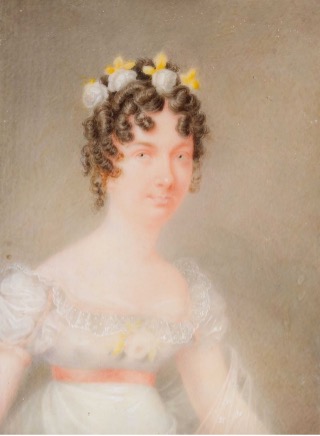
Isabella Parry
Isabella Parry wrote for a more select audience. She penned a diary and sent numerous letters to family, the Stanley’s of Alderley Park in Cheshire, that are today held in the archive of the Scott Polar Research Institute at the University of Cambridge.
The Stanley’s were a large, well-connected family that belonged to the upper echelons of imperial society.
The letters Parry sent to her family reveal her deep curiosity in the natural and material world she encountered in Port Stephens, as well as the complex and often contradictory attitudes she felt towards its inhabitants.
Robert Dawson: The Materiality of Diplomacy and Exchange
The Australian Agricultural Company was founded in 1824 by an Act of British Parliament and granted one million acres in New South Wales for the cultivation of pastoral land.
Dawson decided on the harbour around Port Stephens as the Company’s first permanent establishment and arrived with small workforce, which soon grew as the Company employed convict labour.
When Dawson arrived in the colony and began to chart a route from Newcastle to Port Stephens, he clearly understood the significance of exchange to mediating diplomatic relations.
Objects to Facilitate Diplomacy
Articles of trade had accompanied successive voyages intended to facilitate first contact between Europeans and Aboriginal people. For Governor Arthur Phillip, hatchets or tomahawks were given in politically significant meetings, and this practice continued at the garrison of King George’s Sound in 1821, and at Carrington during Dawson’s management.
Dawson likely derived his knowledge of inter-cultural diplomacy from the explorers’ accounts that saturated British print culture and fashioned himself in this guise when recounting the first meeting he had with an Aboriginal man, a guide who he gave the name Ben, who led him to Port Stephens.
Gifts for Aboriginal Guide Ben
During the journey, the men came across the schooner Dawson had sent from Sydney, and he promptly went on board to order:
‘A tomahawk and suit of slop clothes, which I had promised to my friend Ben’.
Dawson wrote that Ben was pleased with his new belongings, and,
‘Strutted about … declaring that all the harbour and country adjoining belonged to him. “I tumble down pickaninny here,” he said, meaning that he was born there. “Belonging to me all about, massa; pose you tit down here, I gib it to you”. “Budgeree,” (very good,) he replied, “I gib it to you;” and we shook hands in ratification of the friendly treaty’ (Dawson, The Present State of Australia, 1830: 12).
Dawson renders this ‘friendly treaty’ in a narrative formula recognisable to his readership. Through the act of naming Ben, then dressing him and shaking hands, Dawson takes on the role of pioneer and diplomat, aligning himself with two typologies that illuminate the political dynamics of colonial exchange relationships.
Material Exchange as Mutual Respect
Exchange as a signifier of reciprocity or mutual respect can be seen in Ben’s performance of ‘giving’ – or rather permitting – Dawson access to the land through means of clothing, a tomahawk, and a friendly handshake.
While Dawson may have understood the transaction to be symbolic of the one million acres already granted to the Company by the Crown, this encounter speaks to what anthropologist Arjun Appadurai identifies as the,
‘Constant tension … that not all parties have the same interests in any specific regime of value, nor are the interests of any two parties in any given exchange identical [emphasis in original]’ (Arjun Appadurai, ed., The Social Life of Things: Commodities in Cultural Perspective, 1986: 57).
Dawson’s Reflections
As the Carrington settlement developed, Dawson reflected that the Worimi:
‘Had become almost necessary to the families in carrying water, collecting and chopping firewood, and supplying them with fish’ (Dawson, The Present State of Australia, 1830: 26).
In exchange for these services, Worimi people received a range of European goods including food, clothing and other materials agreed to by the individuals in question.
This economy was sustained through mutual reciprocity and revolved around small-scale tasks that created a constant cycle of employment and exchange.
Cross Cultural Friendships and Caring Relationships
Cross-cultural transactions at Carrington also extended to friendships and caring roles, with Dawson describing Worimi women caring for settler children, Worimi children playing with their white counterparts, and Worimi men working alongside white men,
‘With as much cordiality as if they had … been of the same colour and nation’ (Dawson, The Present State of Australia, 1830: 30).
Dawson noted that the most sought-after European materials among the Worimi were steel fishhooks and hatchets. Dawson recalled that Ben, his Worimi guide, would visit Carrington when he ran out of,
‘Iron fishing- hooks, which the natives preferred to their own [and] was sure to wait upon me with … pearl fishing-hooks, which I received as curiosities’ (Dawson, The Present State of Australia, 1830: 308).
Aboriginal women were responsible for making fishhooks and the woven bark lines that accompanied them, as well as for fishing itself, but it was men who conducted the object exchange with settlers.

This page from the Skottowe Manuscript shows common Hunter region material culture, including a fishhook and a tomahawk fashioned with a European blade. “Native Arms,” In Select Specimens From Nature of the / Birds Animals &c &c of New South Wales, Collected and Arranged by Thomas Skottowe Esqr. The Drawings By T.R. Browne, 1813, State Library of New South Wales, SAFE / PXA 555, 55.
While fishhooks made from shell were vital tools that provided sustenance to Aboriginal people as well as the newcomers, the arrival of steel hooks introduced new categories of value. Shell hooks became objects of European ‘curiosity’ rather than solely objects of ‘labour’.
Laden with value in the eyes of men like Dawson, shell fishhooks acquired status as a signifier of authentic Aboriginal practices. Through the act of European collecting, came came to satisfy what Richard Neville identifies as the colonial ‘rage for curiosity’.
Isabella Parry: Objects of Curiosity and Colonial Morality
‘Curiosity’ was certainly a motivating factor in Isabella Parry’s exchanges with Indigenous people, and over her four years in Port Stephens, she packaged numerous parcels of stuffed birds, seeds, and Aboriginal material culture to send to her family.
Eight of these objects are today in the British Museum and were donated by the Parry’s grandson, Frederick Sydney Parry, in 1926. These include a shield, four fishhooks, and three fishing spears attributed to New South Wales.
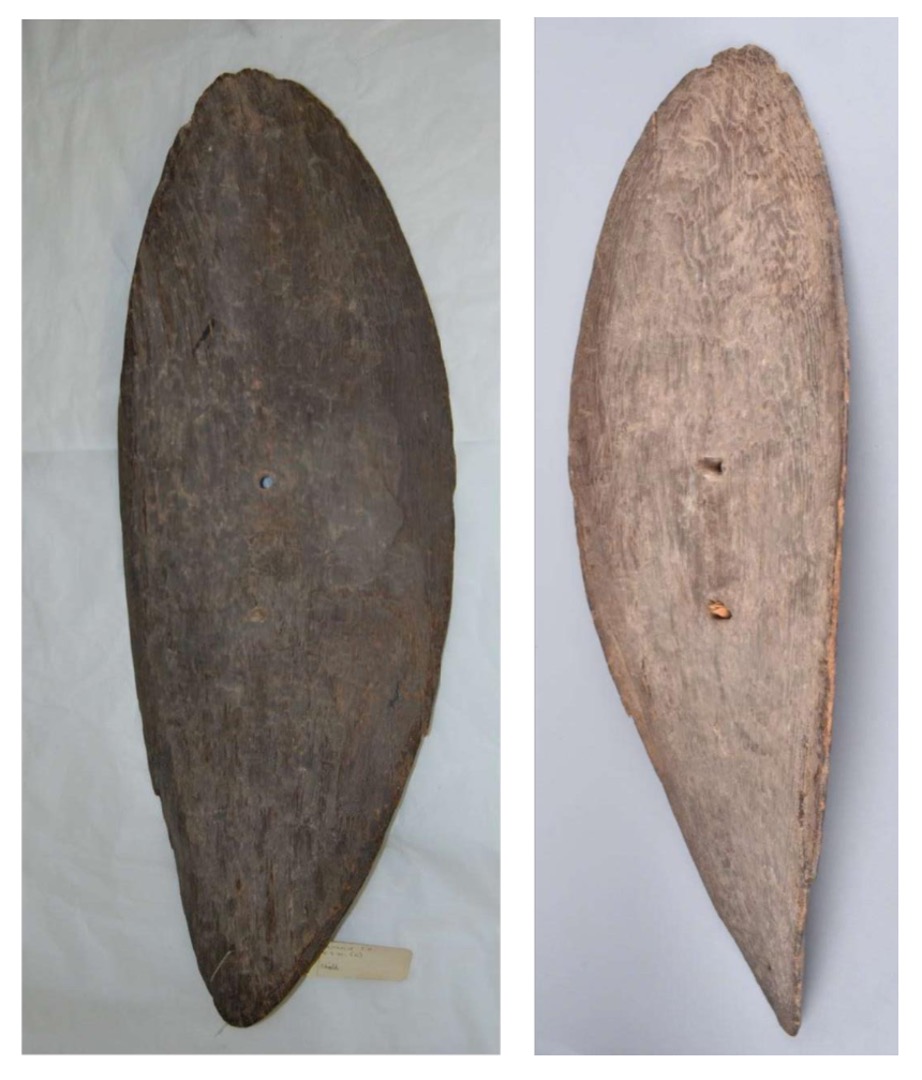
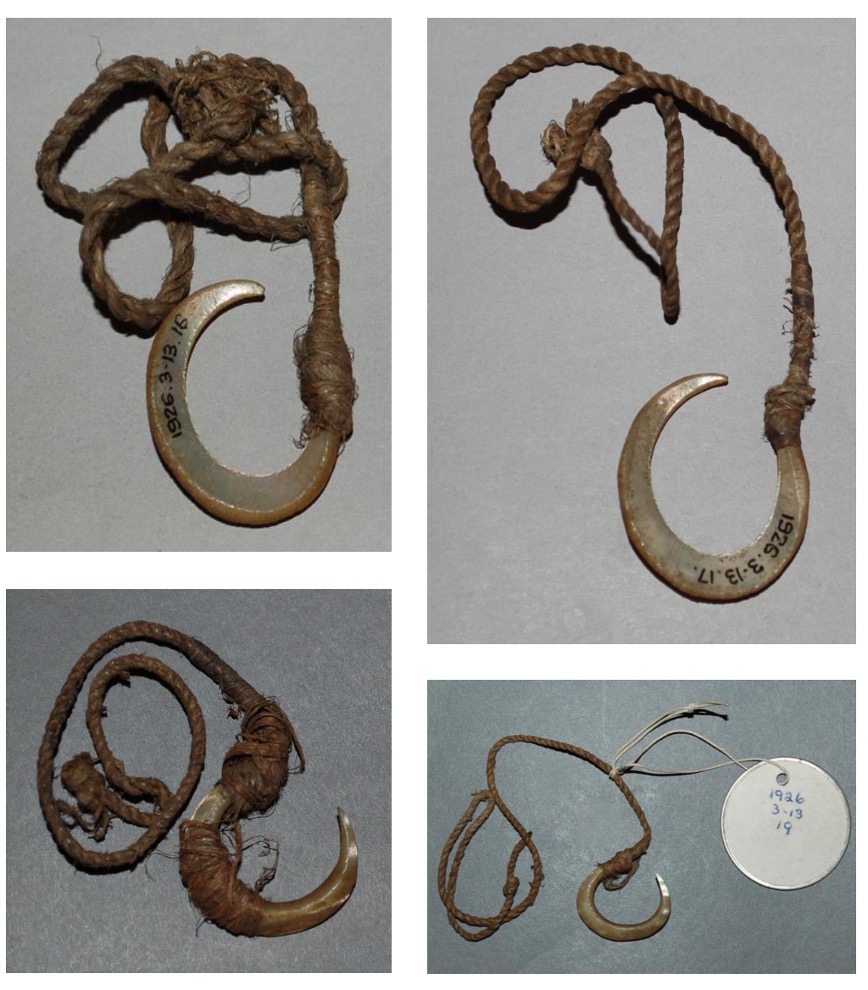
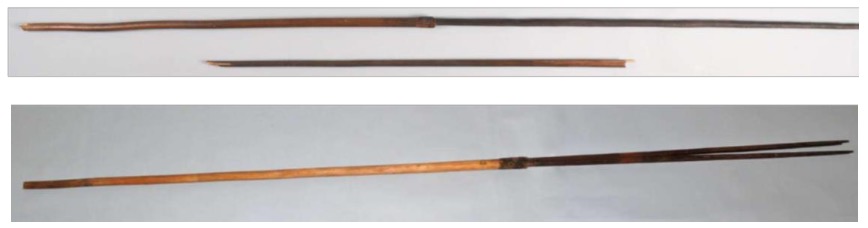
Objects donated by Sir Frederick Sydney Parry to the British Museum in 1926, from British Museum Collections Online.
As Isabella does not detail the circumstances in which she acquired these objects, it is difficult to state with certainty where and from whom they were collected.
However, as Dawson’s reflections indicate, fishhooks were common exchange items at the Port Stephens Australian Agricultural Company settlement. Fishing was also a key part of Worimi life, and indeed life for all coastal Aboriginal people.
Aboriginal Shield
The shield resembles others made by Aboriginal people of the Hunter region. It may have been collected by Isabella or Edward Parry from Port Stephens or one of the Company’s inland settlements such as Stroud or Gloucester.
Despite not leaving evidence of where the objects now in British Museum were collected from, Isabella Parry’s writings about the Worimi and life in Port Stephens are laden with an emphasis on materiality. She wrote to her mother that:
‘The little bark canoes look very picturesque paddling across the bay … I wish very much that I could take the likeness or paint groups of figures, yesterday … there was a group of blacks, sitting round a fire, with their spears and waddies’ (Letter to Maria Stanley 30 October 1830).
Aboriginal Objects
Similar descriptive accounts abound throughout Parry’s letters, constantly recalling to her family how the Worimi are dressed, and what objects they carry.
Isabella sketched some of the contents of the first package she sent to her family and took care to emphasise the pronunciation of the weapons.

1831, Scott Polar Research Institute MS.435/25/183.
The language Parry uses to describe collections are infused with uncertainty at how the objects will be received by her family as well as anxiety that their value and ‘curiosity’ be appreciated. She told her mother:
‘I have been very busy today making up the different parcels to go in our box, and I think you will be rather amused at the queer collection of articles, some of which certainly are scarcely worth sending, except that in England anything from New South Wales acquires value’ (Letter to Maria Stanley 1-5 February 1831).
Her ambivalence about the beauty of the material is qualified by acknowledgement that,
‘Their Fishhooks and nets are curious and will have an interest in the Australian Shelf’ (Letter to Maria Margaret Stanley 1 January 1831).
Source of the Curiosities
This indicates that the Stanley family already boasted a collection from Australia at their Alderley Park estate. As Isabella was the first in her family to spend time in the colony, it is probably that these objects were acquired from someone within the Stanley’s social network, or possibly via auction.
Historical anthropologist Nicholas Thomas writes of the category of ‘curiosity’ that,
‘A thing could not be considered a curiosity without reference to the knower’s intellectual and experiential desire’ (“Licensed Curiosity: Cook’s Pacific Voyages” In Samson, J. Ed. British Imperial Strategies in the Pacific, 1750-1900. New York and London: Routledge, 2003, 122).
Material Evidence of Parry’s New Surroundings
Parry sought to share objects with her family as material evidence of her new surroundings and this desire was likely matched by the Stanley’s expectation at receiving such collections.
This is clear in the anxiety Isabella exhibits in awaiting news of the package’s arrival. She writes to multiple family members for their thoughts on what she sends, asking whether,
‘The various native instruments were worth the expense of the carriage’ (Letter to Maria Stanley 23 January 1832).
Where instances of cross-cultural exchange with the Worimi do feature in Parry’s writings, it is commonly in reference to clothing.
European Dress
She notes that while Worimi women generally avoid interacting with her, they occasionally request European dress to be worn by them and their children. Parry was herself a new mother, having given birth to twins at Government House in Sydney in 1829, and leveraged this position when telling her sister:
‘The other day one of the Gins [women] came up with a little pickaninny [child] and begged me to give a cap or frock like my pickaninnys, and I wish you could have seen the little black thing jump about with delight when I gave it a small white shirt’ (Letter to Miss Louisa Stanley 15 May 1830).
While Parry does not note what, if anything, she receives in return for petticoats, she told another sister that:
‘If you were here, you would have a whole menagerie, as the black fellows constantly bring things for you to buy and if you were disposed to pay for them, you may have as many as you please’ (Letter to Harriet Scott 10 December 1832).
Though this comment refers to native birds, exchange currencies may have included material culture as a relation-building medium shared by settlers and the Worimi.
Dressing Hannah
Parry also references the act of dressing an Aboriginal child named Hannah. Hannah was just four years old and was a playmate of the Parry children. She was the daughter of Myall Tom, who appears in Dawson’s account as ‘a black constable’.
Hannah attended the school for Company children that Isabella had helped to establish in Carrington. Parry wrote that:
‘Little Black Hannah went [to school] very regularly as long as her clothes lasted, but when her little jacket which Crowther [the Parry’s maid] had made … was worn out, she would not go, being ashamed of her native dress amongst the other children. She is to be washed and dressed tomorrow in Alethea’s tunic’ (Letter to Maria Margaret Stanley 4 November 1831).
The tunic in question was a gift from Parry’s sister in England. When the Parry family received a package of clothes from Alethea, a dress that was too small for the Parry children was given to Hannah. Isabella wrote that she:
‘Expect[s] [Hannah’s] native companions will be quite jealous and beg for a blue tunic and necklace’ (Letter to Harriet Alethea Scott, 25 October 1831).
References to Hannah drop off in Parry’s writings after 1832, with Isabella’s last mention being:
‘Little black Hannah that had Aunt Alethea’s dress is a murray naughty girl and has been away from school’ (Letter to Louisa Dorothea Stanley, 31 January 1832).
Use of Local Aboriginal Terms
Parry’s use of the local term ‘murray’ to mean ‘very’ reveals her propensity to collect colonial language as well as material culture. Tellingly, she also commonly used the word ‘pickaninny’ to describe Worimi children as well as her own.
These references to Hannah and her relationship to European dress reveal the standards of colonial morality that were prevalent in the Australian Agricultural Company settlement.
While Parry is fascinated by what she calls ‘native dress’ and the traditional weapons and material culture of the Worimi, she nevertheless imposed European clothing on children as the requisite for accessing the colonial education system. When Hannah ceased to attend the Carrington school, it is possible that she was seeking to distance herself from the settlement in order to remain connected with kinship networks and the local knowledge of her community.
Facilitators of cross-cultural interaction
As the writings of Robert Dawson and Isabella Parry reveal, material culture and exchange were core facilitators of cross-cultural interaction in the early years of the Australian Agricultural Company.
Objects played an important role in diplomatic relations between settlers and the Worimi, and goods and labour were exchanged as part of the everyday functioning of the Carrington settlement.
Like in many colonial locales, Indigenous objects were desired by settlers for their status as ‘curiosities’ in Western exchange networks. Clothing too served as a measure of colonial decency, desired by Aboriginal people as well as imposed on them by the moral standards of British settlers.
The accounts of Dawson and Parry provide insight into the materiality of cross-cultural exchange in Port Stephens, enriching our understanding of social life in the Australian Agricultural Company.
Eleanor Foster
PhD Student, Department of Social Anthropology
Research Assistant, Museum of Archaeology and Anthropology
Trinity College, Cambridge
Eleanor Foster is a PhD Student in the Department of Social Anthropology at the University of Cambridge. Her research explores Indigenous Australian material culture that was collected from pastoral properties in the nineteenth century and is now held in British and European museums. She is interested in the social lives of these objects and the meanings they hold for people today.
I would be very interested to read a Worimi perspective on this article.
The first transaction made by Dawson was not the tomahawk, but the liberty of Ben. Ben was abducted by force at the suggestion of the Pilot, whilst Ben and his wife were visiting Newcastle.
“The black man whom we had thus caught, was our only guide, and it was with much reluctance that he consented to act in that capacity alone” p9 Present State of Australia.
Dawson left England with 40 employees.
It seems to me the main transaction between the locals and Dawson was to engender mutual security and a measure of respect. This occurred in both directions. Thus, Dawson played a key role in bringing to justice the white murderers of a local boy. Local men accompanied Dawson in a quest to apprehend the locals thought responsible for spearing a shepherd. In response to his approach, the locals were very helpful, indeed essential, to the survival of the settlement.
Dawson’s closeness with the locals was used by his enemies in their campaign to have him discredited. Parry adopted an entirely different approach, reducing contact and hardly referencing the locals in his writings except as messengers.
“Pickaninny” is thought to be a word derived from the Portuguese and entered usage in Australia through creole. Ben was speaking in a form of English when he used the term and I suspect it was not a local language word but an example of language adopted to facilitate communication with English speakers
Hi Stephen,
I agree – it would be wonderful and an invaluable addition.
Thanks for your comments and engagement with this post. The additional information you have shared about the relationship between Dawson and Ben and the context of abduction is very important. I agree with your analysis.
While it is true Edward Parry worked to minimise cross-cultural relations in the settlement and rarely wrote about First Nations people, there are hints in other writings (Isabella Parry’s diary and letters, and a chapter on Tommy Dumaresq in “The admiral’s wife: Mrs. Phillip Parker King, a selection of letters 1817-56”) that recall how a number of Worimi men had valued roles as guides and guards over Tahlee House, as well as messengers, during Parry’s tenure.
Thanks also for providing further insight into the etymology of “pickaninny”. In a similar vein, Isabella Parry commonly wrote about the “verandah” at Tahlee, which I believe entered colonial lexicon in much the same way.
Best wishes,
Eleanor
Thanks for your reply
The use of Dawson’s close relationship with the local people as a weapon against him is discussed by Rolls, Bairstow and others. In particular, the outbreak of venereal disease in both settler and local populations was documented and became a reason for segregation- an unwanted physical exchange.
If you don’t have them already I will attach some references which shed light on the interaction.
Benson David ed. 2015 The Present state of Karuah, Port Stephens https://aacoroad.com/2015/11/16/the-present-state-of-karuah-an-aboriginal-perspective-3/
Bairstow, D. ‘With the Best Will in the World: Some Records of Early Contact with the Gambignal on the Australian’s Company’s Estate at Port Stephens’, Aboriginal History, vol. 17, pt 1, 1993, p. 4-16
Bairstow Damaris- A Million Pounds, A Million Acres The Pioneer Settlement of the Australian Agricultural Company 2003. self published
Ramsland John. 2009 The Rainbow Beach man. the life and times of Les Ridgeway Worimi Elder . Brolga Publishing, Melbourne.
Rolls Eric 2011 A million wild acres Hale and Ironmonger Sydney
Ryan, Lyndall. “The Australian Agricultural Company, the Van Diemen’s Land Company: Labour Relations with Aboriginal Landowners, 1824–1835,” in Penelope Edmonds and Amanda Nettelbeck, eds. Intimacies of Violence in the Settler Colony: Economies of Dispossession around the Pacific Rim (New York: Palgrave, 2018), 25–43.
Scott W The Port Stephens Blacks Recollections of William Scott 1929 prepared by Gordon Bennett- Dungog Chronicle’s Office, Dungog
digitised at https://livinghistories.newcastle.edu.au/nodes/view/57773?keywords=&type=all&lsk=027febf0737aa82a28bfed7a67c1271a#idx111868