Last night (2 May 2024) two of the latest films in the Stories of Our Town series: Whibayganba: The Story of Nobbys Headland and Val Blackett: Kindness, Valour and Humour were launched at the Thirsty Messiah Brewery in Broadmeadow.
Whibayganba is the original First Nations Aboriginal name of Nobbys, Newcastle’s natural symbol and icon.
For the first time on film, the biography of Nobbys Whibayganba spanning 255 million years has been told.
Val Blackett: Kindness, Valour and Humour features the wartime experiences of a teenage gunner stationed at Newcastle and Stockton. It is the twentieth film produced by the Stories of Our Town team.
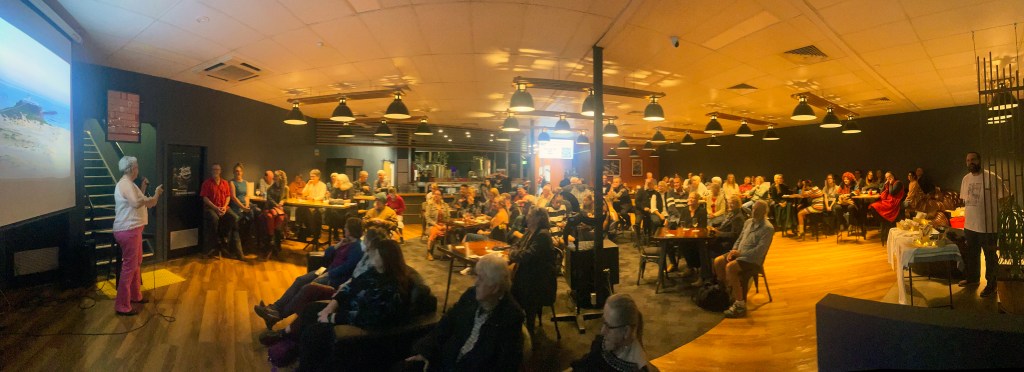
Carol Duncan speaking to her Lost Newcastle Crowd at Launch of Stories of Our Town Whibayganba and Val Blackett films at the Thirsty Messiah Brewery – 2 May 2024
“It’s our Eiffel Tower”
It is the 21st Stories of Our Town film produced by local film makers Chit Chat von Loopin Stab and Tony Whittaker, in close collaboration with Newcastle’s cultural institutions, Aboriginal scholars, academics, historians and wider communities.
“It’s our Eiffel Tower, our Harbour Bridge, our Statue of Liberty, and its history is more fascinating to us than all three,” they said
They turned their lens to Newcastle’s most recognisable icon, Nobbys Whibayganba Headland and according to them “it’s been a wild and fascinating ride.”
How to tell a 255 million year story in 31 minutes
So, how do you tell the 255 million year story in 31 minutes?
“You get EVERYONE involved.” – said Chit Chat (a.k.a. Glenn Dormand)
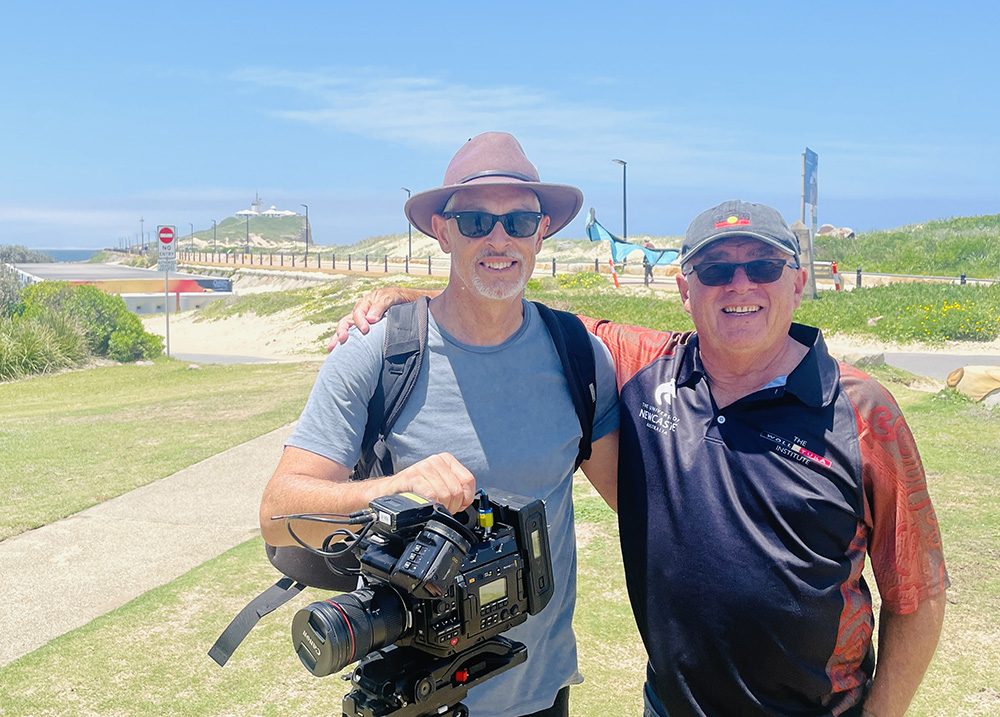
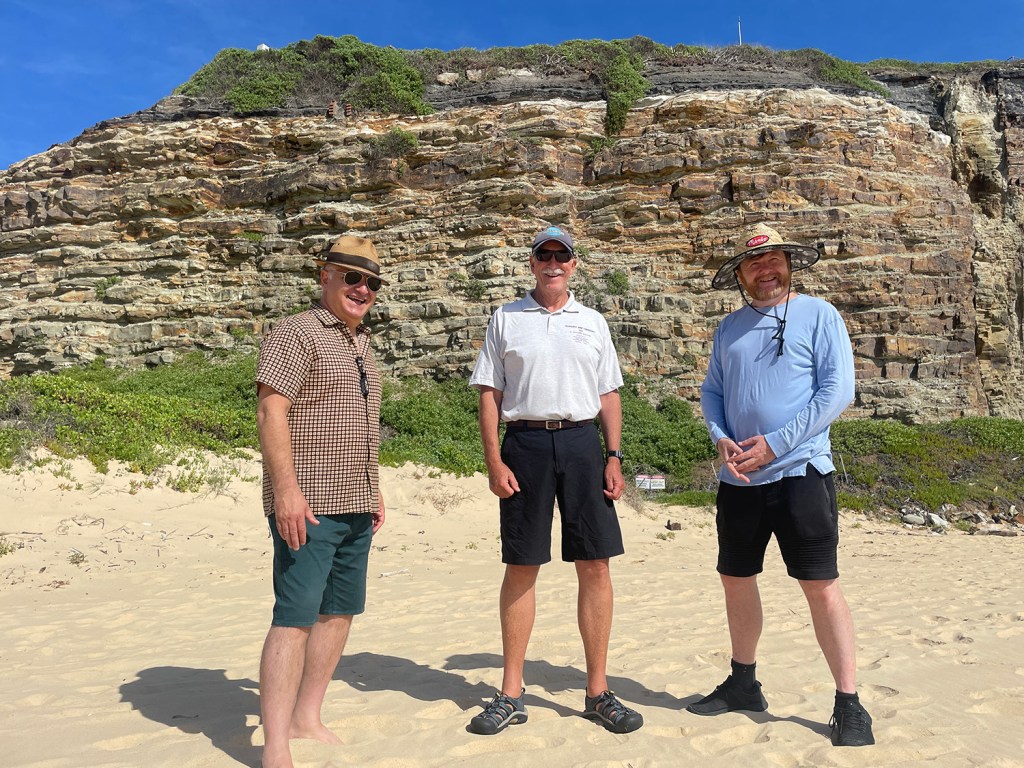
Stories of Our Town Film Maker Tony Whittaker and Emeritus Professor John Maynard at Whibayganba Nobbys
“We interviewed Aboriginal scholars, historians, geologists, surveyors, ship captains, archivists, Pro-surfers, a harbour master, and a former inhabitant and more to bring this story to life. It incorporates hundreds of archive images, animation, high end photography, personal photographs, drone footage and newspaper clippings to tell the story of the rock known to indigenous locals as Whibayganba.”
Nobbys Whibayganba Under a Blood Moon. [Photograph Courtesy of Eddie O’Reilly.]
The Port Authority of N.S.W. even lent them a vessel and crew to capture Nobbys from the water at sunset.
The community support has been overwhelming with hundreds of personal shots being emailed to us.
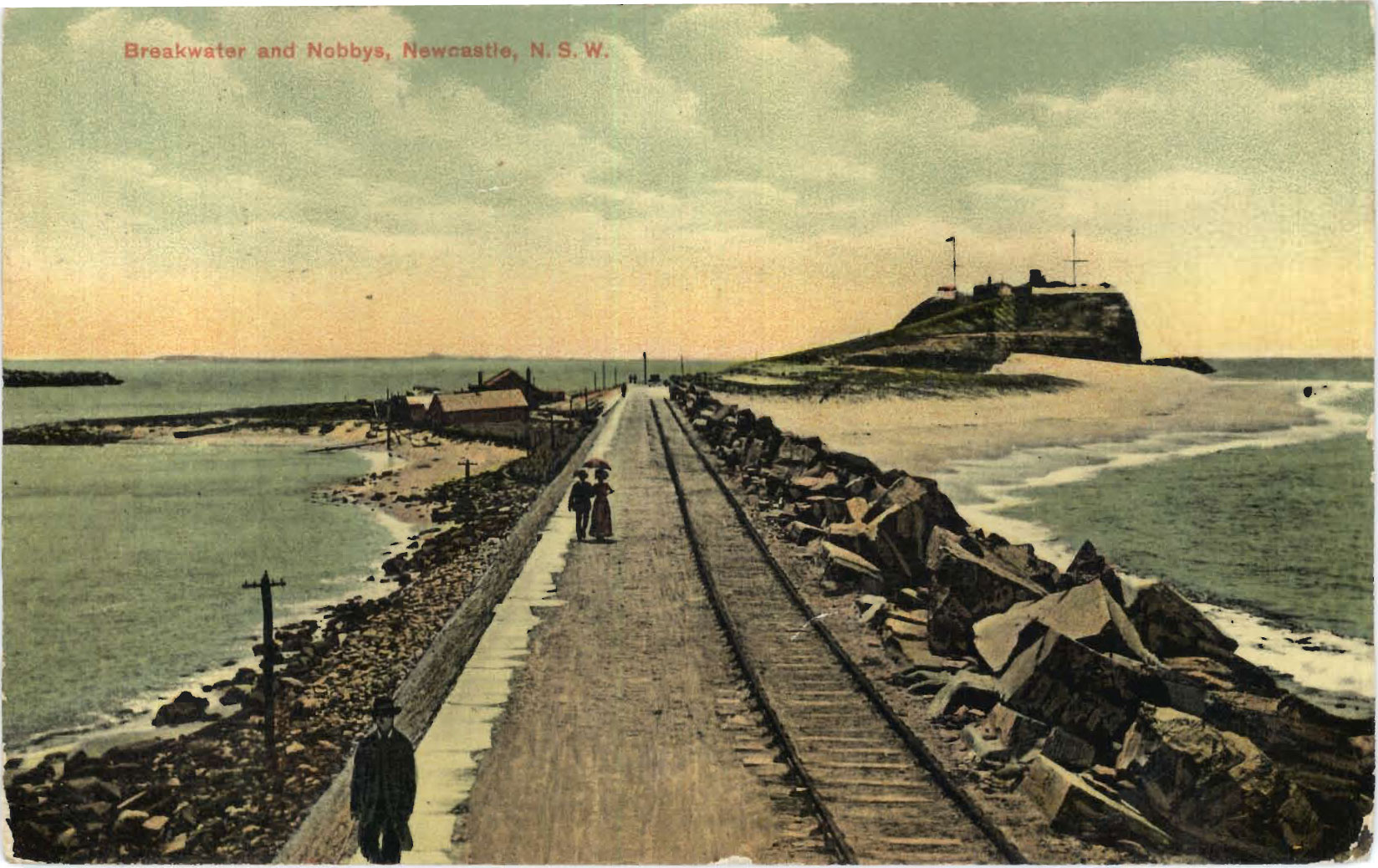
Breakwater and Nobbys, Newcastle N.S.W. Postcard featuring walk along Macquarie Pier (Courtesy of the Nelly Bligh Collection, University of Newcastle)
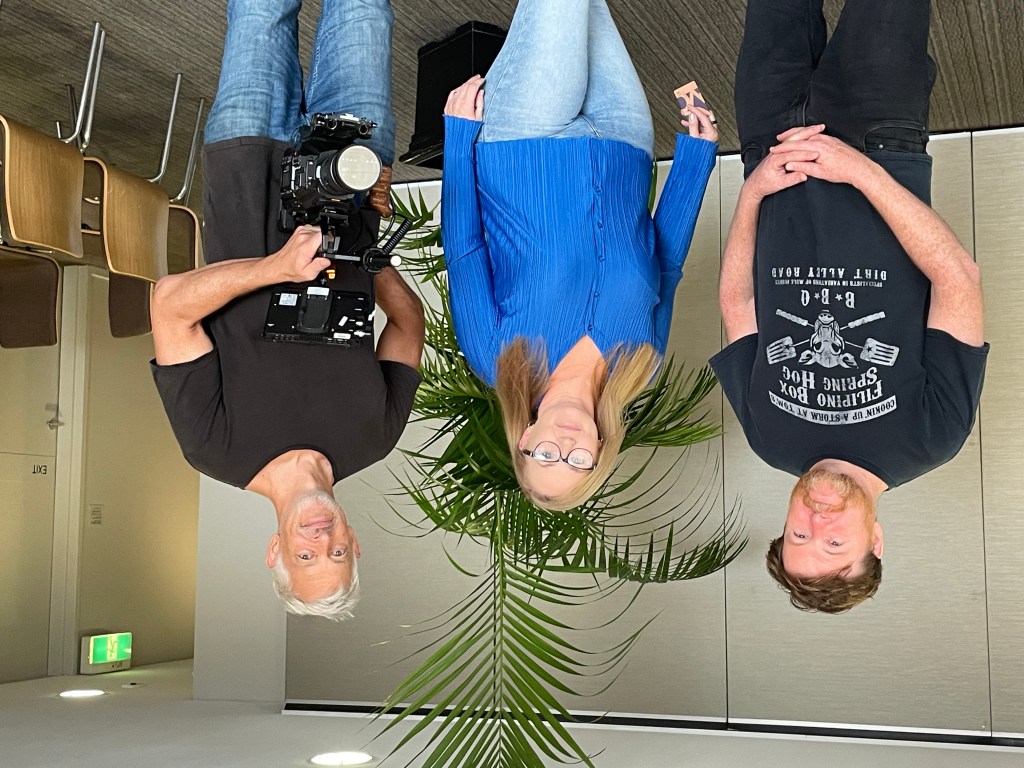
Penny Cecil with Chit Chat and Tony Whittaker
A Love Letter From Newcastle to Nobbys Whibayganba
Nobbys, Newcastle, N.S.W., Australia [c.1890’s] (Courtesy of the Newcastle & Hunter District Historical Society Collection, University of Newcastle)This film has been described as “a love letter from Newcastle to Nobbys.”
Nobby’s/Whibayganba headland has had many names, but officially it is now dual named meaning you can call it by either its European or First Nations name.
Gionni Di Gravio OAM, Professor Ron Boyd of the University of Newcastle with Chit Chat von Loopin Stab (a.k.a. Glenn Dormand) at Nobbys Whibayganba
Respect for Whibayganba, the Original Name of Nobbys
If it is important for us to honour and never forget the ANZAC story, because it connects us with our European history with those whose sacrifice in battle safeguarded our homeland.
Then, it’s equally important to respect the ancient Indigenous history and name of Nobbys as part the story of Aboriginal people who loved and also protected and cared for this land.
We respect and honour it like we honour the Anzacs.
Whibayganba – “the place of the one who makes it windy”
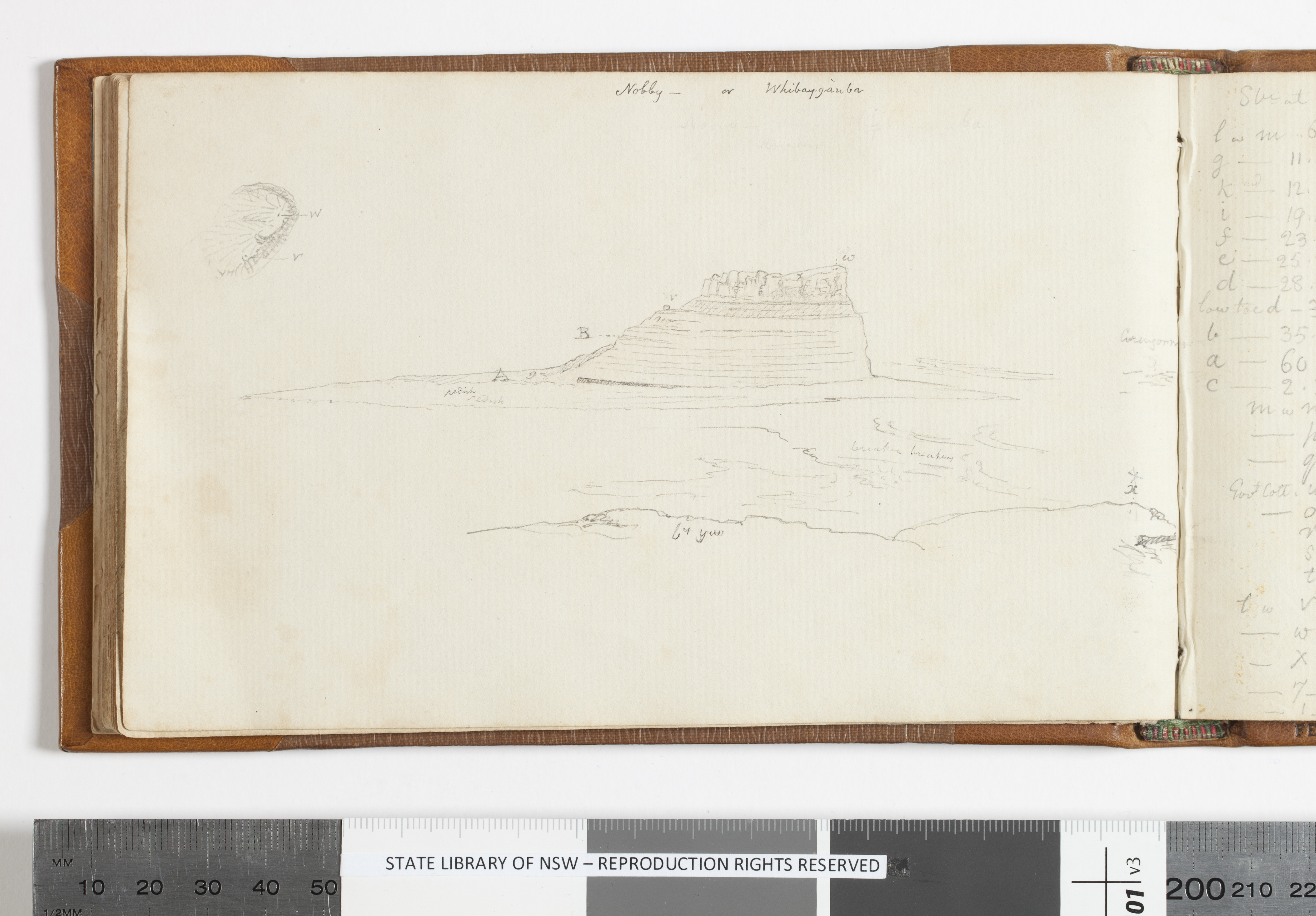
Sir Thomas Livingstone Mitchell (1792-1855). Sketch of Nobbys Whibayganba in 1828 from page 27 in Field Book – Port Jackson and Newcastle, 1828 (C 40)(Courtesy of the State Library of New South Wales).
Update from Mr Leigh Budden on the Aboriginal name Whibayganba and its meaning (via email received 27 May 2024):
“I hope to be back from my travels and into the GLAMx lab to continue with the Haslam collection scanning on 13th June ( if that is OK?), but I caught up with the HLH post on the Whibayganba film while on the road in NT and noticed it didn’t seem to venture into the meaning of the word recorded by Mitchell from his Aboriginal informant – Whibay-gan-ba?
So I thought I’d send this email in prep for your showcase on the 3rd.
Mitchell captured the word that literally means: ” the place of the-one-who / one-which makes the wind”
Which means “the place of the one who makes it windy”
ba = place of
gan = the derivational suffix that functions as bearing the meaning of ‘one who/ one which’
wiibay = Gathang and LM word for ‘wind’
Hope this is of interest to you all
Cheers leigh
P.S from subsequent email: fyi (this is just my speculation) I think it relates to the the wind from the North East which grows in intensity in the afternoon from the direction of the island “
Respect for Burrabihngarn, Original Aboriginal Name of Coastline Around Stockton Oyster Bank
According to Leigh Budden (Email to GDG: 19 June 2024):
‘Burrabihngarn’ translates as ‘country-of-lots-of-bull sharks’
LB: The country of lots of bull sharks is the harbour and its entrance I think (from Dangar’s map). Burrabihngarn is – garn = bull shark; bihn = lots of or many; and Burra = country, earth, world of and in the context of both the bull shark ( and the freshwater eels) Burra has been used by the Aboriginal informant to describe what we would say in English as ‘the domain of” or perhaps ” inhabited by”
Burra is a very interesting word and Threlkeld captured it being used in a couple of different and interesting ways, but I think for the map responses the informant was conveying something like –
Danger ” what do you call this place?”
Informant answers ” this is where the bull sharks live”
So it’s not country as in the land, so doesn’t reference the land now known as Stockton.
Respect for Corengorra/Gorengorra, “Resting Place of the Waves” .. Original Aboriginal Name of Big Ben Reef
Email Discussions between Leigh Budden (LB) and Gionni Di Gravio (GDG) 28 May 2024 -13 June 2024
LB: ‘Gorenngorra‘ as ‘the nest of (or camp) of the Goren’
GDG: Canon Carlos Stretch has its meaning as that of a “rough place”
LB: That’s fascinating Gionni – it’s either the nesting place of a bird or the hangout of something like a seal, or if it’s a reef perhaps abalone or lobster site because Mitchell has definitely written ‘ngorra‘ which is now written as ngurra, and has the same meaning in many close languages like Gathang, Gamilaraay, HRLM, Darginung etc as camp or nest. I.e, where people or animals or fish etc live.
GDG: (Referencing Mitchell’s 1828 sketch above) It looks to be the reef, very obvious at low tide. It was named Big Ben; some suggested it was because if a ship hit it – “For whom the bell tolls”.
LB: I’ll have to research what Gore might have been, but if you think it is a reef his informant may have misunderstood and gave him a land based name by mistake. Pity the sketch didn’t extend further.
LB: I’ve had a look at Dangar’s map and ‘Tahlbihn Point‘ is literally ‘salt-lots of” point, i.e., salty point as in cooking salt, but it’s not so straight forward with Gorengorra (Corengorra).
Map of the River Hunter, and its branches [cartographic material] : shewing the Lands reserved thereon for Church purposes, the Locations made to Settlers, and the Settlement and part of the Lands of the Australian Agricultural Company at Port Stephens together with the Station of the Mission to the Aborigines belonging to the London Missionary Society on Lake Macquarie, New South Wales – Click Image for even Larger View (24MB) – Courtesy of the State Library of NSW.
LB: I’m 100% positive that the word is made up of two nouns, divided into a noun (Gore/Core) and then the noun ‘ngurra‘ (which means camp, nest, home, resting place). So it is Gore-ngurra.
Gore could be Mitchell’s approximation of a noun that we don’t have a record of, but my best guess is that his Aboriginal guide and advisor told him that the site was the ‘home or resting place of the waves of the ocean’. Written today as ‘karu-ngurra‘ but interpreted by Mitchell’s Scottish ear as ‘Gore-ngorra‘
I can go into detail to explain my thinking on this if you are interested, but in precis the Gathang, HRLM and Darkinjung word for ocean or the sea is ‘garuwa‘. I think that ‘garuwa‘ is made up of the word ‘garu‘ and the particle ‘waa‘. In Gathang the particle ‘wa‘ was recorded by one researcher as meaning ‘and, and then’ – i.e., repetitive action. While Threlkeld didn’t record this particle separately, it’s seen in many of the words he recorded that describe repetitive action – and is probably the meaning of the word ‘awaba‘ on Proctors 1840’s map of Lake Macquarie.
Anyway – if you are interested in knowing more I’m happy to go into more detail – but my thinking on the meaning of the word recorded by Mitchell as “Gore-ngorra” is “the resting place of the waves”. Which (I think) is a pretty cool name for a reef.
LB: I had a look at today’s HLH post on Jeffries 1816 survey and the map clearly shows a line of rocks between Nobbys island and the main head land. This reef would be where the waves ‘camp’ as their repetitive motion would be dissipated and broken up and they would come ‘to rest’. Seeing this 1816 drawing makes me certain that I have interpreted what Mitchell’s informant has replied to his question which may have been something like ‘what do you call this place?’ (pointing to the row of rocks that makes up the reef) and the answer was ‘ gorengorra = this is where the wave slow down and stop to rest’
Chit Chat von Loopin Stab (a.k.a. Glenn Dormand) with Surfers Paul Parkes and Peter McCabe
This Story is for Newy
Most of the films in the Stories of Our Town try and capture a national or international audience.
This one is just for Newy, and we hope you love it.
Thank you to Port Authority of N.S.W. and Heritage N.S.W. for their financial support.
The Stories of Our Town Film Project has made 21 documentaries about Newcastle and the Hunter Region over the past 4 years. Five of these films have made it on streaming services (Foxtel/Binge/SBS/NITV).
Stories of Our Town see Local stories as being important National and in 2022 they were Highly Commended at The National Trust Heritage Awards for services to Education.
Another great film from the Stories team. Well done.
Intriguing aside with the mention of Henry Hacking. If it had remained named after him we would certainly have had some renaming issues. There were numerous incidents in Sydney. However his actions when sent by Hunter to investigate the two boats detained by the locals in 1799 set a tragic precedent.

![Map of the River Hunter, and its branches [cartographic material] : shewing the Lands reserved thereon for Church purposes, the Locations made to Settlers, and the Settlement and part of the Lands of the Australian Agricultural Company at Port Stephens together with the Station of the Mission to the Aborigines belonging to the London Missionary Society on Lake Macquarie, New South Wales – Click Image for even Larger View (24MB) – Courtesy of the State Library of NSW.](https://hunterlivinghistories.com/wp-content/uploads/2016/07/Dangar-Cross-Z_M4811_2_1828.jpg)


Simply fabulous to collate and present such a big and complex story! Congratulations on this significant achievement
Congratulations! Most definitely a very welcome cultural contribution.
Another great film from the Stories team. Well done.
Intriguing aside with the mention of Henry Hacking. If it had remained named after him we would certainly have had some renaming issues. There were numerous incidents in Sydney. However his actions when sent by Hunter to investigate the two boats detained by the locals in 1799 set a tragic precedent.