

Further Colonial Historical Accounts of the Supreme Aboriginal Spirit Being
By Leigh Budden
Warning to Aboriginal and Torres Strait Islander People:
This brief paper contains historical references to Aboriginal cultural practices ‒ but does not provide secret details about those ceremonies.
It references historical articles that contain terms or views that were considered appropriate for Australian Colonial period but no longer considered respectful to Aboriginal First Nations People. These historical articles do not reflect the views of the University or the author.
It also contains names of Aboriginal People who are deceased.
The author pays respect to all Aboriginal Elders, past, present, and emerging, and fully recognises and honours their intellectual property, knowledge, and traditions.
The author also acknowledges and respects contemporary Aboriginal Cultural Knowledge holders. This brief synopsis of historical references is for the purpose of informing discussion about the cultural astronomy and is not to be misinterpreted as a challenge to contemporary cultural belief or practice.
There are some historical records from colonists that describe what the Aboriginal People of the east coast of N.S.W. believed in, and how they viewed the world, and their responsibilities in it.
These are records of what Aboriginal People told British settlers and missionaries from the time of first or early contact in the part of Australia that felt the first full force of colonisation – the part of the east coast from Botany Bay to the Hunter River in New South Wales
The historical language used by the colonists to describe Aboriginal People and their beliefs and cultural practices was often dehumanising and is difficult to read. It often involves the colonists’ biases and beliefs as well as their English word interpretation of the Aboriginal names.
Threlkeld’s Works and Niel Gunson
The very important work of author Neil Gunson in curating and publishing Reverend Lancelot Threlkeld’s work as a missionary to the Aboriginal People of Lake Macquarie in New South Wales cannot be considered as anything other than a unique historical resource.
(Gunson 1974) Australian Reminiscences & Papers of L.E. Threlkeld, Missionary to the Aborigines, 1824-1859. 2 vols, ed. Niel Gunson. Canberra: Australian Institute of Aboriginal Studies, 1974.
The Gunson 1974 resource has enabled the historical Language of the Aboriginal People of Lake Macquarie to be shared worldwide through Hunter Living Histories posts. We are also fortunate that Reverend Threlkeld recorded the Culture and Cosmology that was shared with him, and through Gunson’s 1974 publication many HLH posts have brought this historical information into the 21st century. For example –
Kon, Koun or Koin – Supreme Invisible and Unknown Being of the Aboriginal Peoples of Port Stephens, Newcastle and Lake Macquarie
Aboriginal Spirit beings – MULLUNGBULA – Two Rock Women
Aboriginal Spirit Beings – KOYOROWEN (Wild Man of the Woods) and Wife KURRIWILBAN
Aboriginal Spirit Beings – KOYOROWEN (Wild Man of the Woods) and Wife KURRIWILBAN
Aboriginal Spirit Beings – Puttikan
Gunson’s Biographical Entry on Eliza Hamilton Dunlop
I was surprised to learn, when reading the post on Puttikan, that Neil Gunson was also the author for the 1966 entry for Eliza Hamilton Dunlop (1796-1880) in the Australian Dictionary of Biography (ADB). (see https://adb.anu.edu.au/biography/dunlop-eliza-hamilton-2007)
The ADB entry written by Neil Gunson describes Eliza Hamilton Dunlop (1796-1880), as:
“a lyric writer and student of the Aboriginals, who was born in County Armagh, Ireland, the daughter of Solomon Hamilton, sometime judge of the Supreme Court, India. She married James Sylvius Law, astronomer; they had a son and a daughter, Mary Sophia Georgina, who was born in 1816 at Coleraine, Ireland. At Port Patrick, Scotland, in 1823 Mrs Law married David Dunlop (1794-1863), a native of County Antrim, Ireland. They arrived at Port Jackson in February 1838 in the Superb with the four children of this marriage. After holding office at Penrith, in 1839 Dunlop was appointed police magistrate and protector of Aborigines at Wollombi and Macdonald River and held office until 1847. He built a stone house, Mulla Villa, in Wollombi. As a minor poet Mrs Dunlop contributed to the literary life of the Hunter River circle.”
![Painting of Eliza Hamilton Dunlop [Courtesy of https://www.morethanourchildhoods.org/stories/eliza-dunlop/]](https://hunterlivinghistories.com/wp-content/uploads/2026/02/Eliza-hamilton-Dunlop.jpg)
More on Eliza Dunlop
And I was also surprised to learn that more recently there has been quite a bit written about Eliza. For examples see –
- Hansord, Kate. “A Forgotten Colonial Woman Poet.” Tinean, 6 November 2015. https://tintean.org.au/2015/11/06/a-forgotten-colonial-woman-poet/
- Johnston, Anna. “Mrs Milson’s Wordlist: Eliza Hamilton Dunlop and the Intimacy of Linguist Work.” Violence in the Settler Colony: Economies of Dispossession around the Pacific Rim, Penelope Edmonds & Amanda Nettelbeck (editors), Palgrave Macmillan, 2018.
- Johnston, A., & Webby, E. (Eds.). (2021). Eliza Hamilton Dunlop: Writing from the Colonial Frontier. Sydney University Press. http://www.jstor.org/stable/j.ctv1mq83wk
The Dictionary of Irish Biography summarises her life and influence as a poet in Australia, along with detailing her sympathy for the suffering of Aboriginal people under colonialism. It also outlines The Sydney Herald’s Editors continued campaign against her, which was reported as being as a result of her strong condemnation of the Myall Creek massacre of June 1838. (see https://www.dib.ie/biography/hamilton-dunlop-eliza-matilda-nee-hamilton-e-h-d-evelina-evelina-matilda-eliza-matilda)
Anna Johnston (2018) in her chapter in “Violence in the Settler Colony” wrote that the “Dunlops were both keenly interested in Aboriginal Language and Culture” (page 232) and that Eliza was acquainted with Rev Lancelot Threlkeld who lived close by at east Lake Macquarie. Also, that she was befriended by a senior man of the Wollombi Mob named Boni. And that Boni was named by Eliza “as her advisor in her manuscript poetry collection, where she quoted his description of the sacred stones as like ‘one bit of the sun’s eye’ “(page 237)
David Dunlop, Husband of Eliza
Her husband David also appears in the historical records.
Appointed by Governor of New South Wales, Sir George Gipps, as the Magistrate and Protector of the Aborigines at Wollombi in November 1839, David Dunlop’s written response to the 1845 government enquiry to the conditions of the Aboriginal People of New South Wales can be found here:
David Dunlop’s report includes an interesting historical account of the Wollombi and Macdonald River Mobs at the time –
“The aborigines of the Wollombi and Macdonald River district are seventy-three in number, divided into three tribes. Township of Wollombi tribe, hunting ground extending to Patrick’s Plains. Ellalong tribe, hunting ground joining that of the Maitland blacks, and the Macdonald River tribe, who range from the Colo to Wiseman’s Ferry.”
Mrs Dunlop’s “Gods and Goddesses” of the Kamilaroi
However, it was the inclusion of a reference to the historical work of Eliza Hamilton Dunlop in the (Gunson 1974) two volumes on Threlkeld that caught my interest.
Posted as part of the Aboriginal Spirit Beings – Puttikan https://hunterlivinghistories.com/2020/06/17/puttikan/
And copied below:
On the deities of the Kamilaroi [Gunson p.77 note 92]:
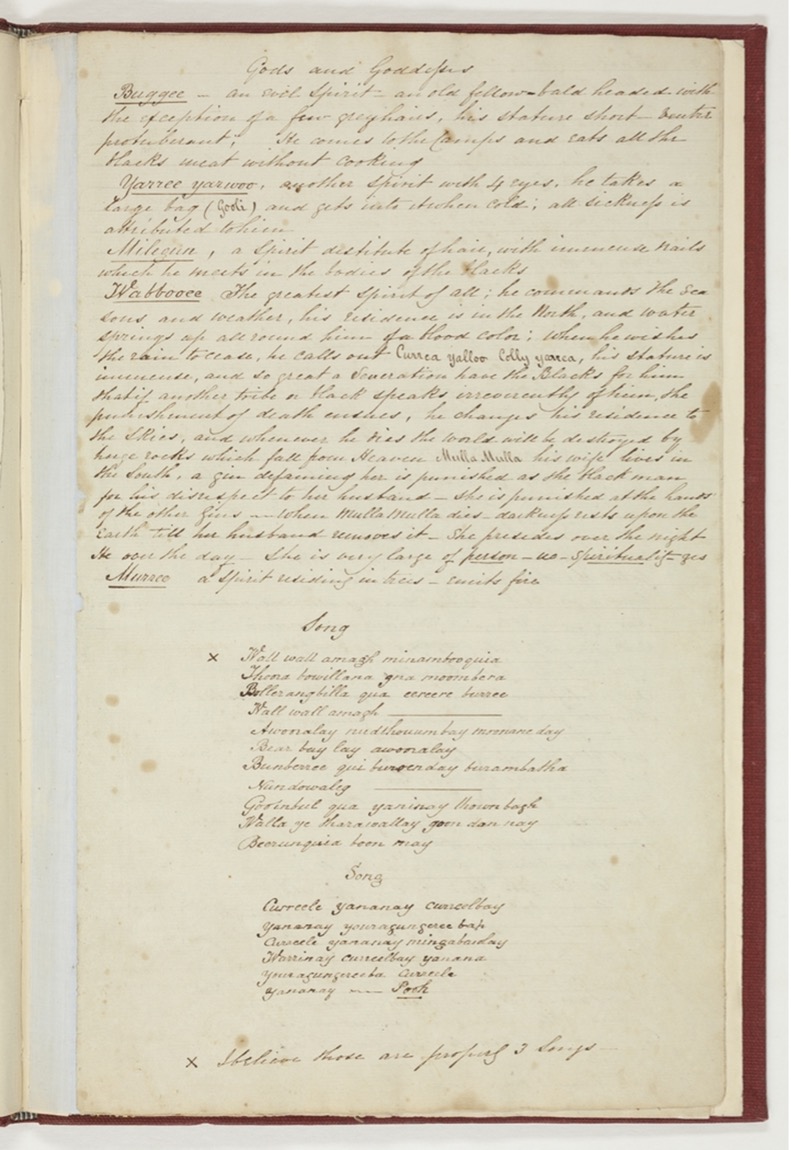
“Few accounts dealing with the subsidiary spirits of the New South Wales sky hero cults survive. However, the scholarly Mrs Dunlop of Wollombi took down a list of ‘Gods and Goddesses’ in the ‘Murreegwalda’ language of the ‘Comileroi’ [Kamilaroi] which makes an interesting comparison with Threlkeld’s list. The spirits appear to have had the same characteristics:
‘Buggee – and Evil Spirit – an old fellow – bald headed with the exception of a few greyhairs, his stature short – ventre protuberant; He comes to the Camps and eats all the blacks meat without cooking. [Buggeen was the ‘Evil Spirit’ of the Wiradgery tribe].
Yarree yarwoo, another Spirit with 4 eyes, he takes a large bag (Gooli) and gets into it when cold; all sickness is attributed to him.
Milegun, a Spirit destitute of hair, with immense nails which he meets in the bodies of the blacks.
Wabbooee. The greatest spirit of all; he commands the seasons and weather, his residence is in the North, and water springs up all round him of a blood color; when he wishes the rain to cease, he calls out Currea yalloo Colly yarrea, his stature is immense, and so great a veneration have the Blacks for him that if another tribe or black speaks irreverently of him, the punishment of death ensures, he changes his residence to the Skies, and whenever he dies the world will be destroyed by large rocks which fall from Heaven.
Mulla Mulla his wife lives in the South, a gin defaming her is punished as the blackman for his disrespect to her husband – she is punished at the hands of the other gins – when Mulla Mulla dies – darkness rests upon the earth till her husband removes it – She presides over the night. He over the day – She is very large of person – no – spirituality – yes.
Neil Gunson who was obviously aware of the work of Eliza Hamilton Dunlop, and included her information on “Gods and Goddesses” as an ‘interesting comparison’ to the historical information on “Gods and Godessess” that Threlkeld recorded (see page 62 Gunson 1974 V.1). Gunson also commented that ‘the spirits appeared to have had the same characteristics’
Wabbooee and Mulla Mulla
And it was the descriptions of Wabbooee and his wife Mulla Mulla that jumped off the page to me!
Had I read a similar historical description before? Well, maybe… My first thought was of the similarities of Wabbooee and Mulla Mulla to the historical accounts of the east coast N.S.W. Supreme Spiritual Being named Koen (Guwiyn) and his wife Tippakalleen (Djipagalyn).
See – Koen: Further Historical Accounts of the Supreme Aboriginal Spiritual Being, and Related Cosmology Recorded by Colonists
Eliza Hamilton Dunlop’s Manuscripts
The manuscripts, poems and songs of Eliza Hamilton Dunlop can be found in the NSW State Library catalogue.
But, as articulated by Anna Johnston in her 2018 chapter –
“Dunlop’s linguistic work did not fall so neatly within mid-century gendered norms, and it remains less well known than her poetry. Dunlop contributed an important Wollombi wordlist and transcribed Aboriginal songs, although few other sources remain of her ethnographic collection. Like many women’s archives, Dunlop’s papers are dispersed throughout family holdings, disaggregated and only partially deposited and identified. What has survived is known as ‘Mrs Milson’s Wordlist’, now held in the Mitchell Library. It is part of a collection put together during the production of a celebratory biography of the prominent pastoralist James Milson. (The Dunlops’ daughter Rachel married into the Milson family. Rachel’s continuation of her mother’s work and curation of her papers ensured Dunlop’s legacy.) What became known as ‘Mrs Milson’s Wordlist’ is in fact Dunlop’s linguistic work.” (Johnston, 2018, page 233)
Mrs David Milson Kamilaroi vocabulary and Aboriginal songs, 1840
Mrs Milsons word list is available online at the NSW State Library.
https://collection.sl.nsw.gov.au/record/1kVdgZen
Its full title is ‘Mrs David Milson Kamilaroi vocabulary and Aboriginal songs, 1840’ and it is a bound manuscript of 18 pages, presented to the library by D. Goddard in 1926. It includes 11 pages of Aboriginal Language identified as Gamilaraay (Murree gwalda or Blacks Language of Comileroi), and the list of ‘Gods and Goddesses’ appear on page 5 amongst the Gamilaraay vocabulary pages.
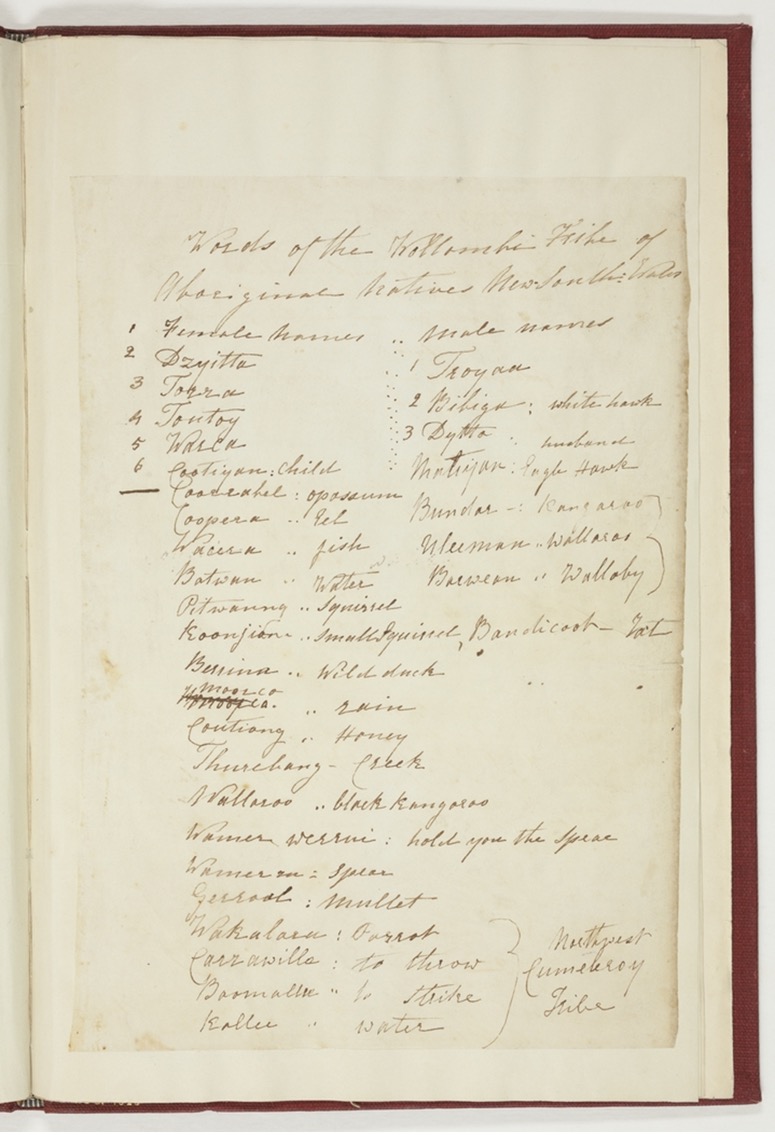
The manuscript also includes 6 pages of Aboriginal Language (plus a list of words on the inside cover) described as ‘Words of the Wollombi Tribe of Aboriginal Natives New South Wales’.
The Gamilaraay vocabulary (including the list of ‘Gods and Goddesses’) in this manuscript have been included in the research into developing the Gamilaraay, Yuwaalaraay, Yuwaalayaay Dictionary compiled and edited by Anna Ash, John Giacon and Amanda Lissarrague (2003 & 2nd edition 2017).
Likewise, the ‘Words of the Wollombi tribe’ have been included in the development of the Darkinyung Grammar and Dictionary by Caroline Jones (2008).
What The Manuscript Contains
A review of the manuscript known as Mrs David Milson Kamilaroi vocabulary and Aboriginal songs, 1840, contains pages pasted into the bound journal that is the manuscript. Many of the pages contain different handwriting.
Anna Johnston (2018) described this work as ‘part of a collection put together during the production of a celebratory biography of the prominent pastoralist James Milson.’ Her daughter, Rachel curating her mother’s papers.
Other family members, including Rachel Milson’s grandson Roy H Goddard, appear to have been involved in the production of James Milson’s biography.
More About Roy H. Goddard
Roy H. Goddard was the author of the 1955 book The life and times of James Milson, and is listed as the author of the James Milson archives held by the NSW State Library:
https://collection.sl.nsw.gov.au/record/Yezv5dK9
https://collection.sl.nsw.gov.au/record/YolEVpN9
So what does this tell us? Well, besides being Eliza Hamilton Dunlop’s great grandson, and an assistant in curating her linguistic work, Roy H Goddard was also a founding member and honorary treasurer of the Anthropological Society of New South Wales (established 1928) as well as a regular contributor to the society’s journal known as Mankind.
But it’s the paper he read before the Australian and New Zealand Association for the Advancement of Science in 1937 titled “Certain Observations of Aboriginal Rock Carvings in the Wollombi District” that may contain a clue to Gunson’s (1974-page 77 note 92) comment that the ‘the spirits appeared to have had the same characteristics’
Goddard’s Field Trip 1935 and the “Wabooee” Petroglyths
In 1935 Roy H. Goddard and Walter Enright conducted a field trip to view petroglyph art on the sandstone platforms in the Wollombi NSW district. In the paper he published about this field trip he mentions his grandmother Mrs Rachel Milson and her description of cultural aspects of the local Aboriginal People, and goes on to speculate that one of the petroglyphs examined as:
“This figure probably represents the traditional Wa-boo-ee, the demon-spirit of the Wollombi tribe” page 4
He continued:
“Wa-boo-ee was of great stature – he thought nothing of stepping up to the sky for a change of residence and of throwing a few rocks, in the shape of mountains, down to the earth as stepping stones. Wa-boo-ee controlled the seasons.’
He goes on to say that:
“Wa-boo-ee, who controlled the seasons, could also be represented by the Sun” (page 7).
He also speculates another petroglyph that they examine represents Mull Mulla (see page 4). (See: https://livinghistories.newcastle.edu.au/nodes/view/57518)
Wabbooee and Mulla-Mulla, Gamilaraay and Wollombi Spirits?
Therefore, Mrs Rachel Milsons 1840 Gamilaraay wordlist contains a description of Aboriginal Spirits including “the greatest Spirit of All – Wabbooee” and his wife “Mulla-Mulla”. These spirits have been interpreted as being Gamilaraay Spirits by both Gunson (1974) and by the editors of the Gamilaraay, Yuwaalaraay, Yuwaalayaay Dictionary (2003, 2017).
But grandson Roy H. Goddard has cited Wabbooee as the “traditional demon-spirit of the Wollombi tribe”. Could they be both?
It is possible, but Gunson’s (1974) observation that the spirits described in Mrs Milson’s Wordlist appeared to have similarities to those described by Reverend Threlkeld certainly seems to have some credibility – particularly for the greatest spirit of all – Wabbooee and his wife Mulla Mulla. They appear to have very similar characteristics to those ascribed by both colonists and the French explorers to Koen and his wife Tippakalleen.
According to Mrs Milson’s wordlist, as the greatest spirit of all, speaking irreverently of Wabbooee is punishable by death. He presides over the day and his wife over the night.
We are very fortunate to have the records of Aboriginal Language and Culture recorded by Eliza Hamilton Dunlop and her daughter Rachel at Wollombi N.S.W. in the 1830’s and 1840’s. And through these records, and those of Reverend Threlkeld, we get a glimpse of Aboriginal Language, Culture and Cosmology that was recorded by colonists at early contact with Aboriginal People of the Hunter Valley on the east coast of New South Wales.
Yanma yambuyn Guri ngurrawa
(Walk softly on Aboriginal Country)
By Leigh Budden
For the University of Newcastle’s Hunter Living Histories