Lambton Photo Mural Unveiled
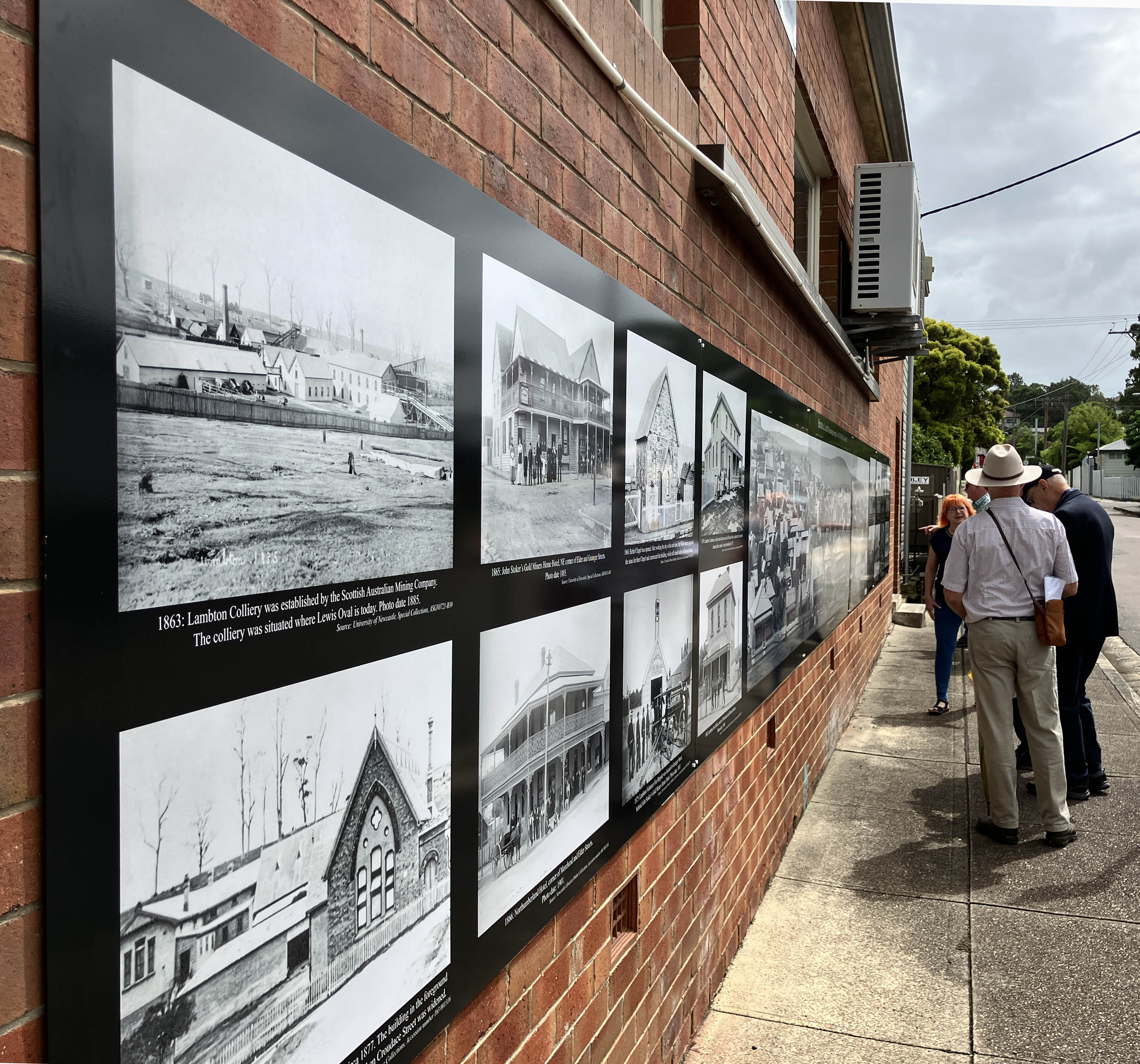
On the 4 March 2025, a 12-metre long photo mural was unveiled in Lambton. It contains 17 images of Lambton taken by Ralph Snowball, before the township became a suburb of Newcastle.
Who Was Ralph Snowball?

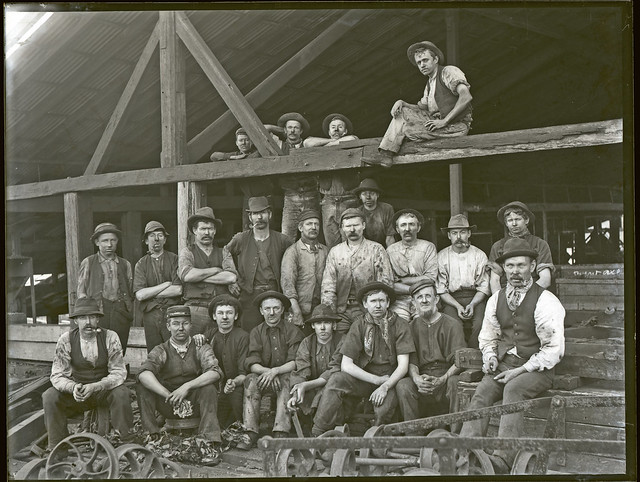
Ralph Snowball came from Durham in the United Kingdom and settled in New Lambton. For several decades (between the 1880s and 1920s) he set himself up as a Portrait, Landscape and Architectural Photographer, travelling around Newcastle, the Lake and coalfields with his horse-drawn wagon.
Around 8000 of his glass plates have survived and been scanned by volunteers at the University of Newcastle and Newcastle Libraries.
For more detail, click here: https://lachlanwetherall.com/then-and-now/ralph-snowball/

Mural Project
Back in 2018, the owner of Dailey Family Funerals in Lambton offered the side of his building as a space suitable for a mural.
However, for a number of reasons, it wasn’t until the second half of 2024, that the Lambton Residents Group and Newcastle Theatre Company applied successfully for a Grant from City of Newcastle.
A Point of Difference
Most public murals these days are painted by artists, and the cost to produce them is very high. They are works of art. But the idea of using Snowball’s images offered a significant point of difference: the fine details in his glass negatives invite the viewer to examine each photo closely.
The wall was quite long, and to have the photos at eye level meant that the format should be like a gallery.
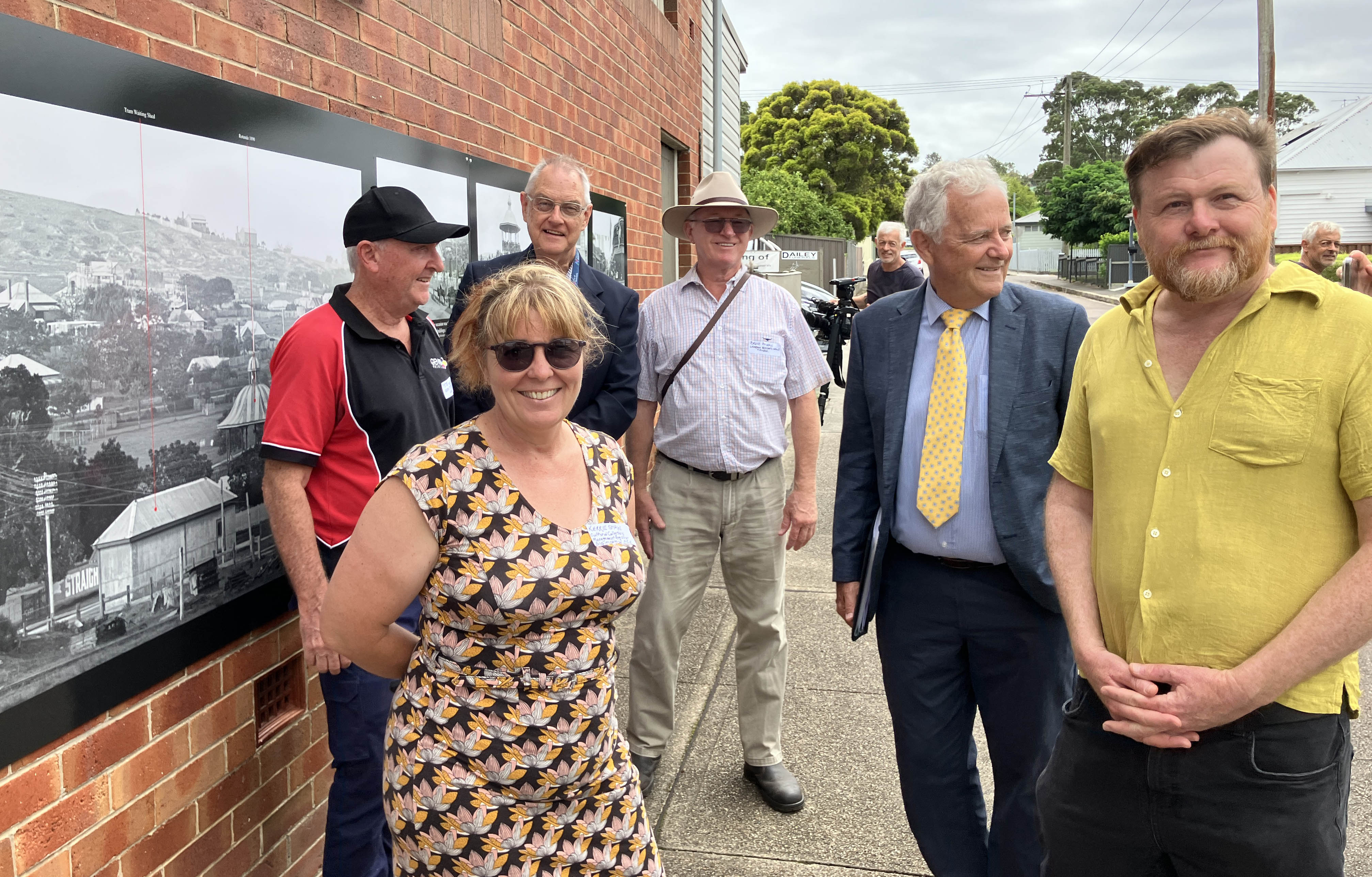
![Launch of Lambton Mural in the presence of Lord Mayor of Newcastle Cr. Dr Ross Kerridge and councillors, along with representatives of Lambton Residents Group, Newcastle Theatre Company, Stories of Our Town film makers, Kerrie Shaw (CON Digitisation Manager) and Gionni Di Gravio OAM (University Archivist) [Photo Credit: Cr Mark Brooker]](https://hunterlivinghistories.com/wp-content/uploads/2025/03/2025_03_04_LambtonMural_MarkBrooker2_s.jpg)
Selecting Photos
How do you pick photos which represent a coal mining township, when it was thriving 125 years ago?
You select things that the community of the time would have been proud of. The school, the mine, a church, the post office, a hotel, the courthouse, the council chamber, fire station, street scenes and the magnificent rotunda. Check that some buildings still exist, and include some others which have been demolished.
Then, add in something unique to Lambton – the electric light plant.
Finally, look for some groups of people, and in this case there were two photos with named people and the class of school girls holding floral garlands.
From that wishlist, it was very easy to make the selections and assemble them into gallery of 16 photos. However, with each print enlarged to A3, there was still wall space for more.
To Clean or Not To Clean?
Old photos and negatives sustain some level of damage or deterioration, so historians are torn between whether to publish a photo ‘as is’, or do some restoration. There are valid arguments for and against. In this case, scratches and dirty marks were going to distract from the enjoyment of the scenes, so cleaning up was undertaken, mostly to the white of the sky.
![Extent of Lambton Photo Mural on corner of Grainger and Elder Streets Lambton. [Photo: Robert Watson]](https://hunterlivinghistories.com/wp-content/uploads/2025/03/2025_03_04_IMG_2139_s.jpg)
The Panorama
There was one other photo which was different, in that it showed a wide view over the township as it was in 1912. Snowball took this photo from where Turner Street runs today, along the top of a ridge. By cropping off the blank sky, and cropping off the foreground, what was left was a panorama of interesting features.
The Rotunda, the Mechanics Institute and the Post Office are three landmarks which Lambton people instantly recognise.
![Lambton, NSW, [29 March 1912]](https://live.staticflickr.com/65535/3880540358_3b36e84597_z.jpg)
See: https://www.flickr.com/photos/uon/3880540358 Or https://livinghistories.newcastle.edu.au/nodes/view/44798
The first street running left to right is Howe Street, where locals know the old stone house and the Exchange Hotel (now called Lambton Park Hotel). Not quite obvious at first glance is the steam tram waiting at the hotel. This tramline connected Newcastle to Speers Point and West Wallsend.
At this point in the design, the mural comprised eight photos on the left, this panorama in the centre and the other eight photos on the right. The wide scene would have to be enlarged. Total length of this gallery would be 12 metres, and it looked good.
Or so it seemed …
The Curiosity of Children
Those buildings along Howe Street were going to be right at the eye level for kindergarten children. Between the stone house and the hotel there is a shop with a sign. When enlarged from 200mm wide to 6000mm, the signs on the shop were too pixelated to be legible. I could predict little voices asking “Mummy, Daddy, what does the sign on the shop say?”
Snowball’s glass negative had been scanned years ago at 600dpi, and fortunately Gionni di Gravio at the University offered to re-scan it … which he did at an amazing 4800dpi!
Now everyone can read that sign: Sharp, Fashionable Tailor.
But Wait, There’s More …
Purely on a whim, one panel was printed life-sized as a test of clarity. It looked great, but on close inspection it was covered in black dots, a mere 3 pixels in diameter. Thousands upon thousands of them. Having come this far, and with the real possibility of the mural being in the public eye for 10 years, each black dots was removed. This process took two days but the effort was worth it. The viewing public can enjoy the scenes and delve right into the detail, and be amazed at the clarity produced on glass plates over 100 years ago.
![From Left to Right: Peter Young (GenR8 Printing); Robert Watson; Lord Mayor Cr. Dr Ross Kerridge; Bruce McLean (Lambton Residents Group) [Photo Credit: Cr. Mark Brooker]](https://hunterlivinghistories.com/wp-content/uploads/2025/03/2025_03_04_LambtonMural_MarkBrooker1_s.jpg)
The Final Result
![Lambton Mural, consisting of 17 Ralph Snowball images held in the University of Newcastle and City of Newcastle Archives [Compiled by Robert Walson, Community Historian] - Click to see High Resolution](https://hunterlivinghistories.com/wp-content/uploads/2025/03/Lambton-Photo-Mural-FINAL-1.jpg)
People are often surprised that museums and libraries have archived material which is largely unknown and inaccessible to the public. Over many years, volunteers at the University and in Newcastle Libraries have scanned Snowball’s plates and now, through this mural, some of those photos are now easily seen on the corner of Grainger and Elder Streets, Lambton.
Robert Watson
Community Historian
More on The Ralph Snowball Archive
Ralph Snowball in the City of Newcastle Libraries
Click here: Snowball Collection
Ralph Snowball Archives on University of Newcastle’s Flickr Site
Ralph Snowball Glass Negatives
Ralph Snowball’s Plate Glass Box Listings

Ralph Snowball Printed Photographs
![[Bramar Creer's House Crebert Street, Mayfield, NSW, 7 November 1900]](https://live.staticflickr.com/4066/4294687366_6b6c7ecd65_z.jpg)
Norm Barney’s “Then & Now” Exhibition
![M4847 Hunter and Wolfe Streets, Newcastle, NSW [n.d]](https://live.staticflickr.com/6062/6067827222_aa187a96f2_z.jpg)
Ralph Snowball in Living Histories
Ralph Snowball Glass Negatives
https://livinghistories.newcastle.edu.au/nodes/view/89
Ralph Snowball Printed Photographs
https://livinghistories.newcastle.edu.au/nodes/view/77
One thought on “A Lambton Photo Mural featuring Ralph Snowball Photographs”