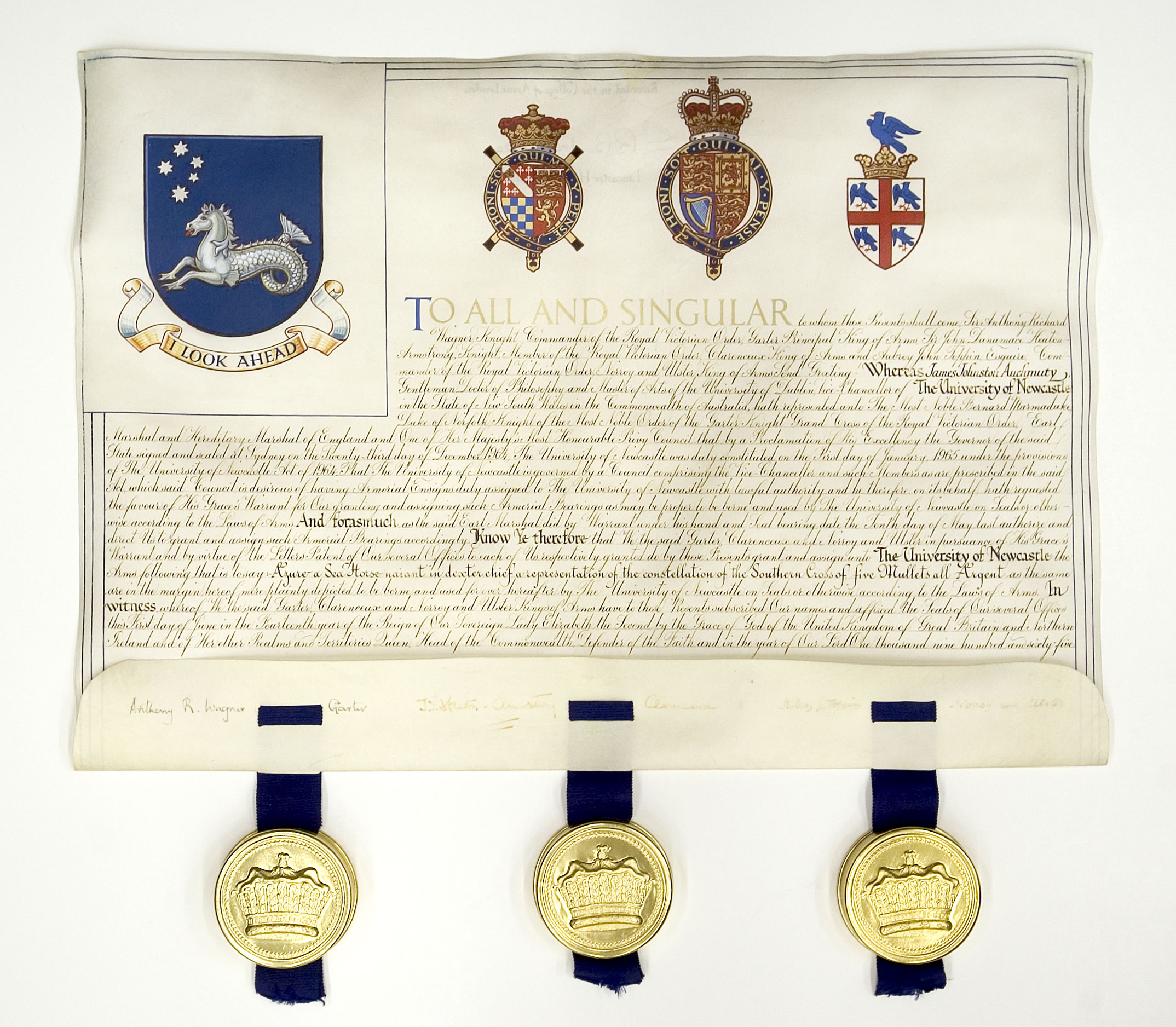
University of Newcastle’s Grant of Arms
By Gionni Di Gravio, University Archivist
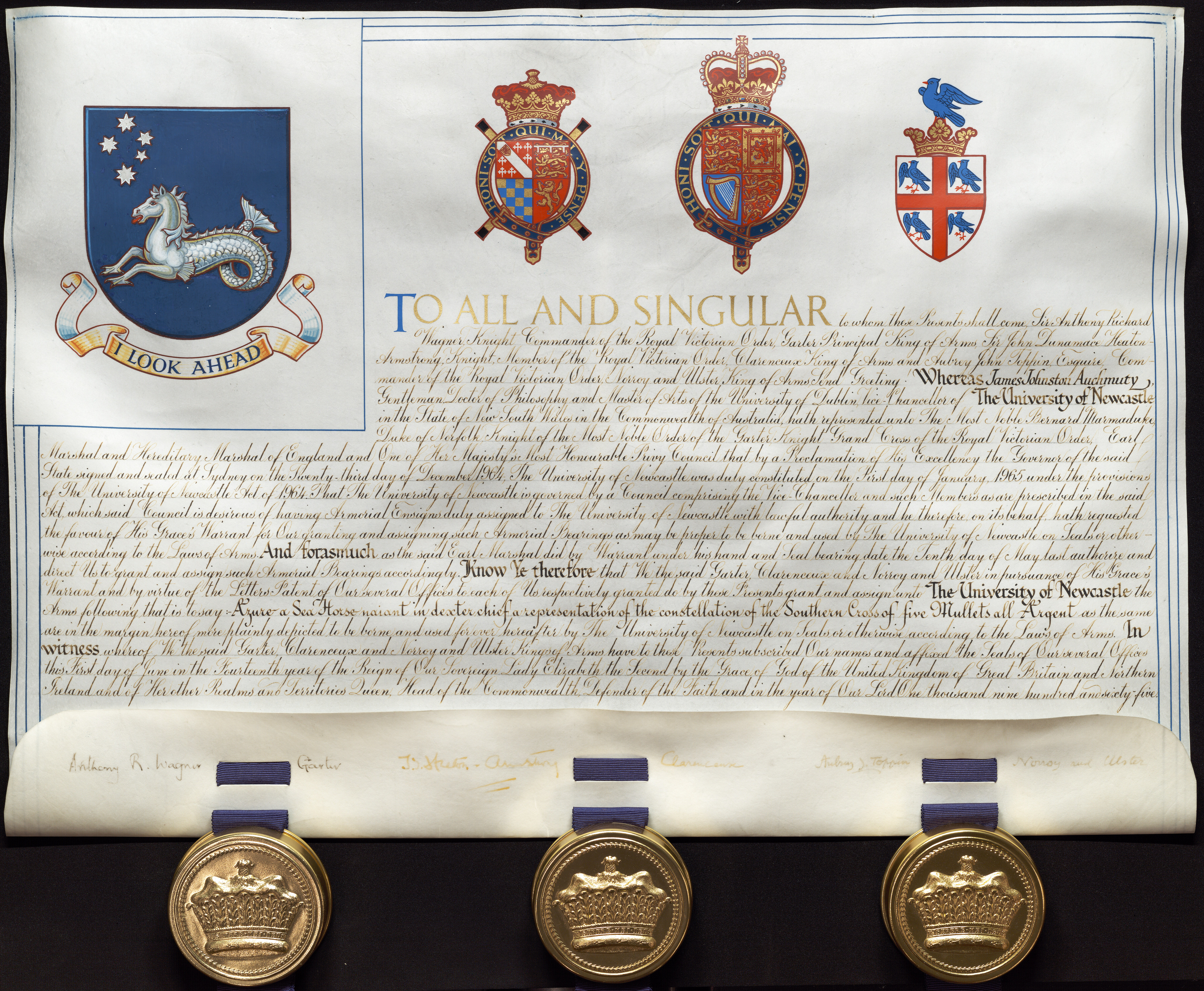
The Grant of Arms is our University’s Declaration of Independence
The University’s beautiful Grant of Arms is our very own Declaration of Independence. This historic document, along with Autonomy Day celebrates the University’s emergence as an autonomous institution on 1st January 1965.
Design Based on Shortland Family Coat of Arms
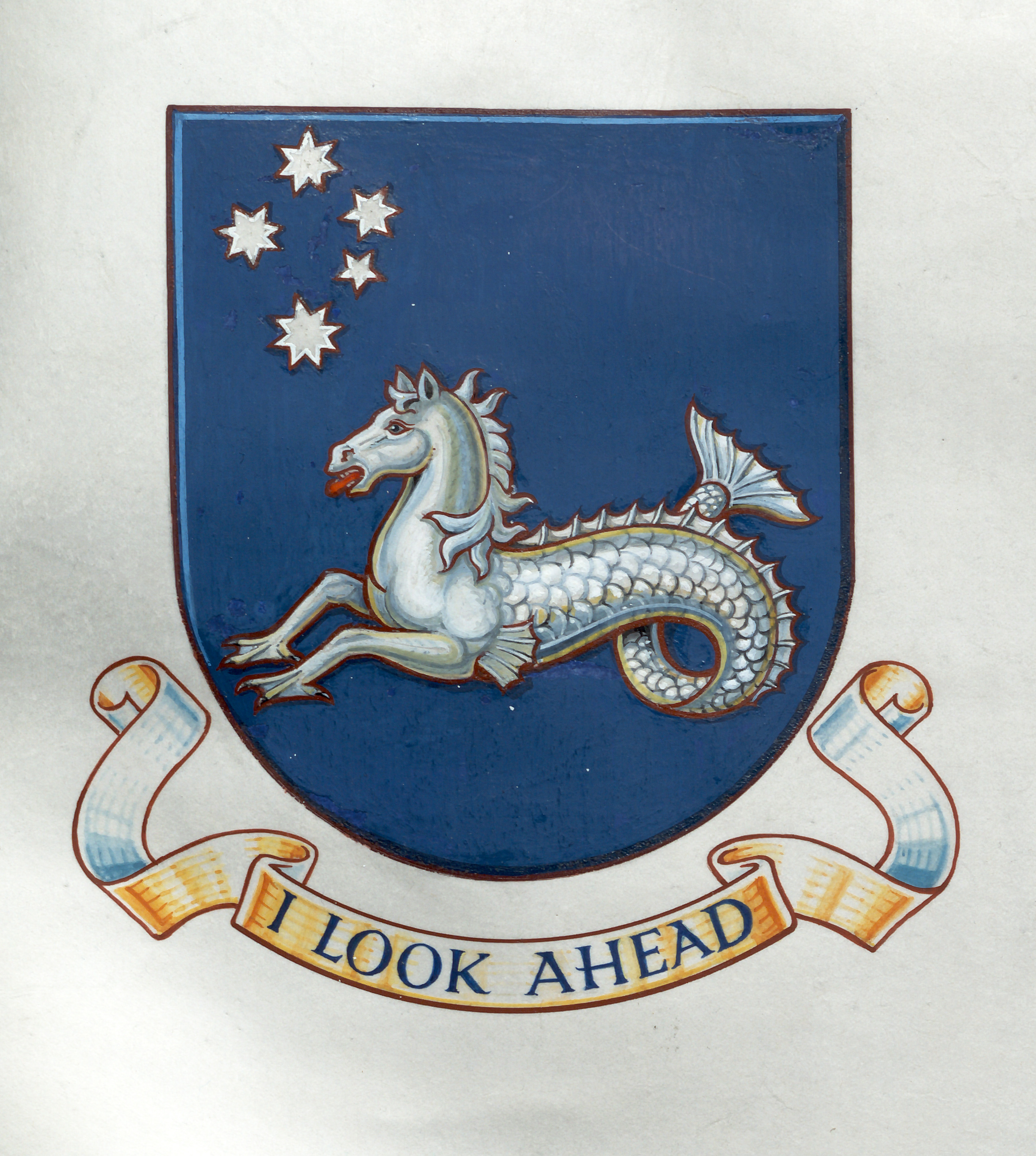
The University of Newcastle’s distinctive Grant of Arms serves as a visual representation of its autonomy. Design based on the Shortland family coat of arms, in respect to the region’s history, the seahorse emblem symbolizes the university’s forward-thinking spirit. The motto, “I LOOK AHEAD,” adopted in 1965, reflects the institution’s ambitious goals.
1989 The Year of Amalgamations & Revolutions
In 1989, the University of Newcastle amalgamated with the Hunter Institute of Higher Education, incorporating the Newcastle College of Education and Newcastle Teachers’ College. This amalgamation, along with the Newcastle Conservatorium of Music, further solidified the university’s position as a leading educational institution in the region.
1989 was a year of upheavals and revolutions with the fall of the Berlin Wall, the invention of the World Wide Web, when Time Magazine placed the “Endangered Earth” on its front cover, for our city, culminating with the devastating Newcastle Earthquake on the 28 December.
The University of Newcastle’s Grant of Arms (1965)
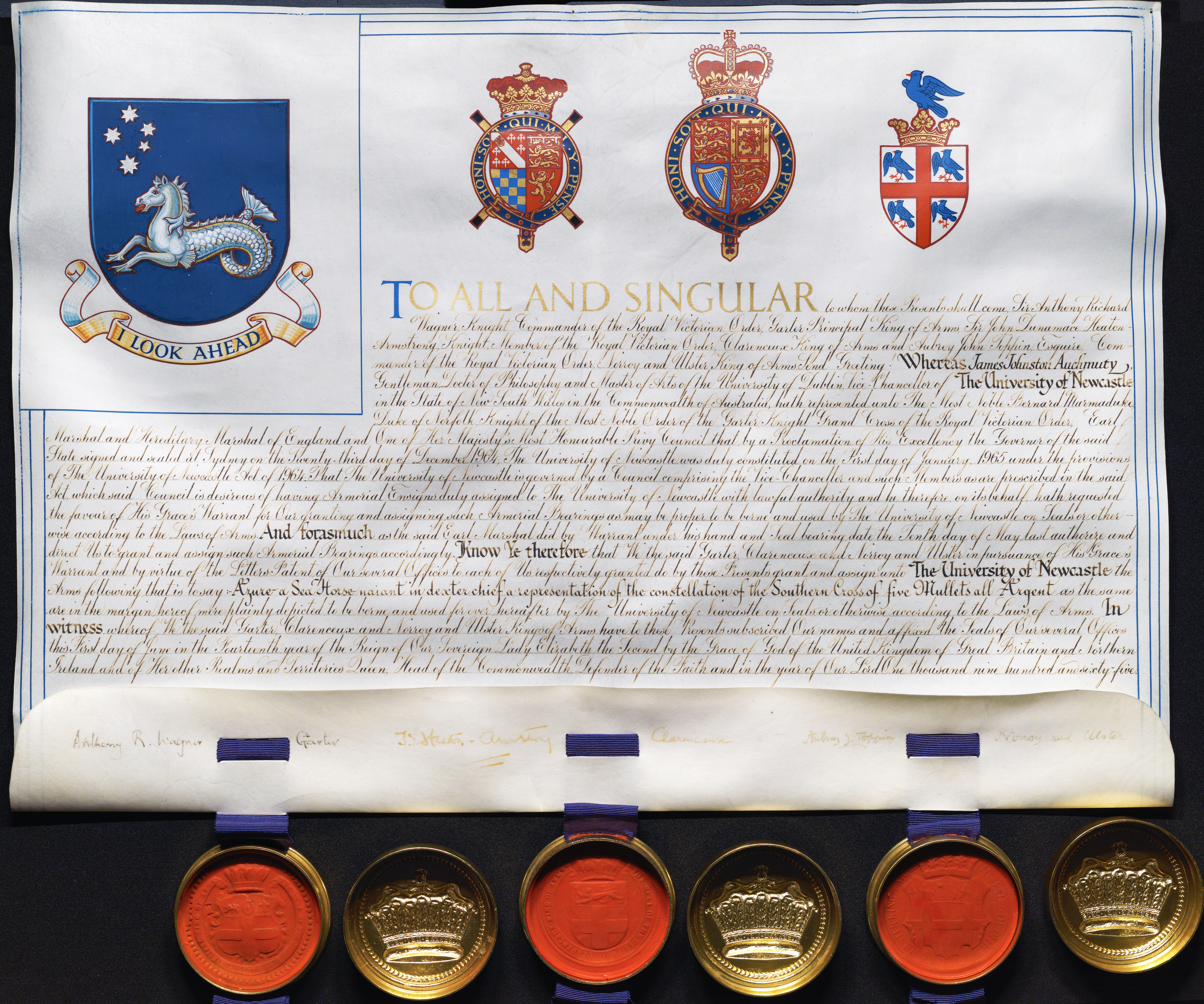
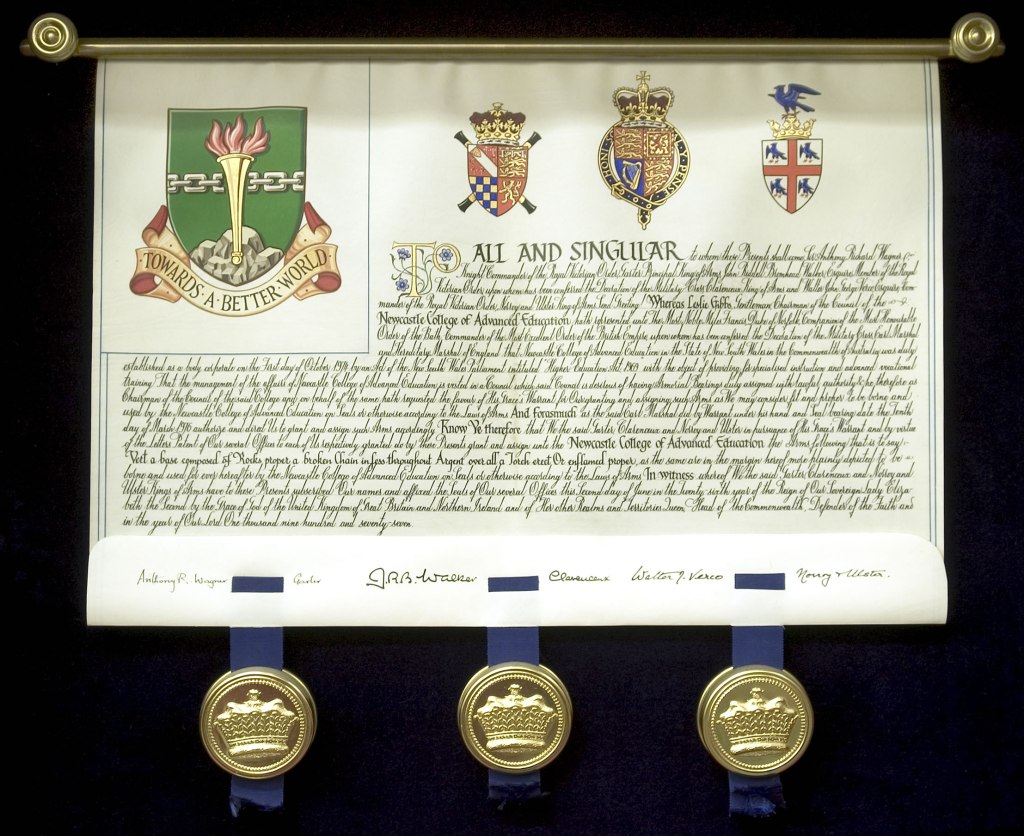
The Newcastle College of Advanced Education’s Grant of Arms (1974)
In addition the University also holds the 1974 Grant of Arms for the Newcastle College of Advanced Education, an institution which in its later incarnation as the Hunter Institute of Higher Education amalgamated with the University of Newcastle in 1989.
Further Reading on the History of Grant of Arms
For further reading on the history of Grants of Arms see The Herald Painter | The Heraldry Society
The University of Newcastle Act
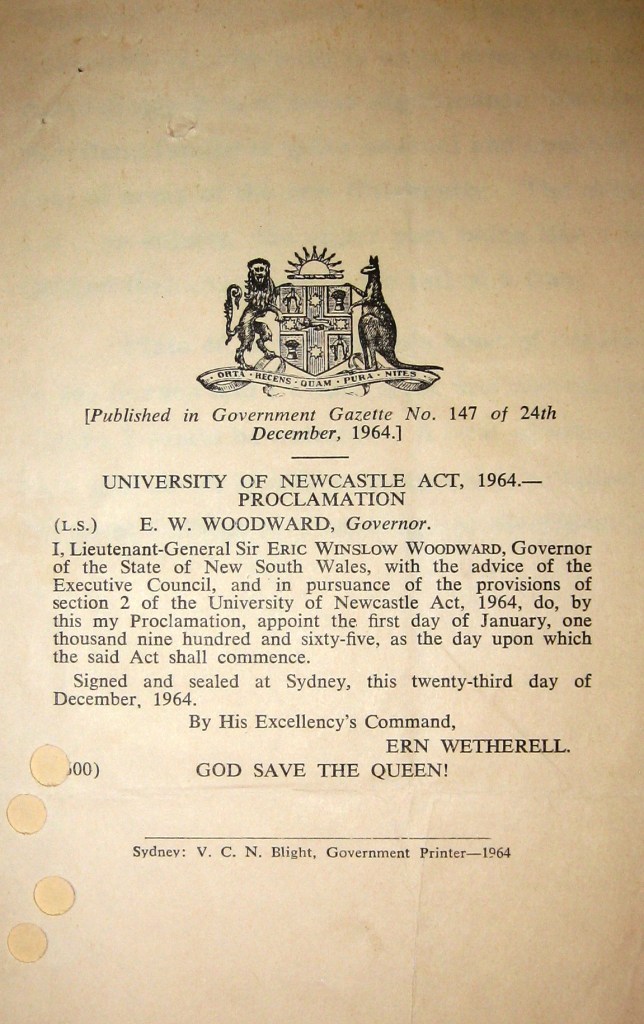
The University of Newcastle was constituted on the 1st January 1965 by a Proclamation of His Excellency the Governor of New South Wales and signed and sealed on the 23rd December 1964 under the provisions of the University of Newcastle Act of that year.
The Symbolic Ceremonial Bonfire on the future site of the Great Hall
According to folk legend, our understanding is that autonomy for the University officially began on the 1st January 1965 with a symbolic ceremonial bonfire held at the site of the Great Hall and officiated by the legendary Professor Godfrey Tanner who poured wine libations on the ground to sanctify the land upon which the University rests. The bonfire signified the “the joy of attaining long sought destiny”.
So why isn’t Autonomy Day at the University celebrated on the 1st January of each year?
Again according to Don Wright, Autonomy day is normally held in early July, and students interpreted it as celebrating the autonomy of the University of Newcastle, from the University of New South Wales. The date actually coincided with the winning of autonomy by the University of Technology from the Public Service Board control on the 1st July 1954. The students were entitled to give the celebration whatever meaning they chose. The fact that they called it ‘autonomy day’ heightened the students’ sense of the importance of autonomy and their need to defend it against outside interference. (Wright, 1992):113
The Original Inspiration for the Seahorse Design
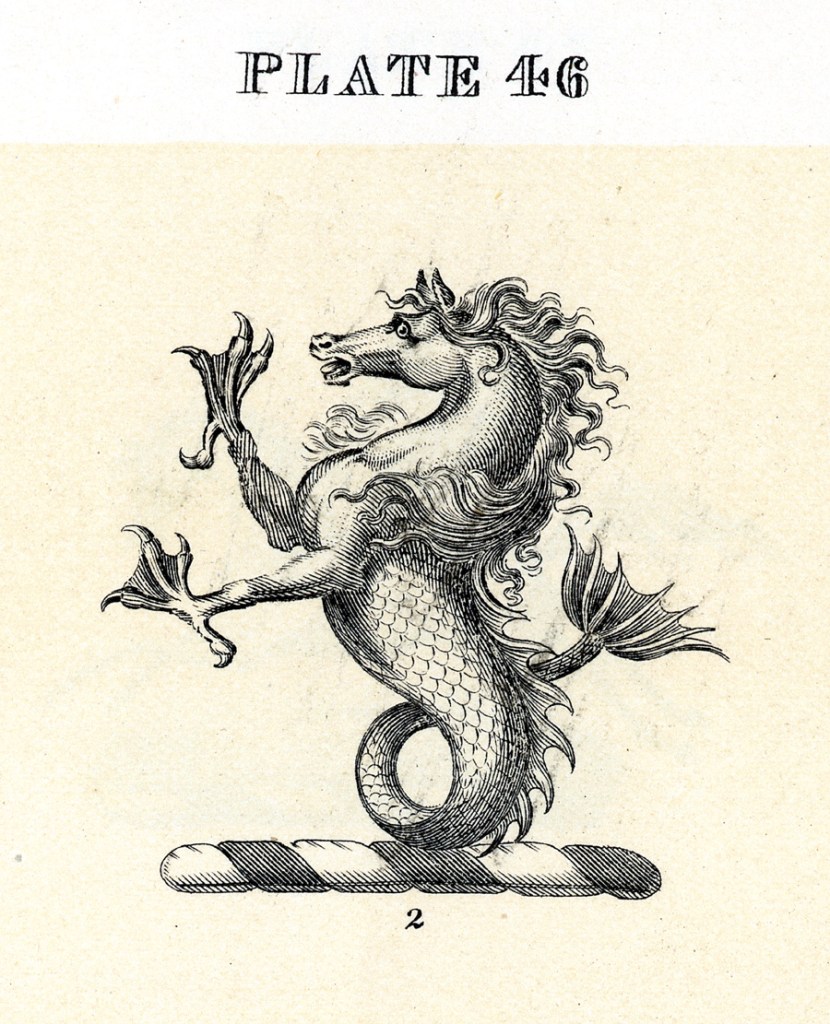
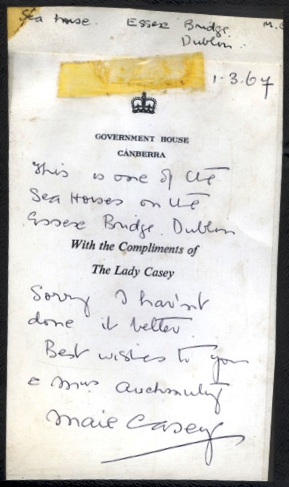
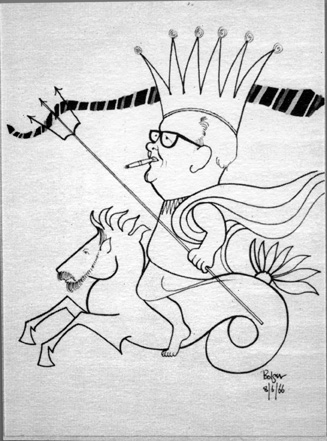
The original inspiration for the University’s (former) seahorse design came from Plate 46 (Figure 2) in Fairbairn’s Book of Crests. This was Professor Auchmuty’s favourite design. (see illustration above)
‘Newcastle was originally discovered by Lieutenant Shortland in 1797 and the site on which the new University of Newcastle is to be built is on an area which is today called Shortland. Accordingly, it is of some consequence that the crest of the Shortland family is quite unusual and could be adapted as the coat of arms of a new University…. I have looked through the coats of arms of various Oxford and Cambridge Colleges and other Universities and it seems to me that a coat of arms occupied solely by a sea-horse would be comparable to those of Downing or Emanuel College at Cambridge or Hartford College at Oxford’ (Ref. Letter dated 5th January 1965 from Professor J.J. Auchmuty to J.R.B. Walker, Lancaster Herald College of Arms, Archives Shelf Location A6395 – Coat of Arms File 1964-1980)
How The Grant of Arms Was Attained
A request to The Duke of Norfolk, Earl Marshal and Hereditary Marshal of England was made on the 25th January 1965 on behalf of the University for Armorial Ensigns to be’ duly assigned with Lawful Authority as may be proper to be borne and used by The University of Newcastle on Seals or otherwise according to the Laws of Arms’. Discussions as to the design continued between Professor J. J. Auchmuty and Lt. Col. J. R. B. Walker, M.V.O., M.C., Lancaster Herald at the College of Arms in London. Auchmuty wanted a design that was both striking and original.
Coat of Arms Based upon Shortland Family
The coat of arms was based upon the that of the Shortland family. Lieutenant John Shortland led the first Colonial Expedition to Newcastle in 1797, and the site upon which the University was built was called Shortland.
The Seahorse Motif on Shortland’s Coat of Arms
It is also significant that the arms of the Shortland family, which depict a seahorse, a mythical, heraldic creature, are quite unusual and have been easily adapted to the coat of arms of the University. The differentiation between the Shortland coat of arms and that of the University has been achieved by including the Southern Cross in the upper part, on a azure blue background.
The University Motto “I Look Ahead”
The motto adopted for the University ‘I LOOK AHEAD’ was approved by Council in August 1965 and was in keeping with the ambitions of a University and the appearance of the seahorse on the shield.

Arrival of the Coat of Arms
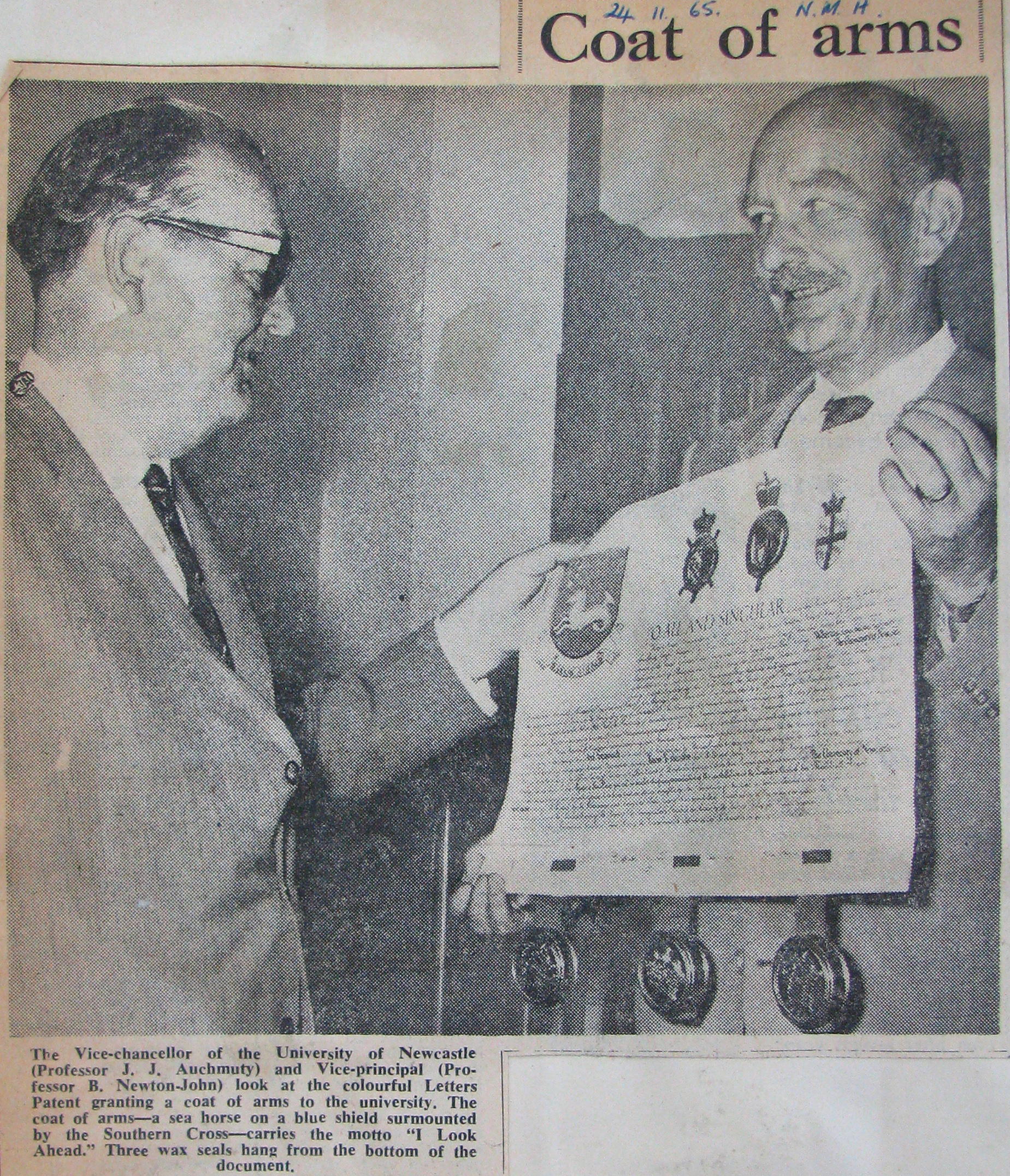
The Letters Patent for the Grant of Arms to the University of Newcastle arrived around 26 October 1965. The Date of the Grant was 1st June 1965 and date of the Earl Marshal’s Warrant 10th May 1965.
The Newcastle University College of the University of New South Wales, then known as the New South Wales University of Technology, was established on 3rd December 1951. The University of Newcastle, created under The University of Newcastle Act, 1964 came into being on the 1st January 1965.
THE SEAHORSE
by Professor Ken Dutton
The seahorse, or more strictly the hippocampus, was a prominent feature of the arms of the Shortland family, a West of England family of strong naval tradition, several of whose members were closely involved in the first days of white settlement in Australia. One of them, Lieutenant John Shortland, RN (1769-1810), is recognised as being the first “official” European discoverer of Newcastle.
Who Was Lieutenant John Shortland?
Shortland was the son of another Lieutenant (subsequently Commander) John Shortland, RN (1739-1803), who was naval agent to the transports of the First Fleet which reached Australia in 1788. The Shortlands had long used the marine emblem of the hippocampus in their family crest as an evocative symbol of the seafaring life.
Shortland After Escaped Convicts
In September 1797, the Government’s largest and best boat, the Cumberland, while on its way from Port Jackson to deliver stores to the Hawkesbury River, was hijacked by convicts who formed part of its crew. These “villains”, as they were described, threatened the life of the coxswain and put him ashore with some others before sailing further up the coast. Governor Hunter despatched the 28-year-old Lieutenant Shortland in a government whaleboat to search for the Cumberland and its occupants.
“A Very Fine Coal River”
On 9 September, Shortland’s crew rowed through the entrance of Newcastle Harbour, and as far as Port Stephens before turning back. While hugging the coast, Shortland (in his own words) “discovered a very fine coal river, which I named after Governor Hunter.” He also made the first chart of the harbour and collected some samples of coal.
Shortland First Significant White Figure
Although it is thought that Shortland may not have been the first European in the area (some fisherman being believed to have taken shelter there from bad weather, and some escaped convicts also having passed through), he is rightly remembered as the first significant white figure in the history of Newcastle and the Hunter region.
Shortland’s Name of Suburb
In 1962, it was decided that the Newcastle University College, on attaining autonomy as the University of Newcastle, should have its own campus on government-owned land in the suburb of Shortland. Autonomy was finally achieved on 1 January 1965, and the first buildings on the Shortland site were opened in 1966.
Coat of Arms
The newly-autonomous University was granted its own coat-of-arms by the College of Heralds in England in 1965.
In view of the significance of Lieutenant Shortland’s discovery, and the location of the University in the suburb bearing his name, the arms of the Shortland family were used to form the basis of the University’s official crest.
Seahorse or Hippocampus?
Although the grant of arms spoke of a “seahorse naiant” (i.e. swimming), the illustration on the grant shows not a naturalistically-drawn seahorse (which, in heraldic language, would be called a “seahorse proper”) but rather a hippocampus – a mythical beast rather resembling a “merman” with the head of a horse.
Monsters Found In Unexplored Seas
This figure would be familiar to those cognisant with early maps of the world, in which a hippocampus is sometimes shown as one of the monsters found in unexplored seas. In classical mythology, it was also the beast on which the god Neptune rode. To the Shortland “seahorse” was added the Southern Cross – the constellation at which the original inhabitants of the area, the Aboriginal people of the Awabakal Tribe – had gazed upwards for tens of thousands of years.
The Heraldic Description and What It Means
The official heraldic description of the University’s arms is:
“Azure a Sea Horse naiant in dexter chief a representation of the constellation of the Southern Cross of five Mullets all argent.”
In plain English, this means:
“On a blue background, a seahorse swimming. In the top left-hand corner a depiction of the constellation of the Southern Cross, made up of five white stars.”
[The term “dexter”, in heraldry, means “left”, despite its Latin meaning of “right”: this is because the arms represent the shield as viewed from behind, i.e. the perspective of the person carrying the shield as distinct from that of the viewer.]
“I Look Ahead” Millions of Years Into The Future
The motto assigned to the University was: “I Look Ahead”. At its inception ceremony in 1965, the Foundation Vice-Chancellor, Professor James Auchmuty, reminded those present that they were laying the foundations for hundreds of years into the future.
From Shortland to Callaghan
Like an individual person, the University of Newcastle is a living organism, which changes over time whilst retaining the same fundamental identity. One of the many changes that have taken place since autonomy in 1965 is that in 1992 the campus and surrounding suburb were formally given the name “Callaghan” in honour of the late Sir Bede Callaghan, Chancellor of the University from 1977 to 1989.
Another Reason to Keep the Seahorse
That this change broke the direct link with the name “Shortland” makes it all the more important that the seahorse has been retained in the University’s visual symbolism, as a reminder of its tradition and heritage.
The emblem currently used in order to “badge” the University is a strong visual reminder of the institution’s official crest and the history that lies behind it.
For further information see selections from the Archival file:
A6395 – File 1/76 University of Newcastle Coat of Arms Design and Manufacture by College of Arms 1964-1980
Thanks for the assistance of Emeritus Professor Ken Dutton and the photography of Dr Ann Hardy.
Compiled by Gionni Di Gravio OAM
University Archivist & Chair, Hunter Living Histories
3 thoughts on “UON60: The University of Newcastle’s Grant of Arms”