FROM
NEWCASTLE BRANCH OF THE STATE CONSERVATORIUM OF NEW SOUTH WALES
TO
NEWCASTLE CONSERVATORIUM OF MUSIC

Junior Strings Classes With Teachers Rene Kearns and William Bowmore, at the Newcastle Conservatorium of Music, late 1960s.
In a nutshell:
(i) Nissan Hut in Civic Park (1952-1957)
(ii) The Cultural Centre (1957 – 1980)
(iii) The People’s Palace (1980 – 1986)
(iv) Amalgamation with University of Newcastle 1989
(v) The “Con” (1989-Present)
The Newcastle Conservatorium was established in 1952 as a branch of the New South Wales State Conservatorium of Music. It amalgamated with the University of Newcastle in 1989. It has enjoyed encouragement and support from the Newcastle City Council and other local bodies.
The Foundation Principal was Mr Harold Lobb, MBE, and other Principals have included Mr Keith Field (1968 – 1973), Mr Peter Martin (1975-76), Mr John Winther (1977-1980), Mr Michael Dudman (1980-1994). In 1989 Dudman’s title changed to being that of Dean and Director when the Conservatorium became the Faculty of Music for the University of Newcastle. He eventually became Professor upon being given a personal chair in Music. He was succeeded by Robert Constable (1994-2007), Carmel Lutton (2007-2008), Richard Vella (2008-2019?). Then, Professor Frank Millward, Professor Paul Egglestone, Professor Catharine Coleborne and now Professor Kate Nash. The current Conservatorium Coordinator is Dr Sue Carson (2024-)
Until 1980 the Conservatorium occupied the top floor of the Newcastle War Memorial Cultural Centre in Laman Street. In that year the NSW State Government purchased for the Conservatorium fine new premises in Auckland Street, formerly known as the People’s Palace. The Conservatorium moved there in February 1981. It is now located as part of the University of Newcastle’s City Campus.
A magnificent new concert hall, was opened in 3 July 1988. The Harold Lobb Concert Hall is a premier facility, which is in constant demand for concerts by local, interstate and international artists.
For more information: www.newcastle.edu.au/campus-life/newcastle/newcastle-city…
Newcastle Conservatorium Born in a Hut in Civic Park in February 1952
The Newcastle Conservatorium was born as a community music school in a temporary nissan hut placed in Civic Park in February of 1952. There were 11 students and 7 teachers.
Life for Music Students in Australia
During the 1870s a music education was to be had overseas. By 1884 music education as a tertiary study was introduced in Australia at the University of Adelaide with the Elder Chair of Music. On the 6th May 1915 the New South Wales State Conservatorium of Music Established in Sydney.
The Four Bacchanalians and the Flute Player in Newcastle 1826
“I have been among the ruins of ancient cities and paused, believing that I flet the phantoms of romance flitting around – but Newcastle conveys a sensation as much otherwise as is found in eating chalk and cheese. The situation is nevertheless charming, and it will one day become ensouled. It stands on the promontory of a sweeping hill, which overlooks a large extent of coast, and the Southern ocean; like Sydney, it is a wonderful place, you go up and down it and wonder – what next! – there may be people of sentiment in it for aught I know, but I was not lucky enough to meet them. Four Bacchanalians, coupled arm in arm following a flute-player, was the most classic exhibition that struck me; they appeared such a loving group, and reeled so naturally to the music.” (my italics) – No Title (1826, June 30). The Monitor (Sydney, NSW : 1826 – 1828), p. 2. Retrieved February 13, 2025, from http://nla.gov.au/nla.news-article31757603

The witness who recorded the “four Bacchanalians” dancing arm in arm to a flute player was from a third diary account of published Travelling Correspondent’s Visit to Newcastle in 1826. The connection between music and the Newcastle as a place becoming “ensouled” is interesting to note, when one compares it to the “other” ancient culture of the Aboriginal people of Newcastle Mulubinba, who had embedded music and everything that went with it as part of their enduring cultural and spiritual practice.
The Musical Life of the Coalfields 1860s – 1870s
The European migrant populations of Newcastle did have a fledging musical scene consisting of amateur brass bands and other musical ensembles springing from the industrial background of the city. For a deeper understanding of this musical life in the Newcastle and Hunter Region of the 1870s see the work of Associate Professor Helen English here.

Celebrating the Centenary of the 1924 Overseas Tour of the BHP Newcastle Steel Works Band
The Newcastle Childrens’ Orchestra Circa 1930s

Bronwyn Law sent us this photograph in 2022 which she described as the Newcastle Conservatorium Youth Orchestra circa 1930s. She writes:
“This photo is of the Newcastle Conservatorium Youth Orchestra that existed in the 1930s pre WW2. My father is front row 4th from the left. He was a violinist as was his mother. All my family played a musical instrument so there were many at home concerts in my growing up years. Dad looks about 12 or 13 which puts the time frame in 1933-34. Dad, Ronald Deakin, was born in May 1921. Back in the 30s the Newcastle Children’s Orchestra was well established.”
She reformed the Newcastle Conservatorium Children’s Orchestra under the baton of Errol Collins in 1980s. Michael Dudman was head of the Conservatorium at the time. Her daughter and her musical friends were all involved. As a local teacher who ran all the Annual Newcastle Primary School Music Festivals for over twenty years, she was able to round up enough students to form this orchestra and possessed the knowledge of who was learning what in local primary schools. The Orchestra grew to 180 children, many of whom ended up learning at the Conservatorium. It performed at the Sydney Opera House and Newcastle City Hall. This could therefore be the second part of a history of the Conservatorium Children’s Orchestra Bronwyn has all the records in her possession. So watch this space.
Dreams on the March
Prior to 1947 the Reverend Harold Marshall formed a liaison committee to discuss a Conservatorium in Newcastle. Mark Howarth, Myra Thomson and Douglas McDougall formed committee to raise finance to build a composite centre embracing the Arts.

Newcastle Becomes “Ensouled” in 1949 with the “Music Out Of Doors” Event in King Edward Park
“Give me books, fruit, French wine and fine weather, and a little music out of doors, played by somebody I do not know.”
– John Keats to Fanny Keats, 29 August 2019
Inspired by the words of poet John Keats, Newcastle began a series of huge public “Music Out of Doors” events in King Edward Park from 1949. These performances were attended by many thousands of people.

Conversations Begin
Frank Hutchens and Harold Lobb begin conversations concerning a Newcastle Branch of the State Conservatorium.
Principal Harold Lobb with Students Judith Ley and Gwenneth Pryor viewing donations to Newcastle Conservatorium Of Music Library, 1952.

YOUR OLD MEN SHALL DREAM DREAMS,
YOUR YOUNG MEN SHALL SEE VISIONS.
[MOTTO OF MR HAROLD LOBB MBE]

Mr Frank Hutchens. Piano Teacher, composer and one of the founders of the Newcastle Conservatorium. Mr Frank Hutchens became Professor of Music at the Newcastle Conservatorium Of Music, circa 1960s.
The Pianos Start Their Journey From Sydney to Newcastle, 1952

Moving Cultural Centre Temporary Premises to Civic Park for house Newcastle Conservatorium Of Music, 1952.

Elvy’s Sydney Supply Collard & Collard Pianos To Conservatorium Of Music Newcastle, 1952.


Harold Lobb Watching Piano Movers Into Temporary Building at Civic Park Newcastle Conservatorium Of Music, 1952.
The activities pictured above were all completed around the 22nd February 1952, with the ‘birth’ of the Conservatorium in a crude Army Nissan Hut in Civic Park, shaken and soiled by passing coal trucks. It had a teaching staff of 11 and 163 students.
The Official Opening 29 April 1952

Plaque for Building Pending Completion Cultural Centre Conservatorium Of Music, 29 April 1952.
![Harold Lobb greets Eugene Goosens at Newcastle Train Station, probably on eve of official opening on the 29 April 1952 when Goosens visited for the opening of the Newcastle Branch of the Conservatorium of Music. [Image provided by Roland Bannister]](https://hunterlivinghistories.com/wp-content/uploads/2025/02/GoossensLobb-copy.jpg)

Presiding over the ceremony was Harold Lobb (Principal) and Eugene Goossens Director of State Conservatorium of Music present.

The Newcastle Conservatorium attracted the most outstanding musical figures such as the operatic diva, Florence Austral.

Pictured above is Florence Austral with Eugene Haynes Newcastle Conservatorium Of Music, 25 April 1952.
The Temporary Hut Come Under Attack!
By June 1952 the temporary premises in Civic Park come under attack from an army of borers, they lay waste on their way to the pianos. The musicians realise they must leave.
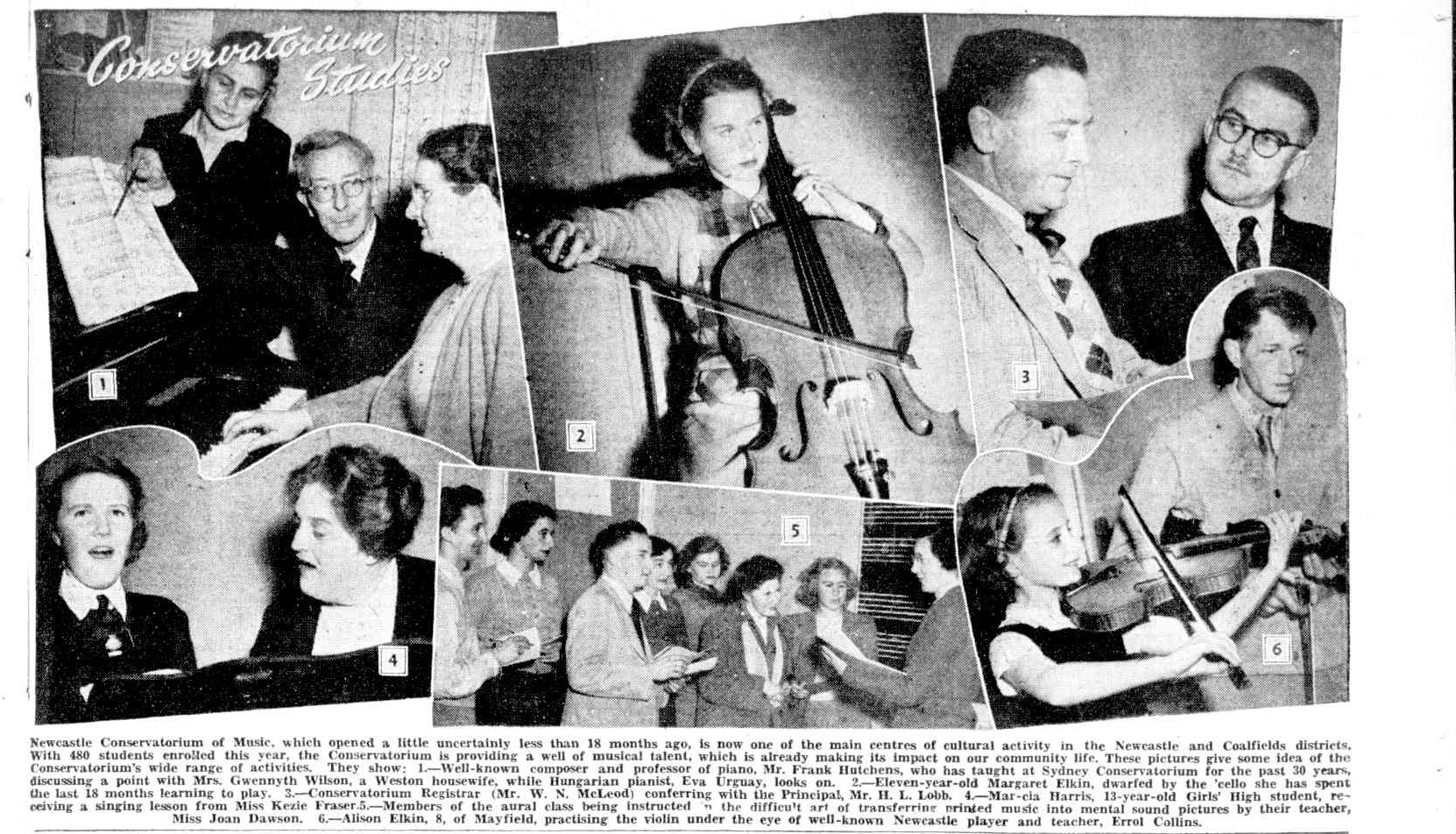
Conservatorium Studies Feature in the Newcastle Sun, 30 July 1953, p.15
War Memorial Cultural Centre in 1957
The Conservatorium moved away from the temporary hut to a home on the top floor of the War Memorial Cultural Centre in Laman Street, Cooks Hill in 1957.

Opening of War Memorial Cultural Centre Housing Newcastle Conservatorium Of Music, 26 October 1957. Conservatorium moves to upper floor with eleven studios, small hall, two lecture rooms, administrative offices, library and no borers. The Conservatorium Orchestra, under the baton of Errol Collins played “Prelude for a Ceremony” especially written for the occasion by Frank Hutchens. By 1964 Student enrolments grow to 608.
More Moves & Expansion in the 1980s
In 1979 the Conservatorium moves to TPI House Auckland Street. On 2nd February 1981 Conservatorium moves to People’s Palace site, just around the corner. On the 26th April 1983
Newcastle Conservatorium Children’s Orchestra, Errol Collins (conductor) at a small function room in Newcastle City Hall. In 1985 Arts Ball with Newcastle Conservatorium Orchestra, conductor Robert Constable. In 1988, the site was expanded to include a performance complex.

Orchestral Work Supervised By Errol Collins Foundation Staff Newcastle Conservatorium Of Music, circa 1980s.
On the 3rd July 1988 the Concert Hall opened.
1989 Amalgamation with the University of Newcastle (Australia)
The University of Newcastle was created by the University of Newcastle Act, 1964 which commenced on 1 January 1965. The University was the autonomous successor to the Newcastle University College, which had been a dependency of the University of New South Wales. The Act of 1964 was subsequently superseded by the University of Newcastle Act, 1989. The Hunter Institute of Higher Education and the Newcastle Conservatorium of Music were amalgamated with the University under the Higher Education (Amalgamation) Act, 1989, effective from the 1st November, 1989.
Excerpt from 50th anniversary speech by Professor Robert Constable
“Real emancipation only came in 1990 when the Conservatorium joined the University. It was then that the Con could really spread its wings and fly, unfettered by the parent body. The long (some would say, too long) gestation had certainly prepared the Conservatorium for its new responsibilities. New programs were commenced, new staff positions created, more students were available for recruitment into the growing number of academic programs.
Throughout the 90s, the Conservatorium also began to shift the balance of its activities into tertiary education and research. More University influences and opportunities were at work here. Notwithstanding this growth in professional and research areas, the Conservatorium has not lost touch with its roots. Its non-tertiary programs have grown and this year look like reaching 1500. This makes us, without a doubt, the largest Conservatorium in Australia. Our pre-tertiary students are mainly school age children, and some are in preparation for future entry into tertiary programs. Our preparatory programs and our other community work are vital to the success of the Con and vital to the city. The State Government financially supports this work.
Even by national standards, this Conservatorium is now a very large school in all its parts. It is extremely complex, offering as it does a sort of ‘cradle to grave’ approach to music education. The Conservatorium produces performers, composers and teachers of exceptional skill and musicianship, it educates and entertains the public, it offers in-service professional coursework programs, it has an off shore program in Malaysia, it is affiliated with leading universities and music colleges throughout the world, and it teaches ‘online’ throughout the world.
The Conservatorium has always been proud of its academic standards. Even under the watchful eye of Sydney, there was always a local sense that Sydney misjudged the quality of what happened here. The academic and performance standards were equal to other similar programs elsewhere. All that Newcastle really lacked was a ‘critical mass’ of activity.
Throughout its life, the Con grew in strength, academic rigour, and in the number of friends it gathered around it. There was an inevitability abouts its progress, even when the progress seemed too slow.
If I had to nominate one single event, one single happening which has allowed the Conservatorium to flourish into maturity, I would not name a person, or a particular period, significant though any number of people or periods might have been. I think history will judge that the single most important occurrence was the creation of this concert hall. Anyone who attempts to analyse and write a history of the Conservatorium in Newcastle will always return to this one central entity, its concert hall, as having provided the means of attaining substantial growth in every direction. All the Conservatorium had to do was learn to exploit it. Without this hall, students and staff would not be inspired to try as hard as they do; without the hall, standards could not have risen as they undoubtedly have; without this hall there would be no Stuart piano, certainly not in Newcastle and probably not anywhere else; without this hall, there would have been stifled growth in every domain; without this hall, real partnerships such as we have with Musica Viva, the Australian Youth Orchestra, Symphony Australia and the ABC would not have been possible; without this hall there would only be limited opportunities for international partnerships; without this hall, we could not have contributed as much to the University and nor could the University have contributed as much to us. The hall is the heartbeat of the Con and it is the envy of every other Conservatorium in Australia and most from overseas, for that matter.”
For more historical information see: Kenneth Wiseman’s From Park to Palace A History of the Newcastle Conservatorium of Music 1952 – 1986.
We will to thank the City of Newcastle Local Studies for the use of the early images of the Conservatorium that were sourced from their archives for inclusion in the Conservatorium’s Photo Albums.
Compiled by
Gionni Di Gravio OAM
University Archivist & Chair, Hunter Living Histories
5 thoughts on “UON60: Prehistory of the University of Newcastle – The Newcastle Conservatorium of Music – Born in 1952”