


Australian Society of Archivists Conference 2023
We are delighted to announce that the Australian Society of Archivists National Conference 2023 accepted our Conference abstract. It’s called The Immortal Archive, Vita Brevis Ars Longa or how to build resilient memory palaces . The Australian Society of Archivists conferences attract delegates from metropolitan, regional and remote Australia, the Asia-Pacific and International. It is a great honour to address our colleagues working across GLAM in institutions large and small.
Rising to our Challenges – Archives at the ‘G’
This year’s theme is Rising to Our Challenges, i.e. how we:
- value archival organisations;
- respect our professional knowledge and skills; and
- adequately resource and support recordkeeping functions.
Our paper explores these matters from a regional institution’s perspective.
The University of Newcastle’s Archives held in Special Collections Auchmuty Library holds the Hannan Photographic Archive. It spans an almost unbroken photographic record of the Hunter Region, Australia from 1953 to 2011. It consists of over a million negatives documenting all spheres of human activities from family, business, industry, and public events.
We have also been active in safeguarding the audio visual history of Newcastle and the Hunter Region dating back to at least 1915, as well as assisting with the digitisation of the NBN Television Archive dating from 1962, and spanning over a million feet of film and magnetic tape.
The work involved in processing both these archives will take generations to accomplish, hence the need to discuss the measures that need to be in place to meet the challenges, threats and opportunities in the creation of an immortal archive for future generations.
The Immortal Archive
The Immortal Archive, Vita Brevis Ars Longa or how to build resilient memory palaces

The Abstract
Many donors bestow their cultural treasures to our safekeeping, believing that they will be safeguarded in perpetuity. But how can we guarantee that our memory institutions will survive into the future?
Besides the ongoing threats of funding, resourcing, environmental disasters, political instability & upheaval, cultural institutions in recent years have also had withstand sustained economic, political and religious ideological attack as well as rise of managerialism, incompetence and digital dystopia. Funding threats to such an established public treasure as TROVE has brought home that it may all disappear.
With specific reference to the experience of a regional archival institution, we look into what we need to do to ensure two of its most at risk and formidable archives; the NBN Television and Hunter Valley Film Archive and the Hannan Photographic Archive consisting of hundreds of thousands of hours of film and magnetic tape footage and over a million+ images and respectively, has a succession plan for a sustainable future, akin to the building of a pyramid or a cathedral.
How can we create a sense of immortality in our cultural memory institutions? Immune and able to withstand the vagrancies of the philistines who to paraphrase Marie Coleman AO “are no longer at the gate, but are now inside and wrecking the place. “ (ABC The Drum July 6, 2021)


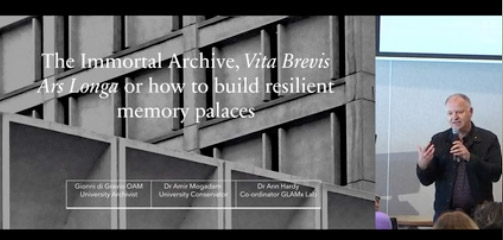
The Presentation – Speech Notes
(Originally presented at the Australian Society of Archivists National Conference 2023 held at the MCG, Melbourne as part of Program 3C Digital Transformation. Words in italics are the spoken transcript and paraphrases with extra bits, of the actual presentation a.k.a. what fell out of the mouth of Gionni Di Gravio at the time)


Introduction
Everything I’m going to say today is couched in Aboriginal custodianship of the land. Aboriginal peoples were the original archivists of this land, they looked after this beautiful, beautiful land until 260 years ago when we arrived and deprived them of their job.
They looked after for thousands of years the “living archive”, and made sure that everything that was needed was bestowed to future generations. The techniques and science on how to do it, i.e. their professional practice, they transmitted through generations through an universal and sophisticated educational process of oral tradition, rock and cave art, engravings, dance rituals sign language.
Europeans showed up around 260 years ago and said we are going to look after the land now, and manage the living archive, through a written tradition. And you can see the results through clapped out river systems, environmental degradation, poor flood and fire management techniques, and an extinction rate off the scale. So, for Aboriginal peoples seeing the destruction of their living archive has been traumatic.
And part of that trauma has been ongoing. (Next Slide Please)
Vita Brevis Ars Longa – Defining the concept
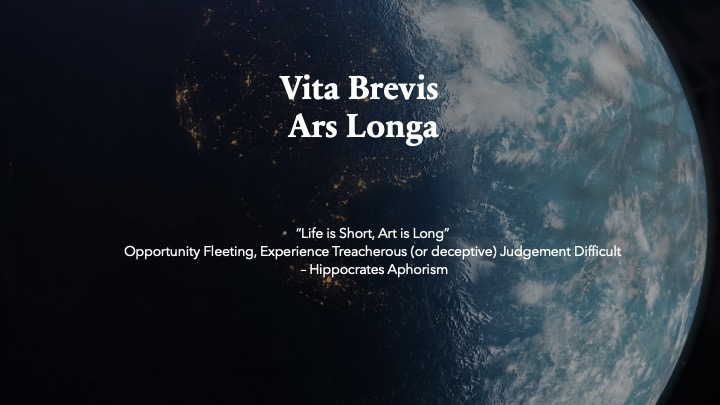
- Vita Brevis – Ars Longa (Latin/Greek/Persian) Englished meaning “Life is short/brief, Art/Techne/Work is Long”
- Connections with First Nations/Aboriginal Peoples love and custodianship of land
- This first slide is our acknowledgement and respect of Aboriginal country and approach to leaving things in better shape for future generations.
- How can we ensure our archives are immortal for future generations?
It’s Latin, for your Life is Brief, but the Work is Long. It’s hard to translate the concepts of Latin into English. English is a relatively young language, and Latin was very young also to the ancient Greek from which the expression had its origin.
The original ancient Greek comes from Hippocrates, the father of medicine, and was one of the first aphorisms ever translated into Latin. In the Greek is it beautifully rhythmic. (If you could, look it up on Wikipedia, and plug the Greek into Google Translate to listen to it)
It’s part of a longer set of verses:
- Ὁ βίος βραχύς,
- ἡ δὲ τέχνη μακρή,
- ὁ δὲ καιρὸς ὀξύς,
- ἡ δὲ πεῖρα σφαλερή,
- ἡ δὲ κρίσις χαλεπή.
- Life is short,
- and craft long,
- opportunity fleeting,
- experimentations perilous,
- and judgment difficult.
This idea that our lives, we do not know (even for the younger members of the audience) how many years, months, hours, minutes, seconds, moments we have in front of you. No one knows, we could be gone in a moment.
But most of the problems I see dealing across these things are very short term. And because this conference is all about confronting our challenges, I decided to go into the abyss, and ask, What do we really need to create an immortal archive? We want to understand the threats that confront us. (Next Slide Please)
Part 1. Vita Brevis Explaining the Problem
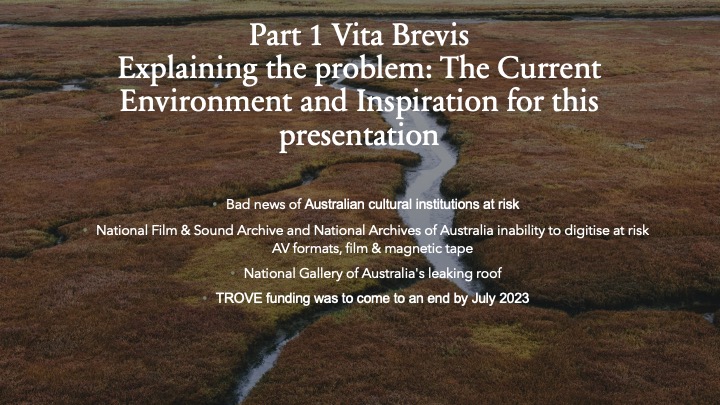
Slide 3. The Current Environment and Inspiration for this Presentation
- Ongoing bad news for Australian cultural institutions at risk
- National Film & Sound Archive and National Archives of Australia inability to digitise “at risk” AV formats, film & magnetic tape, emergency injection of $67M to do core work.
- National Gallery of Australia’s leaking roof
- TROVE funding was to come to an end by July 2023
These are the things that inspired us in this presentation. The ongoing bad news of Australian cultural institutions at risk, unable to digitise their at risk deteriorating film and magnetic tapes, core work, leaking roofs previous Liberal government’s hidden ticking time bomb in the forward budgets leading to the impending loss of TROVE. Luckily the present Albanese government stepped in and stitched it back together. But it was months and months and months of not knowing what was going on.
How do we understand this? How do we keep this stuff going, so it’s not short term anymore? The sorts of things we deal with are eternal things, that go on forever, and we are constantly stuck in these business cycles of trying to pull together applications for ourselves. And then we see projects at conference after conference, database after database that either become orphaned or no one’s going to look after them into the long term. That’s not Aboriginal thinking. If we are really fair dinkum about acknowledging Aboriginal thought and Aboriginal custodianship, we have to think in terms of very very long time, not just short periods. (Next Slide Please)
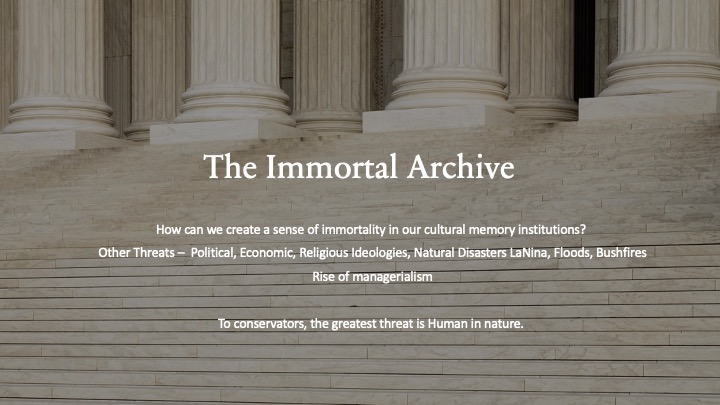
Theory: The Immortal Archive
Slide 4. How can we create a sense of immortality in our cultural memory institutions?
- The threats facing cultural institutions defined
- Humans identified as the major threat and ideology of managerialism as its manifestation.
- E.g., Natural disasters or damage some foreseen and unforseen are examples of humans taking care of risk management, disaster management and planning. ( LaNina, Floods, Bushfires)
- Rise of managerialism
So this is the idea of how do we create a sense of immortality in our cultural memory institutions?
They’re under threat. We have political threats, ideological threats. They can be political, economic, religious, natural threats like natural disasters; we’ve been seeing a whole lot of those, floods, bushfires.
But the ultimate threat, and this is something which our conservator, Amir, has alerted us to, conservators see human beings as the biggest threat.
Even things like pests and relative humidity and temperature, things I never thought of, I thought a rodent was a threat to the archive. But who controls whether the rodent can get in to the archive? Who controls how much food librarians allow students to bring in to eat into the institutions, that attract the rodents and pests into the archive?
So, the hidden thing that was brought to light in terms of the heart of some of these things , especially illuminating podcasts on the idea of managerialism.
Managerialism is the hidden elephant in the room. (Next Slide Please)

Slide 5: What is Managerialism?
- As a conservator, I have learned by experience that humans are the most important factor in both the preservation and destruction of works of art and cultural heritage.
- From a destructive perspective, human damage to cultural heritage can occur through an act or combination of acts of vandalism, destructive measures driven by ideologies (e.g., Nazis, Taliban and ISIL destroying artworks deemed corrupt), war (e.g., the Russian attack on Ukrainian cultural heritage), destroying cultural heritage under the old and modern banners of damnatio memoriae and negligent management and policies.
- The last item on this list is a matter of concern in relation to damage caused by managerialism to cultural heritage.
- Managerialism is an ideology that suggests organisations share more similarities than differences.
- Consequently, the knowledge and expertise necessary for an organization’s core business are considered secondary (Klikauer, 2015).
- Managerialism assumes little difference between the skills required to run a gallery, library archive or museum and those needed for an advertising agency.
- As a result, the idea that originally emerged for profit-seeking enterprises now dominates not-for-profit and public institutions.
- Consequences
- Risks to Reputation,
- Risks to Collections, and
- Damage to the Physical, Mental, Spiritual Wellbeing of People (i.e. psycho-social hazards) working in organisations.
- Therefore, the managerialist approach to management relies on generic management tools and knowledge, while depriving experts of decision-making power in public institutions like archives and museums. The main feature of this system is the increasing emphasis on generalism, which undermines the role of expert staff (Braverman, 1974). It also fosters a language and oligarchic structure that prioritise team fit over job fit.
- Through personal experience, I have witnessed the negative impact of this oligarchic structure, which leads to irreparable damage by draining institutions and countries of expertise and professionalism. The damage will be to the extent that at any stage, even if the organisation wants to solve its deeply neglected issue, it will be unable due to the lack of enough expertise.
- From a governance perspective, the managerialist ideology focuses on business metrics, market-based outcomes, efficiency, cost-cutting, and short-term goals. However, culture is a long-term phenomenon, and heritage preservation is a not-for-profit and ongoing endeavour. When such an ideology is applied to cultural institutions, one can observe a lack of institutional vision and expertise in leadership, as well as a deficiency in long-term planning, including risk management for cultural heritage.
- Simultaneously, this governance ideology tends to prioritise short-term goals such as entertainment over education and sidelines the necessary depth and critical engagement. While the work of GLAM (Galleries, Libraries, Archives, and Museums) institutions may not necessarily be cost-effective or short-term, there is a tendency to cut budgets or outsource critical tasks, leading to a loss of public and institutional memory and expertise.
- Within cultural institutions, managerialism results in staff burn out and job dissatisfaction, negatively impacting the performance and service provided to the public. the oligarchic managerialism structure creates a pseudo-dictatorship that psycho-pathologises staff discontent. It becomes more significant when considering the significant correlation between the competence of immediate supervisors and higher job satisfaction, productivity, and overall excellence across organizations.
- Whether in democracies or dictatorships pockets of managerial oligarchies can form, with similar outcomes. And no matter in which system, they can harm cultural institutions to an irreversible state. This paper argues that managerialism shifts cultural institutions away from fundamental values such as scholarly engagement and critical inquiry. Therefore, a change and reorientation toward expert leadership is necessary to ensure the longevity and relevance of these institutions in the future.
Managerialism, what is it?
It’s an ideology that suggests that organisations have more similarities than differences. So, knowledge and expertise considered necessary for an organisation’s core business are considered secondary. In our case, managerialism assumes little difference between the skills required to run a museum or an archive, and those of an advertising agency. As a result, the idea that originally emerged for profit seeking enterprises now dominates not-for-profit and public institutions.
So the consequences of this ideology is that your institution risks reputational damage, secondly, risks damage to your collections, and thirdly, it risks the wellbeing of your staff.
So this is an idea that been around gestating from the 1980s. When the idea that public organisations had to be more businesslike in their approaches; we needed more efficiencies, more metric. We needed no so much patrons, but now needed to treat our clients as “customers”.
And so this business mentality started to come into the management of public institutions and now runs everything. You’ve seen the recent news with the big four consultancies that have now taken over everything. We have no idea what they do. We have no idea how they operate. They’re opaque institutions that run the public sector now. They’re not accountable to anyone. They charge tax payers multiple times than an in-house institution once were able to do. And the skyroketing costs of all this drives me nuts because I don’t want that amount of money going into that sort of area. I would rather it go into young emerging professionals. Right?
But the whole idea of managerialism is that you don’t need to be an expert or versed in the industry that you run. You don’t have to have any experience. The case of the nurse in England recently convicted of killing those babies. There were professionals there that understood medical professional practice that were picking up on this, and blew the whistle. They were not listened to because the management of the place had no experience in medical professional practice.
And so, what is this professional practice? What is archival professional practice? (Next Slide Please)
Managerialism – Podcast summaries and transcripts:
Future Tense (ABC) “Managerialism and our obsession with hierarchy”
- Managerialism is an organizational theory born of neo liberal ideology.
- From the 1980s under Thatcher and Regan new public management (Christopher Hood) asked that we treat Government citizens as we treat business customers. We place the citizen at the centre of a customer service model with an emphasis on centralized control, to provide efficiency, cost savings and performance targets. Sounded great, but it hasn’t work very well.
- This idea evolved in the 1990s into public values theory to think of Government as companies, with governments creating public value equating to companies creating shareholder value.
- Managerialism therefore sees everything through an efficiency matrix that mimics the profit and loss focus of the private sector. It also separates management from the organization’s specific knowledge and expertise.
- Managerialism is the belief that only highly trained managers can run an organization, that management is a generic set of skills that can be dropped into any setting without need of specific professional qualifications or expertise in that organization. It relies on top-down power, with a strong emphasis on metrics, data and efficiency.
- Average remuneration of CEO vs Staff in the 1960s was 20 to 1, now in the 2020s it is 400 to 1. Managers make many thousands of times more that the average worker. The managerial class looks after itself, there is a real them versus us mentality and a confusion of Power Vs Authority. To them authority is a form of power.
- Power Vs Authority. Authority can be seen as a form of power because the person with authority knows something that others do not. E.g., doctor/patient relationship.
- However, power is never a source of authority. Managers have the power, but do not know the necessary professional knowledge about everything in their organization. They confuse power with authority. Therefore, authoritarian decision makers have no authority or expertise. They do not listen to experts, they only pretend. Managerialists see their staff as there to apply the executive decisions of management.
- e.g., Hospitals used to be run by medical professionals who understood professional practice. Instead now they are run by managers who treat hospitals like hotels with beds. E.g. in Higher Education the education of undergraduates is treated like a sausage factory. Little interest in education, senior lecturers who bring in funding can buy out teaching obligations to junior academics therefore the quality and standard of the education is degraded. Obsession with global rankings, whilst academic researchers and teaching has been sidelined through bloated executive management and administrative ranks. E.g. Justice system saving money degrades justice system, conveyor belt justice, police station is most important area keeping cases out of the courts and saving money, as adversarial system is expensive.
- Managerialism has spread across the world, the downsizing craze only created a blowout in the managerial classes. More managers than staff.
Podcast: “Managerialism An Infectious and Toxic Ideology”
https://podready.no/episode/2528996
- Managerialism rules the world. It is invisible and that is its power.
- Managerialism takes the factory floor to the world infiltrating all public organisations health, education, sport and recreation.
- Etymology: Manager comes from manis (hand) and ager (control).
- In the medieval period management meant the manual control of farm animals, training horses to act, etc.
- After the industrial revolution, management oversaw production process of making things.
- Frederick Taylor (Taylorism) Work of the Head, Work of the Hand Factory administration to management. Getting people as resources to accomplish management goals. Resources in, stuff out. For profit. Maximum profit for minimum input. Economic exploitation.
- Managerialists do not need to have to have any expertise or knowledge or the organizations they have to manage.
- E,g, Teritary education Ross Gittins:
“Universities have turned undergraduate teaching into money making sausage machines. Students don’t need to attend lectures, can access them online, sometime the lectures are years old, and recorded by former lecturers. The academics teaching the students are under the fear that their contracts will not be renewed if their ratings are not good. Senior lecturers bought out, and junior lecturers treated badly. Students’ education are sold short, and bamboozled with KPIs and fad metrics. Richard Hill “We get the education system we deserve”
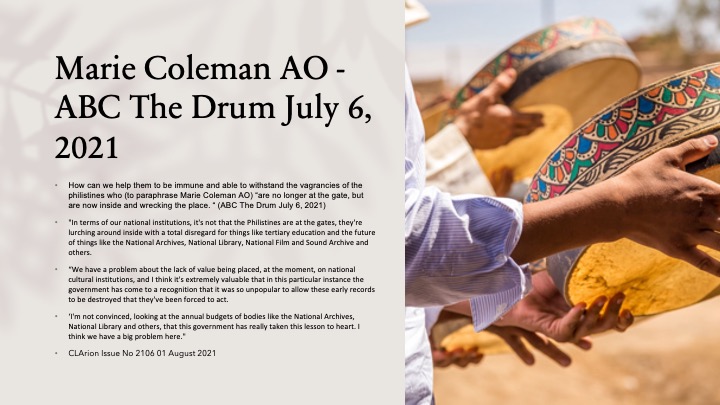
Slide 6: Marie Coleman AO (ABC The Drum July 6, 2021)
And then this wonderful woman, appears on the Drum one night. I didn’t catch everything, during a conversation about the despair facing cultural institutions, she was asked somethingabout whether the barbarians were still at the gate of cultural institutions. This was a time when the National Archives was trying to get funding to do its digitisation and they finally announced that they we getting $67 million. And she was asked “are the barbarians at the gate?” and she says, they’re no longer at the gate, but inside and wrecking the place right now.
I only recently tracked down the original quote, thanks to CLArion this is the transcript of Marie Coleman AO July 6th 2021.
Philistines invade the houses of culture
(CLArion Issue No 2106 01 August 2021)
National female icon Marie Coleman summed up the plight of Australia’s cultural institution on the ABC’s ‘The Drum’ last month. after the recent exceptional, emergency payment of $67 million over four years to National Archives because it had run out of money to do its core work properly.
Coleman (photo: NLA pic) was the first woman to head an Australian statutory authority. She has an AO and a Public Service Medal.
“In terms of our national institutions, it’s not that the Philistines are at the gates, they’re lurching around inside with a total disregard for things like tertiary education and the future of things like the National Archives, National Library, National Film and Sound Archive and others.
“We have a problem about the lack of value being placed, at the moment, on national cultural institutions, and I think it’s extremely valuable that in this particular instance the government has come to a recognition that it was so unpopular to allow these early records to be destroyed that they’ve been forced to act.
‘I’m not convinced, looking at the annual budgets of bodies like the National Archives, National Library and others, that this government has really taken this lesson to heart. I think we have a big problem here.”
A neat encapsulation of the current situation, writes Dr Ray Edmondson, the ‘father’ of the NFSA and a CLA member. See: https://insidestory.org.au/authors/ray-edmondson/ 23 July 2021
Now, if that’s the National Archives, the National stream, then what hope have we got in regional or remote Australia? What are we going to do with all those at risk formats? Thanks Marie (Next slide please)

Part 2 Ars Longa, Art is Long – Discussion, Solutions, etc,
Slide 7. National and Regional visual and photographic archives
I’m speaking generally, because these are the sort of things anyone could have. So, photographic archives. The Hannan Archive that our conservator Amir is photographed with here; there are over a million+ images. This was a phoographic firm, we got the entire archive! They photographed everthing families, public events, industrial things, they photographed ship building of every ship that came off the Carrington Slipways. Not only did they photograph every ship coming off the slipways, they photographed it in stages as it was being constructed. So we have an incredible photographic legacy.
But, there’s one conservator. There’s no apprentice. There’s no workshop, there’s none of that. He works at a little desk doing a million+ archives.
So what are you going to do with this stuff? What sort of a plan are you going to have? I started thinking that the approach we should have is really like a 500 year plan, like people who build cathedrals. We have to think long term. (Next Slide Please)

Slide 8. Audio visual archives
- At risk formats including photo, film, TV, magnetic tape, audio etc million feet of footage
Then there’s the audio visual archives. You store these wonderful machines. We’re lucky we have some volunteers, ex-production guys (from the NBN Television Channel in Newcastle) that have set up a lab, buying machines on eBay, and they’ve basically been digitising all our magnetic tape. If you have any questions, they’re there to answer anything on the technical side of that. These guys have been wonderful, but they’re ageing guys. They’re older fellows, and some are just on their last legs and they’re still doing this work. They’ve digitised hundreds of thousands of hours of audio visual material. They understand how it was produced, they understand where the secrets, where they’ve put information on the reels, understood as the technologies changed during the 20th century. Now we would love to join the expertise of these guys and transmit that knowledge and expertise and technical know-how to younger students. They could look at this and say “Who cares? I’m in the era of Facebook and Instagram and Tik Tok. I don’t have to worry about VHS tape.” But human being love creating new things, new ways of doing things, but they don’t always think about where this stuff, where the important bits are going to be kept or how they are going to keep these important bits. So, it’s all at risk, it has to be done quickly. It has to be done now. But then you get tied up again into this silly business world that thinks about copyright and IP and all this nonesense between solicitors..who will care in one hundred years? We’re thinking as archivists, right? And if your’re thinking about Aboriginal archivists, then your’re thinking about thousands of years, aren’t you?
What’s the 47,000 year plan for this stuff? (Next slide please)
Case Studies
- NBN Archive – quick facts, 1961+, million feet footage, race against time, volunteers etc Capturing and unlocking a community Audio-Visual archive
- Preparation and digitisation of audio-visual formats require not only specialist knowledge and skill, but leadership also that takes a common-sense approach essential. There is no time to wait to lengthy agreements to be drafted around Copyright/permissions, ownership of the physical item is quite different to who owns the copyright which can be sorted out in the future. What is being lost by not acting now to digitise, is not only the means of physically doing it, but the opportunity for creators to view, review and provide important knowledge about content, context and technologies used to capture. As we know there is an urgency to digitise audio visual formats (especially magnetic tape).
- Audio visual formats need to be digitised now, or at the least planning for the commencement of digitisation. Institutional support to do this is paramount. Special Collections have started this process in preparing and digitising film/magnetic tape/audio incudes the region’s television AV archive estimated to be million feet of footage. The team of industrial professionals and volunteers have been successful in digitising all magnetic tape from the local television archive. There has been challenges in working with vulnerable formats. Firstly, there is no dedicated area for conservation of film formats (only preparation area available). The specialised team is led by Phillip Lloyd, Adjunct Lecturer with Creative Industries who supervisors’ volunteers, many of whom have specialist knowledge AV formats. This community of practitioners with specialist knowledge and skill is vital in the digitisation and for mentoring the next generation.
- The lack of funding is also a challenge. As mentioned, the digitisation being done at Special Collections is being done by those with specialist knowledge, who are passionate about preserving the history of this regional television archive. Funding is also an issue in terms of purchasing industry standard equipment and software for the type of digitisation being done. It is not always the case that an institution’s supported software is the most suitable, therefore a strong use case as to why specialist software is required needs to be written. This can take some time, even if supported may not be considered a priority. Another challenge is the purchase of equipment and parts. Most of the equipment in use at the GLAMx Lab for AV digitisation is second hand, are original machines such as projectors and magnetic tape players. These old machines are using purchased on online marketplaces such as eBay or are donated. Many institutions are set up to only purchase new goods and equipment and have distributors they deal with. This can make it very difficult to purchase second hand equipment.
- The ageing technical expertise is also limited. Special Collections has been fortunate to have the technical expertise of volunteers and industry professionals to digitise AV material. This has been the key reason for the success of the digitisation program; however, succession planning is also needed to ensure the program is sustainable. Succession planning needs the support of management. The technical knowledge that these industry professionals have is unique, is knowledge of a bygone era relating to analogue devices and applications that today is difficult to learn. Without those with knowledge and the machines to gain experience on, it is difficult to gain the level of proficiency needed to successfully digitise AV formats (this is specifically the case for film).
- The well-being of volunteers and industry professionals undertaking important digitisation is also crucial. Many of these people are retired and donate their time and expertise, and often have other priorities and commitments. Work of this group needs to be valued at an organisational level and where possible their needs be accommodated to ensure their work is supported. For example, it could be by looking at ways to alleviate their costs, such as parking, or extending the days/times they are able to attend. Also including this group in team meetings and discussions about equipment, software and other matters related to audio visual digitisation.
- Finally, there is a role for staff and those involved in digitising ‘at risk’ formats to educate others about the urgency to digitise and Deadline2025. Managers also need to be educated so they can further advocate and support initiatives. Sharing knowledge can mean a better understanding of processes and how procedures can be streamlined so that important work can be realised. However, this is likely only achievable if there is a culture within the organisation of knowledge sharing.
- It is crucial to capture the knowledge from the creators of film and magnetic tape and the generation of people who worked with these formats. And if possible, knowledge today be shared through the various networks of practitioners working with audio visual formats.
- The stark reality if that the generation of those who created and worked in the industry won’t be around forever. As decades pass there will be fewer people with experience working with these formats and associated machines. Action is needed now to save content contained on film and magnetic tape, requiring an all of community approach that is uninterrupted by unnecessary bureaucracy and red tape.
- In 2022 the University of Newcastle launched ‘Whizzard’ – a world first video content discovery and playlist solution. This was a collaboration between Special Collections at the university Library, IT Services and Linius to create a search tool to unlock historic audio-visual archives. Unlike other video products with playlist-based experiences, Whizzard provides users in complete control of their viewing experience, enabling them to deep-dive into videos and identify ‘moments’ relevant to their search, which are then stitched together into compilation videos to watch and share — all within a matter of seconds. This innovative pilot program unlocking the NBN Television video archive from 1981-1995 capturing the intricate details of industry, community and social lives of people in the Hunter and surrounding region, and giving users unbridled opportunity to curate relevant content into playlists and shared or saved for future use. The search tool is available to all University staff and students, making searchability of this collection much more efficient and time effective, also making this archive more accessible. Unlocking AV material, which is typically a difficult format to search means that this television news archive is becoming recognised for the valuable that it contains.
- GLAM organisations should be playing a significant role in preserving and digitising our unique cultural heritage contained in AV formats. However, many organisations are facing uncertainty often struggling with their own challenges of sustaining financial, human, physical, skills and expertise in certain areas. This threatens the planning, sustainability and in turn the longevity of audio-visual digitisation, which at present does not seem to be a priority. The common problems inherent in cultural organisations requires urgent assessment and action to safeguard digitisation into the future and perhaps there needs to be an all of community approach.
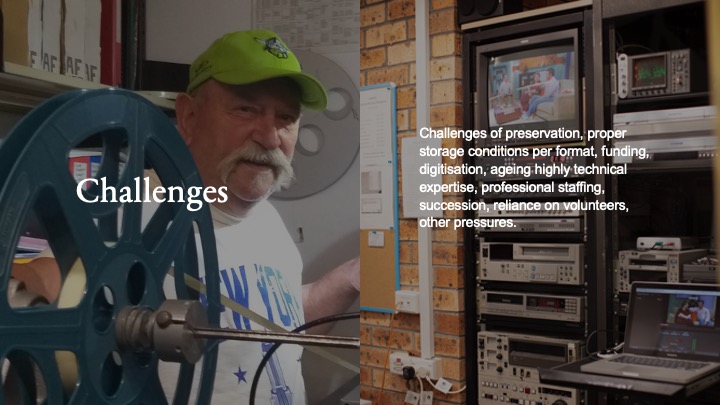
Slide 9. Challenges of Preservation, storage, funding, digitisation, ageing technical expertise, volunteers, pressures.
So, that’s Terry, one of our volunteers, and he loves Turkish Delight.
Succession planning. Why are we relying on volunteers?
Because (across Australia) our executives earn multiples of the salary of the Prime Minister of Australia, and it costs millions and millions of dollars because they’re living in this corporate world, where public organisations are some kind of business. I think this sort of stuff has had its day; it’s got to stop!
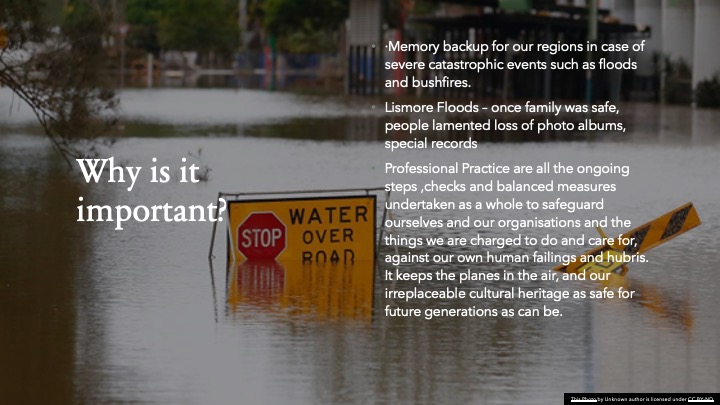
Slide 10. Why is it important? (Photo of Lismore Floods)
- Memory backup for our regions in case of sever catastrophic events such as floods and bushfires etc.
- Professional Practice are all the steps we take to guard against our own human fallibilities and hubris.
So why is it important? This is a picture of Lismore. So, if you saw the fottage, people lost everything in Lismore. The Koori Mail’s archive was destroyed. But once people were safe, the next thing they said was “I’ve lost my picture of grandma, or I’ve lost my picture of my son, dad, something like that. It was the photos, the albums that they missed.
And then I thought back to those photographic archives and those millions of images; they are the memory backup for our region. Alright?
So cultural institutions should see themselves as the memory backup for the regions they serve. Universities, public libraries, whatever it may be, those safe places where the collective memory has a backup. So that when people suffer these calamities, which they’re going to be suffering more of because of the nature of the world that we’re entering into, then, they are going to depend on our records.
So professional practice, why is it important?
Why should we strive to be professional archivists because these are all the checks and balances that we need to do in order to safeguard ourselves from our own human failings and follies and delusions. So, when professional practice is missing in an institution, or suffers lack of respect and commitment, then it has disastrous effects.
We’ve seen what managerialism in a hospital setting can do, what it creates? In a University setting you start treating degrees like sausage factories. That is not what education is about. Education is about enlightening you to things that you didn’t even think were possible. But when the poor lecturers have to be confronted, (especially the casual lecturers) with an opinion poll, then how can they really teach a student? Honestly, when that evaluation goes wrong for them they get thrown out of their job. There’s got to be some safety there for people to learn and be able to teach what they need to know (not what they want to hear!)
So professional practice keeps the planes in the air, and keeps our irreplaceable cultural heritage safe for future generations. (Next slide please)
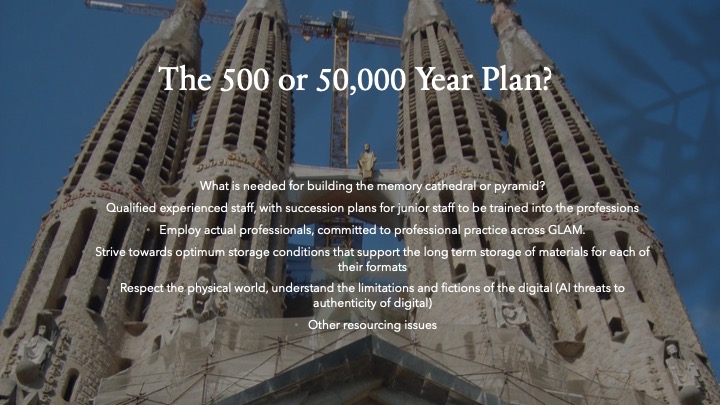
Slide 11. What is needed for the 500 or 50 000 Year Plan, for building the memory cathedral or pyramid?
- Qualified experienced staff, with succession plans for junior staff to be trained into the professions
- Employ actual professional people, committed to professional practice across GLAM
- Providing optimum storage conditions that support the long term storage of materials for each of their respective formats
- Respect the physical world, understand the limitations and fictions of the digital (including the AI threats to authenticity of digital)
- Other resourcing issues
So this is the 500 0r 50,000 year plan, take your pick. So if we are fair dinkum about building a memory cathedral or pyramid, these things will taken generations. One generation needs to be bestowing the building to the next, and so on. We need to be thinking like NASA scientists who at the moment are sending probes out to the moons of Jupiter. The guys that are working on that now, won’t be around when the craft gets there, it will their children’s generation that will be dealing with the mission, the operations of that craft, and its outputs. So we have to start thinking of this work as crossing generations, and plan as such, and bin the short term business thinking that is destroying the world we live in.
Aboriginal people made sure that everything in their environment was there and looked after for the next generations. It wasn’t there to be trashed by our generation, which is what we are currently doing.
Qualified experienced staff, with succession plans. Very important for junior staff to be trained into the professions. Employ actual professionals committed to professional practice across GLAM.
Strive towards optimal storage conditions that support long term storage of physical materials. They were right. We can’t keep digitising willy-nilly.
The human race created 1 yottabyte of data (i.e. a stack of DVDs from the sun to the planet Mars) in 2016 alone.
Now, where are they going? The “cloud”.
Where is the cloud? [In a British posh accent] The cloud is not up there. The cloud is down here. It’s a forest, it’s a forest that was once a forest. It may have had a Bora ground, it may have had Aboriginal engravings on it. We don’t care anymore because now it has a data centre because we’ve had to digitise all this stuff. But if you can keep the original VHS tapes in proper conditions, they will last 500 years. If you store them properly. In their optimum conditions, just like all these other things.
So we may think about getting out heads out of the digital dystopia and start thinking about (maybe) the need to look after the physical stuff as well.
Respect the physical world, understand the limitations and the fictions of the digital age.
You’ve seen the ads for the new Google thing where I’ve taken a picture of me on the beach. But, “I don’t like the seagulls”. I’ll get rid of the seagulls. I don’t like the scarf I was wearing? I’ll get rid of the scarf. I don’t like the guy I was standing with? Get rid of the guy.
So, what’s that done to your digital image? Your record?
Where’s its authenticity? It’s gone out the door. The Digital Age has been destroyed by AI. And then what is it going to do with all that stuff already out there? Roald Dahl’s books are being rewritten. I’ve asked the librarians to stop binning books, because, soon enough, people will be requesting a copy of Dahl, and you will point them to the digital online version. But they will want the physical one, printed in 1984, that they can trust as authentic.
So who can you trust? (Next Slide Please)

Bows to the Audience
The Authors
Gionni Di Gravio OAM, is our University Archivist. Gionni’s work is focused on preserving our region’s rich cultural heritage and making the archival research treasure of the University accessible to local and global audiences. Gionni is a strong advocate for supporting Aboriginal history. In 2020 he received an OAM in recognition for his dedication and many years of work towards preserving our local history as an archivist.
Dr Ann Hardy, is Co-ordinator at the University of Newcastle’s GLAMˣ Living Histories Digitisation Lab. She supervises Work Integrated Learning (WIL) students on placement in the GLAMˣ Lab (Galleries, Libraries, Archives & Museums) and collaborates on cultural heritage projects with students, colleagues, and the wider community. Projects often have a multidisciplinary focus that aims to preserve and unlock the region’s rich history.
Dr Amir Moghadam is a conservator at the Special Collections, University of Newcastle. Amir’s work is focused on investigating historical narrations and the care and promotion of the region’s visual memory. He is interested in and has worked on exploring the use and possibilities digital technology provides for the research and documentation of historical material.

