


FORTRESS NEWCASTLE PROJECT
(November 2021 Update)
‘It can be said, that without our steel industry the invasion of Australia by Japan could not have been prevented’.
D. O. Morris 1947
November 2021 Update
See the completed Fortress Newcastle: Life Under Threat Film here:

February 2021 Update:

The Fortress Newcastle Project 2020 – 2021
A coalition of ten community groups, heritage researchers, University of Newcastle researcher and other stakeholders is conducting research, to produce a multi-format resource for development of enhanced public awareness, interpretation of remnant sites and visitor experiences of the story of Fortress Newcastle.
During World War II Newcastle was the ONLY place in Australia where:
- Coastal guns fired on an enemy naval vessel.
- All three military services operated from the same command building.
- Had the largest mainland military establishment in Australia’s history.
- Was the critical hub of Australia’s largest war materials production.

What is Fortress Newcastle?
At the commencement of World War 2 Newcastle was the location of Australia’s largest integrated steel-making facilities, many associated heavy industries, various minor industries, many coal mines, a busy deep harbour for merchant shipping, floating dock, ship building dockyard and critical production infrastructure.
The Hunter Region became Australia’s major industrial production hub for manufacturing and supplying a massive range of essential war related products, making it the most important location for mainland defence.
The military operation to defend these vital industries became known as ‘Fortress Newcastle’ – the largest military defence establishment in Australia’s history.
Fortress Newcastle is an untold Nationally significant major regional story. The war effort in this region was critical to the survival of Australia. Many remnant facilities of Fortress Newcastle exist and are awaiting interpretation and adaptive reuse.

What did Fortress Newcastle Defend?
Fortress Newcastle extended from Port Stephens in the north, south to the Tuggerah Lakes and west to Muswellbrook.
The key points to be defended were the entrance to Port Stephens itself, the whole of the Stockton Bight beach between Anna Bay and the entrance to the Newcastle Harbour, and the beach areas south to the entrance of Lake Macquarie.
In December 1941, this area was defended by four fixed coastal defence forts, two major air bases and four army accommodation and training camps.

The Four Forts
Tomaree at the entrance to Port Stephens, Fort Scratchley at the entrance to Newcastle Harbour, and the Park Battery, located on the high ground at the southern end of King Edward Park in the city, all were armed with two six-inch (150 mm) calibre guns. Fort Wallace at Stockton was armed with two 9.2-inch (240 mm) calibre guns.


The guns at all forts, except those at Fort Tomaree, were capable of firing inland as well. A much smaller fortified position, located on the Breakwater at Nobbys, was armed with a six-pounder (2.72 kg) gun to control the entrance to Newcastle Harbour.


Royal Australian Air Force Radar Stations were positioned on the summit of the Tomaree Headland, Park Battery in Newcastle, Ash Island, Catherine Hill Bay and Wipers near Williamtown Air Base to provide electronic surveillance over the sea and air approaches to the Newcastle Defended Area.
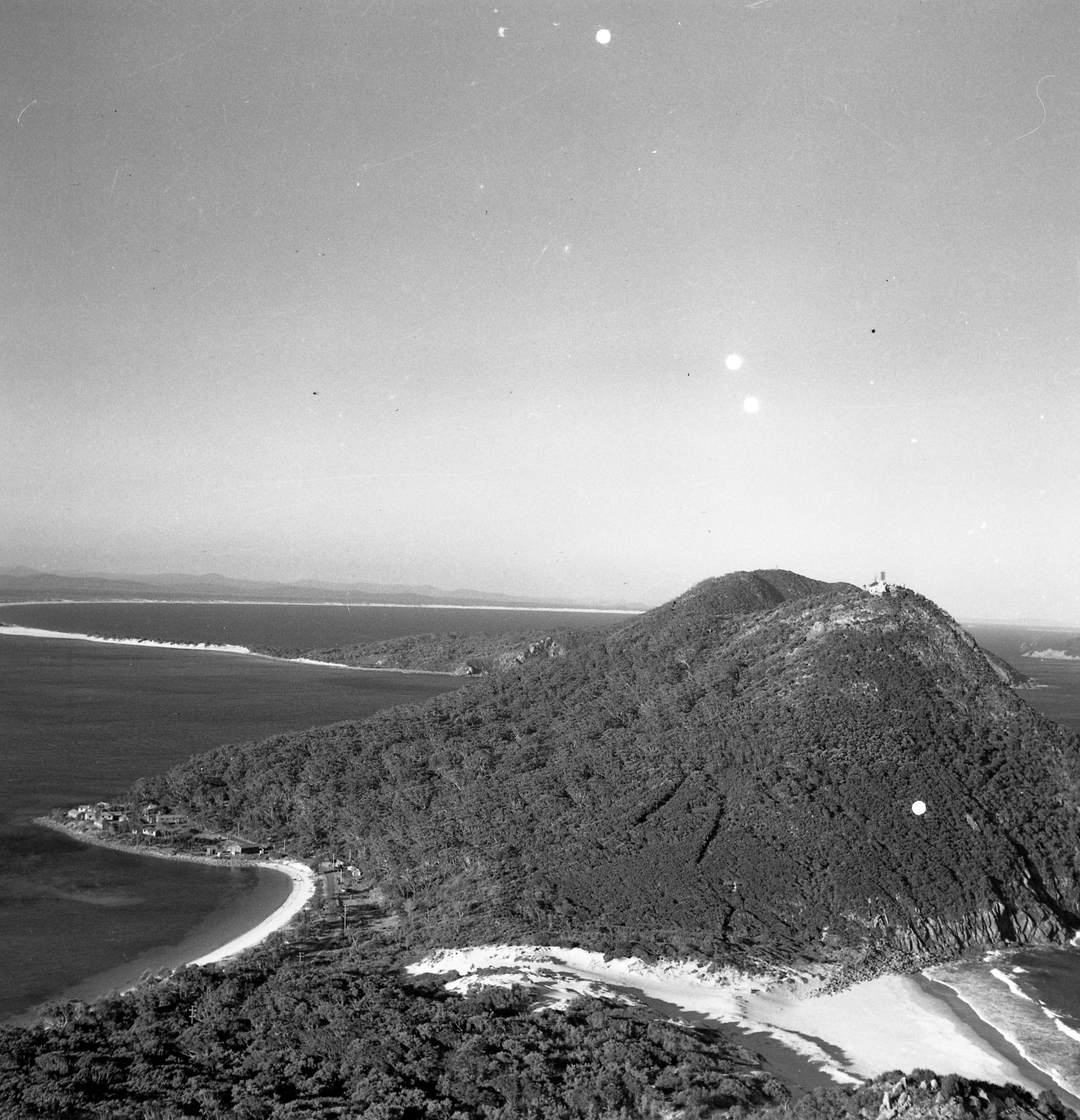
The Tomaree Fort also included a torpedo-launching system and 18pdrs that could cover the whole of the entrance to Port Stephens. Also at Nelson Head next to the inner lighthouse inside the port was armed with 60pdrs.
The Royal Australian Navy established a port examination service in Newcastle Harbour to check arrivals and departures of all shipping.
A naval transit station, HMAS Maitland served as the port’s war signal station, harbour defences and general security, and providing convoy support.

At the entrance to the Newcastle harbour for its defence an indicator loop was laid seawards from a minefield with the indicator loop and minefield controlled from a building located on the Stockton foreshore.
The Royal Australian Navy constructed a 5000-ton oil fuel tank at Tighes Hill, together with the installation of the necessary oil-loading pipework connection to provide a fueling capability for naval ships based at or visiting Newcastle Harbour. A southern defence line was established with an anti-tank ditch at Cold Tea Creek, south of Belmont.
A Naval base, HMAS Assault was established at Nelson Bay, to train American and Australian landing craft boat crews and beach commandos.
Army accommodation and training camps were located at Rutherford, Largs, Greta, Gan Gan and Singleton to provide accommodation and a training area for three to four thousand men.
Anti-aircraft batteries were positioned at Tomago, Fern Bay, Mayfield, Stockton, Wangi as well as other very mobile batteries, easily relocated in and about the approaches to Newcastle and its industries. The RAAF operated air bases at Williamtown north of Newcastle and a large seaplane base at Rathmines at Lake Macquarie south of Newcastle

The Components of Fortress Newcastle
Fortress Newcastle consisted of:
- Five large Army Training Bases – Singleton, Greta, Largs, Rutherford and Raymond Terrace. (up to 4000 men each in training) Many other small training locations.
- Two Naval Bases – HMAS Maitland, (now TS Tobruk) and HMAS Assault at Nelson Bay.
- Two Air Force Bases – Williamtown and Rathmines.
- Four large Coastal Gun Batteries – Fort Scratchley, Park Battery Shepherd’s Hill, Fort Wallace and Fort Tomaree including torpedo launcher.
- Seven Anti-Aircraft Batteries – at Tomago, Fern Bay, Newcastle Harbour, Mayfield West, Wave Battery, Stockton and Wangi Wangi.
- Three Radar Stations – Shepherd’s Hill, Catherine Hill Bay and Ash Island.
- Ten Searchlight Stations – 30 projectors in various places, usually near gun emplacements.
- Two Antitank Traps on Stockton Beach and Cold tea Creek, Belmont.
- Boom Net and Controlled Mines across Newcastle Harbour.
- Armour Proof Range at Fern Bay – for munitions and plate testing.
- Large American Amphibious Training Centre (JOOTS) and an American Navy Landing Forces
- Depot at Nelson Bay, with some 20,000 Personnel.
- Many stores and training centres were established in requisitioned community facilities.
- A 5,000 Ton oil fuel storage tank was constructed at Tighes Hill, for ship refueling.
This was all controlled from Shepherd’s Hill in Newcastle and HMAS Assault in Nelson Bay. Fortress Newcastle was established to protect the critical war production industries.

MILITARY DEFENCE UNITS
Amphibious Training Command Centre Gan Gan near Port Stephens
Camp Gan Gan
Camp Nelson Bay
Camp Shoal Bay
“HMAS Assault” Naval Training School Port Stephens
Nelson Bay – RAN Temporary Engineers Workshop Stockton Street
Port Stephens Boom Defence net – Salamander Bay
Port Stephens – United States Navy Landing Forces Depot
Royal Marine Camp, Nelson Bay
Salt Ash Air to Ground Gunnery Range
VHF D/F installation at Tea Gardens, Port Stephens
Tank Traps Stockton Beach
RAAF Williamtown
3.7 HAA guns Tomago
3.7 HAA guns Links battery Fern Bay
Fern Bay Armour Proofing and Testing Range
Fort Wallace Stockton
3.7 HAA gun Fort Wallace
3 pndr unit Carroboro Oval Stockton
Wave Battery between the two Breakwalls Stockton
U.S Army artillery Unit Williamtown
WAAF plane spotters unit
Fort Tomaree Port Stephens
Fern Bay Rifle Range
Bob’s Farm Cadre Camp
Ash Island RAAF Radar Station
Australian Army Greta Army
Australian Army Largs
Australian Army Singleton
Boomerang Park Army Camp, Raymond Terrace
Fort Scratchley
Park Battery Shepherds Hill – operated by Army, Navy and RAAF
Mayfield West HAA battery
Ash Island RAAF Radar Station
Camp Shortland Newcastle
7th Australian Casualty Clearing Station, Australian Army Greta
60 AASL Coy, Company Headquarters
Drill Hall in Percy St., Hamilton, Newcastle
Wangi Wangi RAAF Stores and Quartering Area
HMAS Maitland
RAAF Rathmines Catalina Base
Catherine Hill Bay Radar Station
INDUSTRIES and SERVICES
Newcastle Steelworks
Stewarts and Lloyds
Lysaghts
Rylands
Wire Rope Works
Commonwealth Steel
Goninans
Morison & Bearby
Sulphide Corp
Cardiff Railway Workshops
Newcastle Chemical Co.
State Dockyard
Electricity Generation
Water Board
Coal Mining
Agricultural production
Harbour Operations
REGIONAL WAR PRODUCTION
The Newcastle Steelworks and associated steel-product manufacturers made up the major industrial manufacturing facility in Australia. During the war all industries installed additional machinery and converted their entire production process to producing an incredible range of war materials. The Newcastle Industrial hub comprised Newcastle Steelworks, Rylands, Stewarts and Lloyds, Lysaght, Commonwealth Steel, Goninan, Cardiff Railway Workshop, the State Dockyard, as well as many smaller manufacturers, a major Sea Port for distribution of many rural products, many coal mines, – all vital for the war effort.
Some Examples produced
- Over 5 million tons of steel and 4 million tons of iron was produced including many specialised steels for use in bullet proof armour plate, aircraft engines, weapons and
ammunition manufacture. - 300,000 18 pounder shells, 50,000 3inch anti-aircraft shells, 1,500,000 25 pounder shells.
- 11 hydraulic heading presses, electric colliery locomotives, engines, crankshafts and 13 stern frame castings for ships.
- 40 Vertical and horizontal milling machines, 14 file making machines, 10 optical grinders.
- A small shipbuilding facility was established to construct 164 barges and 8 tugs for the US Army, and 7 tugs for the British Army, as well as Refrigeration barges.
- Forgings were made for a wide range of ammunition as well as components for Bren and the Owen guns.
- 820,000 tons of steel sheeting for roofing, 137,000 Anderson air raid shelters for Britain, portable aircraft hangars, pontoons, aircraft components, as well as bush knives, machetes and ammunition shells.
- 12 million tons of Tar, 21 million gallons of Benzol, 1.6 million gallons of Toluol, 320,000 gallons of solvent Naphtha and a long list of special chemicals.
- Magnesium ingots, crystals, powder and cheeses totalling 2,700 tons.
- Oxygen, hydrogen, acetylene, carbon dioxide and many other gasses.
- 2 million steel helmets for the Australian, New Zealand and Indian armies.
- 335,000 tons of wire products including wire netting, wire ropes, nails, barbed wire, wire for telephone field cables and torpedo nets, including the net which captured a
Japanese submarine in Sydney Harbour in 1942. 16,000,000 fence pickets. - At the State Dockyard the first new vessel was launched in July 1943. Over 20 vessels were built at the dockyard and over 600 had were repaired, many of them heavily damaged by enemy action.
- Also overlooking Newcastle harbour was the Zaara Street power station, which was an important link in the NSW electricity supply system.
- The railway network and workshops provided a vital production and transport link to all parts of Australia.
- A large munitions factory was built at Rutherford. It was the largest of six such enterprises.
- As overseas supplies were not available, the jigs, machine tools, moulds, gauges etc. to manufacture these products our Industries had to practically start from scratch to make the necessary items required in time of war.
PROPOSAL
A coalition of ten community groups is currently researching all components of Fortress Newcastle and will launch an exhibition and digital media to city leaders in October 2021, to gain stakeholder support for further development of visitor experiences. Interpretative redevelopment of the Master Gunners Cottage and remnant structures at
Shepherd’s Hill will provide a base for Fortress Newcastle, allowing linking of Fort Scratchley with the soon to be opened Fort Wallace at Stockton, the Armour Proof Range, Fighterworld and Rathmines Catalina base. This will result in guided and self-guided tours of this network of facilities using web and GPS based digital mobile apps.
Anyone with information or experience willing to support this project is invited to contact:
Newcastle Industrial Heritage Association
Email: nihanewcastle@gmail.com
Web: www.niha.org.au
Ph: 0419241731
Bob Cook
June 2020
Updated February 2021