

The “Little” Collection – Viroconium Artefacts – Notes and Talking Points
This week beginning August 31, 2026, we will be introducing our University’s ancient history students to a sample of archaeological objects retrieved from 1960 archaeological dig at the site of one of Roman Britain’s most important site, Viroconium Cornoviorum (Wroxeter). These notes are to assist students and presenters from the Auchmuty Library to familiarise themselves with Collection.
Provenance (Viroconium et al)
- The artefacts were donated to the University on 22 January 2003 by the Reverend Wardlow Little and his wife along with a collection of books.
- The Reverend Little was a retired teacher of classics that taught Greek and Latin at several Sydney schools in the 1950s-60s. He had been living in Newcastle for some time and said they had been sitting in his loft for many years.
- The Coins are part of a University collection, originating with the former Newcastle Teachers’ College and found in a safe.
When and where were they found?
This “Little” Collection consists of around 120 objects, most of which represent the fruits of a 6-week archaeological dig conducted in 1960 at:
- Viroconium (the ancient name of Wroxeter in Shropshire) and a nearby Iron Age hill-fort.
- Caerleon (“City of the Legion”) near Newport in Southern Wales and
- Mawgan Porth in Cornwall.
Viroconium was the fourth largest city in Roman Britain and was first settled by the Romans in AD48. Both Viroconium and Caerleon have their supporters as possible sites of King Arthur’s legendary capital, Camelot.
Discussion:
- Wroxeter Roman City – https://www.english-heritage.org.uk/visit/places/wroxeter-roman-city/
- Graham Phillips’ intriguing research into Viroconium and the possible location of the lost tomb of King Arthur. See: Podcast: https://podcasts.apple.com/nz/podcast/lf186-graham-phillips-the-lost-tomb-of-king-arthur/id1693490952?i=1000707885826 and website: https://www.grahamphillips.net/index.htm
Other sites represented outside of Roman Britain:
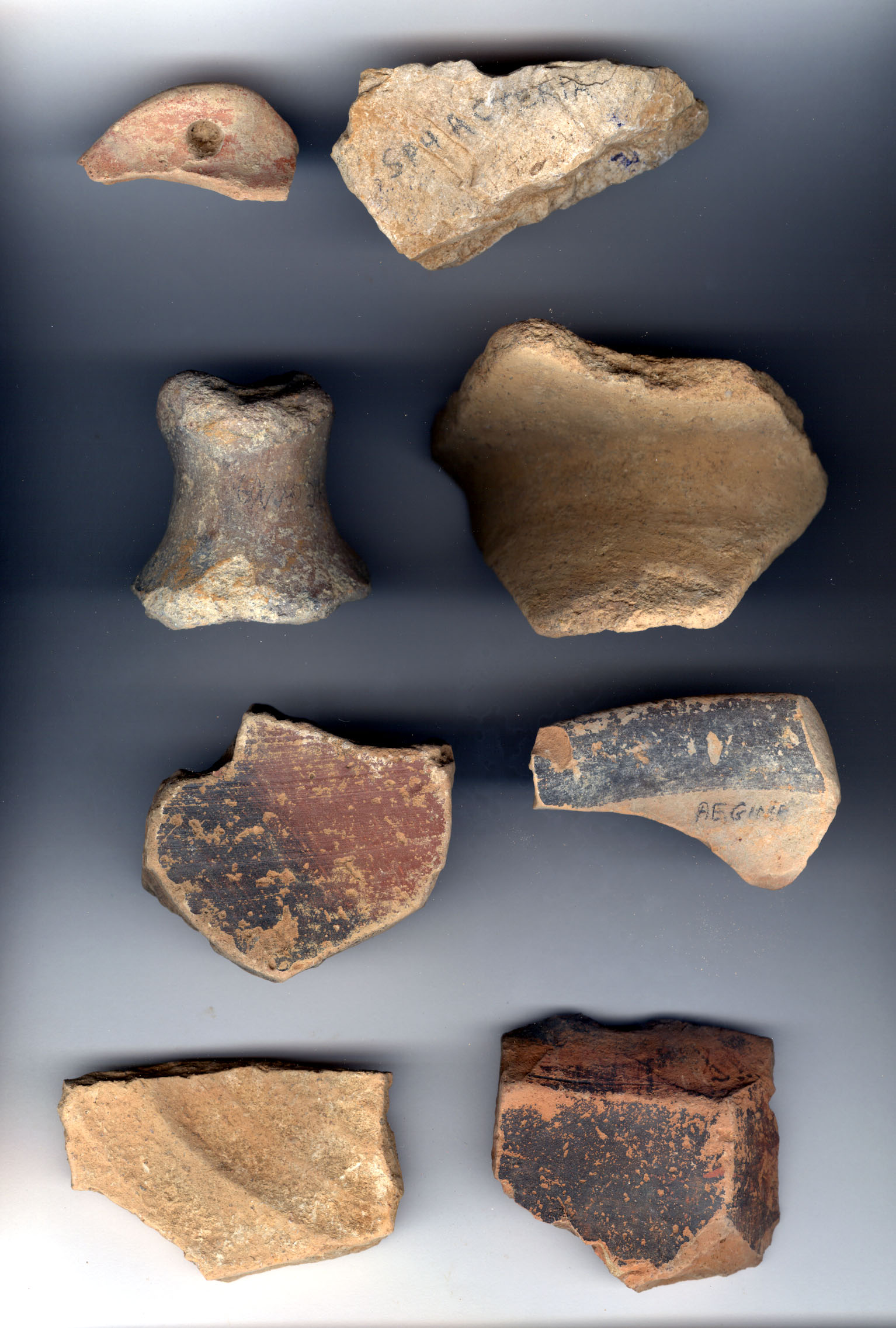
- Besides artefacts from Roman Britain, the collection also includes items from the Greek islands of Aegina and Sphacteria and the ancient city of Gournia, known as the “Pompeii of Minoan Crete”.
- Sphacteria was the site of a major battle of the Peloponnesian War recorded by Thucydides, where the Athenian general Demosthenes captured the Spartan forces.
Further information – British Tribe Cornovii
Viroconium (Wikipedia)
- Viroconium or Uriconium, formally Viroconium Cornoviorum, was a Roman city, one corner of which is now occupied by Wroxeter, a small village in Shropshire, England.
- Viroconium is a Latinised form of a toponym that was reconstructed as Common Brittonic *Uiroconion (“[city] of *Uirokū“). *Uirokū (lit. “man-wolf”) is believed to have been a masculine given name meaning “werewolf”. Original British Tribe – Cornovii
- Discussion: Aboriginal tribes, Britons, Anglo Saxon Invasions, oral verses written cultures
Reverend Little’s six weeks in 1960
- Following the explorations of 19th-century antiquarians, Wroxeter saw further archaeological campaigns before and after the First World War. Then, after the Second World War, the site was the location of two of Roman Britain’s largest and most significant excavations, when Graham Webster and Philip Barker of the University of Birmingham investigated the area of the public baths, the adjacent macellum (covered market), and the remains of the legionary fortress that lies beneath the later city (see CA 14, 25, 39, 75, and 112). These research and training excavations took place from 1955 to 1990, and hundreds of students and archaeologists (including two authors of this article below) worked with these two distinguished, and presumably extraordinarily patient, scholars of Roman Britain. https://archaeology.co.uk/articles/features/revealing-roman-wroxeter.htm
What sort of artefacts does the collection contain?

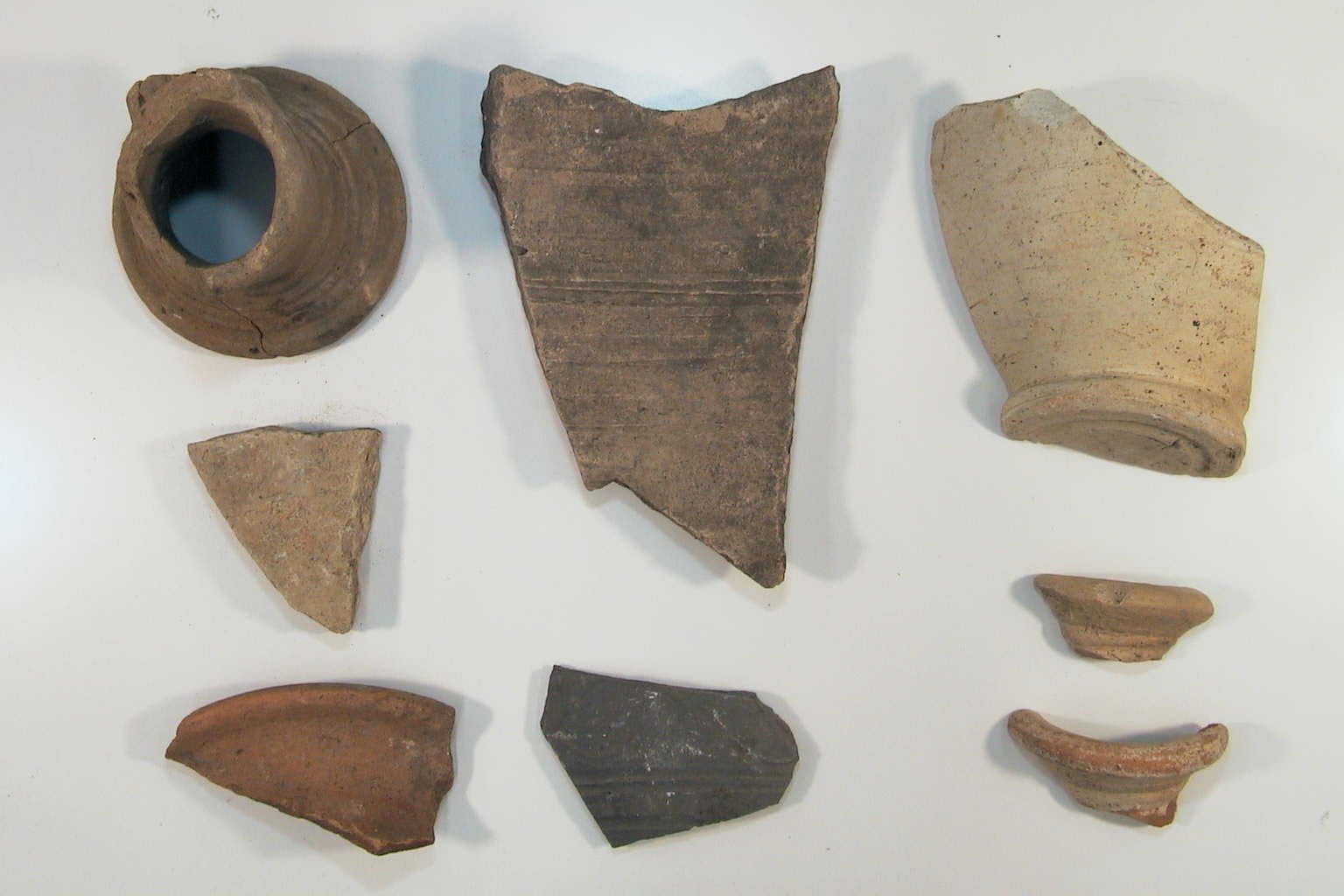
- The collection consists predominantly of potsherds, representing a variety of different Roman and British pottery types.
- There are also some fragments of wall plaster, preserving parts of the painted surface (without, unfortunately, any discernable design features),
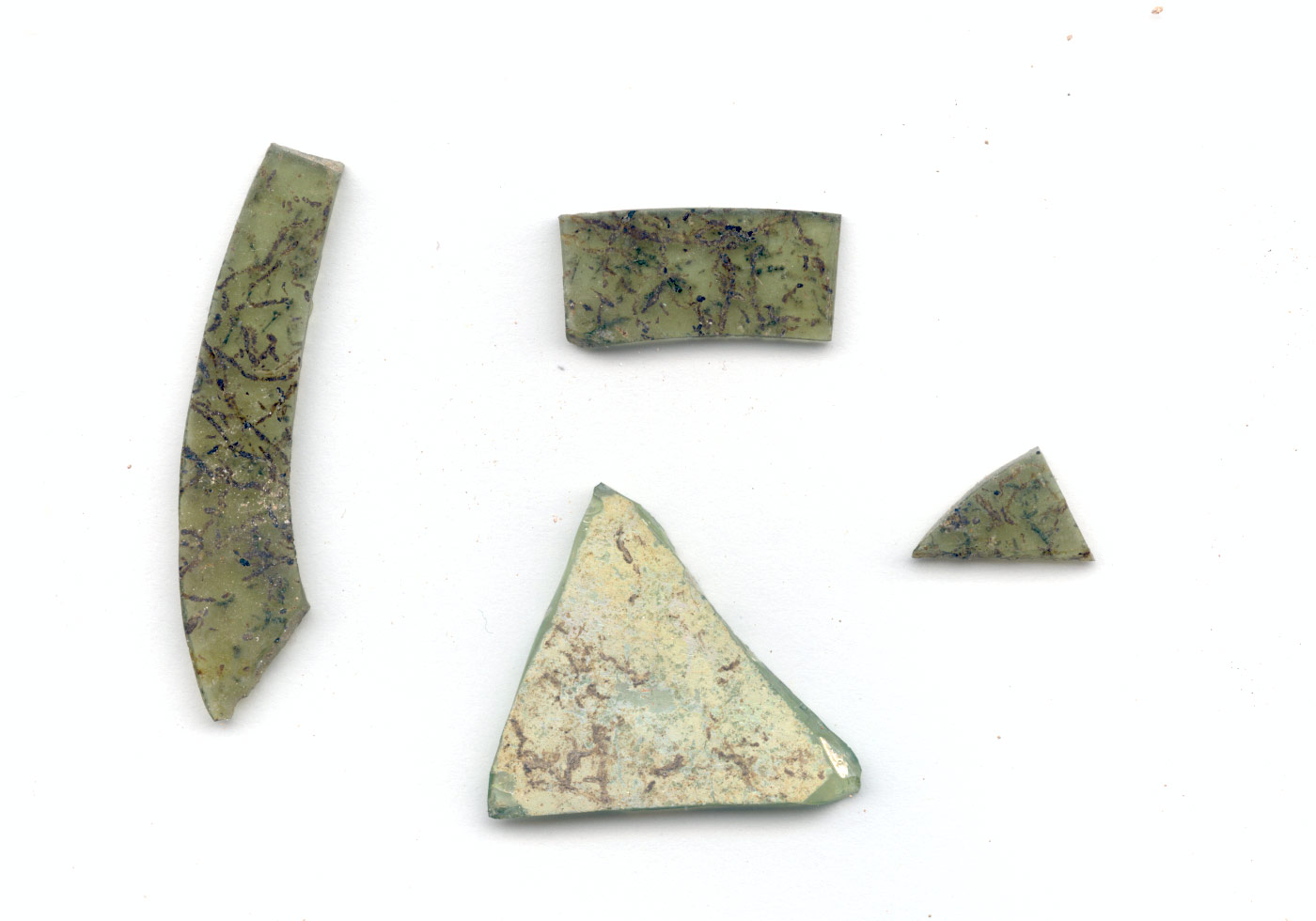
- four pieces of Roman glass (three of them apparently from the one artefact),
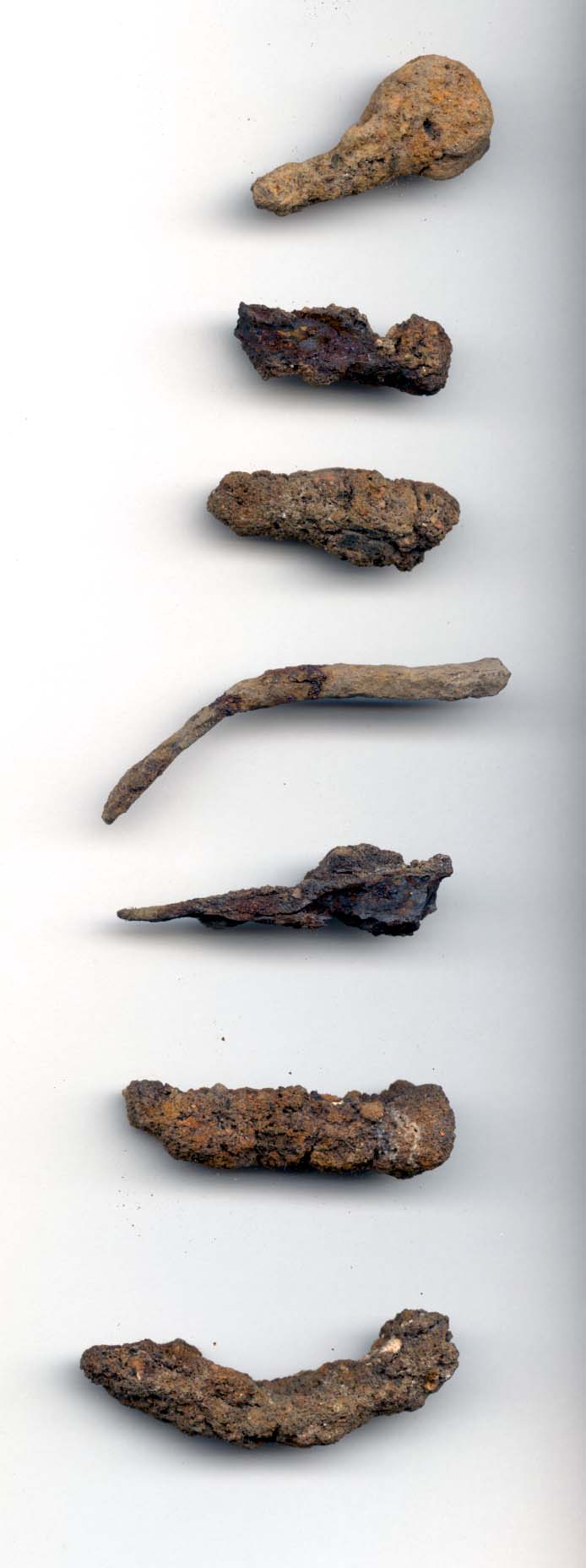
- several nails and rivets,
- some fragments of roofing tile and similar domestic pottery,
- a Roman brick,
- and four bronze items: a hairpin, what appears to be an awl, a bronze-gilt pin of uncertain application, and (perhaps most intriguing to the modern eye) a combination ear-scoop and toothpick, evidently part of a toiletry set.
- As a reminder that older cultures have left their traces at some of the sites represented, the collection also includes two flint cores (the “left-overs” after usable blades and points have been struck from a nodule of flint).

What will the collection be used for?
- The range of items in the collection makes it a useful tool to bring students to an awareness of the real texture of life in Roman times – not the marble grandeur of the great monuments (and Hollywood epic!), but the everyday brick and pottery of typical provincial life.
- It also includes examples to illustrate a variety of ancient technologies – ceramics, metallurgy and glassworking.
Some general info about the study of the artefacts from Roman Britain etc.
- The study of artefacts from Roman Britain is especially valuable in that so little literary evidence, relatively speaking, for the four-hundred year history of the Roman province has survived.
Ancient Coins
In addition, the students will view a number of ancient coins from the University’s Coin Collection dating from Ptolemaic Egypt to the Roman Empire. These were found in the University Safe and are said to date from the former Newcastle Teachers’ College days. View the collection here: https://livinghistories.newcastle.edu.au/nodes/view/81020
EGYPTIAN.

A bronze decadrachm of Ptolemy I 323 – 285 B.C., the successor of Alexander the Great.
OBVERSE: head of Ptolemy I
REVERSE: imperial eagle
During three centuries of rule by the Ptolemies in Egypt all coins bore the head and legend of Ptolemy I, except on special issues.
GREEK.

A bronze coin of the city of SYRACUSE in Sicily, reign of Hiero II, 274 B.C. – 215 B.C.
OBVERSE: head of Poseidon, God of the Sea.
REVERSE: trident between two dolphins.
This coin is typical of those of Greece in this period; obverse is a bust and reverse a design of local interest.
ROMAN.

A bronze coin of Augustus, first Roman Emperor, (B.C. 24 – 14 A.D.)
OBVERSE: head of Augustus.
REVERSE: temple of Lyons in Gaul.
All Imperial coins of Rome bore the head of the reigning emperor on obverse & an illustration of his political or social activities reverse.
ROMAN.

A bronze sestertius struck as a memorial after the death of Marcus Aurelius (AD 161-180).
OBVERSE: head of Aurelius
REVERSE: imperial eagle standing on a tomb.
- Aurelius, Roman Emperor and Stoic philosopher, died fighting the Germans. He deified after his death.
ROMAN.

A silver denarius of Alexander Severus, Emperor 222-235 A.D.
OBVERSE: bust of Alexander Severus
REVERSE: figure of Peace holding an olive branch.
In the 3rd century the Roman coinage was being continually debased to supplement the Imperial revenue, causing inflation.
ROMAN.

A bronze coin of Emperor Aurelian (270 – 275 A.D.)
OBVERSE: bust of Aurelian
REVERSE: figure of winged victory handing a symbol of victory to the Emperor seated on a throne.
Aurelian attempted to stabilise the coinage, but this led to severe rioting in Rome. Inflation soon began again.
The full collection can be viewed here:
https://livinghistories.newcastle.edu.au/nodes/view/81020