



In an interview on June 27, 2025, university alumna Mary Stewart (née Henery) shared memories and reflections of her student days at the University of Newcastle.
Interview Summary
Student Life & Academic Journey
Mary reflects on her studies in Arts, majoring in English with honors. She describes the small, tight-knit cohort, the close (and occasionally party-filled) relationships with lecturers, and the challenge of navigating university education without formal training in research and academic writing.
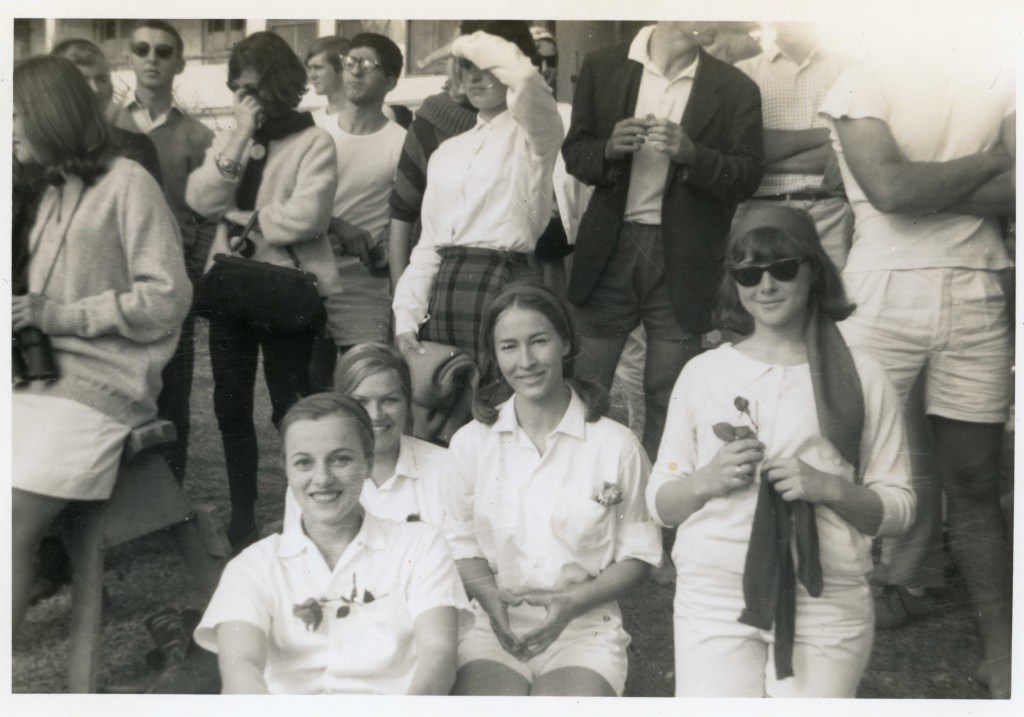
Womens Rowing Team

Motivation & Daily Commute
The interviewee explains her path to university, influenced by her brother. She details her daily commute from Blackalls Park to the Tighes Hill campus via diesel train, carrying heavy briefcases, and her subsequent time at the Teachers College.
Campus Activism & The Struggle for Autonomy
She recalls the “autonomy parades” down Hunter Street as students campaigned for the university’s independence. She vividly remembers the camaraderie between Arts and Engineering students, and their antics in Throsby Creek.

![University of Newcastle Autonomy Day [1965-]](https://hunterlivinghistories.com/wp-content/uploads/2026/08/C3014_V_037-1024x679.jpg)
Financial Support & Career Aspirations
She discusses winning a Commonwealth scholarship, followed by a Teachers College scholarship. She reveals that she originally wanted to be a journalist and was encouraged by staff at the Newcastle Herald but faced systemic hurdles and family pressure to pursue teaching instead.
The Academic Environment & Harry Jones
The interviewee shares her experience as a top English student and pays tribute to Harry Jones, a poetry lecturer who had a profound impact on her and her peers before his untimely death in 1965.
The Role of the Union & Brin Newton-John
She discusses her interactions with Brin Newton-John, noting his influence on the campus community, his love for opera, and his hosting of sherry parties. She emphasizes how the construction of the Union building transformed student life by providing a central hub for social and academic interaction.
Influential Lecturers & Post-War Context
Reflections on the university’s foundation, noting that many lecturers were post-war refugees from England and Europe. She reflects on the “invisible” presence of historical trauma, recalling a teacher who had a concentration camp tattoo.
Graduation Traditions & Barry Humphries
She discusses the formal graduation traditions that persist, and recounts a memorable 1962 visit by a young Barry Humphries to the campus.
Graduation Choice
She reveals that in 1966, the graduating class was given the choice to graduate under the University of New South Wales or the newly established University of Newcastle, opting for the latter out of pride.
Social Restrictions & Teaching
She recounts the strict regulations of the era, specifically that female students on teaching scholarships were generally not permitted to marry. She married her husband, David Stewart, the day after completing her teaching practice in 1966.
Post-Graduate Life & Career
Despite not initially enjoying teaching, she later found fulfillment in teaching English as a second language while living in Hong Kong and completed a Master’s degree, which led to her writing a book on the writing process.
Miss Australia Nomination
She shares the story of being nominated as the University’s entry for the Miss Australia contest, noting the social respectability of the pageant at the time despite her own personal misgivings about it.
Conclusion:
Concluding thoughts on the enduring influence of the university and her lecturers. She notes that her in-laws, Kathleen and Ian McColl Stewart, were both foundational figures at the university, with buildings named in their honor.