

![Pindimar City (1919) Concept for Australian Capital City by H. Sheaffe, licensed surveyor., Pindimar City Map, Port Stephens, New South Wales. [c. 1919], [M1590]](https://hunterlivinghistories.com/wp-content/uploads/2024/08/Pindimar-City-1919-Nations-Capital.jpg)
This archival research guide containing the archival and rare book resources relating to Pindimar consulted on the day (6th February 2026) was prepared by Gionni Di Gravio OAM, University Archivist as a preliminary overview for the University of Newcastle’s Architect Master Level Students.
![Master Level Architecture Students with lecturer Shellie Smith with the Pindimar Archives, Auchmuty Library 6th February 2026 [Photo: Kaitlin Dykstra]](https://hunterlivinghistories.com/wp-content/uploads/2026/02/Master-Level-Architect-Students-6-February-2026.jpeg)
We wish to acknowledge the research work of Mr Kevin McGuiness whose article on the “City of Peace” at Pindimar (November 2023) is one of the inspirations for our archival guide.
This work is conducted in memory and respectfully honours the First Australian People, the Aboriginal People of this land.
Project: Spectral Urbanism – Pindimar City.
Topics for discussion:
- what is in Special Collections & Archives?
- how do we search and view the collection?
- What is an archive?
- How to engage with collections ethically?
- Mapping! And interpreting historical materials – especially maps?
- How do we authenticate sources / cross check / critically examine etc?
- Any thoughts on the role of archives to understand the present?
What is Special Collections & Archives?
Special Collections & Archives are where all the University and Region’s primary source historical records of enduring value and importance are located across three levels of the Auchmuty Library, University of Newcastle (Australia). The facility holds the Archives, Rare Books and Special Collections research centre situated primarily on level 2 of the Auchmuty Library with the GLAMx Digitisation Lab located on Level 3. Further archival collections, map library and museum and art works are situated on Level 1.
It is the home of the historical and cultural memory of the University and its regional context. A recognised Regional Archives Repository (RAC) of NSW State Records/Museums of History NSW.
Our role is to protect and safeguard the documentary history of the University and its regional context for current research and for future generations. These collections provide a window into the human activities that have occurred in our local region across many thousands of years, and can provide us with some wise and useful pathways for the future.
How do we search and view the Collections?
To search our digital and online listings of content (please note, that our digital content is just a very small part of our holdings which extend to trillions of items):
- Library Search Page: https://www.newcastle.edu.au/library
- Living Histories @ UON: https://livinghistories.newcastle.edu.au/
- Hunter Living Histories site: https://hunterlivinghistories.com/
- UONCC Flickr (for images): https://www.flickr.com/photos/uon
- UONCC YouTube (for films): https://www.youtube.com/user/UoNCC/videos
- UONCC SoundCloud: (For audio): https://soundcloud.com/uoncc
- Search Everything Button (except YouTube): https://libguides.newcastle.edu.au/ccsearch
What is an archive?
An archive can be described as:
- historical evidential records (in all forms and formats) of permanent ongoing value, and
- the facility, in which such permanent value evidential records are kept.
Special Collections & Archives, in the AUCHMUTY LIBRARY, founded in 1975, is where the University’s permanent value Archives, Rare Books & Special Collections spanning 7000+ years are held for current research and future generations in safe custody for the University and its regional communities.
The University Archives was originally founded in February 1975 to safeguard the permanent value records of the University of Newcastle. Since then many more important and valuable research collections relating to the region have been donated the archives including the magnificent Pender Archive, the records of the Anglican Diocese of Newcastle and the Percy Haslam Collection relating to Aboriginal culture.
How to engage with collections ethically?
Ethics is part of archival professional practice as are many aspects of the profession. Archives can be quite confronting, as they are the first draft of history, and are the evidential records of historical events. People do not like what they see and hear and can be offended by the views people once had to other peoples. The mythologist Joseph Campbell once said, “the virtues of one age become the vices of the next”, and so we must be careful to learn from the past and not sanitise it for our own generation’s prejudices and norms. Archives can be contested places, and are usually the target of political, religious, economic and societal attack depending on who is in power. It is easier to “disappear” what we don’t like, rather than to try to understand why people thought that way, and learn from it. So, building sensitive and meaningful relationships with the archival content and communities, and allowing for adaption and evolution in archival description and engagement is crucial for protecting the “original”, and being also able to transform ourselves and our culture for the better over time.
Mapping! And interpreting historical materials – especially maps?
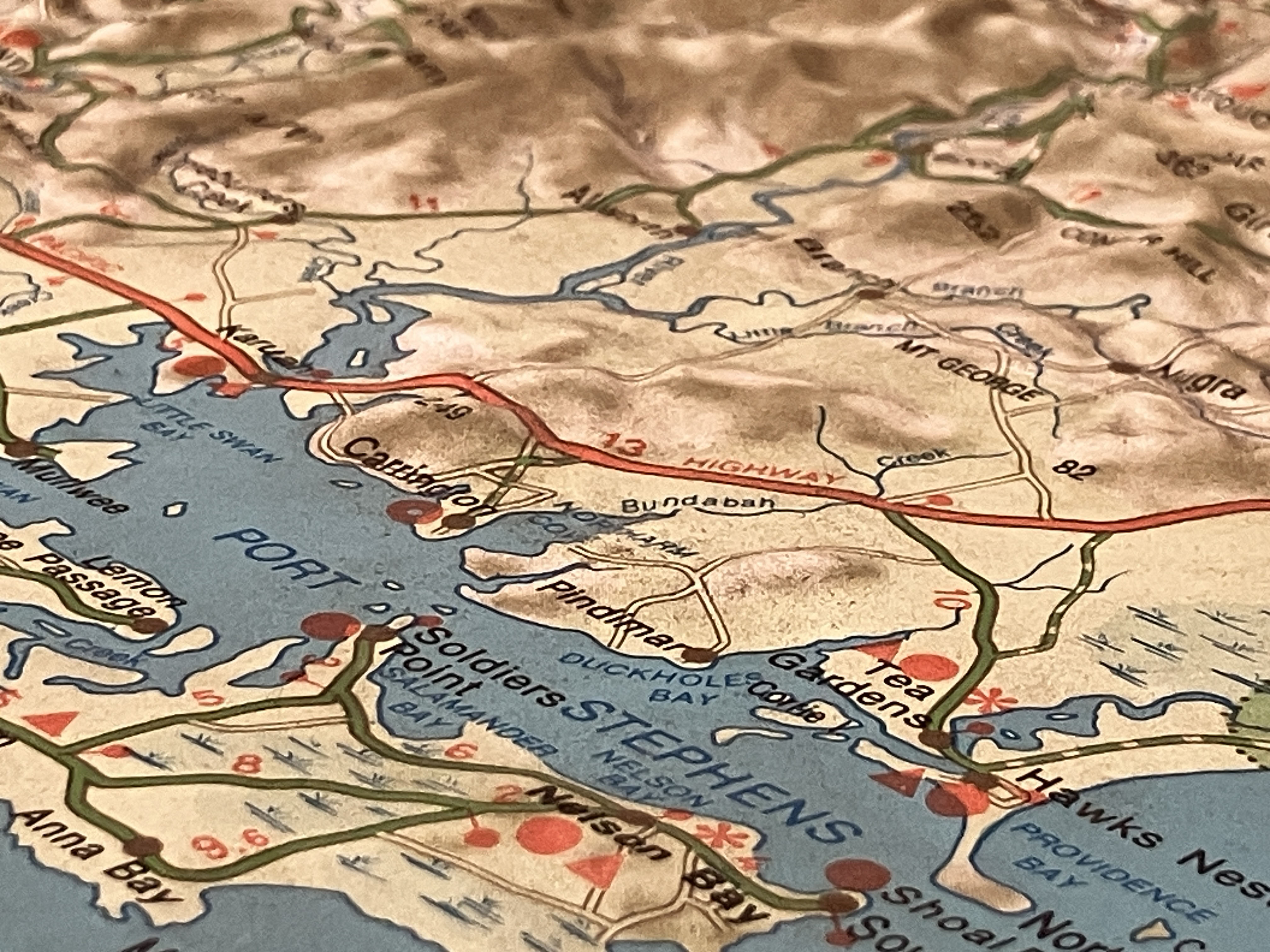
Where to Begin: Where is Pindimar?
Step 1. Start with a simple Google Search. Be careful of AI generated responses, take nothing for granted and check the sources. KNOW YOUR DATA. We will expand our horizons by questioning everything!
- Pindimar City at Port Stephens by Kevin McGuiness (November 2022)
- A City of Peace at Pindimar – 1918 by Kevin McGuiness (November 2023)
Pindimar as a “City of Peace” uncovered by Kevin McGuinness’ research sparked us into tracking down the original article. Mr McGuinness has provided a transcription, but how can we find the original article? How do we know if it has been digitised? Search “Construction and Local Government Journal” on TROVE (https://trove.nla.gov.au/) and yes, it has been digitised. You can download the original article, but I chose to screen shoot and connect together in Photoshop to present the full article across two pages below.
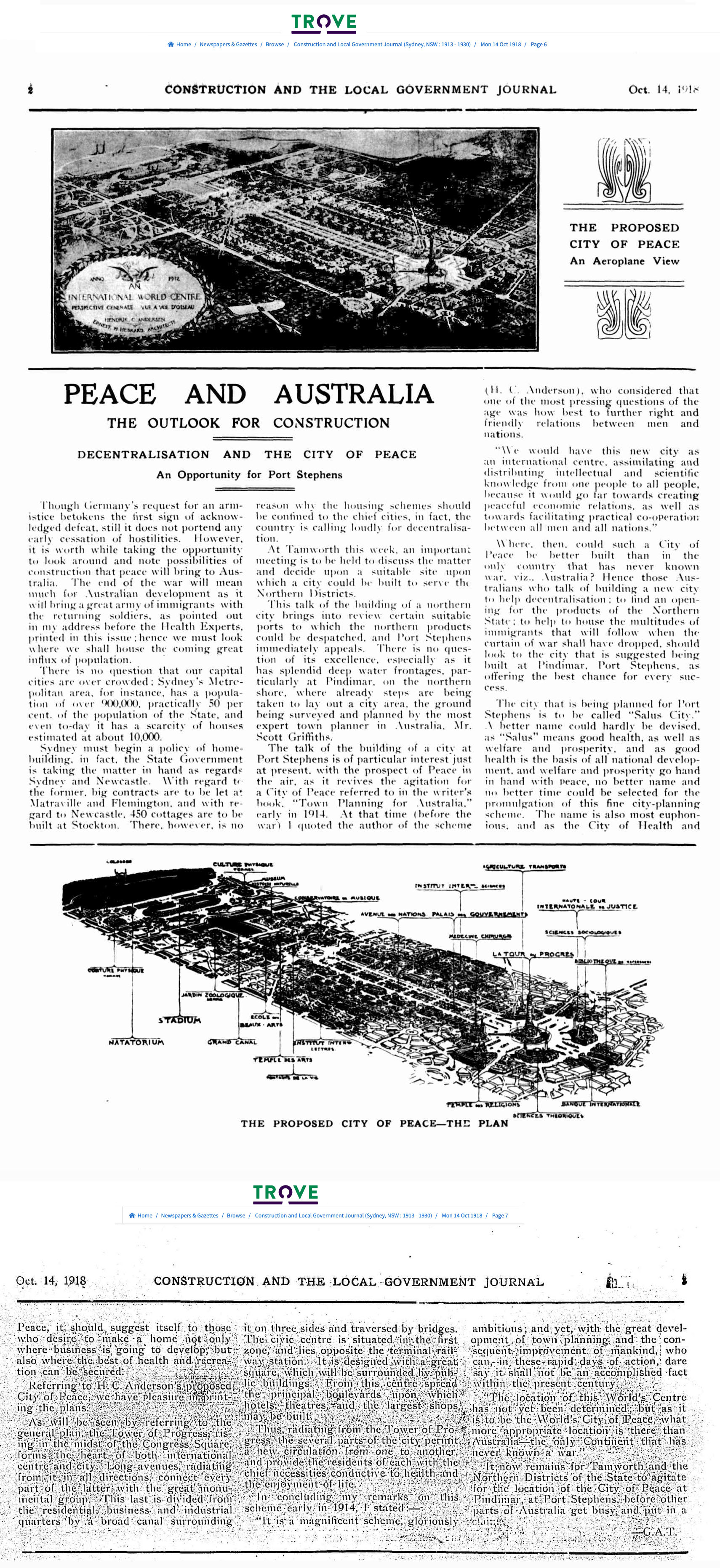
The original article is on TROVE (1918, October 14). Construction and Local Government Journal (Sydney, NSW : 1913 – 1930), p. 6. Retrieved February 6, 2026, from http://nla.gov.au/nla.news-page11145719
I also asked ChatGPT to clean up the poor quality image in the article. Here is what it produced:
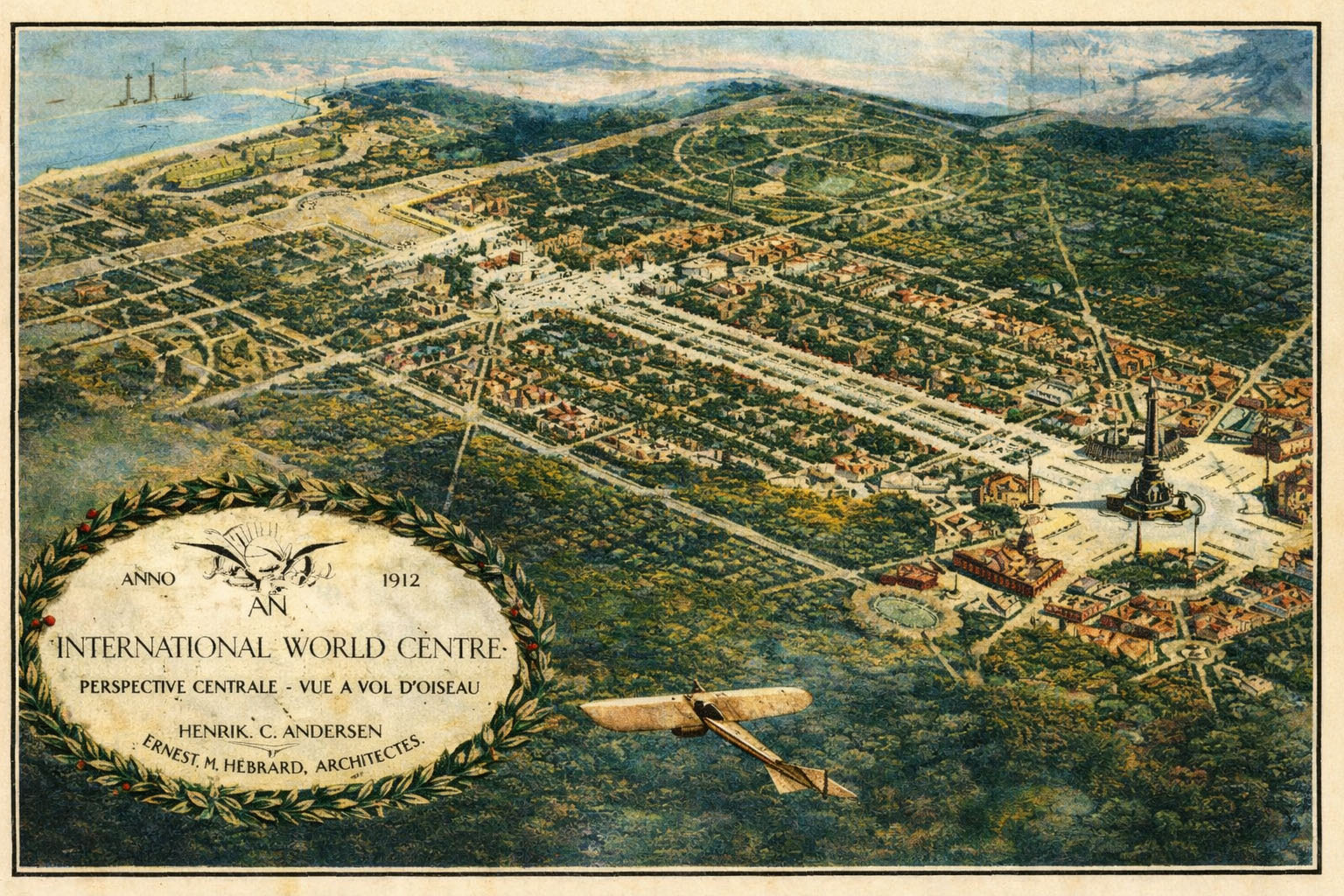
- Living Histories Pindimar Plan [c.1919] – Google has hit on one of our resources in our Living Histories Digital Platform
https://livinghistories.newcastle.edu.au/nodes/view/77250
- Tomaree Museum. The article below references the 1899 NSW Royal Commission that considered the land Pindimar now rests on was a potential site for Australia’s National Capital. 1899 Royal Commission (a NSW Royal Commission) listed the area between Balberook Cove and North Arm Cove as the 16th of 40 potential sites for the nation’s capital. We were not able to track down a copy of the original Royal Commission Report. ACTION: Please see if you can find a digital copy, or a library that holds one.
https://tomareemuseum.org.au/pindimar-city/
- The Port Stephens Book of Pleasure and Profit (NLA) – when you view online, only one page of publication is available. Luckily we hold a copy in the Gray Pamphlet Collection 919.442 PIND and also digitised it thank you Karen Moller, Digitisation Officer.
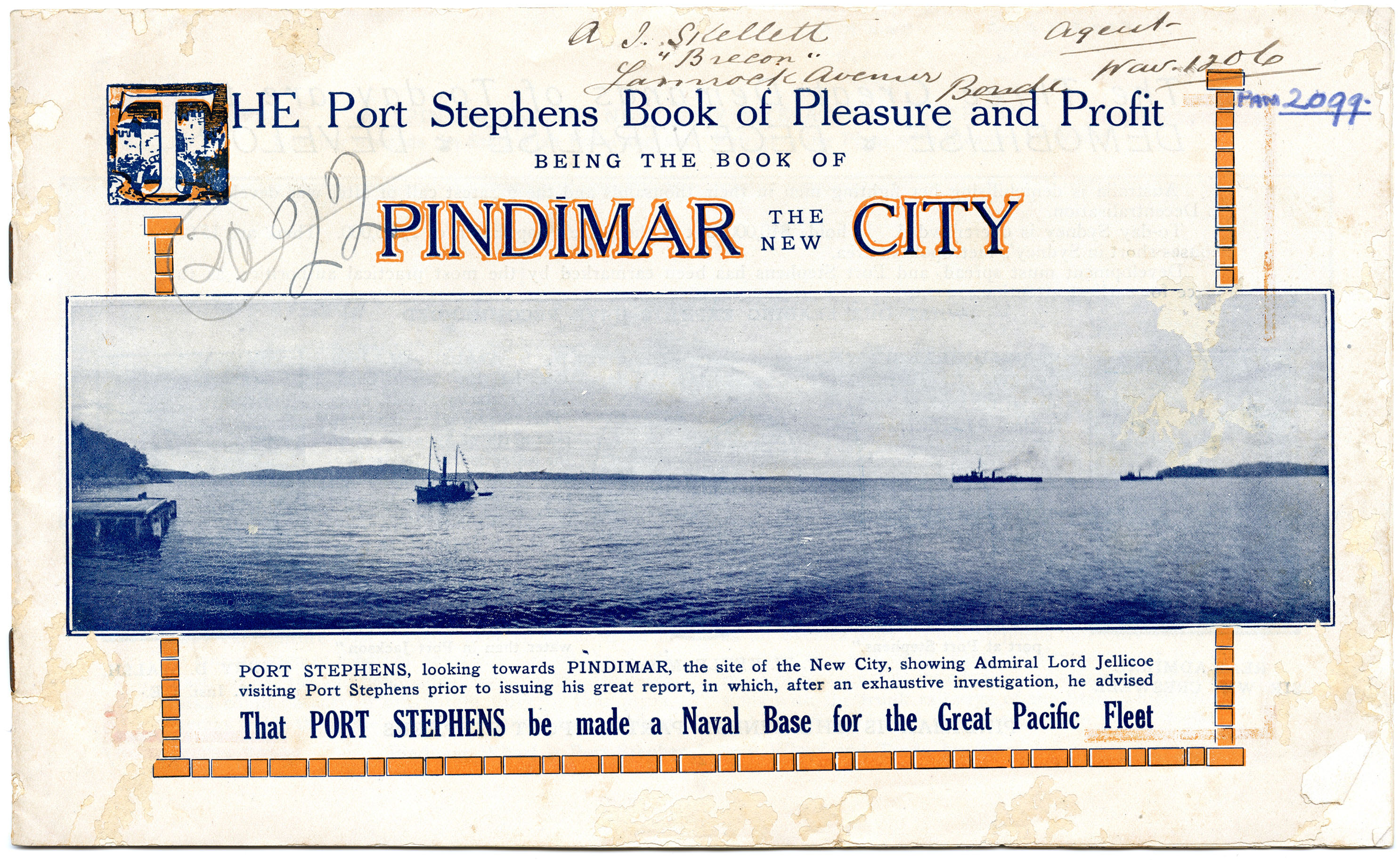
- Pindimar City plans (NLA) W. Scott Griffiths
https://nla.gov.au/nla.obj-229905753/view
We have digitised copies of the same plans. You can view them either through our UONCC Flickr site or Living Histories data platform. Just remember the downloadable image (i.e., “original size”) through flickr is many thousands of pixels larger than what it can display.
![Pindimar City, Port Stephens, New South Wales. Designed and laid out under the supervision of W. Scott Griffiths, Town Planning Engineer; H. Sheaffe, licensed surveyor. M1590 - Pindimar City Map, Port Stephens, New South Wales. [c.1919] https://www.flickr.com/photos/uon/5854858430/](https://live.staticflickr.com/65535/5854858430_3796ba921e_o.jpg?s=eyJpIjo1ODU0ODU4NDMwLCJlIjoxNzcwMzM0ODk1LCJzIjoiMzllMmU1YTA3OTkxZWRmZDFmOTg1ZGE1MzZlOTUwMmU4NGQ5Y2U2YSIsInYiOjF9)
![Pindimar City, Port Stephens, New South Wales. Designed and laid out under the supervision of W. Scott Griffiths. H. Sheaffe, Surveyor. W.C. Plan of proposed Federal Capital of Australia, at Pindimar, Port Stephens. M1590A - Pindimar City Sales Plan, Port Stephens, New South Wales [c.1919]](https://live.staticflickr.com/65535/5854307213_8cae8d3bba_6k.jpg?s=eyJpIjo1ODU0MzA3MjEzLCJlIjoxNzcwMzM2MjM4LCJzIjoiYzE5MTQyY2YzM2FlOWYwZGJjODYxOWFiNjFiYThkNWNkYjgyODZkMiIsInYiOjF9)
The Plans from the Gray Pamphlet Collection Location: 919.442 PIND
![Pindimar City Port Stephens New South Wales [c1919] [GRAY 919.442 PIND]](https://live.staticflickr.com/65535/55086631422_3c2155510d_z.jpg)

![Pindimar City Port Stephens Showing the general scheme. [c.1919] GRAY 919.442 PIND](https://live.staticflickr.com/65535/55086631642_9f8d24fb33_c.jpg)

Map Overlays
https://thespatiallab-newcastlehistory.netlify.app/
Fred Phillips
- History of Fred Phillips and ‘Pindimar City’ ACTION: Can you find out anything further on Fred Phillips as champion of the idea of Pindimar City?
https://www.newsofthearea.com.au/history-fred-phillips-and-pindimar-city
Aboriginal Origins of the word “Pindimar”
- Worimi Conservation Lands
Pindimar = Place of Black Possums
How to check? Canon Carlos Stretch was a Anglican priest whose three interests included; creating sermons for his congregation, driving around in his car, and Aboriginal Place names. He wrote under the pseudonym of “Boscobel” in the Newcastle Herald. His Toponomy manuscript ledger containing 5,500 Aboriginal and European place names across New South Wales, was compiled during the 1930s. There are boxes of archives containing thousands and thousands letters, notes, jottings and documentation relating to origin of place names across New South Wales, both Aboriginal and European.Stretch also records the name as “Pindimah”.

Compare Stretch’s work with Aboriginal words and names and sounds recorded the 1826 Ebsworth Map of Port Stephens and Aboriginal Place Names. Does “Pindimar” appear in 1826? Why not? What is there instead?
Other sources to consult?
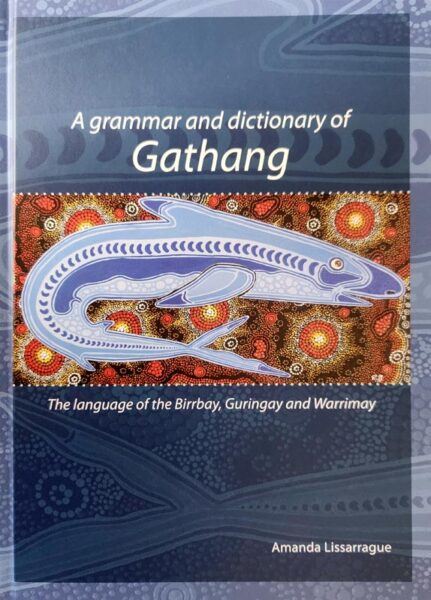
Lissarrague, A., & Muurrbay Aboriginal Language and Culture Centre. (2010). A grammar and dictionary of Gathang : the language of the Birrbay, Guringay and Warrimay. Muurrbay Aboriginal Language & Culture Co-operative. Also known as Bindayima or Bindima Source: RAS Royal Anthropological Society of Australia manuscripts. ACTION: Can you locate the original source for the place name “Pindimar”?
Library Search
https://www.newcastle.edu.au/library
A search of the Library catalogue also found us the following:
Armstrong, J., & Port Stephens . Council. (1996). Yacaaba and Tomaree : a history of Port Stephens (Rev. ed.). Port Stephens Council. – On page 58 of this well researched work we learn that the Australian Agricultural Company sold the land on which Pindimar is located to H.A.M. Merewether.
The University’s Archives holds the early records of the Australian Agricultural Company, dating back to 1824, including copies of the Conveyance Books. From the A.A. Company Conveyance Index transcribed and located here:
https://livinghistories.newcastle.edu.au/nodes/view/68156
We find two entries in the A.A. Company Conveyances:
B7949 Merewether, Henry Alfred Mitchell Book G No. 208 Date: 9 July 1908
Read in FULL: B7949 Merewether, Henry Alfred Mitchell Book G No. 208 Date: 9 July 1908
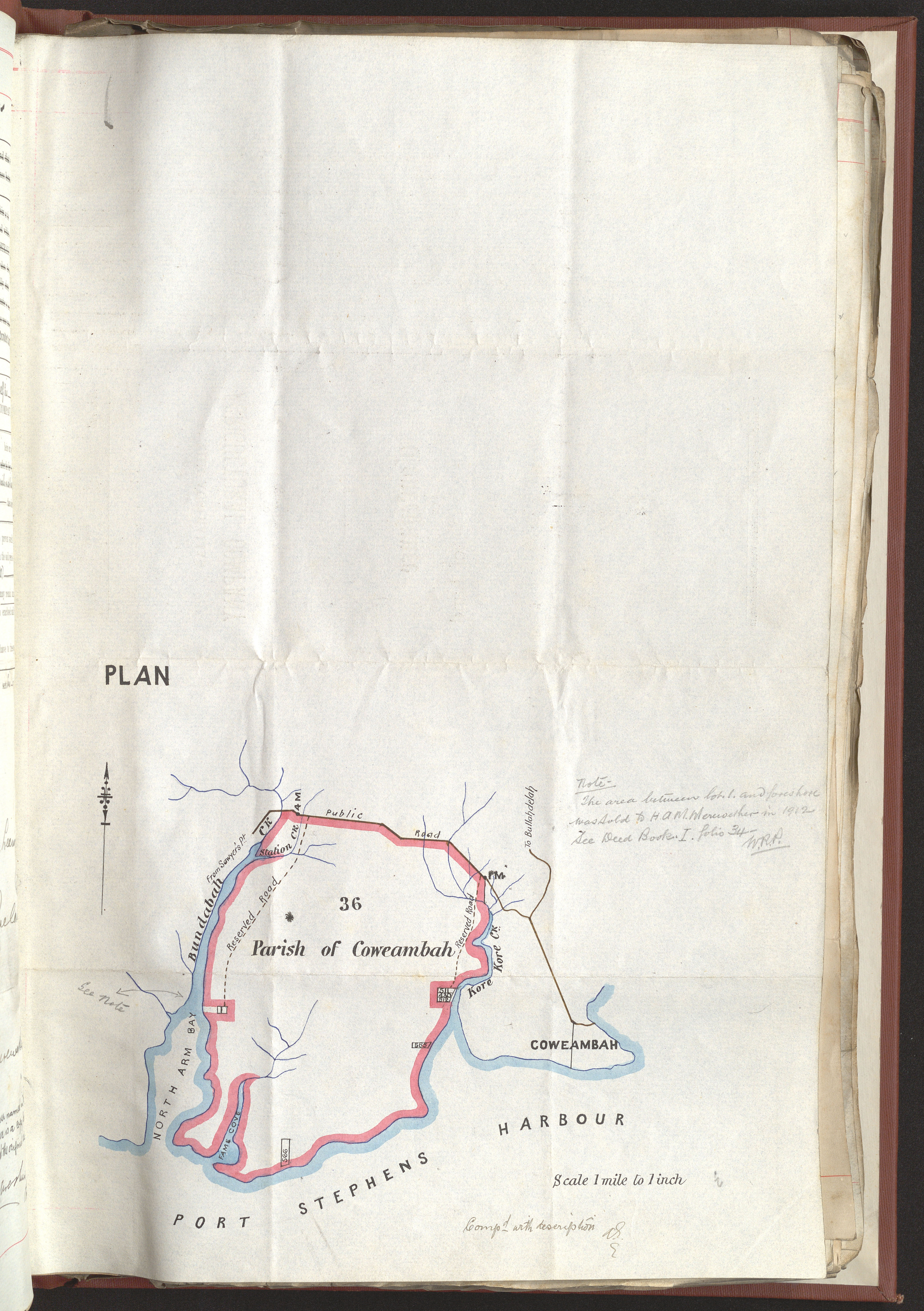
ACTION: Note the Aboriginal names on this plan, and compare to the 1826 Ebsworth map, and work of Canon Carlos Stretch above.
7946 Merewether, Henry Alfred Mitchell Book I No. 34 Date: 2 November 1912
Read in FULL: B7946 Merewether, Henry Alfred Mitchell Book I No. 34 Date: 2 November 1912
Further Resources (Thanks to Catherine Studdert)
- Port Stephens Past and Present, 1970 (Special Collections Q994.42 PORT)
- Port Stephens Heritage: Historical Context Report including Thematic Analysis prepared for the Port Stephens Council Community Based Heritage Study, Cynthia Hunter, 2001 (Special Collections Q994.42 HUNT-7)
Comments:
- “Pindimar” not shown on the 1826 map of Port Stephens
- “Pindimar” exists on Canon Stretch’s 1930s researches (see: https://hunterlivinghistories.com/2019/05/16/stretch/)
- Where, when, why and by who was it named?
- In the Worimi language – Pindimar translates to ‘Place of the Black Possum’
- Pindimar is situated on the North, right side of Port Stephens between North Arm Cove and Tea Gardens/Hawks Nest across from Nelson Bay
Online Publications:
Port Stephens – A History Exploration, researched and compiled by Kevin McGuinness, November 2022 Pindimar City at Port Stephens – Port Stephens – a history exploration
- In 1918 and the period immediately following WW1, Pindimar was suggested as the location for a Port for overseas shipping, then as a naval base in 1919.
- In 1899 following a Royal Commission it was suggested as the location for what is now Canberra, proposed to be developed as Pindimar City with plans for it to be the 3rd largest city in Australia – see the 1919 plans by W. Scott Griffiths, Town Planning Engineer, and H. Sheaffe, licensed surveyor. Marketing commenced in 1920.
- At that time, the only existing development was the Fish Processing Factory – the State Fish Receiving and Refrigerating Plant founded by the NSW Government in 1917.
- Pindimar sits in a commanding position at the entrance to Port Stephens, has a deep-water frontage (60 to 90 feet deep close to shore) and links to the main northern and north western lands, as well the main shipping wharf in Port Stephens @1919.
- The Hunter River Steamship Co., Ltd service between Sydney and Newcastle ran as well as a twice daily passenger/mail service.
- Fishing and oystering industries in the area.
History of Port Stephens: Evolution of a Seaside Sanctuary History of Port Stephens | Port Stephens Australia
- A shark catching and processing station opened at Pindimar in 1927 and was later converted into an ice factory.
‘Who established Pindimar’ indicate Pindimar may have been established as an area somewhere between 1826 and 1899:
-
- Information stating that following a N.S.W. State Commission in 1899, referring to the area as ‘the area between Balberook Cove and North Arm Cove’ was identified as potential for the Nation’s Capital City. Architect, Walter Burley Griffin developed a plan although rejected: A Tale of Two Cities | Tomaree Museum
- Googled who established Pindimar, information stating Frederick Phillips went there sometime after 1903 HISTORY – Fred Phillips and ‘Pindimar City’ – News Of The Area
- Also searched ‘The Lower Hunter Steam Ship Company’ (established in 1883) anticipating the possibility of a mention of Pindimar as a steam ship stop, as the company had been referred to in the specified publication/s and Google searches: Hunter River Steamers
Catherine Studdert
February 2026
International Inspirations
Walter Burley Griffin and wife Marion Mahony Griffin
What inspired the grand vision of Pindimar City?
- In 1908, the choice for the location of Australia’s national capital was Canberra. According to author Peter Proudfoot, Walter Burley Griffin, the American born designer, and his wife Marion Mahony Griffin, were steeped in esoteric philosophy and ancient beliefs, that influenced their design as a sacred city.
- In 1914 the world was plunged into the First World War, a war to end all wars. The human price was immense, especially among the young who died on the battlefields.
- Our plans date from c.1919, at the end of the war, so the spirit of the “City of Peace” was alive and well in the idea of Pindimar.

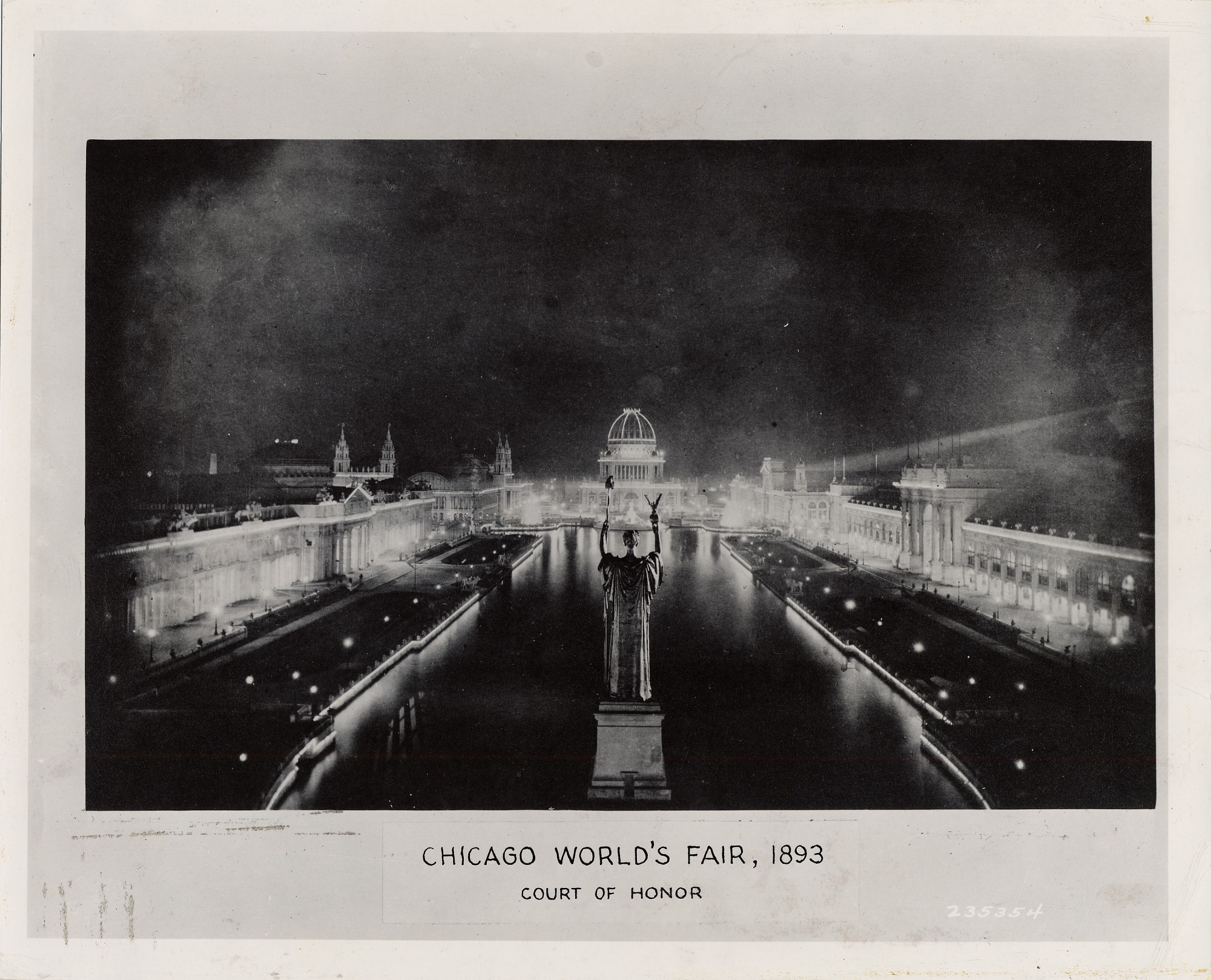
1893 Columbian Exposition or Chicago World Fair
In the illustration reproduced in the article of the proposed “City of Peace” at Pindimar you can see a tiny representation of a “Colossus” at the Harbour in direct alignment with the Cathedral. This appears very reminiscent of the Court of Honor, that was illuminated with 160,000 light bulbs in a magnificent display of electrical illumination for the 1893 Chicago World Fair by Westinghouse and Nikola Tesla.

https://archive.org/details/photographsworl00worl/page/16/mode/2up?q=tesla
https://moa.recollectcms.com/nodes/view/3610
https://moa.recollectcms.com/nodes/view/3842
The Ninth Wonder of the World: Turning Day into Night at the 1893 Columbian Exposition
Compiled by Gionni Di Gravio OAM
University Archivist & Chair, Hunter Living Histories