


The Newcastle Teachers’ College
The end of the Second World War saw an unprecedented increase in Australia’s population with the advent of the “baby boomers” and new immigration policies.
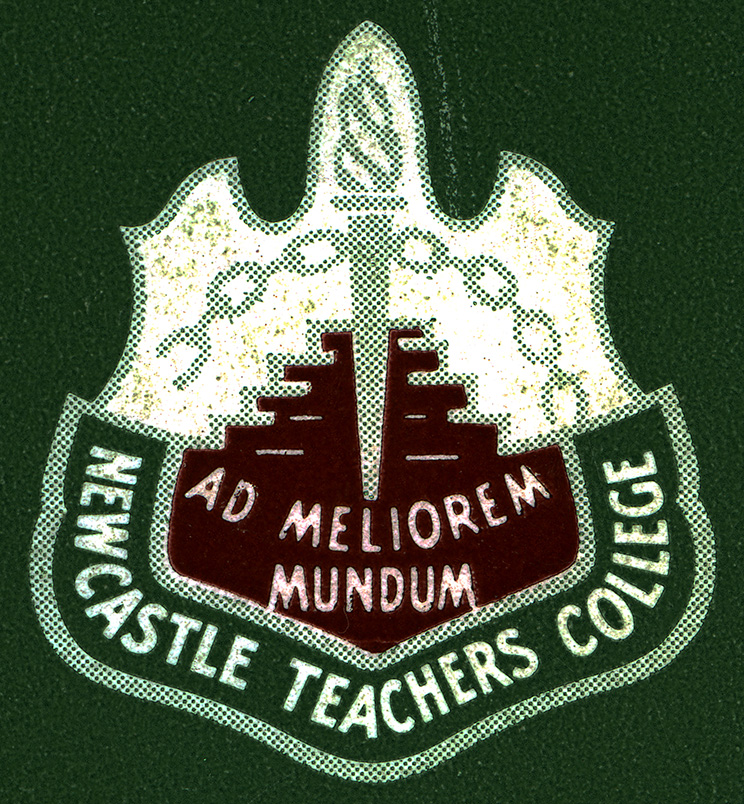
Teachers Needed for Baby Boomers
To provide the additional teachers for infant and primary schools the New South Wales Department of Education began to establish additional teacher training colleges – Wagga Wagga 1947, Balmain 1948, Newcastle 1949, Bathurst 1950. Wollongong, Lismore and Goulburn were to follow.

The Newcastle Teachers’ College Established 1949
The Newcastle Teachers’ College was established as an agency of the N.S.W. Department of Education in 1949, and commenced operation on the 28th February, in temporary occupation of premises at Broadmeadow which were being constructed for the Newcastle Technical High School.
Students with appropriate Leaving Certificate qualifications were recruited by way of a two-year scholarship, which included a three-year bond and a requirement for three years country service. The value of the scholarship equated to three guineas per week for students living away from home and two guineas for the others.
The College’s Principal was Mr Griffith H. Duncan, who had previously been Vice-Principal at Wagga Wagga Teachers’ College.

Buildings Not Yet Complete
Temporary accommodation for the Newcastle College was to be in a building designed as the Manual Arts Department of what was to become Newcastle Boys’ Technical High School in Chatham Road, Broadmeadow.
Unfortunately on enrolment day, Tuesday, 2nd March 1949 the building was not complete and the whole area was no more than a building site. As a result the students were dispersed to schools for practice teaching to begin the following day.
For some students the vision of a college with manicured playing fields and convenient dormitories was shattered. Improvisation and initiative by both staff and students became a feature of their college experience which enabled them to survive on a meagre scholarship allowance while training and then as teachers where they had to cope with poor accommodation, oversized classes and lack of teaching material.
Altjiringa – The Magazine of the Newcastle Teachers’ College
View the 1949-1985 Altjiringa Magazines here: https://livinghistories.newcastle.edu.au/nodes/view/81168
From 1953-1967 and 1973-1974 Altjiringa released a special edition known as the Altjiringa Annual, which apparently replaced the Magazine for the intervening years.
View the Altjiringa Annuals from 1953 here: https://livinghistories.newcastle.edu.au/nodes/view/56659
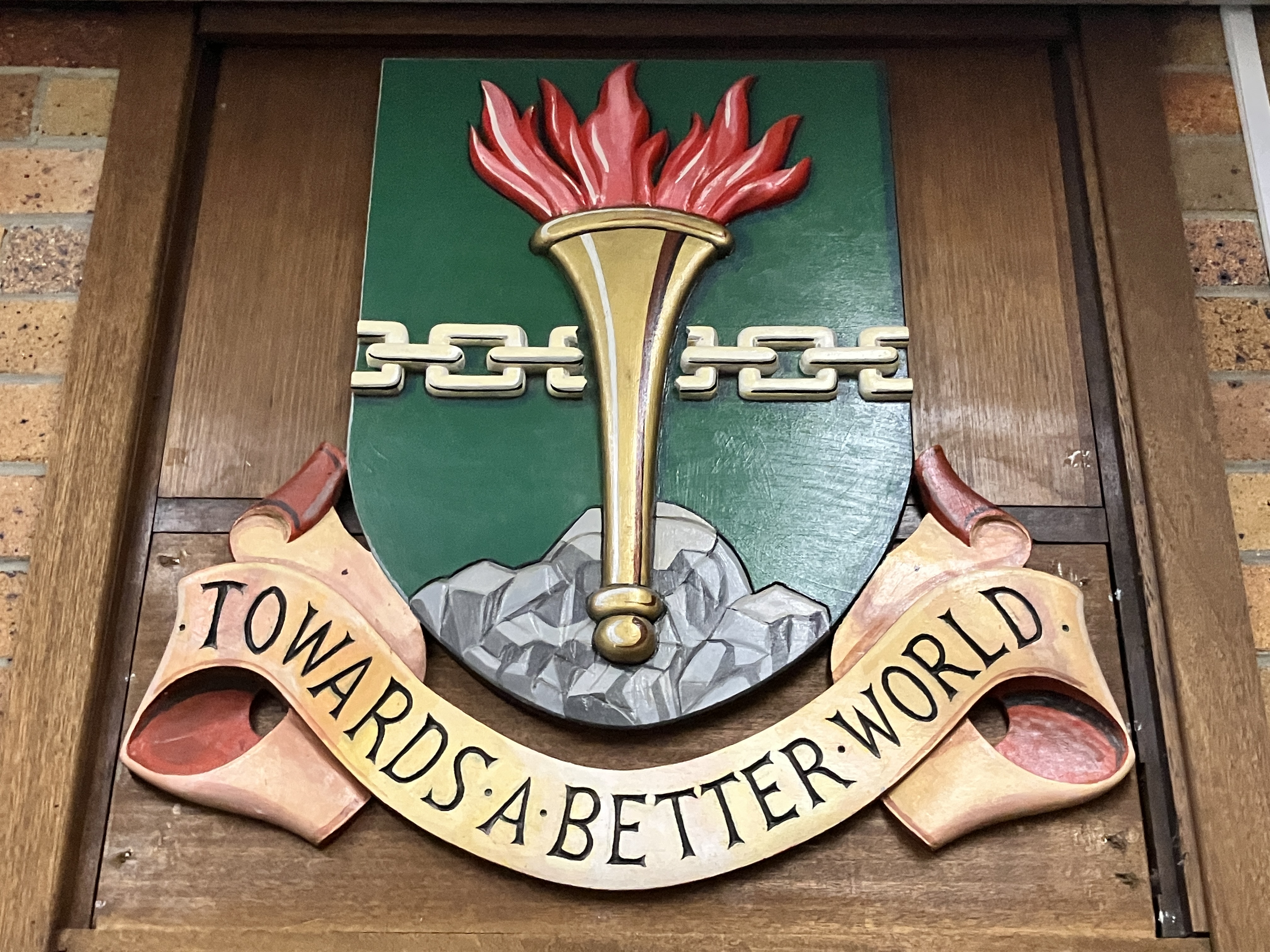
Origin of the Name ‘Altjiringa’
From the Editorial of Vol. 1 No. 1, the editor, Noel Rutherford explains:
“Altjiringa? A strange name no doubt. It is aboriginal language from the Aranda tribe and it is a free translation of our own motto.
Our conception of a “better world ” is the aboriginal “dreamtime”. It embodies all that is best in the future and includes that general philosophic and religious consciousness which guarantees the social cohesion of the tribe. As such it is an order, with rigorously trained initiates, which keeps alive tribal traditions, records the mythical exploits of the cult heroes and generally strives to raise the levels of thought of the tribe.
In choosing “Altjiringa” as the name of our magazine we have keep these points in mind. We hope that “Altjiringa” will will assist in making a “better world” by the indirect method of broadening the outlook of the future teachers of the world’s children. We know that it will make a better college.
The “initiates” to our altjiringa, the members of the editorial staff, have the same duty as the initiates of the old altjiringa. They will strive ‘to elevate the levels of thought at College, to carry the spirit of the College to future generations of students, and to record and praise the acts of collegiates which are considered worthy of attention.
This paper has been printed under great difficulties and we gratefully acknowledge the help of those people outside the editorial staff who made this first edition possible: Mr. S. Parkes, whose advice on aboriginal customs led us to choose our name; Mr. B. McNamara for valuable advice on blocks and setting; Mr. Duncan, our Principal, whose kind donation of £1 allowed us to buy blocks; and the S.R.C., without whose financial and moral support we could not have gone to press.”
The Pioneer Session

The majority of the 181 pioneer students came directly from a variety of public and private high schools in the Hunter Region. Others came from the North Coast Central Coast and the Sydney area. A few accepted scholarships after work experience and a few were ex-servicemen.

The students came from diverse backgrounds and went on to work at different professional levels. Some rose to positions of power and influence while others gained satisfaction from maintaining direct contact with pupils in classrooms.
Unknowingly, as college students, they were establishing standards and traditions, which would enhance the name of the college, and its acceptance by the Newcastle community would encourage civic leaders to strive for the establishment of a university.

The Official Opening 15 March 1950

The official opening by Minister for Education Mr Heffron took place on the 15 March 1950, to coincide with the centenary year of the opening of the first national school at Hexham in 1850.


The College Moves to Union Street Newcastle
Construction of 24 prefabricated units, to serve as a temporary college began construction in January 1951 on the corner of Union-Street and Parkway Avenue opposite No 4 Sportsground. [1] The College moved into more nearly permanent premises at Union Street, Newcastle in 1952. (see: http://nla.gov.au/nla.news-article133719710)


In July, 1973, the Minister for Education appointed an Interim Council for the College, to advise him and to undertake forward planning in advance of the impending transformation of the Teachers’ College into a College of Advanced Education. [2]
College Moves to Waratah West, Adjacent to University
In February, 1974 the College moved again, to a new site at Waratah West, adjacent to the University of Newcastle. [2] It was then given administrative independence, from the 1st July, 1974, by delegations of authority to the Interim Council to enable it to handle administrative matters which had previously been dealt with directly by the Department of Education. [3]
On the 1st October, 1974, the College was declared a corporate college under the Higher Education Act, 1969, with the name of the Newcastle College of Advanced Education [4], and from that date the Newcastle Teachers’ College ceased to exist. [5]
In time the college moved to temporary accommodation in Union Street Newcastle, before finding a permanent campus at Shortland. It was here that diversification to an Advanced College of Education took place and ultimately the amalgamation with the University of Newcastle.
[1] Newcastle Teachers’ College Calendar, 1960, p.17.
[2] Newcastle College of Advanced Education Calendar, 1976, p.3.
[3] ibid., p.62; Minutes of the Interim Council, p.33.
[4] N.S.W. Government Gazette, No.114 (20th September, 1974), p.3636; Higher Education Act, 1969, Section 16(1) & (2).
[5] Newcastle College of Advanced Education Calendar, 1976, p.3.
II. Newcastle College of Advanced Education (N.C.A.E)/Hunter Institute of Higher Education (H.I.H.E.) [Agency no. 3562]

Newcastle College of Advanced Education (N.C.A.E)
The Newcastle Teachers’ College became known as the Newcastle College of Advanced Education in 1974 when it was declared so by the Minister for Education on October 1, 1974 and governed by a Council established under the Colleges of Advanced Education Act (1975) of New South Wales.
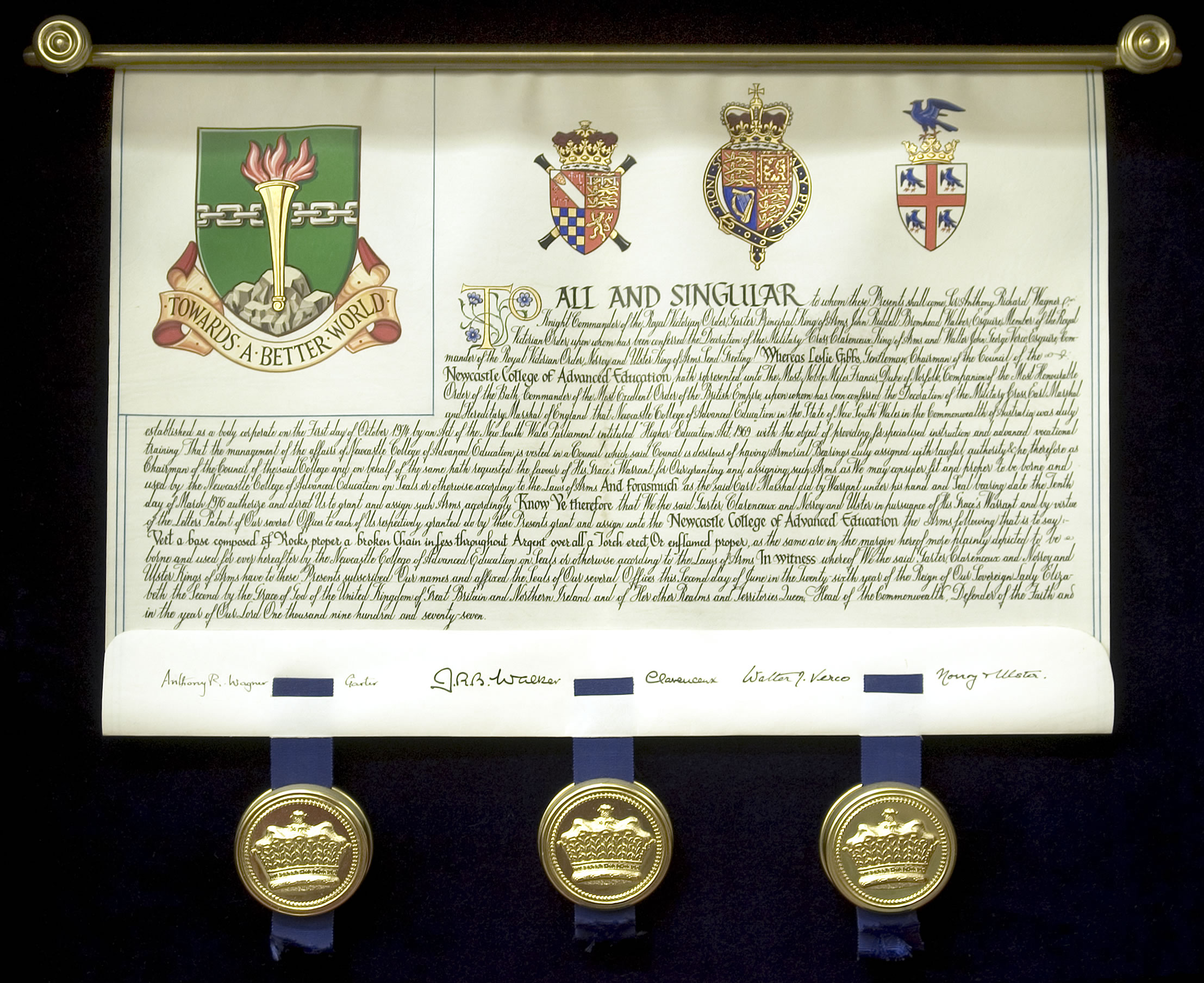
On the 1st October, 1974, the Newcastle College of Advanced Education was declared a corporate college under the Higher Education Act, 1969, [1] and the first College Council (the “First Constituted Council”), appointed under Section 16(6) of the Act, assumed office. [2] The College was formally opened by H.E. the Governor of New South Wales, Sir Roden Cutler, on the 23rd November, 1974. [3]

Mr Griffith Duncan, the first Principal of the College, who had also been Principal of its predecessor institution, the Newcastle Teachers’ College, retired on the 27th March, 1975. [4]

The College achieved full corporate status upon the gazettal of its Bylaw on February 25th, 1977 and the reconstitution of its Council from April 1, 1977. The First Constituted Council was originally appointed to hold office until the 30th September, 1976, [5] but its term was extended until the 31st March, 1977, [6] and its final meeting took place on the 21st February of that year. [7]
The College By-Law was gazetted on the 25th February, 1977, [8] and the Council elected in accordance with its provisions under Section 16(7) of the Higher Education Act, 1969 (the “Reconstituted Council”) met for the first time on the 18th April. [9]

The institution in 1987 applied to the N.S.W. Minister for Education to change its name to the Hunter Institute of Higher Education because of its continuing diversification and its wider regional base. Following Ministerial approval, the institution became known as the Hunter Institute of Higher Education on January 1, 1988.

The Hunter Institute of Higher Education (H.I.H.E.)

The Hunter Institute of Higher Education was a multi-discipline tertiary institute catering to the demands for higher education in the Newcastle and Hunter Valley Region. Teacher education still played an important role for the Institute but in the 13 years prior to 1989 had seen an expansion into the areas of visual arts, paramedical and community welfare studies, nursing and administration and technological studies. The lnstitute’s diversification of its academic programmes commenced in 1975 when it assumed responsibility of the Fine Arts diploma courses, formerly offered by the Department of Technical and Further Education at the Newcastle branch of the National Art School, and full responsibility for the Diploma in Art (Education) courses formerly offered in association with that department.

The Institute occupied extensive, modern, well-appointed buildings in an attractive natural bush land setting of some 24 hectares at Waratah West, adjacent to the University of Newcastle and 11 kilometres from the city of Newcastle. Stage 1 of the Institute complex at Waratah West was occupied progressively, first by the Department of Industrial Arts in 1970 and then by the Department of Art Education which followed in 1971. Stage 2 of the new complex was fully occupied in March 1974 when the institute moved most of its remaining activities from the former Union Street site in the city. Stage 2 was finalised with the completion in November 1974, of an auditorium incorporating an extensive stage area, excellent facilities for the performing arts and seating on two levels for 924 persons.

The Institute occupied extensive, modern, well-appointed buildings in an attractive natural bush land setting of some 24 hectares at Waratah West, adjacent to the University of Newcastle and 11 kilometres from the city of Newcastle. Stage 1 of the Institute complex at Waratah West was occupied progressively, first by the Department of Industrial Arts in 1970 and then by the Department of Art Education which followed in 1971. Stage 2 of the new complex was fully occupied in March 1974 when the institute moved most of its remaining activities from the former Union Street site in the city. Stage 2 was finalised with the completion in November 1974, of an auditorium incorporating an extensive stage area, excellent facilities for the performing arts and seating on two levels for 924 persons.
In the total complex there were art studios; craft rooms; science, woodwork, metalwork, and materials science laboratories; geography, history and social science rooms; home science, cooking and food science laboratories; needlework and textiles rooms, mathematics lecture and computer rooms; music rooms; music practice rooms; general lecture rooms and theatres; a Physical Education complex incorporating two fully equipped gymnasia, a dance studio, health studio, change rooms and lecture facilities, with adjacent courts and playing fields; sound studio; photographic rooms; and cafeteria. The Library consisted of a single floor reading room, including study areas, offices, typing rooms, stacks and catalogues; and a second lower floor which includes an audio-visual teaching aids resources centre, tape recording rooms, visual education rooms, a language laboratory and extensive storage space for films, cassettes and records.

In 1981 the institute opened a TAFE Curriculum Centre at the Tighes Hill campus of the Newcastle Technical College. The Centre was funded and supported by the Commonwealth Tertiary Education Commission. The Department of Technical and Further Education (N.S.W.) and the Institute and provides facilities for TAFE teachers undergoing initial teacher training.
Construction was completed in 1980 of an Art building costing $1.5m and this housed a number of the Institute’s fine arts courses and craft courses. The building included studios for design, drawing/painting and printmaking, display areas, workshop, darkroom, offices and course service facilities. There were three sculpture workshops adjacent to the building. The ceramics specialisation was relocated from the Union Street premises of the Institute to Waratah West in 1985 following the completion of the second stage of a new Block. The third and final stage was constructed at the end of 1986.
A major capital building development completed in 1976 was the construction of the Special Education Centre to facilitate the consolidation and development of the Institute’s courses and research in the field of special education, especially the provision of courses for the preparation of resource teachers and teachers of educationally handicapped children. The Centre was magnificently designed and equipped for exemplary training, research and clinical activities and provides excellent opportunities for the teaching of special education courses, particularly where clinical conditions are appropriate. It consisted of two major intervention classrooms; four smaller observation/clinical rooms; as well as four diagnostic/clinical rooms, a conference room, staff office wing, staff lounge, computer and curriculum resources reference room, directors suite, audio-visual control room, and extensive direct observation rooms via one-way glass. A Motor Skills Therapy wing had been added to the Centre and included a small hydrotherapy pool, an additional preschool room and a large area for the treatment of physical disabilities, to be used in the treatment of children who have motor disability and whose ages range from a few months to eight years. Close links have been established with the schools and children with specific learning difficulties are brought to the Centre for special corrective programmes, which are conducted in the intervention classrooms established by the Institute. It is the lnstitute’s aim that the Centre should become, in cooperation with other educational institutions, a centre for further development and research in special education and thus provide a valuable service to the community.
A Multi-Purpose Centre, which includes a Child Care Unit, was officially opened at the Institute in 1984. The Centre is being developed on a progressive basis and the Child Care Unit provides a flexible range of care and hours for children from a few weeks of age up to four years. The Unit is available for staff and students and the nearby community and can cater for 25 children.

Another development in 1984 was the establishment and opening of a Studies Resources Centre for Aboriginal students at the Institute. This Centre was superseded in 1987 when an Aboriginal Education Centre was constructed on campus and this facility was officially opened in 1988. The Centre includes a large multi-purpose room, a comprehensive Aboriginal library, tutorial rooms, counselling room and an Administration and reception area.
A major building project completed in 1988 was the Richardson Wing which mainly accommodated students enrolled in the Diploma of Applied Science (Nursing).
Extensions to the Student Union Building, to the Institute Library and a new office block for academic staff were completed in 1987 and a new administration building was constructed in 1988.
The name of the College was changed to the Hunter Institute of Higher Education at the beginning of 1988. [10]
In 1988 the Institute had a student enrolment of 4,300, an academic equivalent full-time staff establishment of 237 in 14 departments and a general staff establishment of 283. The Institute’s vocational courses were offered through four Schools; the School of Administration and Technology, the School of Health, the School of Education and Humanities and the School of Visual and Performing Arts. A Council of members drawn from the community, the staff and the students governed the Institute. The Council is responsible for the management of the Institute’s affairs and exercises its powers, duties and authorities under the Colleges of Advanced Education Act, 1975. It was later amalgamated with the University of Newcastle in 1989.

On the 1st November, 1989, the Hunter Institute was abolished and its assets vested in the University of Newcastle. [11]
[1] N.S.W. Government Gazette, No.114 (20th September, 1974), p.3636; Higher Education Act, 1969, Section 16(1) & (2); Newcastle College of Advanced Education Calendar, 1976, p.3.
[2] Minutes of the First Constituted Council, p.1.
[3] ibid., p.65.
[4] Minutes of the First Constituted Council, p.26.
[5] Newcastle College of Advanced Education Calendar, 1976, pp 3, 16.
[6] Newcastle College of Advanced Education Calendar, 1977, pp 5, 18.
[7] Minutes of the First Constituted Council, pp 168(a), 182.
[8] N.S.W. Government Gazette, No.20 (25th February, 1977), pp 726-752.
[9] Council Minutes, p.183.
[10] N.S.W. Government Gazette, No.165 (23rd October, 1987), p.5961; Council Minutes, p.1453.
[11] Higher Education (Amalgamation) Act, 1989, section 11(1)(2); N.S.W. Government Gazette, No.105 (27th October, 1989), p.8844.
Key Figures
Griffith Hammond Duncan (1914 – 1988)

Griffith Hammond Duncan, O.B.E., M.A., B.Ed., F.A.C.E. was born in Kurri Kurri in 1914 – half Welsh, half Scottish. His early education was at Kurri, his secondary at East Maitland Boys’ High School and tertiary at the University of Sydney where he pursued his love of English and his bent for Mathematics and Science. Griff completed his professional training year at Sydney Teachers’ College and was eventually appointed in 1935 to the N.S.W. Teaching Service at Newcastle Junior High School. In 1940 he was triumphantly awarded his Master of Arts degree in mathematics, with First Class Honours, and the University Medal. Griff had just been “run in” into teaching when, also in 1940, he joined the R.A.A.F. and remained there for five and a half years. After discharge, he returned to teaching at Sydney Technical High School. Thence he was appointed to Balmain Teachers’ College as a Lecturer in Mathematics, and part-time at the University of Sydney, before going to Wagga Teachers’ College as Vice-Principal for two years. Then a State decision was made to open a Teachers’ College in Newcastle. Griff says he “was fortunate to get the job”. In 1949, he opened Newcastle Teachers’ College in the Manual Arts Room of what was to be part of Newcastle Technical High School, with 13 staff and 182 students. He retired in 1975 after watching its development from Teachers’ College to Newcastle College of Advanced Education to Hunter Institute of Higher Education. (Exerpts from “Griffith Hammond Duncan Memorial Service 19th April, 1988 Eulogy delivered by Mr Phil Marquet”.)
Dr Edward Richardson Principal, Newcastle College of Advanced Education 1976 -1984

The late Principal of the College, Dr Edward Richardson, was a very far- sighted man and a Principal who would be hard to replace, according to the President of the College Council, Mrs Margaret Bowman. Mrs Bowman said Dr Richardson was dedicated in his efforts for the advancement of Newcastle C.A.E. and also its status as an educational institution. Mrs Bowman was one of many people who paid tribute yesterday to Dr Richardson after learning of his death. Dr Richardson passed away on Saturday morning in the Mater Hospital after suffering a heart attack at his home. He was 54 years of age. Mrs Bowman said Dr Richardson was a Principal who was always looking at the future of the College and a man who was not prepared to be happy with a status quo situation.”He was a man who respected strength and forth-rightness in the people who he was dealing with,” said Mrs Bowman. It’s an unfortunate fact of life but you never really appreciate what the contribution of a person is until you have to replace that person,” she said. Dr Richardson was born in Seghill, near Newcastle-upon-Tyne in the north of England and after school entered Kings College at the University of London. He graduated from the University in 1951 with a Bachelor of Science degree, for which he gained honours in Chemistry. In 1952 he was awarded a Postgraduate Certificate in Education, again from the University of London. Dr Richardson started his doctoral studies by external study whilst a technical college teacher in England and gained his Doctor of Philosophy in Chemistry in 1956. He came to Australia in 1968 to take up a position of Senior Lecturer in Education at Macquarie University and was promoted to Associate Professor in 1971. Dr Richardson was appointed as Principal of the Newcastle College of Advanced Education in 1976 and was responsible for guiding the institution through a period of continuing diversification. From a major emphasis of teacher education,the College now offers a variety of courses in the fields of the arts and paramedical and community welfare studies. Under Dr Richardson’s direction it is also looking at the possibility of offering courses in the business and technological studies area. Assistant Principal, Dr Doug Huxley, said one of the most striking points in his mind about Dr Richardson was the late Principal’s empathy with people from less fortunate socio-economic groups. “Dr Richardson knew a lot about that kind of situation because of his own background,” said Dr Huxley. “He understood the struggle people went through when they didn’t have the start of a good background,” said Dr Huxley. “He was interested in making sure first or second generations of these socio-economic groups who didn’t feel comfortable in entering tertiary education would feel comfortable in this C.A.E.” Dr Huxley said Dr Richardson was also determined to make sure that Newcastle C.A.E. emphasised its academic strengths. “He continued to fight to make sure the College recruited the best people, whether academic or non-academic,” Dr Huxley said. “This seemed to set the tone for the College to strive for high standards of staff and operation.” Two other people who paid tribute to Dr Richardson were the President of the Students’ Association, Jennie Lang, and the Acting Vice-Chancellor of Newcastle University, Professor Michael Carter. Jennie said she believed the S.R.C. had lost a friend instead of a Principal because of the close association the Students’ Council had with Dr Richardson in the past three years. “His work with the students was not widely known because he didn’t publicise it very much,” said Jennie. “It was largely because of his interest that we were able to build the Student Union Building and the Child Care Centre. “His door was always open and he helped the S.R.C. Executive many times by his advice and direction,” said Jennie.
Professor Carter said Dr Richardson was a strong advocate of improving the educational opportunities in the Hunter Region. “He was particularly concerned to develop courses which would enable people from all backgrounds and all ages to enter a tertiary institution and fulfill their potential to the utmost,” said Professor Carter. Dr Richardson is survived by his wife, Brenda and two daughters. The youngest, Ann, is a student in Home Economics at this College. A church service was held for Dr Richardson at 2 pm on Wednesday October 17th 1984 at St Luke’s Uniting Church in Narla Road Belmont. A private cremation followed at Berefield Crematorium. (Reprinted from: Campus News: Newcastle College of Advanced Education 5:19 (October 16, 1984)
Dr Douglas Rex Huxley Principal, Hunter Institute of Higher Education (1987-89) Deputy Vice-chancellor (Planning) (1989-1993)

Dr Huxley was born in Gulgong, New South Wales, in 1933. He received his education at Mandooran Central School and Dubbo High School. After leaving school, he attended the then Newcastle Teachers College. He graduated from the College in 1952 and took up appointment as a teacher with the New South Wales Department of Education, and taught at various centres in New South Wales from 1952 to 1969. While engaged in his teaching duties, Dr Huxley undertook university studies and, in 1965, obtained the Degree of Bachelor of Arts from the University of New England and in 1967, his Bachelor of Letters from the same University. He then registered for further higher degree studies at the University of Newcastle, and in 1972 was awarded the degree of Master of Arts and, in 1976, the degree of Doctor of Philosophy from that University. Dr Huxley was appointed as a Lecturer in English at the Newcastle College of Advanced Education and, in 1972, was promoted to Senior Lecturer in English. After the position had been extensively advertised nationally and overseas, Dr Huxley was successful in being appointed Assistant Principal of the College in August 1976. Following the death of the former Principal, Dr Richardson, in October 1984, the College Council appointed Dr Huxley as Acting Principal, then, in December 1984, as Principal pending the advertising of the position and the making of a permanent appointment. Dr Huxley was Principal of the Hunter Institute of Higher Education and was honoured in 1989 by the Institute Council resolving to name the Institute Library in his honour. This was deemed a tribute to his commitment to the institution and his highly respected leadership. Dr Huxley was appointed Deputy Vice-chancellor (Planning) of the newly amalgamated University of Newcastle in 1989. Dr Huxley retired from the service of the University on 3 January, 1993.
Acknowledgements
Thanks to Dr Edward Bridle in the preparation of State Records NSW (now Museums of History NSW) Agency Descriptions for (1) The Newcastle Teachers’ College [Agency no. 3561] and Newcastle College of Advanced Education (N.C.A.E)/Hunter Institute of Higher Education (H.I.H.E.) [Agency no. 3562]. Thanks very much for our wonderful dedicated volunteers, especially Peter Longworth, who digitised over 17,000 archival photographs in his time with us.
Further Reading
Compiled by Gionni Di Gravio OAM
University Archivist & Chair, Hunter Living Histories.