

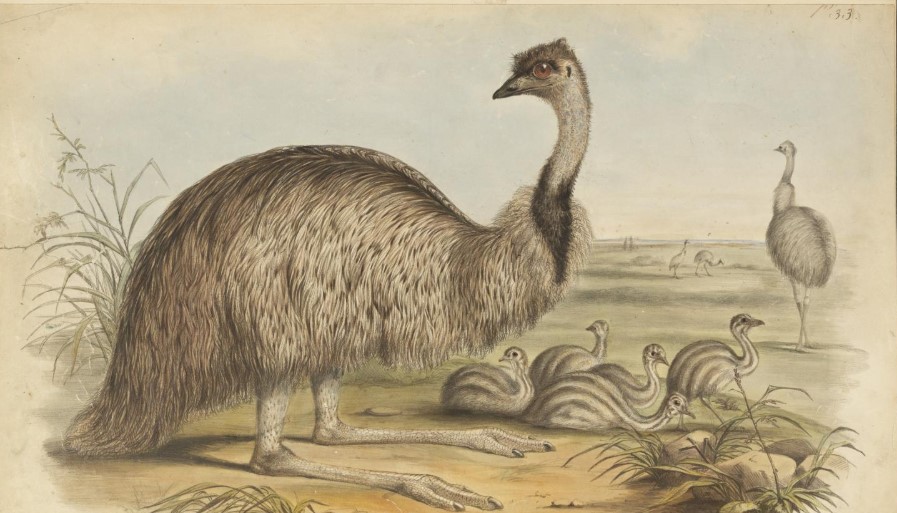
By Sharon Nott, Community Historian & Museum Project Officer
As an Amateur Historian and Bird Enthusiast who is living in the small township of Dunedoo, in Central West NSW, l thought l would share some links that l’ve been able to put together that shows key connections, within our district, during the European Age of Natural History, when it came to Birds. Figures like John Gould, Gregory Mathews, Thomas Austin and the Gould League during the period 1838-1927 were to transform European understanding with detailed bird studies and artistic representation. Although the township of Dunedoo didn’t take off till the railway came through in 1910, the area was being settled by Europeans from 1822. From vast areas of bushland (Grassy Box Woodlands in particular) to closer farming settlements, the landscape was to change dramatically. Our Dunedoo area has played a part in the narrative of Australia’s birds and scientific history and showcases how even remote small communities hold untapped historical and ecological significance. So what are these ‘Bird Connections’?
Dunedoo District Area (within 80km) Liverpool Ranges, Cobbora, Merrygoen, Wellington – our BIRD association with prominent Australian Ornithology Identities and Environmental Education.
John Gould (1804-1881) and Elizabeth Gould (1804-1841)
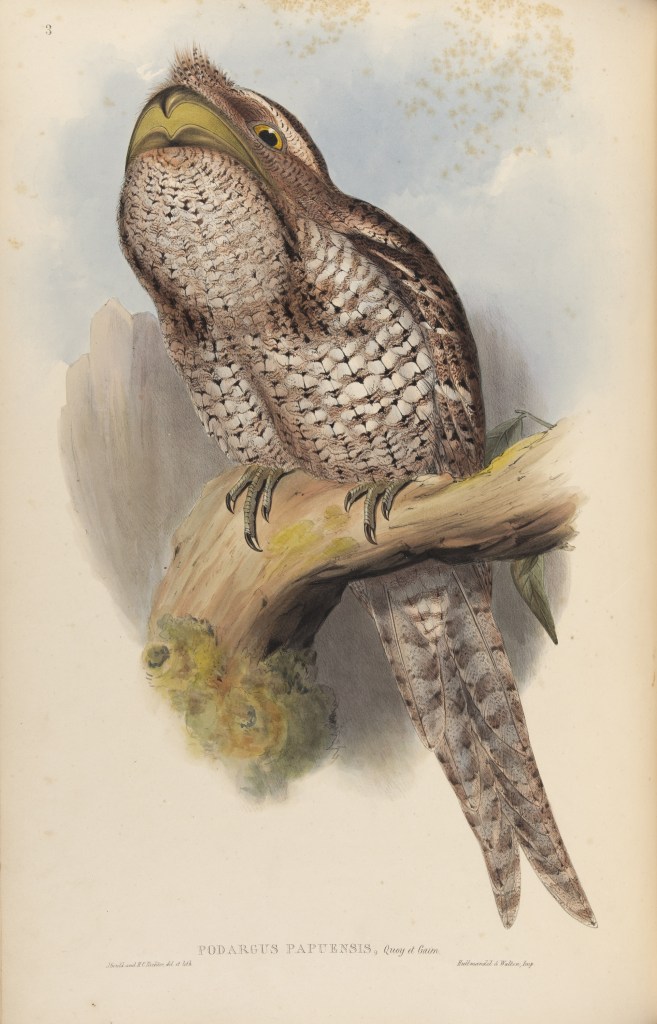
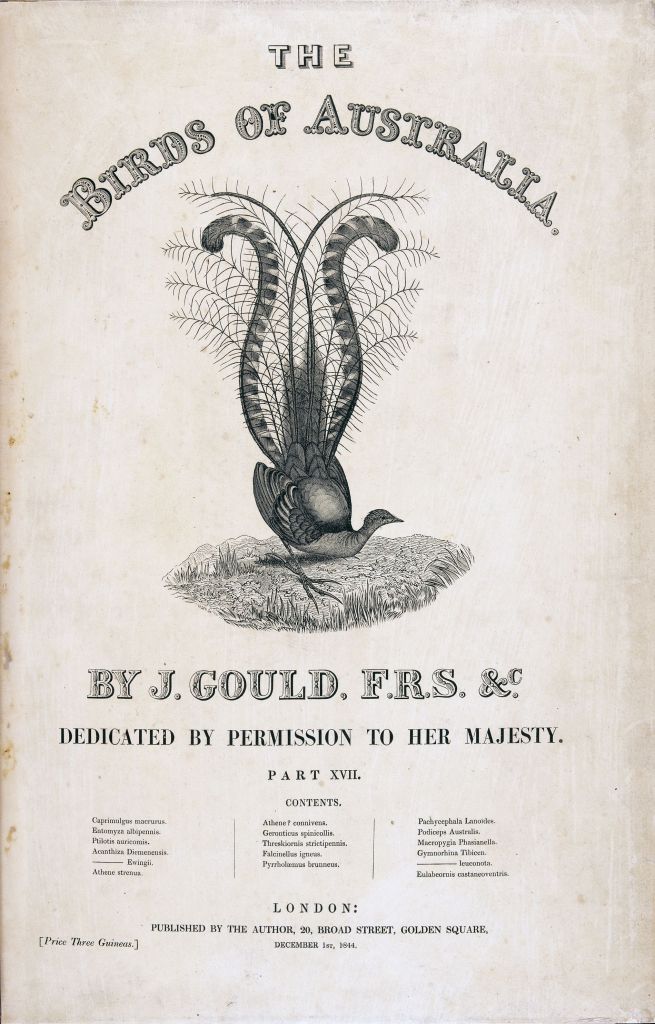
John Gould (1804-1881) and Elizabeth Gould (1804-1841) -the prominent complimentary English ornithologist and artist couple. John Gould is renowned for his extensive work on the birds of Australia and Elizabeth, her lithograph scientific illustrations. John and Elizabeth sailed to Australia in May 1938. Gould spends nearly 3 months with Stephen Coxen (Elizabeth’s brother) at his ‘Yarrundi Station’ near Scone. Her other brother- Charles, had been sending bird skins overseas to Gould for a number of years from his travels around the Hunter area. Gould does a number of expeditions through the Liverpool Ranges-collecting, exploring and documenting birds. John and Elizabeth leave Sydney in April 1840. The first comprehensive account of Australian Birds with illustrations takes Gould 8 years to complete 1840-1848. It is titled ‘The Birds of Australia’ – 7 volumes with 250 printed cpoies (a supplement was completed in 1869). It included 681 species, 328 of which were first described by Gould. In 1848 Gould would sell his 1500 Australian bird skins to the Academy of Natural Sciences at Drexel University Philadelphia after the British Museum refused to pay the asking price. Apart from the many books Gould published he also worked closely with Charles Darwin and played a significant role in the development of the theory of evolution.
The Talbragar river source is on the western end of Liverpool Rangers and flows south-west through Dunedoo- who knows whether Gould and his brother-in-law, Charles, may have collected birds in the vicinity when undertaking the explorations through the Liverpool Ranges. Dunedoo area lies on the border of the Wiradjuri and Kamilaroi First Nation Lands. Gould collected a number of live ’Warbling Grass Parakeet’s’ on the Liverpool Plains that he took back to England. He actively sought out the Indigenous names of the specimens he collected -from Kamilaroi language this bird was the Betcherrygah (we call it the Budgerigar which is now the most caged bird in the world). It is highly likely that the aboriginals that helped Gould, travelled through the Dunedoo district in particular seasons.
Thomas Austin (1874-1937)
Thomas Austin (1874-1937) –the Cobbora Station Manager/Owner who held one of the best Oological (Egg) Collections in Australia that he donated to the Australian Museum, Sydney in 1937 (15,000 eggs of 750 species of land and sea birds found breeding in Australia). He was meticulous with his recordings. The son of a Victorian Grazier (and nephew to the pastoralist Thomas Austin of ‘Barwon Park’, who brought rabbits into Australia in 1859) Thomas managed, then owned Cobbora station from 1901-1929. It was during his time at Cobbora- especially up to 1917, that he began to build up a comprehensive oological collection from his 8,000ac property, which the Talbragar river ran through. He also collected from other collectors and built up a collection of some 3000 clutches and was a main contributor to the RAOU Oological Collection. Austin also maintained a bird study-skin collection and supplied Gregory Mathews with many field notes. In 1918 Austin presented the paper ‘Birds of the Cobbora District’ to the Royal Zoological Society of New South Wales – he lists the birds, nests and descriptions. The comprehensive list includes -Winking Owl (Barking Owl), Warbling Grass Parrakeet (Budgerigar) and Warty Faced Honey eater (Regent Honeyeater) – all names associated with Gould’s ‘The Birds of Australia’ and Gregory Mathew’s ‘Handlist of the Birds of Australasia’, 1908, and all birds that are no longer found in the Dunedoo area. As well as donating his egg and skin collection to museums, with the hope that further research would be inspired, Austin also donates his rare book collection of Gregory Mathew’s 12 volumes ‘The Birds of Australia’ to his old school – Geelong Grammar School – Austin’s citation ‘It is not a good thing to encourage boys to collect in a haphazard and useless fashion’.
The Collector – Gregory Mathews
Gregory Mathews (1876-1949) born at Merrygoen –who goes on to become the first, Australian born, to publish ‘The Birds of Australia’– a comprehensive 12-volume work between 1910-1927. Gregory’s father was Robert Hamilton Mathews- Surveyor and early Aboriginal anthologist. Mathews was born at the property owned by his father-‘Biamble’ on the Casteraegh river where he spent his first four years.
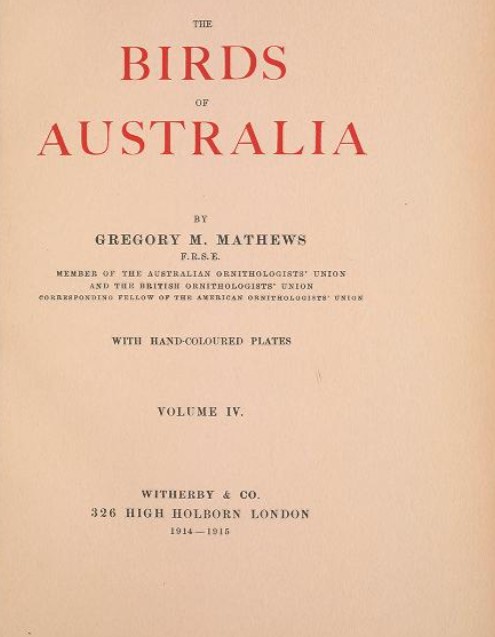

Mathews developed a love of birds whilst at Kings School at Paramatta and continued this passion whilst working on cattle stations near Charters Towers in Queensland. He marries in 1902 at the age of 26yrs to Marion Wynne- a widow, 10 years his senior and the daughter of H.C White of ‘’Havilah- Mudgee. They move to England and whilst visiting the British Museum, Mathews meets Dr Bowdler Sharpe (the 14 yr old boy that Gould had met collecting birds at Berkshire village in 1862) who is now in charge of the Department of Birds. Bowdler Sharpe encourages Gregory to compile the first ‘Handlist of Australasian Birds’ and, with Bowdler Sharpe’s assistance this is released in 1908. Realising how little was actually known about the life histories and distribution of Australian Birds, Mathews embarks on an ambitious undertaking that takes 17 years from 1910-1927 in which ‘The Birds of Australia’ (the same name as Gould’s Book) is produced in 12 volumes – with a 13th supplementary volume and was limited to 225 copies. It was reviewed in the RAOU (Royal Australasian Ornithologist Union) Journal by J.A.Leach ( who was the Director of Nature Study in the Victorian Education Department and supporter of the Gould League) ‘Gould emphasized the field and natural history sides, while Mathews stressed the academic and nomenclatural aspects’
As with Goulds, ‘The Birds of Australia’ multi volume work, very few people could actually afford the lavishly illustrated handbooks and they are now collector items being available online through the National Library and State Library. J.A Leach’s – ‘An Australian Bird Book’ 1911 and Neville Cayley’s – ‘What Bird is That?’ 1931, focused on bird identification, rather than collecting, and they ended up becoming the go to book for the general public.
Gregory Mathews ornithological library of books, collected over 30 years (including Gould’s volumes of ‘The Birds of Australia and the first ever illustrated published book in Australia ‘Birds of New South Wales’ 1813, John William Lewin,) was considered to be the most complete in existence, and was gifted to the National Library in Canberra in 1939. A condition was that it would be made available to ornithologists and students in Australia. Gregory came back to Australia for a short time to help with its cataloguing. Mathews 30,000 bird skin collection was sold to Lord Rothschild of England in the 1920s after the Australian Government refused to purchase them. Rothchild then sold the skins to the American Museum of Natural History in New York (Philadelphia, thus has both Mathew’s and Gould’s Australian Bird Skin Collections)

Gould League of Bird Lovers (1910-2010)
Gould League of Bird Lovers (1910-2010) the first NSW branch was founded in Wellington at the Wellington Public School on the 13th October 1910. The Gould League is an Australian Environmental education organisation established in Victoria in 1909 with the support of J.A Leach. It was dedicated to bird and habit protection and environmental education (in particular egg collection and the 1800s fashion industry’s obsession with plumed hats). The League was named in honour of John and Elizabeth Gould. The initiative for a Gould League of Bird Lovers in NSW came from teacher Walter Finigan and his headmaster, Edward Webster. Webster (along with James Dawson the Chief Inspector of Schools) encouraged all schools in the area- including Dunedoo, Cobbora, Leadville and Tucklan to have their pupils join the League – there was a definite rural push targeting students. Raising awareness about the importance of protecting Australia’s unique bird species the League focused on primary schools, as children were seen as key agents fostering long-term societal change. The League produced educational materials such as booklets, posters and activity guides and these resources aligned with subjects like science, geography and nature studies, making it easy for teachers to integrate them into lessons. Initial membership was 1 penny and a certificate and badge were issued. The Gould League pledge, which became the focus of the League, was – ‘I herby promise to protect all birds except those that are noxious, and to refrain from the unnecessary collection of wild birds eggs’.
Early Years of the League
In the early decades, the League was immensely popular among school children – by the 1950s there were over 1 million members nationally, with a significant proportion in NSW due to its widespread adoption in the educational system. This helped cultivate a conservation-minded generation and the League indirectly supported the development of broader wildlife protection legislation including the National Parks Act, Wildlife Protection Laws across Australian states and the creation of organisations and movements advocating for biodiversity. During the 1980s and 1990s a number of challenges started to face the League- changing educational priorities (the setting up NSW Environmental Education Centres throughout the state), declining membership as schools focused on a wider range of topics, financial challenges with a lack of state government support and, competition from other organisations like Landcare and WWF Australia. So, after 100years the Gould League of Bird Lovers of New South Wales ceased operations in 2010 – at a ceremony at Wellington Public School. The Leagues legacy continues to influence modern environmental initiatives and the Gould League is still active in Victoria and their programs cover topics like waste management, sustainability, biodiversity and climate change.

Although l have focused on the connections I have made within our district with Gould, Mathews, Austin and the Gould League what also needs to be mentioned is 1. Bird Skins were used in many of the drawings for illustrations in Gould and Mathews books and that ‘Skin Collectors’ and ‘Egg Collectors’ were paid occupations – these people where scatted throughout rural areas and 2. The connections with the Aboriginal people and their knowledge of Australian birds is very much overlooked within the colonial narrative of science and conservation. While Aboriginal knowledge significantly influenced early ornithological work, it was often underappreciated or uncredited by European naturalists and scientists of this era – where the colonial mindset was all about ‘European enlightenment’. History does matter and as we move forward integrating Aboriginal perspectives into conservation and education will help bridge these historical gaps, honouring both the people and the birds that define Australia’s (and Dunedoo’s) rich natural heritage.
Ahhh -Is that a Restless Flycatcher l can hear! time to grab the binoculars and my Bird App!. Happy Birding. Sharon Nott 1/25
References:
Internet– National Library of Australia – The Australian Zoologist Vol1.-Part5 may 1918 The Birds of the Cobbora District, Thomas Austin; Birds and Books-The Story of the Mathews Ornithological Library, Gregory Mathews 1942.
Online -Wikipedia, Australian Museum, Australian Dictionary of Biography.
Books -Mr and Mrs Gould, Grantlee Kieza, 2024; Passions in Ornithology: A Century of Australian Egg Collectors, Mason & Pfitzner,2020; The Gould League in New South Wales From Bird Lovers to Environmentalists, Roberts & Tribe 2010;
Inserts – Australian Museum Research Library, Warty-faced (Regent Honey Eater), Elizabeth Gould; Powerhouse Museum, The Gould League of Bird Lovers of New South Wales; National Library, ‘The Birds of Australia’ Volume 1, Gregory Mathews 1910; The Birds of the Cobbora District (as above) Page 119, Nest and eggs of the Warty-Faced honey-eater with an egg of the Pallid Cuckoo, Thomas Austin.
My personal experiences living in Dunedoo, having an interest in bird watching, researching local history and exploring the outdoors (+museums/libraries)- a greater appreciation of our connections to nature and ‘science’.