

The Cultural Collections Unit
presents
With Assistance from
Professor Harold Tarrant and Emeritus Professor Godfrey Tanner
Prepared by
Gionni Di Gravio
On the Occasion of Dr Rhona Beare’s Retirement
from the University of Newcastle
2nd Edition
2001
Preface
Dr. Beare has been very much part of the Department of Classics for longer perhaps than she cares to remember. Her career at Newcastle began in early 1966 and has been characterised by long devotion to her subject and to her students, and an inquiring mind that devotes itself naturally to the minutiae–not only of Classics but also of other subjects including Tolkien. Her interests in the classical world continue well into medieval times, and in these circumstances she has been an invaluable source of answers to the thorny questions that the public have directed (launched, even) at the Department. She has survived many changes in the shape of the Department and in the needs and demands of the students, and she has emerged from it all in surprisingly good shape. She retains an agile mind, capable of retaining anything other than the names of her students, and, so far from being moulded by the necessities of life into a recognisable pattern; she remains, like her long-term colleague Godfrey, sui generis. She will be missed for her intellectual gifts, for the colour she has brought to the Department, and for her generosity towards it. We wish her every happiness back in England.
Prof. Harold Tarrant,
Dept. of Classics
Introduction:
Solution to the Authorship of the Mysterious “Angelic” Manuscript Fragment
In early September 2000, the Archives, Rare Books & Special Collections Unit of the University of Newcastle purchased a manuscript fragment dating from the 13th to 15th centuries. The purchase of the fragment was made at an auction sale for the sum of $66.00AUS. It became the University’s oldest manuscript, and most treasured ‘bargain’.
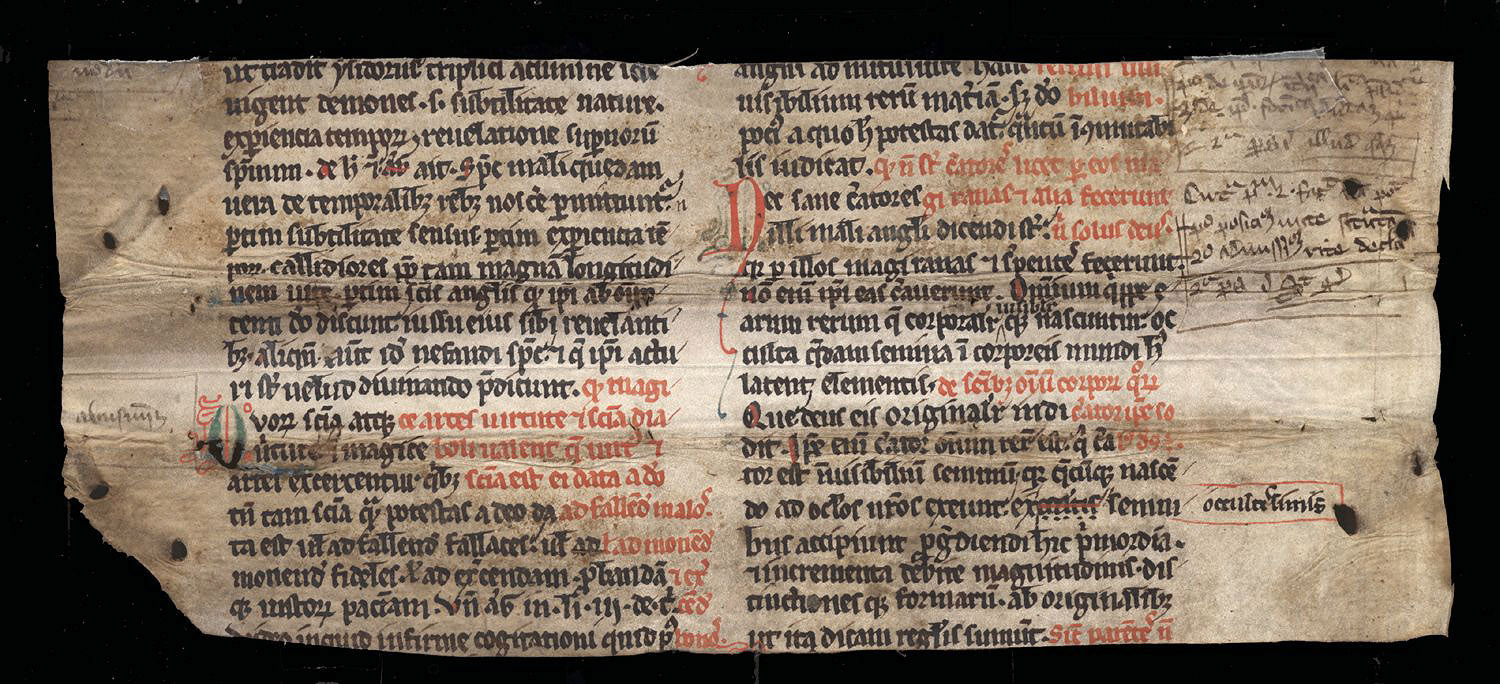
The small fragment was described as being from a medieval work, inscribed on vellum in two columns, with 18 lines remaining per column. There were also marginalia present in another hand. It has highlighted initials, was of European origin, and was recovered from a binding.
Mystery surrounded the provenance of the manuscript, and the author and title of the work from which it was taken. Upon arrival of the fragment on the 11th October, Dr Rhona Beare of the Dept of Classics (Ancient History), after an initial examination, said that the fragment was from a theological work on angelology and demonology, concerning the nature of angels and whether they can sin. With the assistance of Professor Harold Tarrant, Head Department of Ancient History (Classics), and Emeritus Professor Godfrey Tanner, Dr Beare began a careful analysis of the fragment, and prepared a transcription and translation.
On Monday 23rd October, Mr Gionni di Gravio, Senior Clerk in Archives, Rare Books & Special Collections, after a number of afternoon ‘angelic’ discussions with Dr Beare on the 100 bus to Newcastle, and a weekend at home in his library, successfully sourced the fragment. Working with only a partial transcription of the text, and with a microfiche copy of the Patrologia Latina (without access to an online database version) he was able to locate the fragment’s source. It came from a work by the 12th century scholastic theologian Peter Lombard (ca.1100 – ca.1160) entitled Libri Quattuor Sententiarum.
The fragment comes from Book 2 [Distinction VII], where Lombard dedicated ten sections of the Sententiae (or sentences) [dist. ii-xi] to the subject of good and evil spirits, a discussion concerning angels, demons, the Fall, grace and sin, the peccability of angels and the relation of demons to the magical arts.
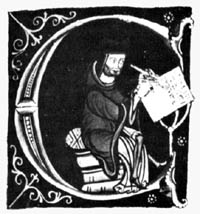
Peter Lombard at work [From a manuscript in the Bibliotheque Municipale at Troyes MS900, fol. 1r
He was born in Novara, Lombardy, into a poor family, and through the patronage of St Bernard, studied in Bologna, Rheims, and Paris, where he was the student of the French philosopher Peter Abelard. Lombard taught theology in the cathedral school of Notre Dame in Paris, from 1136 to 1150. In 1159 he became bishop of Paris, but he died the following year.
Lombard’s style stood in contrast to that of his teacher. His temperament towards his authorities was conservative and harmonising, rather that provocative and questioning as that of Abelard. Lombard sought to reconcile and soften the disagreements, rather than enflame them. By 1205 the Sentences had been glossed by Peter of Poitiers, and by 1215 they were stamped with the approval of the 4th Lateran Council.
The Four Books of Sentences was probably composed between 1147 and 1150, and earned for him the title Magister Sententarium or “Master of the Sentences”. It was a compilation of the teachings of the Fathers of the Church and opinions of earlier theologians, and remained the chief theological textbook in European universities up until the 16th century. Many of the greatest western philosophers and theologians, such as Albertus Magnus, Thomas Aquinas, Thomas de Strasbourg, Duns Scotus and Bonaventura lectured and wrote commentaries on it.
This fragment, therefore, comes to us from a very important germinal period in the intellectual history of the West. As the late mythologist Joseph Campbell stated in a radio interview, the period from 1150 to 1250 marked a time of a profound formulation and statement of ideas in the post gothic world. It was the period of the troubadours, the Arthurian legends and the construction of the great cathedrals. Indeed, its importance in the medieval world is comparable to the importance of the Homeric epics to the classical world, and the stock exchange to the modern world.
It is with great pleasure that we welcome this small fragment to the rare book collection of the University and present (to the best of our knowledge) the first ever translation of it and its source from Book 2 Distinction VII. The English translation was prepared by Dr Rhona Beare. The areas of text coinciding with our manuscript are in bold.
Archives Rare Books & Special Collections
October 2000
Images
[Manuscript] A small fragment from a medieval book, a manuscript of the Libri Quattuor Sententiarum Book 2 Distinction VII by 12th century scholastic theologian Peter Lombard, on vellum, two columns with 18 lines remaining, highlighted initials, worn, recovered from a binding, Europe, 13th to 15th century. [Recto].
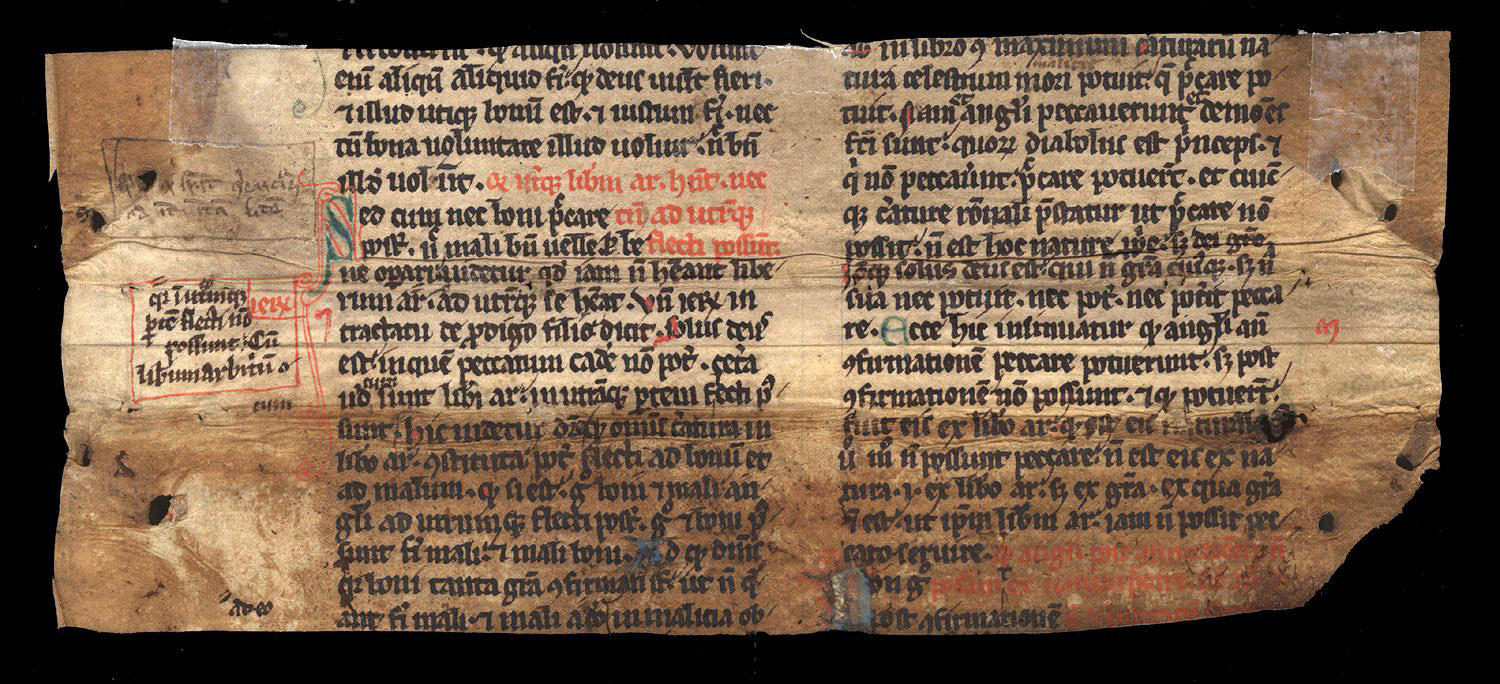
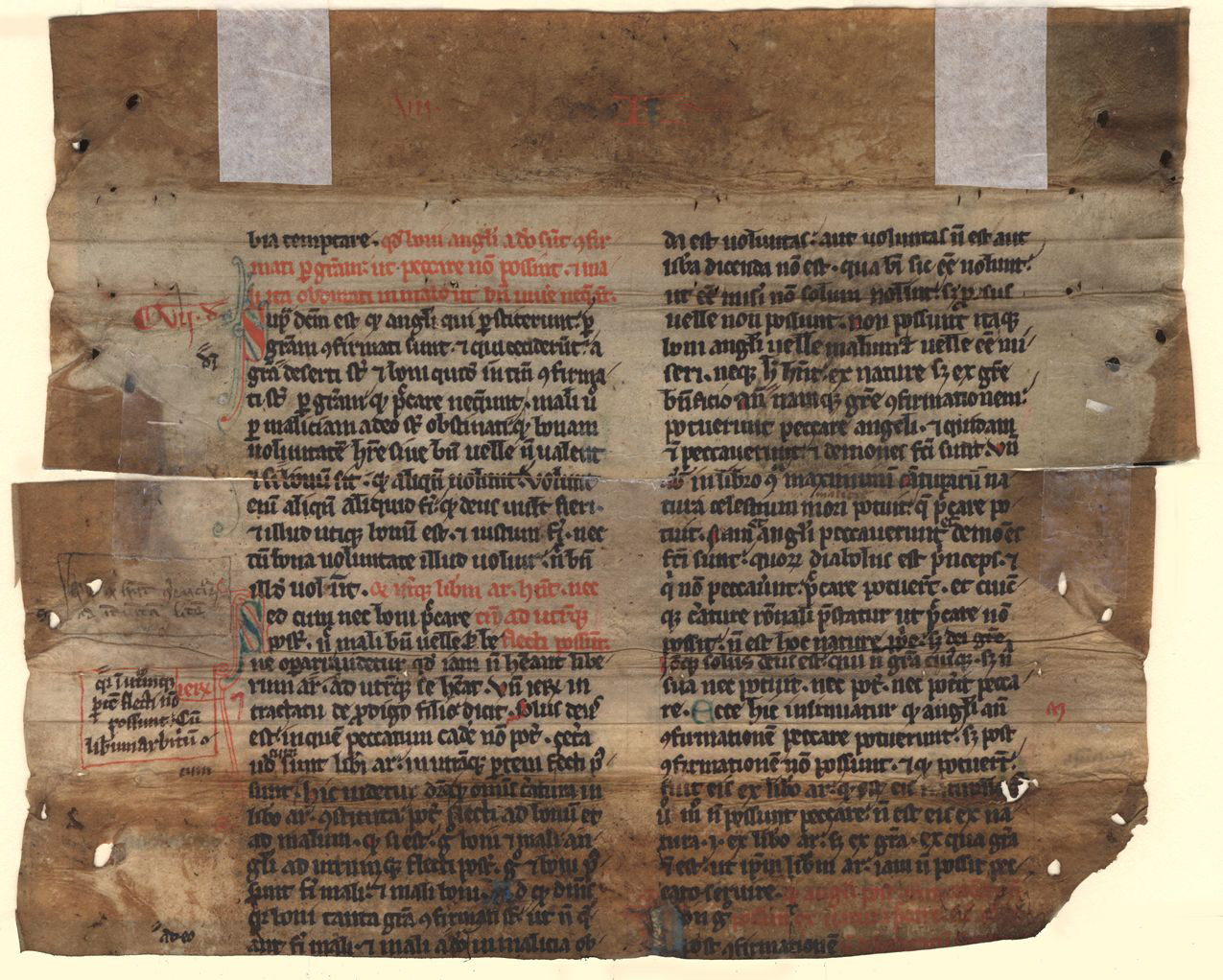
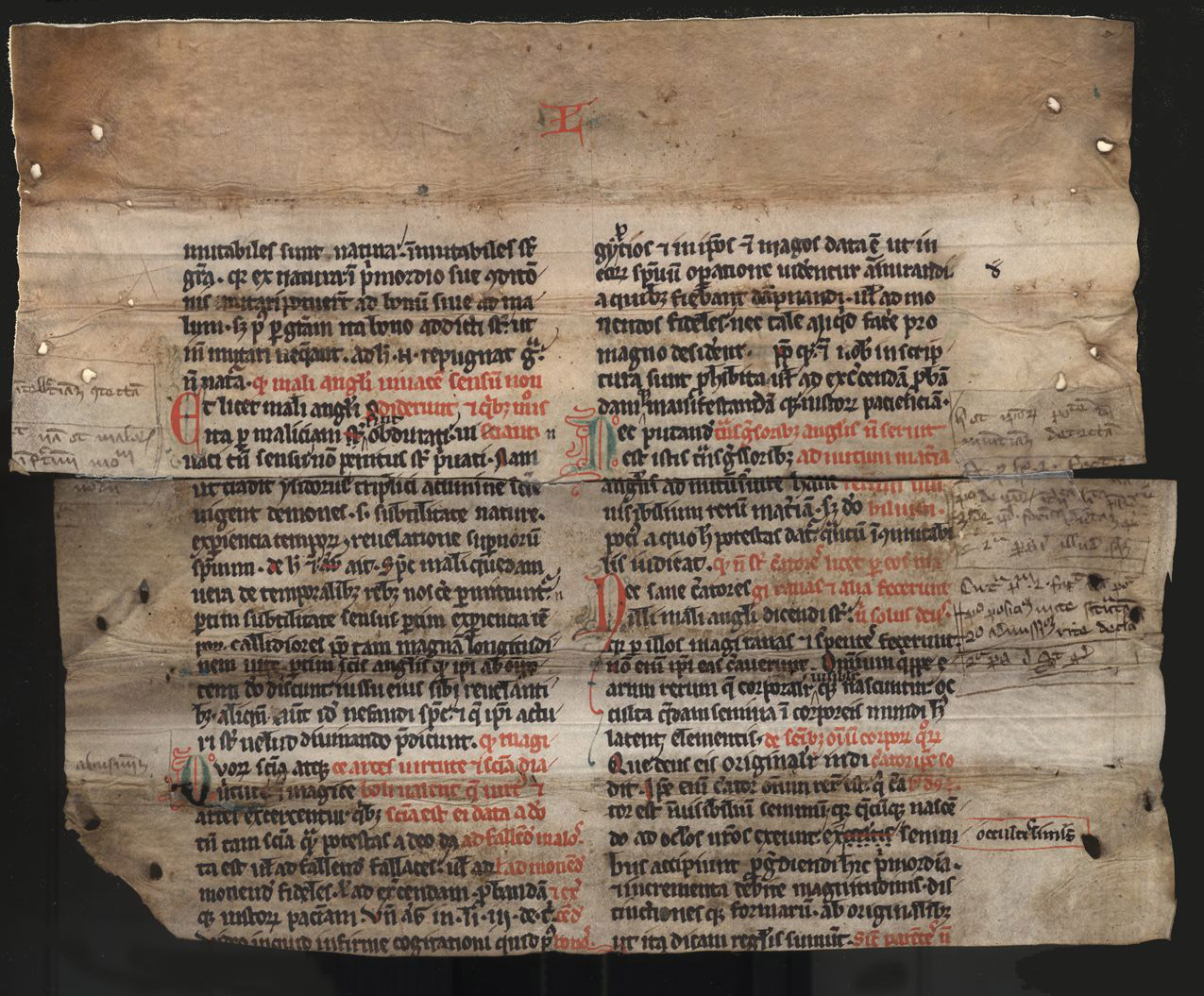
[Manuscript] Two small fragments from a manuscript of the Libri Quattuor Sententiarum Book 2 Distinction VII by 12th century scholastic theologian Peter Lombard, highlighted initials, worn, recovered from a binding, Europe, 13th to 15th century. [Recto].
Latin-English Translation[The areas of text coinciding with our manuscript fragment are in bold.]
Notes[1] The title of this first chapter differs in the St Bonaventura edition (1916) of Peter Lombard’s work. It reads “Utrum boni Angeli possint peccare, vel mali recte vivere” (“Whether good angels can sin, or bad angels can live well.”) See Petrii Lombardi Libri IV Sententiarum studio et cura P.P. Collegii S. Bonaventurae in lucem editio 2nd edition Ad Claras Atques prope Florentiam 1916 p.333 (Copy in the Bodley Library.) [2] Chapters 1 and 2 are said by the editor of the Bonaventura edition to be based upon Hugo of St Victor Summa Sententiarum Tractate 1 capitula 4 (Patrologia Latina tome 176 p.84 – 85) which says: “One must also know that good angels have been so confirmed by grace that they cannot sin; but bad angels have been made so obstinate by malice that they cannot do good. To this is opposed the argument that they have free will; therefore they can be turned in either direction. But it is not called free will from that, as we shall show in its own place, but is voluntary; and the good angels abstain from evil by free will, not with necessity compelling them; similarly also the bad angels abstain from good. Likewise what Jerome says is opposed to this: “God is the only one on whom sin cannot fall; other things since they are of free will can turn their will in either direction.” How this is to be understood, we can guess from these words of Isidore: Angels are changeable by nature, unchangeable by grace. Whence it seems necessary to admit that good angels can sin of their own nature, that is, their nature does not prevent this, yet it is not to be agreed that good angels can sin. Rather, they cannot sin, that is, the grace by which they have been confirmed prevents this. And although bad angels have been made obstinate by malice, yet they have not lost their lively senses: Because, as Isidore says, they are strong with threefold acuteness of knowledge: with subtlety of nature, with experience of times, with revelation of superior powers. Augustine says: Bad spirits are allowed to know some things about temporal matters, partly by their experience of times, more cunning because of such great length of life; partly by holy angels revealing to them what they learn from all-powerful God at his command. Sometimes too the same wicked spirits predict as if by divination even things which are of the author himself”. [3] The manuscript fragment adds: nec bene illud volunt (and they do not want that good thing). These four extra words are present in the Bonaventura edition (1916) but not in Migne’s text. The word ‘bene’ (or bonum) is abbreviated in our fragment to ‘bn’. We have read this as ‘bonum’; the Bonaventura editor has read it as ‘bene’. If the abbreviation is taken as ‘bene’, then we translate as “and they do not want it well.” [4] The Bonaventura edition has a slightly different title, which reads: Quod cum utrique habeant liberum arbitrium, non tamen ad utrumque flecti possunt. (That though each group have free will, yet they cannot be turned to either). The editor also adds that Jerome’s tractate on the prodigal son is Jerome’s Epistle 21 to Damasus. See note 6 below. [5] This sentence was accidentally omitted by the scribe of our fragment and added in the margin. [6] St Jerome (Eusebius Hieronymus) c.347 – c420. For complete works see Migne P.L. v.22-30. [7] Jerome’s Epistle to Damasus on the Prodigal Son, Epistle XXI, Ad Damasum de duobus filiis (To Damasus on the two sons ). Jerome says that the elder son was jealous, just as the ten apostles were jealous of James and John, Matthew 20:24. God sees faults even in angels, so it is impossible that the prodigal son’s elder brother was faultless, even though in Luke 15:29 he says, “I never transgressed a commandment of thine”. Peter Lombard shortened the following section from Jerome that states: “God is the only one on whom sin does not fall: since the other things are of free will, just as man too was made in the image and likeness of God, they can turn their will in either direction.” [8] Chapter 3 contains the quotation from Augustine Against Maximin. The Bonaventura editor explains that this passage comes from Book 2 Chapter 12 and will be found in the Patrologia Latina Tome 42. Migne calls this Book 2 as ‘Book 3’. The Bonaventura text merely has “in libro contra Maximinum” which is exactly what our fragment contains: “in the book Against Maximin” without any numerals. Did J.P.Migne have access to a more complete manuscript version with the numerals included, or did he add them in? [9] At the end of Chapter 3, the Bonaventura text reads: ex qua gratia est etiam. The J.P.Migne version reads: et qua gratia etiam est. Since ‘ex’ is better latin than ‘et’, there is the suspicion that the ‘et’ in Migne is a misprint. [10] Augustine refers to humans, Peter Lombard applies Augustine’s ideas to angels. “105. Thus it was fitting that man should be created, in the first place, so that he could will both good and evil – not without reward, if he willed the good; not without punishment, if he willed the evil. But in the future life he will not have the power to will evil; and yet this will not thereby restrict his free will. Indeed, his will be much freer, because he will then have no power whatever to serve sin. For we surely ought not to find fault with such a will, nor say it is no will, or that it is not rightly called free, when we so desire happiness that we not only are unwilling to be miserable, but have no power whatsoever to will it. And, just as in our present state, our soul is unable to will unhappiness for ourselves, so then it will be forever unable to will iniquity. But the ordered course of God’s plan was not to be passed by, wherein he willed to show how good the rational creature is that is able not to sin, although one unable to sin is better. So, too, it was an inferior order of immortality – but yet it was immortality – in which man was capable of not dying, even if the higher order which is to be is one in which man will be incapable of dying.” Augustine, Enchiridion, Chapter 28: 105 pp.402-403. [11] Chapter 5 has a different title in the Bonaventura edition: Quibus modis mali angeli noscant veritatem temporalium rerum (How bad angels know the truth of temporal matters). Lombard’s source for this section was Hugh of St Victor’s Summa Sententiarum (see J.P. Migne, Patrologia Latina tom. 176 pp 84-85). [12] Isidore, On the Highest Good, (or, Sentences) 1.10.17, writes of bad angels: Non tamen amiserunt vivacem creaturae angelicae sensum. Triplici enim modo praescientiae acumine vigent, id est, subtilitate naturae, experientia temporum, revelatione superiorum potestatum. (However, they have not lost the lively senses of the angelic nature. For in a triple manner they are strong with acuteness of foreknowledge, by subtlety of nature, by experience of times, by revelation of superior powers). Isidore stated similar ideas in his Etymologies Book 8 Chapter 11 Section 15-17: “They are called demons by the Greeks; demons = daemons = skilled and knowing things. For they know many future things beforehand, and therefore are accustomed to give some oracular responses (prophecies). For in them is knowledge of things, knowledge greater than human weakness, partly from the acuteness of more subtle sense(s), partly from experience of very long life, partly by angelic revelation at God’s command. These are strong with the nature of airy bodies. Before sin indeed they had celestial bodies. But after falling they were changed into airy quality, and were permitted to occupy not the purer spaces of that air but those dark places, which are their prison until the day of judgement. These are the false angels, whose prince is the Devil.” Compare this with Lactantius, Divine Institutes, Book 2 Chapter 16, pp.157-158. [13] Augustine De Genesi Ad Litteram Book Two, Chapter XVII, 37 (XIII). The following translation is from the end of Chapter XVII. It includes a passage quoted or paraphrased by Peter Lombard. The context of this section is that Augustine has been calling astrology nonsense. He says that astrologers claim that if you tell them the day and hour at which a child is conceived, they can tell you what will happen to that child. But twins are conceived at the same time and do not lead identical lives. Astrology, therefore, is nonsense, yet the predictions of astrologers sometimes come true. Section 37 (XIII) [Translation by Dr Rhona Beare] begins (the section quoted by Lombard is in italics): “Since by those people true things are said, one must admit that they are said by some mysterious instinct which human minds experience unconsciously. Since this happens in order to deceive humans, it is the work of spirits who are seducers. It is permitted to them to know certain true things about temporal matters, partly by the acuteness of their more subtle senses because they enjoy more subtle bodies, partly by their more cunning experience because of their so great length of life, partly because the holy angels reveal to them what they learn from all-powerful God, even at the command of Him who distributes human merits by the purity of most hidden justice. Sometimes however the same wicked spirits, as if divining the future, predict even what they themselves are about to do. Therefore a good Christian must beware of astrologers or any of those impiously diving the future, especially those that say true things, lest by association with demons they ensnare the soul deceived by a certain pact of alliance.” Augustine, in the next chapter goes on to talk of the heavenly lights (i.e. the sun, moon, etc) as to whether they are wholly material, or whether they have guiding spirits. [ From Bibliotheque Augustinienne Oeuvres de Saint Ausgustin 48 septiene serie La Genese au sens litteral en douze livres De Genesi ad Litteram libri duodecim tradution, introduction et notes par P. Agagesse et A. Solignac Desclee de Bronwen 1972 p.208. Copy in Bristol Library BR 65.A5] [14] The title is longer in the Migne edition than in Bonaventura: Quod magicae artes virtute et scientia diaboli valent, quae est eis a Deo (That magic arts are effective by the power and knowledge of the devil, which they have from God) [15] Both our fragment and the Bonaventura version have tamen tam instead, reading “however both the..” [16] Peter Lombard begins quoting Augustine here in Section 6 and continues until the end of Distinction VII, while omitting some parts of it. [17] Exodus 8.15 [18] Bonaventura edition title reads: “That they are not creators, though through them magicians have made frogs and other things; in the same way, good angels are not creators, even if through their ministry creatures are made”. [19] In our fragment ‘hidden’ is crossed out and ‘most hidden’ (occultissimis) substituted. Bonaventura in the text printed occultis, and at the bottom of the page added a note that Manuscript D has occultissimis. This means that our copy of Peter Lombard was not originally copied from Manuscript D, but was (at this point) later “corrected” from D, (or a manuscript related to D). [20] Both ‘seed’ and ‘beginning’ are words Lucretius uses for the atoms of which everything is made. |
Postscript February 2001
From her retirement Rhona has continued her research into the sources of our fragment. The results of this new research have been included in the endnotes to the text. In addition, she has located another published edition of Lombard’s work by Bonaventura entitled Petrii Lombardi Libri IV Sententiarum studio et cura P.P. Collegii S. Bonaventurae in lucem editio 2nd edition Ad Claras Atques prope Florentiam 1916 located at the Bodley Library to compare with the Migne edition.
In January 2001 a Sydney bookseller located another piece of our fragment which had been separated at some time and framed for display purposes. He was able to negotiate the sale with the owner and it now resides with our fragment.
Postscript March 2001
Thankyou to Bro. Alexis Bugnolo, editor of The Franciscan Archive, who has sent me a link to an ongoing English translation of Lombard’s Sentences from the Quarrachi edition of 1882. At the present time only selected distinctions from Lombard’s first book, in Latin & English, have been completed.
Postscript May 2002
Denis Muzerelle (via email dated 25.5.02) from the Institut de recherche et d’histoire des textes (Section de paléographie latine) 40 avenue d’Iéna, F-75116 Paris believes the origin of our manuscript fragment is undoubtedly Northern France (presumably Paris), 2nd quarter of the 13th century. We thank him for his expert opinion.
http://irht.cnrs-orleans.fr/cipl/cipl.htm
Postscript October 2004
According to Associate Professor Wanda Zemler-Cizewski from Marquette University in Milwaukee, Wisconsin our fragment has been identified as forming part of another that binds one of the rare books held at Marquette University in Milwaukee, Wisconsin. Associate Professor Zemler-Cizewski who has examined and compared their vellum leaves with our online ones, believes that they are from the same manuscript. The book is a 1526 printing from the Parisian press of Johannes Petit of Thomas Aquinas’ lectures on the epistles of St. Paul entitled Sancti Thome de Aquino Ordinis Predicatorum Super epistolas Pauli commentaria preclarissima : cum tabula vel indice alphabetico. She says that “the boards of the original binding are missing, but there are two full vellum leaves attached, one in front and the other at the back. They contain the text of Peter Lombard’s Sentences lib. 2, dist. 8 and 9. The text is in a 13th c. north French hand, in two columns 5.1 cm. wide with a 1cm. space between the columns. The average height of the letters is .5 cm. Each column is 39 lines. Capital letters are done in blue ink with fine red penned decoration around them and subheadings within the text are done in red ink.”
I was also contacted by the donor of the Aquinas volume, Mr. William Throckmorton Warren, who thanked us for the work we had done on the manuscript fragments. He said that the work he donated to Marquette University has been in his family for centuries. Written in Latin, the book is missing its cover but is still extremely valuable, as only two other copies are known to exist in all the world. In the binding of this book are the 8th and 9th distinctions from Book 2 of Lombard’s work. We hold the manuscript fragments of distinction 7.
The book was published and found its way into Mr Warren’s family in the 17th century, when it was acquired by his ancestor, Sir Robert Throckmorton, 1st Baronet of Coughton, Warwickshire, in England. This distant relative, who signed the book in 1627, along with others in the family had a history of religious persecution. Mr Warren is unclear concerning the book’s provenance between the years 1627 and 1938, when it was purchased in England by a friend, who subsequently returned it to the family when Mr Warren was born. In July of this year he donated the volume to the Marquette University library. There is a further Australian connection in that he was educated at Footscray Institute of Technology in Melbourne.
The Marquette University’s connection to our University’s Dr. Rhona Beare is yet another coincidence. They own the original manuscripts for The Hobbit and The Lord of the Rings and later this week they’ll be hosting an international conference to commemorate the 50th anniversary of LOTR, and so they are very familiar with Dr. Beare’s scholarship on J.R.R. Tolkien.
Sources
To the best of our knowledge no complete English translation exists of the Sententiae.
For the complete works of Peter Lombard, see the Patrologia Latina (ed. J.P. Migne) Vol. 191-192. For other printed editions of the Libri Quattuor Sententiarum see the one prepared by the Franciscans of Quaracchi. 2 vols. (1916) and Bonaventura’s edition Petrii Lombardi Libri IV Sententiarum studio et cura P.P. Collegii S. Bonaventurae in lucem editio 2nd edition Ad Claras Atques prope Florentiam 1916.
See also an ongoing online English translation of Peter Lombard’s Sentences from the Quarrachi edition of 1882.
De Ghellinck, J. “Peter Lombard” in The Catholic Encyclopedia, Volume XI, 1911 online version located at: http://www.newadvent.org/cathen/11768d.htm (1 of 3) [22/10/2000 19:08:44]
Haskins, C. H. The Renaissance of the 12th Century. New York: Meridian, 1957 pp.357-358Hastings, J (ed.) Encyclopedia of Religion and Ethics. Edinburgh : Clark, 1908-1926. Vol.4 pp 582a-b.
Kibre, Pearl The Library of Pico Della Mirandola. New York: Ams Press, 1966.Article: Peter Lombard (1095 – 1160) from The Internet Encyclopedia of Philosophy located at: http://www.utm.edu/research/iep/l/lombard.htm [22/10/2000 19:00:27]
Keck, K. R. Peter Lombard article from The Ecole Glossary located at: http://cedar.evansville.edu/~ecoleweb/glossary/plombard.html (1 of 2) [22/10/2000 19:07:41]
Peter Lombard Article from internet location: http://www.fwkc.com/encyclopedia/low/articles/l/l015001245f.html [22/10/2000 19:04:52]