

Search for a “Piece of Metal” Found in the Pilliga Forest
We get the most intriguing enquiries. In February 2025 Davina Pellatt, Library Officer in Special Collections received a request from an enquirer trying to locate information
“regarding a piece of metal that was found in the Pilliga Forest by a sleeper cutter, Philip Roser of Boggabri.”

The Original Clipping in Poor Condition

The clipping was in poor condition, and another subsequent copy including the date of the find, which was the 25 September 1975, again, did not help us with the date of the actual article.
Fruitless Searches through TROVE, the Newcastle Herald Indexes
A search through TROVE, the National Library’s online portal for digitised newspapers also proved fruitless, as it was too late, and TROVE had not been able to get it digitised due to copyright restrictions. Further searches through the online indexes of the Newcastle Morning Herald also failed to locate the original article.

The Archives of the late Professor Colin Keay
A search was also conducted through the archives of the late Professor Colin Keay. The papers were donated to the University Archives on his retirement in 1993.
The eight boxes of materials, in the University Archives, covered the four decades of Professor Keay’s work at University of Newcastle since 1965, as well as his thesis notes and scientific observations on meteors which spanned two voluminous diaries dating from the 1950s which he worked on in New Zealand prior to his taking up the post at the University of Newcastle.
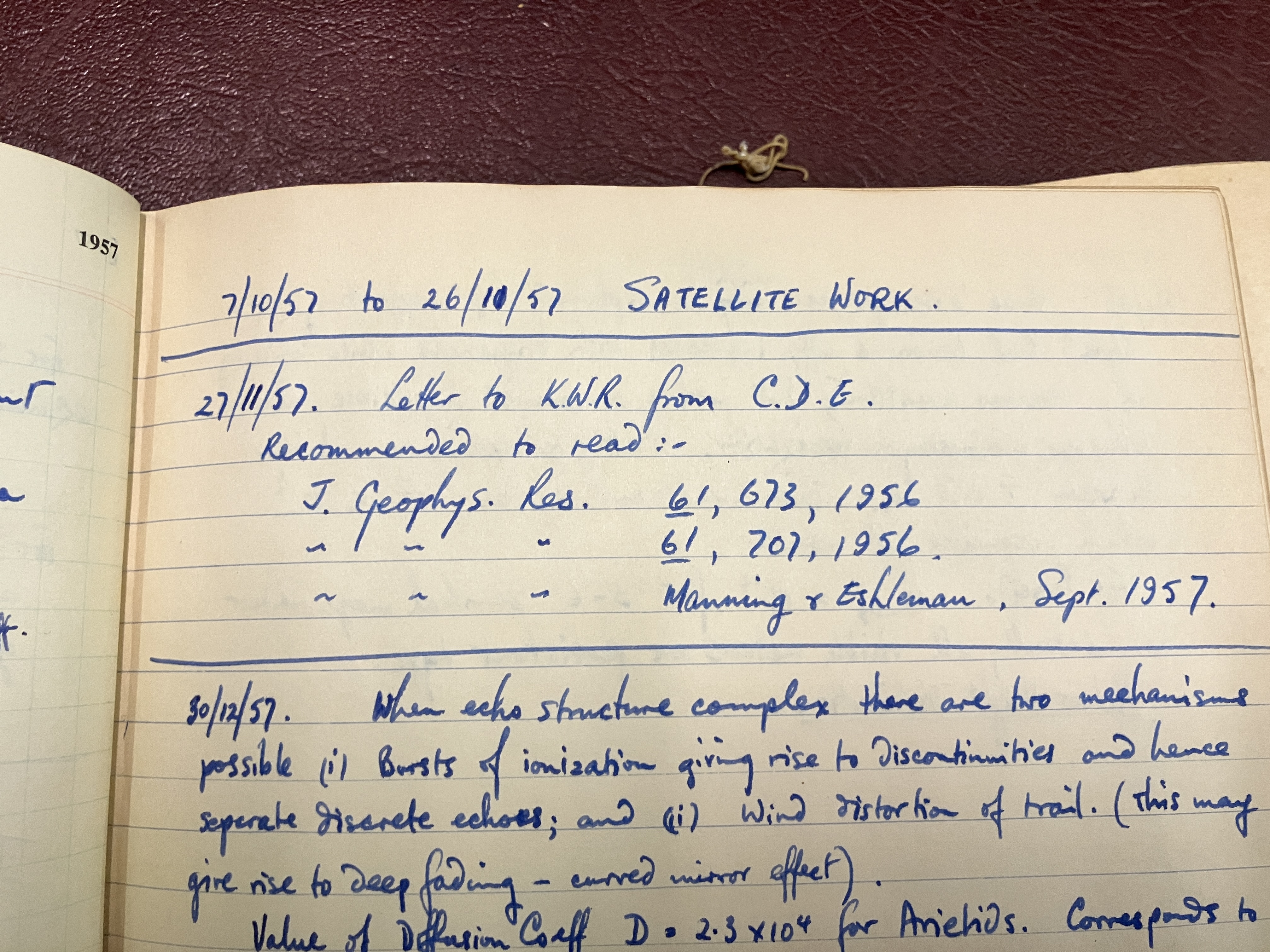
Browsing through them was an inspiration to his lifelong pursuit and passion for science and community engagement. There was a folder of correspondence of all his invitations to speak at public gatherings, and schools science clubs; the most emotional were a couple of beautiful student projects on the later ill fated Space Shuttle Columbia which he also saved.
He was one of those academics who could be the devout specialist in his chosen field of physics and astrophysics, but also be able to champion and participate in wider University matters of concern as well as the community push for better public transport infrastructure, roads and the aims of the cycleways movement for better planning for bike riders.

Above all, he was was excellent scientific communicator, inspiring so many young people to be interested in the stars through his regular science columns in the Newcastle Morning Herald during the 1970s and 1980s. I always looked forward to the latest starchart, and what to expect for that week in the night sky above our heads.
But unfortunately, no luck finding the article we were looking for!
Bingo! Original News Article Found
It was only when two subsequent letters to the Newcastle Morning Herald came to light, written four years after the 1975 find, that Davina was eventually able to locate the “needle in the haystack”.
One was penned by Mr D. B. Cameron of Boggabri, who was given the “odd metallic specimen” by Philip Roser. The other was Professor Colin Keay’s response.
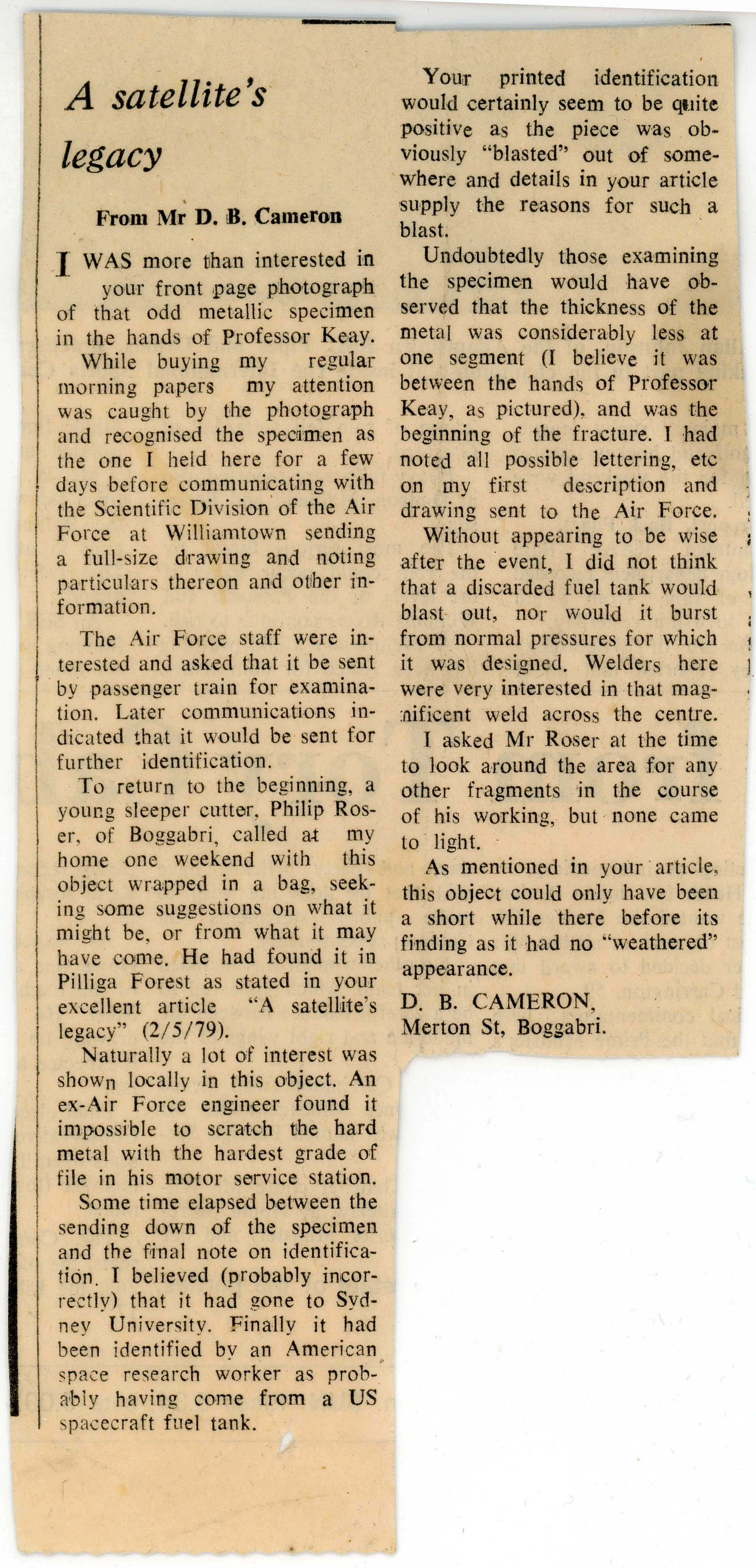
![A satellite's legacy From Professor C. Keay. Letter to the Editor, Newcastle Morning Herald, May 1979 [?]](https://hunterlivinghistories.com/wp-content/uploads/2025/02/1979-05-A-Satellites-Legacy-Professor-C.Keay-NMH-Letters.jpg)
The microfilm readers are always a pain to use, but she won out in the end.
The Original Story of the Satellite’s Legacy


The Unfolding Story
Philip Roser in October 1975, in a remote corner of the Pilliga State Forest, about 40kms from Boggabri, discovers a fragment of mysterious metal.
One weekend following the discovery, Roser, who was a young sleeper cutter, of Boggabri called into the home of Mr D. B. Cameron, also of Boggabri.
He was carrying the object wrapped in a bag, seeking suggestions on what it could be and where it came from. He tells Mr Cameron he had found it in the Pilliga Forest. Mr Cameron asked him to look for more pieces, but none were ever found.
Local interest in the object started to mount, and Cameron had the object looked at by an ex-Air Force engineer at the local motor service station who found it impossible to scratch with the hardest grade of file.
He held it at his home for a few days before communicating and later sending it (by passenger train) to the Scientific Division of the Air Force at Williamtown N.S.W. for further identification, accompanied by a full-size drawing and other documentation.
From there it had probably gone to the University of Sydney, and later identified by an American space researcher as probably having come from a US spacecraft fuel tank.
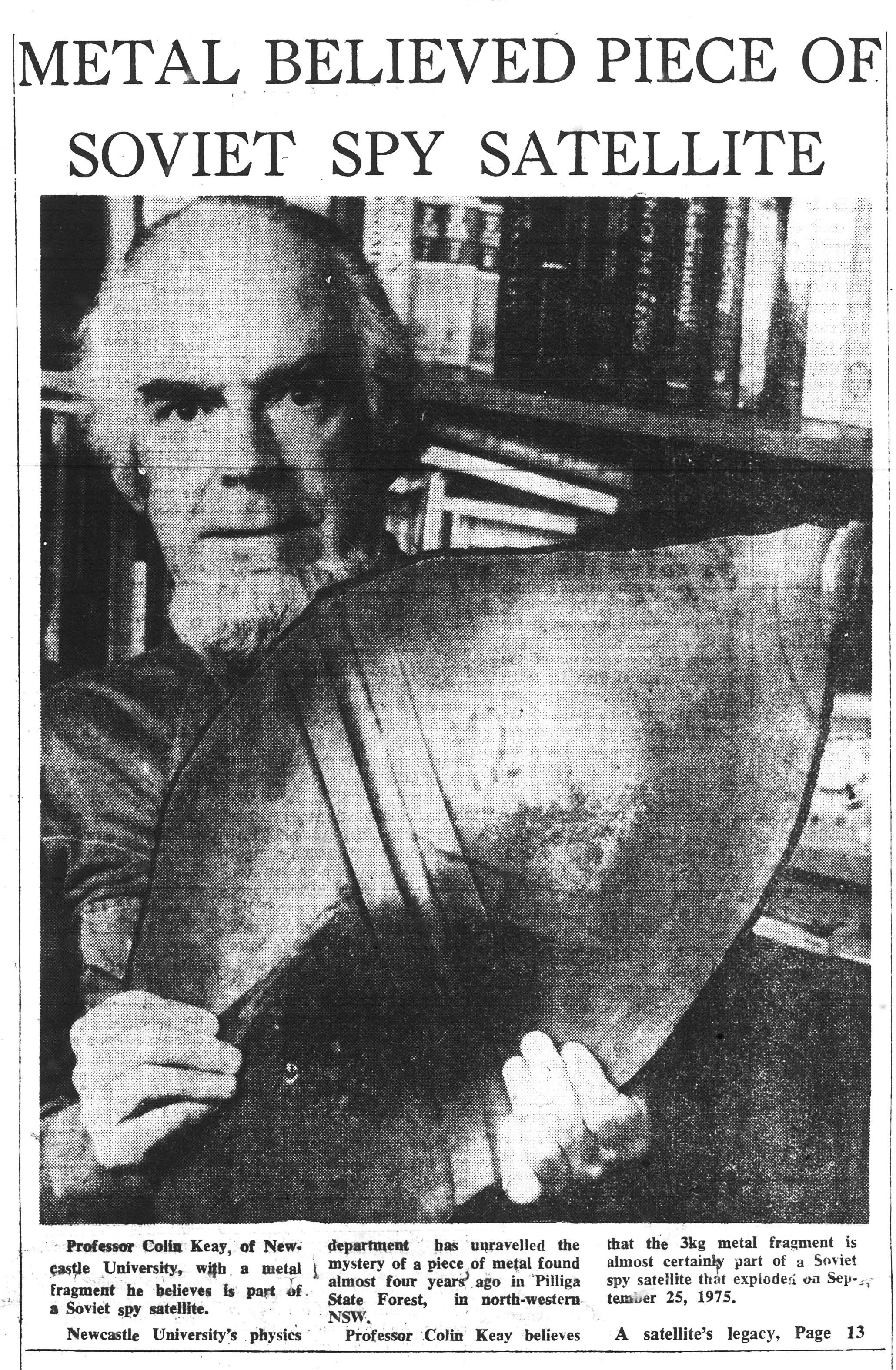
Professor Colin Keay examines the fragment of metal from the sky

Fast forward to 1979, and Professor Colin Keay reports in the Newcastle Morning Herald that in April the Physics Department at the University of Newcastle was presented with a:
“most interesting fragment of metal which had fallen from the sky.”
Scientific Testing Results
Professor Keay conducted some tests, found that it:
- weighed 3kg,
- was torn from a thick metal shell by a violent explosion followed by a searing heat that had almost melted it
- that it was a piece of satellite debris
- before the explosion the shell comprised one-quarter of a spherical tank 60 cm in diameter
- its two hemispheres joined by a laser weld
- that the explosion gave the fragment the aerodynamic properties of a sycamore seed that helped survive re-entry
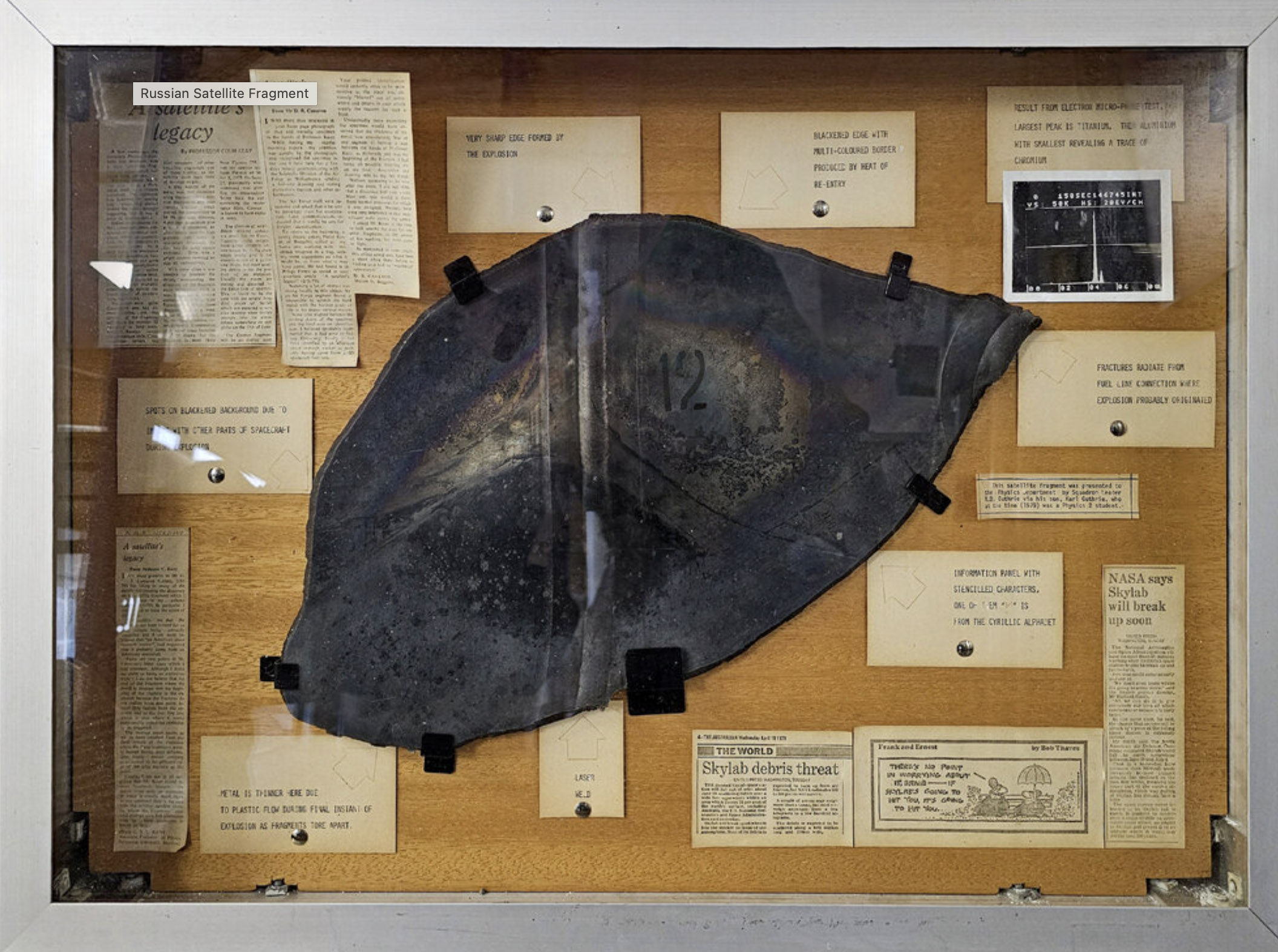
- the fragment still bears the number 12 stenciled in Russian rather than American style
- one of the other faint remnant characters in Cyrillic suggesting it may have been of Russian origin
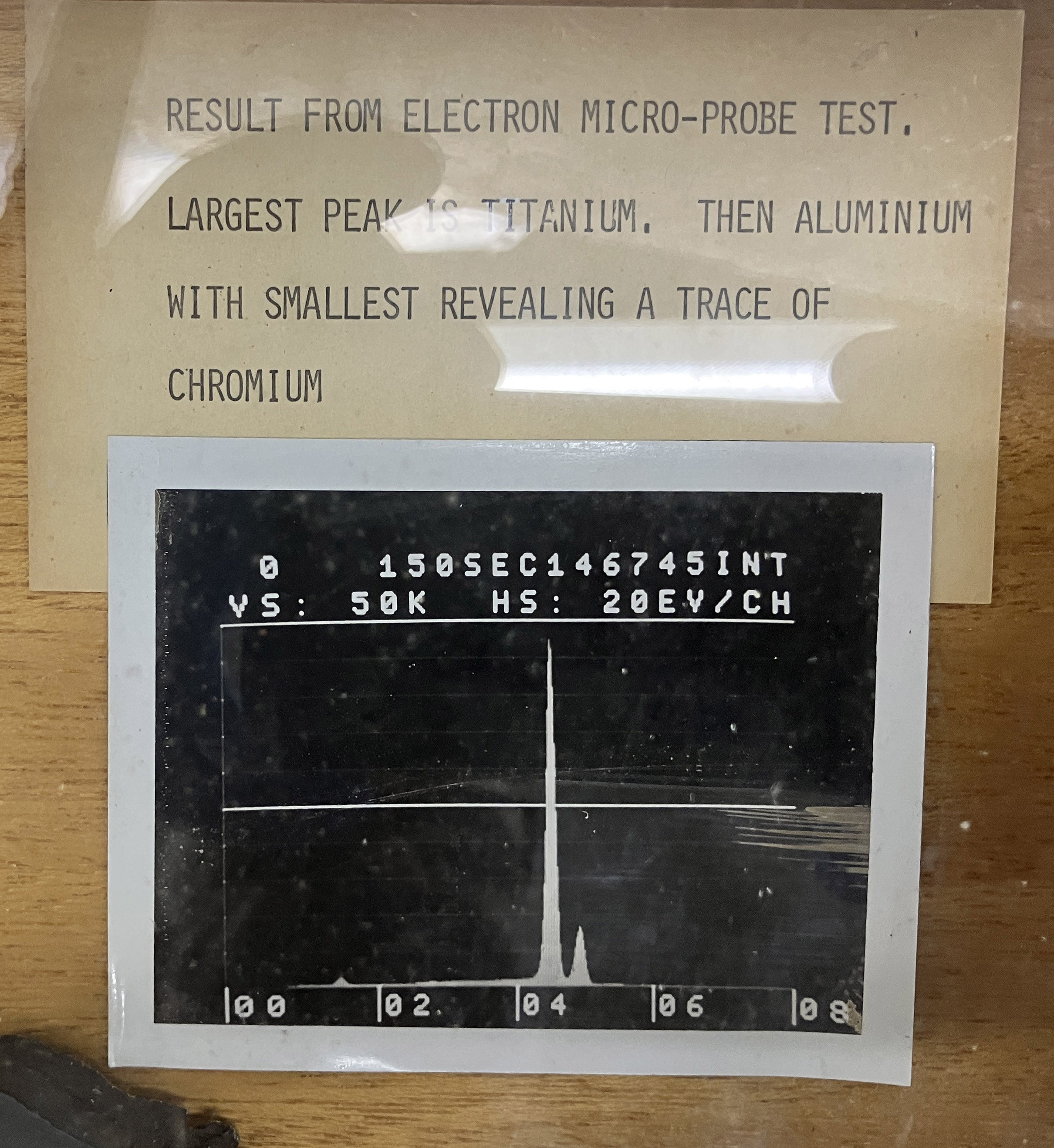
- examination by the University’s electron microscope proved its composition to be 96% titanium, 4% aluminium, plus a trace of chromium, an alloy used widely for high pressure fuel tanks in spacecraft.

Which Satellite Could It Have Been?
Knowing that it had been discovered early in October 1975, Professor Keay then
- examined a log of space launches in 1975
- identifies that the fragment probably came from Kosmos 758; a Soviet Spy Satellite launched from Plesetsk on September 5, 1975.
- On September 25, presumably when the command was given to fire the retro-rockets to bring back the capsule containing the reconnaissance films, Kosmos 758 exploded in orbit.
More on the Yantar-2K Reconnaissance Satellites:
http://www.svengrahn.pp.se/histind/Recces/fourth.htm
What Became of the Kosmos Fragment of Spy Satellite?

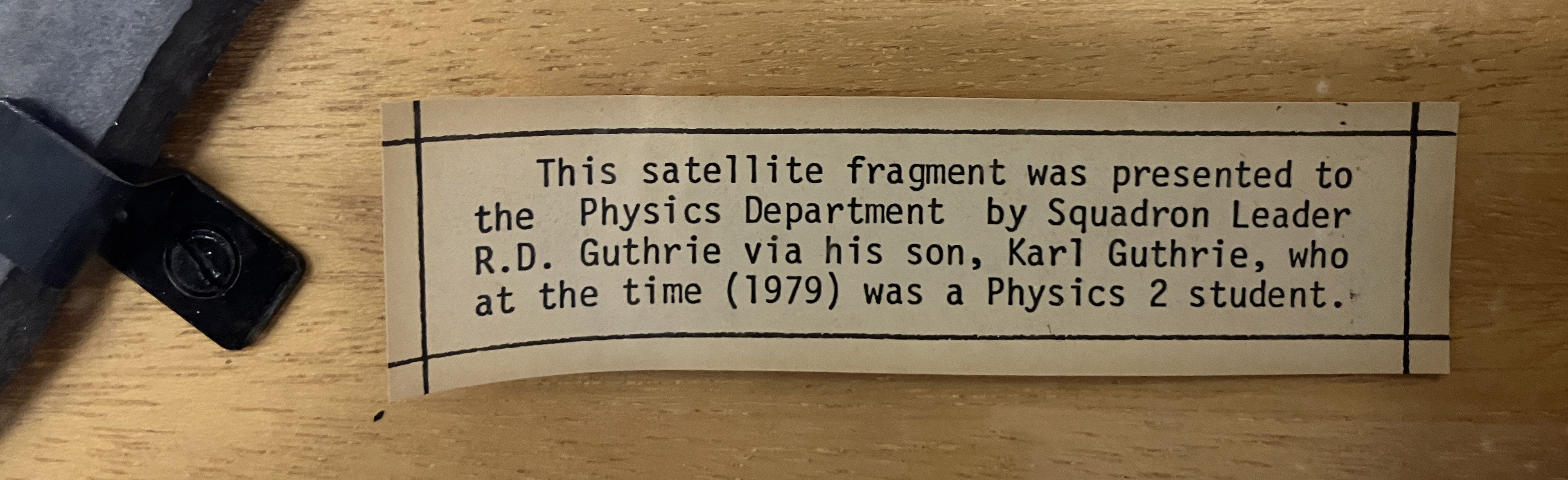
The Kosmos fragment was on display in the Circulation area of the Auchmuty Library before going into permanent display in the Physics Department.
Emeritus Professor John O’Conner, Head of Physics at the time, says (Email: 21/2/2025):
“When I arrived at UoN in 1981 it was on display and in the early 80’s I hosted a senior German technician who had serious experience in vacuum welding. It was his opinion that the Russians did not have lasers of sufficient power to perform such welds at the time of this satellite and he believed that the weld was performed by a very high energy electron beam welder. Other than that I did initiate the Display’s improvement over a decade ago but there has been no progress so far.”
From 2015 it was placed into art storage at the University awaiting conservation treatment for eventual return to the Physics Department for ongoing display.
Emeritus Professor O’Conner had this message for Philip:
“I would love to be there however I have a zoom meeting at that time that I cannot move. When you are talking to Philip Roser assure him that the fragment had pride of place in the foyer of the Physics Building from well before 1981 to 2015 when it was removed for its incorporation into a more impressive case.”
Kosmos 758 Found
University Art Curator Gillean Shaw retrieved the Kosmos Fragment in display case from the University Art Stores and delivered it to Special Collections in the Auchmuty Library on 26 February 2025.

Acknowledgements
Compiled by Gionni Di Gravio OAM & Davina Pellatt
With the assistance of Philip Roser & Family, Sue Keay and Myra Keay and family of Professor Colin Keay, Emeritus Professor John O’Conner and the staff of the Physics Department, University of Newcastle (Australia) Art Curator Gillean Shaw.
Further Reading – Newspaper Transcriptions
2 May 1979 p.13
A satellite’s legacy by Professor Colin Keay
A few weeks ago the university Physics Department was presented with a most interesting fragment of metal which had fallen from the sky.
Weighing almost 3kg, it was torn from a thick metal shell by a violent explosion. The explosion was followed by searing heat which had almost melted the metal, strongly suggesting that it was a piece of satellite debris.
Before the explosion the shell comprised about one-quarter of a spherical tank about 60cm in diameter with its two hemispheres beautifully joined by a laser weld. The enormous force of the explosion flattened the metal and gave the fragment aerodynamic properties not unlike those of a sycamore seed. The fragment fluttered as it fell and this probably allowed it to survive the fierce heat of re-entry from earth orbit.
The edges were quite discoloured and had almost melted, but the centre of the fragment still bears the number 12 stencilled in bold numerals of Russian rather than American style. Close inspection reveals the faint remnants of other stencilled characters, one of them Cyrillic, so the satellite must have been of Russian origin.
A tiny sample of the metal was then examined using the university’s electron microscope and microprobe analyser which proved the composition to be 96 per cent titanium, 4 per cent aluminium plus a trace of chromium, an alloy widely used for high pressure fuel tanks in spacecraft. Obviously the fuel had for some reason exploded. Tests with a Geiger counter revealed no sign of radioactivity.
With these clues it was possible to interpret the details surrounding the discovery of the fragment in October, 1975. It was found in a remote corner of the Pillaga State Forest, about 40 kms from Boggabri, within a week or so of the fall, judging by its clean condition upon discovery. Examination of a log of space launches in 1975 shows that the fragment is most likely from Cosmos 758, a Soviet spy satellite launched from Plesetsk on September 5, 1975. On September 25, presumably when the command was given to fire the retro-rockets to bring back the capsule containing the reconnaissance films, Cosmos 758 is known to have exploded in orbit.
The chances of satellite debris striking someone are small but the Cosmos fragment could certainly have killed instantly anyone struck by it. Its sharp edges would give it the smooth action of a guillotine blade, but most satellite debris is not the product of an explosion. Usually the pieces are melted and distorted by the fierce heat of re-entry. This is likely to be the case with the several hundred pieces of Skylab which are expected to survive re-entry when Skylab plunges in the atmosphere somewhere on our globe on the 19th of June.
The Cosmos fragment will be on display soon in the Circulaion Area of the University Library. Later it will go on permanent display in the Physics Department along with any bits of Skylab brought in by readers of this column.
Turning now to more permanent objects in the sky, the visual planets are all on display. Jupiter and Saturn continue to adorn the evening sky but this week we have a delightful conjunction of Venus, Mercury and Mars in the early morning sky. For this reason our all-sky chart has been prepared for 5.30am when the planetary trio has risen high enough to be easily visible in the eastern sky. Later than that the light of approaching dawn will fade the planets from view.
_________________________
1979-05-07-A-Satellite’s-Legacy-Mr.D.B.Cameron-NMH-Letters
A satellite’s legacy From Mr D.B. Cameron
I was more than interested in your front page photograph of that odd metallic specimen in the hands of Professor Keay.
While buying my regular morning papers my attention was caught by the photograph and recognised the specimen as the one I held here for a few days before communicating with the Scientific Division of the Air Force at Williamtown sending a full-size drawing and noting particulars thereon and other information.
The Air Force staff were interested and asked that it be sent by passenger train for examination. Later communications indicated that it would be sent for further identification.
To return to the beginning, a young sleeper cutter, Philip Roser, of Boggabri, called at my home one weekend with this object wrapped in a bag, seeking some suggestions on what it might be, or from what it may have come. He had found it in Pilliga Forest as stated in your excellent article “A satellite’s legacy” (2/5/79)
Naturally a lot of interest was shown locally in this object. An ex-Air Force engineer found it impossible to scratch the hard metal with the hardest grade of file in his motor service station.
Some time elapsed between the sending down of the specimen and the final note on identification. I believed (probably incorrectly) that it had gone to Sydney University. Finally it had been identified by an American space research worker as probably having come from a US spacecraft fuel tank.
Your printed identification would certainly seem to be quite positive as the piece was obviously “blasted” out of somewhere and details in your article supply the reasons for such a blast.
Undoubtedly those examining the specimen would have observed that the thickness of the metal was considerably less at one segment (I believe it was between the hands of Professor Keay, as pictured), and was the beginning of the fracture. I had noted all possible lettering, etc on my first description sent to the Air Force.
Without appearing to be wise after the event, I did not think that a discarded fuel tank would blast out, nor would it burst from normal pressures for which it was designed. Welders here were very interested in that magnificent weld across the centre.
I asked Mr Roser at the time to look around the area for any other fragments in the course of his working, but none came to light.
As mentioned in your article, this object could only have been a short while there before its finding as it had no “weathered” appearance.
D.B. CAMERON
Merton St, Boggabri
____________________________
1979-05-?-A-Satellite’s-Legacy-Professor C.Keay-NMH-Letters
A satellite’s legacy From Professor C. Keay
I am most grateful to Mr D.B. Cameron (Letters, 7/5/79) for filling in many of the details surrounding the discovery of the satellite fragment which I wrote about in my column (NMH, 2/5/79). In particular I am pleased to learn the name of the finder.
It astonishes me that the fragment has been around for so long without being correctly identified and I am most intrigued that “an American spoace research worker” had suggested that it probably came from an American spacecraft.
There are two points in Mr Cameron’s letter upon which I can comment. Although I make no claim to being an explosives expert, I do not believe that the end of the fragment where the metal is thinnest was the beginning of the fracture in the explosion because the fractures do not radiate from that point. Instead they radiate from the opposite end at the fuel line join which is also where I would more readily expect the explosion to be triggered.
The thinnest metal seems to me to have resulted from the final instant of the explosion where the metal fragments, greatly heated during their deformation, finally parted company as evidenced by the different taper of the edge fracture at this point.
Finally, I am not at all surprised that Mr Roser found no more fragments because the debris from such an explosion in space is usually much more widely scattered than is the case with the normal satellite re-entry where fragments may land over an area 100 kilometres wide by 1000 kilometres in length or larger.
(Prof) C.S.L. KEAY
Associate Professor of Physics,
Newcastle University, Shortland.
______________________________
OBITUARY: Dr Colin Keay
By Sue Keay.
Newcastle Herald; Newcastle N.S.W. , 30 August 2015.
Dr Colin Keay, 1930 – 2015
WHEN former University of Newcastle physics professor Dr Colin Keay died peacefully last week, he was holding his daughter Andra’s hand and listening to Vivaldi and Beethoven’s 9th Symphony at St Andrew’s War Memorial Hospital in Brisbane.
His wife Myra, and myself, Sue, were also there.
Dad had been on palliative care and had been calm and comfortable.
His last few days were spent with family around him, listening to his favourite composers, and blissfully free of most of the Parkinson’s tremors.
Colin was born on February 2, 1930, in Timaru, in the South Island of New Zealand, the elder of two sons to William and Ruby Keay. His brother Alister was born three years later.
Dad was dux of Papanui High School in 1947 and a founding member of the Canterbury Astronomical Society.
He received his BSc and MSc from the University of New Zealand (Canterbury) and joined Cliff Ellyett’s Radar Meteor Astronomy group.
His mettle was sorely tested as a young child, spending time in an orphanage and boarding away from home due to his mother’s poor health and then fighting off tuberculosis during his undergraduate studies. He spent almost two years in Cashmere sanatorium and endured two major operations in 1956-57 to remove part of both lungs. The scars on his back looked like a singlet, but it was hard to notice any reduction in his lung capacity for the energy and drive he brought to his life and work.
Dad married Mum in 1958 in Christchurch. He was awarded his PhD in physics in meteor astronomy at the University of Canterbury in 1964 and was also awarded the Mechaelis Gold Medal in astronomy from the University of Otago. He also received an MA in astronomy from University of Toronto in 1965 and, near the end of his career, was distinguished with a DSc from University of Canterbury in 1997.
Mum and Dad moved to Australia in 1965 for Colin to take up a senior lecturer position in physics at the University of Newcastle where he worked until his ”retirement” in 1993. Both Mum and Dad kept so busy in retirement that some of us wondered how they ever found time to work.
There were a number of firsts in Dad’s long career. He created a new branch of science called geophysical electrophonics ‘ ”theproduction of audible noises of various kinds through direct conversion by transduction of very low-frequency electromagnetic energy generated by a number of geophysical phenomena”.
Within 24hours of the launching of the first satellite (the Russian Sputnik in 1957), Dad was the first to calculate that it would be visible over New Zealand. This led to Dad and Dick Anderson publishing the first two papers on observing a satellite.
He also published the first papers on high resolution infrared maps of Jupiter and was president of Commission 22 of the International Astronomical Union and inaugural chairman of its working group on the prevention of interplanetary pollution (space junk). In 1997, Minor Planet 5007 was named after Dad in recognition of his services to astronomy.
As a pioneering science communicator, as well as numerous public talks, Dad wrote monthly newspaper columns, first for the Christchurch Press and then for The Newcastle Morning Herald, which regularly published his Sky and Space notes for more than 30years.
As a press correspondent, he covered some of the launches of NASA’s space missions.
Away from science, Dad was active in the community, being the founding president of the Hunter Skeptics (1987), president of the Newcastle Cycleways Movement (always lobbying for more bikeways), founding president of the Newcastle Astronomical Society (1993), and a member of University of Newcastle council representing staff, among many other notable activities.
Colin Keay, DSc FRASNZ FAAAS FInstP FASA, was husband to Myra, brother to Alister, father to Andra, Lindsay and Sue, father-in-law to Michael and Mark, grandfather to Ilyan, Rob, Miranda, Zoe, Sarah and Sammy. He will be greatly missed but what an amazing 85 years it was.