


CELEBRATING THE CENTENARY OF THE 1924 OVERSEAS TOUR OF THE BHP NEWCASTLE STEEL WORKS BAND
It is 100 years now since the BHP Newcastle Steelworks Band’s legendary thirteen-month overseas tour to the UK, South Africa, and New Zealand. In this posting I record, and reflect upon, celebrations of this Centenary: a magnificent Brass Band Newcastle tribute concert, and my own discovery of four hitherto unknown 1920 images of the band.
Brass Band Newcastle Formed To Celebrate Centenary
To celebrate the centenary of the BHP Newcastle Steelworks Band’s historic thirteen-month overseas tour of 1924, well-known Newcastle cornet virtuoso and band conductor Conrad Curry and his colleagues formed a Brass Band Newcastle, compiled a two-hour program of music drawn from the original band’s playlist, and presented a magnificent tribute concert at Newcastle Conservatorium on 30 June.
Standing Ovation for A grand Celebration
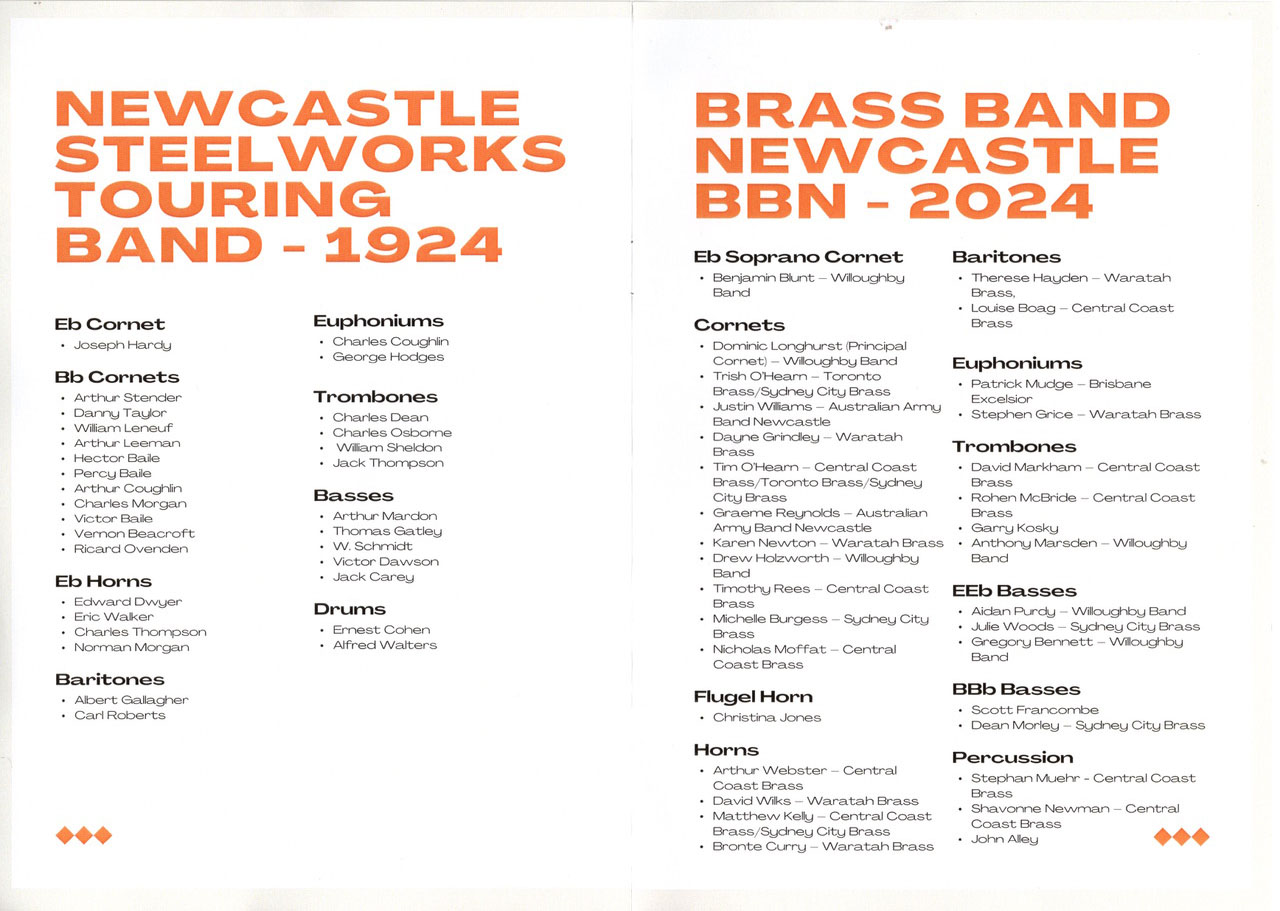
The near capacity crowd gave the band a standing ovation as the performance concluded, and the band played Elgar’s Nimrod as a return thank you. A lovely, printed program[1] listed the personnel of the 1924 band, and of the June 2024 band. Composer and musician Ross Fiddes, Artistic Director of the Newcastle Music Festival, delivered an informative commentary to the performance, and a wonderful audio-visual show made by Mark Corben was projected onto a screen above the band. Here historical information and images of Newcastle and the BHP served to link today’s musicians and their audience with people and places of the past. This was a first-class tribute to the blokes who bought fame to our city a century ago. A grand celebration of an event worth celebrating.
Need for a Comprehensive History
Stories of this bold venture have been told in band rooms, at barbeques and water coolers, and in books and newspapers ever since. Nowadays stories of the band appear on the Web. There is a need for a definitive, scholarly history of the band, and a good starting place would be Jack Greaves 1999 book[2] and Chris Helme’s website.[3] More recently available information from on-line newspapers and magazines should help in the compilation of a comprehensive history.
Published accounts of the Band are often accompanied by photographs and the photos are in the styles of the times: the musicians – all of them men – pose in serried ranks proudly holding their instruments according to the prevailing conventions: big instruments seated, small instruments standing. Looking straight ahead.
Four “Lost” Images”
In this article I want to introduce a set of four ‘lost’ images of the band, images that I discovered recently by a stroke of good fortune – the kind of serendipity that could only come to an enthusiastic ‘bandie’ like myself. I’ve been keen to contribute to the centenary, and my discovery of these pictures gave me a chance do so!
Photographs in the Newcastle Industrial Heritage Association
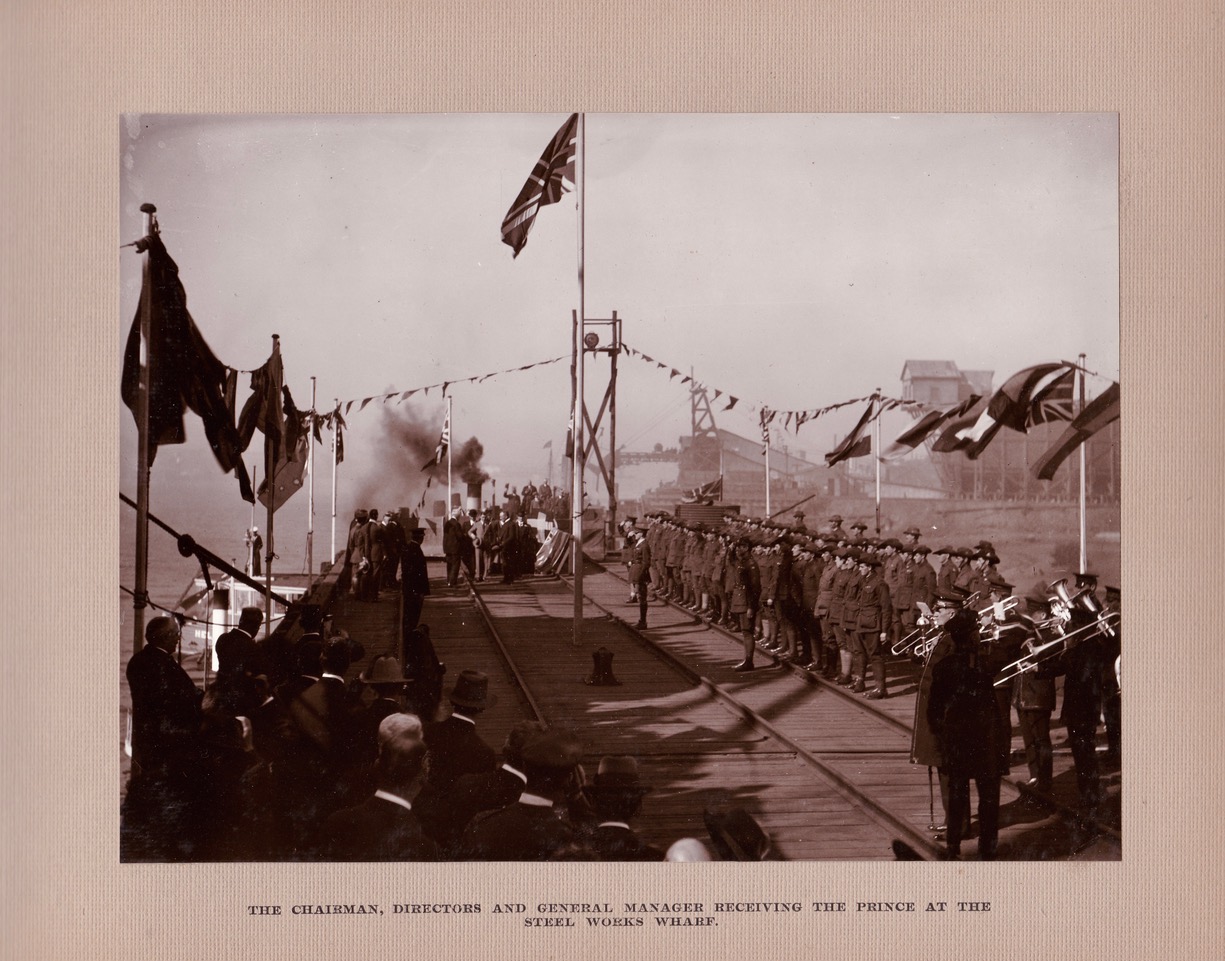
I had noticed an uncaptioned photo of a band on the open page of a book housed in a glass case at the Newcastle Industrial Heritage Association’s (NIHA) Delprat House. I suspected that this would prove to be an unlabelled image of the Steel Works Band. The NIHA gave me digital copies of what turned out to be four pictures from the publication. Four shots of the same band on the same occasion. The book is a 15-page leather-bound memento of the welcome to the BHP Steel Works of the Prince of Wales in 1920.[4]
Photographs of the Steel Works Band?
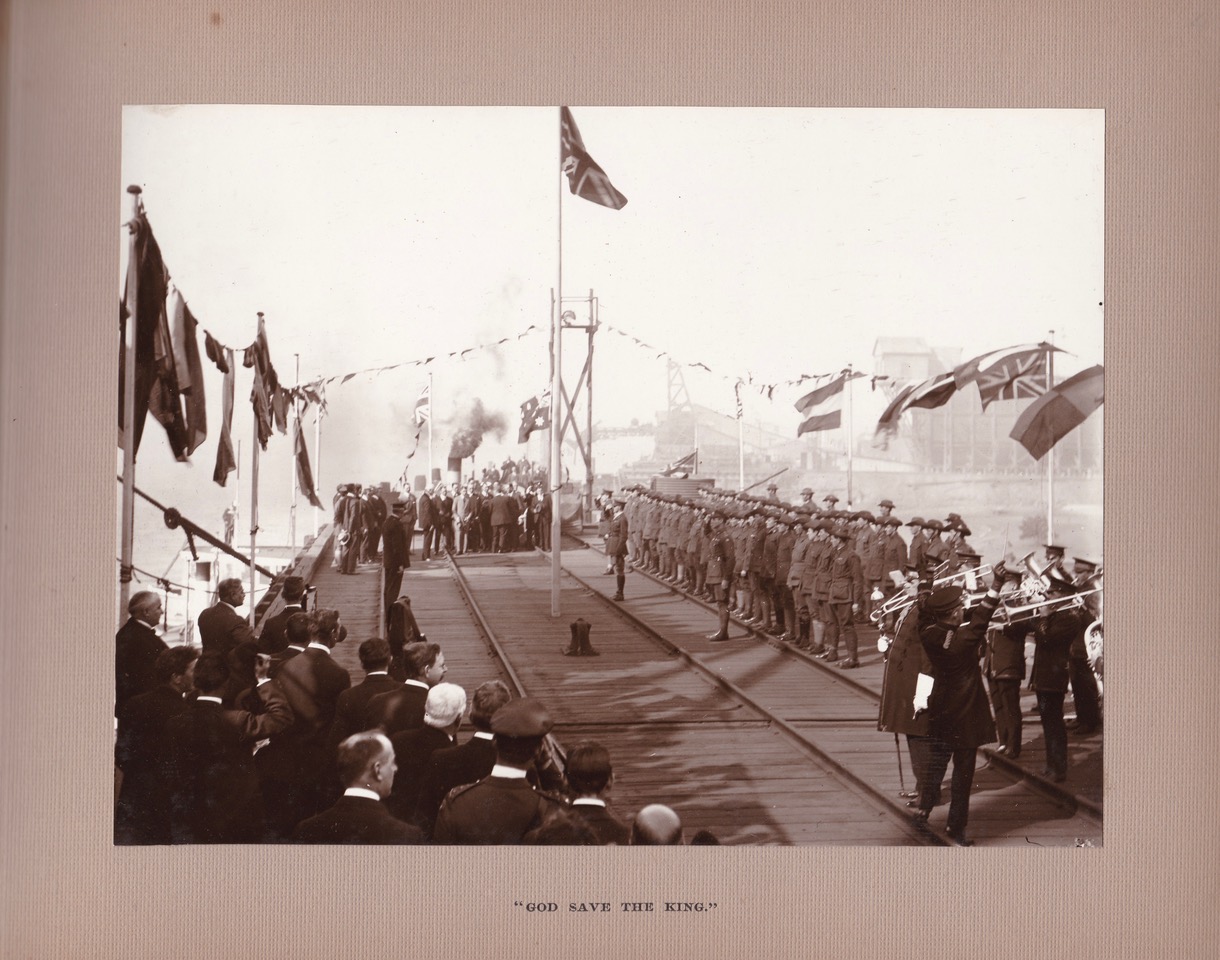
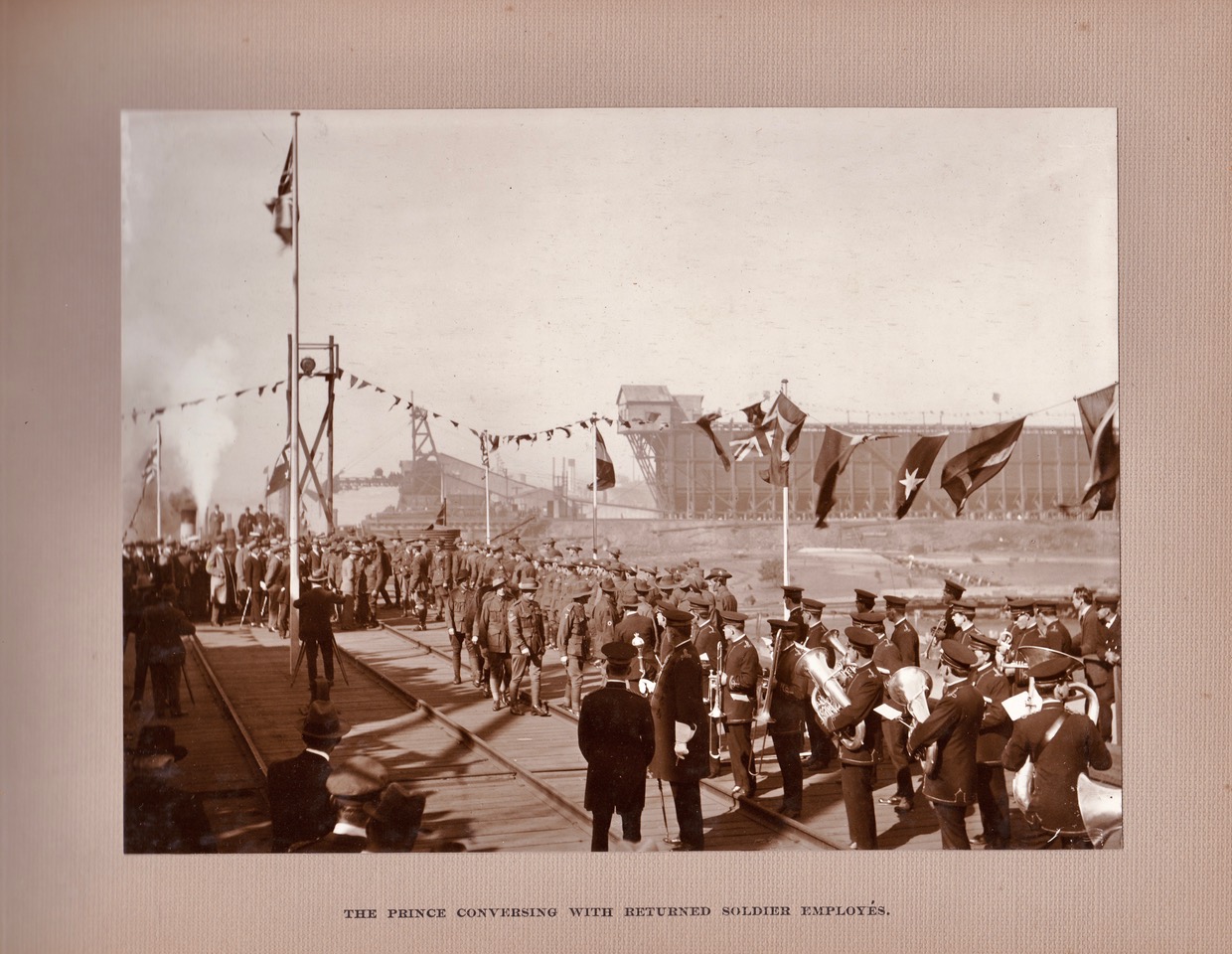
There is no published evidence that the band in the images is the Steel Works Band but it seems reasonable to think that BHP would have used its own band at such an important affair. A close comparison of the musicians, their uniforms, and their instruments in the Prince of Wales (PoW) images with a well-known 1922 posed image of the band confirms that these are indeed photos of the Steel Works Band. I believe these to be the only extant photos of the band standing, and of the band playing. All other photos that I know are posed. We can be certain that these images have not been published or displayed since the prince’s visit in 1920.
This Is “Our” band
The comparison confirms – despite the lack of sharpness in the photos – that this is ‘our’ band. In the third PoW picture the bandsmen are standing at attention holding their instruments, and it is in this image that the uniform is clearest and best suited for comparison with the 1922 image, a comparison best done with a zoom application. Note:
- hats (similar style and colour)
- jackets (similar style and colour):
- a white band high on the dark collar
- embroidered cuff accoutrements (best seen on an enlarged digital image)
- shoulder epaulettes (best seen on an enlarged digital image)
- the presence of a G bass trombone in all photos. (While this instrument was not uncommon, it was unusual enough to claim it as a confirming sliver of evidence.)
- the drum major in all photos seems to be the same man: taller and stouter that the other bandsmen and holding the same mace.
The Four Photographs
The four pics are like a short video clip. The photographer stood in the same place – it would have been difficult to move the tripod – and watched and clicked as the prince and his party are welcomed by the Steel Works VIPs as they disembarked from their vessel. The band greeted the prince with ‘God Save the King’. As the royal party moves shore-ward, the prince talks with returned servicemen who now work at BHP. The party continues to make its way to the Royal Train. The captions on the plates tell the story:
1.00 ‘The Chairman, Directors and General Manager Receiving the Prince at the Steel Works Wharf.’
2.00 ‘God Save the King.’
3.00 ‘The Prince Conversing with Returned Soldier Employees.’
4.00 ‘The Chairman, Directors and General Manager Escorting the Prince to the Royal Train.’

History of The Newcastle Steel Works Band
The Newcastle Steel Works Band was formed in 1916 from employees of the Newcastle BHP Steelworks, under the directorship of Arthur Brown formerly of the South Notts Temperance Band, England. Manchester born Albert Baile was appointed bandmaster in 1920 and soon the band won the A grade competition in Newcastle and a similar contest in Sydney and were the runners up to the Malvern Tramways Band in the A Grade at the Royal South Street Eisteddfod, Ballarat, in 1921 and 1922.
Baile then invited seven distinguished players to sign up including Arthur Stender of the Collingwood Citizen’s Band in Melbourne. Stender was appointed principal cornet, a real coup for the band.
Band Departs For England March 1924
In March 1924 the band sailed for England, and 15 000 people are said to have attended their farewell concert in Perth, the city that Albert Baile made his hometown when he came to Australia.
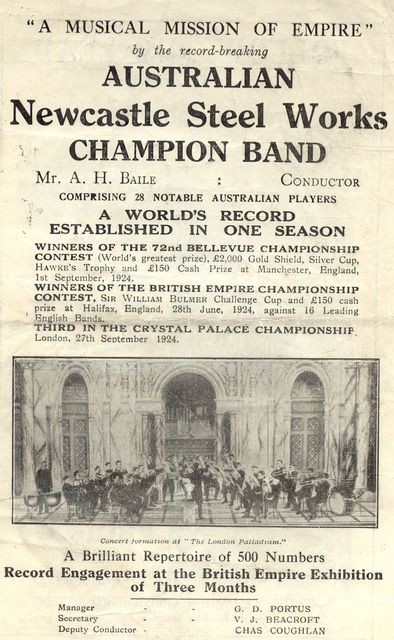
It is said that the band rehearsed 6 hours a day en route and had a repertoire of 500 pieces. In England the band won the British Empire Championship against the likes of Foden’s Motor Works Band and the Black Dyke Mills Band. They won the prestigious Belle Vue competition in September same year – where they played sitting down, an innovation immediately adopted at the Belle Vue where bands had always stood. In October they came third in the Crystal Palace Championships where Black Dyke were placed second and St Hilda’s Colliery band came first.[5]
Back in Australia April 1925
The Band arrived home on 25 April 1925 to a welcome next day by Alderman Morris Light, Lord Mayor of Newcastle.
On tour the band scored numerous engagements, and while these helped to pay its way, the band was heavily indebted when it arrived home. Some scandal as to the distribution of money ensued, and eventually – in about 1932 – it morphed into a Newcastle City Band.
The Centenary Tribute 2024
This year’s tribute to the Steel Works band is the second such effort. In 1988 a BHP Steelworks Re-creation Band performed concerts in the Great Hall at the University of Newcastle and in the Civic Theatre.
The success of the Newcastle Steelworks Band stands out as a major event in Newcastle’s music history. Newcastle is a working city where working people do working people’s stuff. ‘Banding’ is one of these activities. Brass bands have a long history of association with industry. As I see it, Newcastle and the Hunter has hosted for many decades a hot bed of tradies, manual workers, and brass band musicians.
In London the band made a series of gramophone recordings, some of which are now available free on YouTube, and collectors still cherish their copies of these fragile 78 rpm shellac discs.
Roland Bannister PhD
Dr Roland Bannister PhD worked as a musician and music educator for most of his adult life. Circa 1960 he was a trombonist in the Newcastle Police Boys Club band and the Band of the 2nd Infantry Regiment (now the Australian Army Band Newcastle), from 1966 to 1969 he was bandmaster of Glen Innes Town Band, from 1972 until 1989 he was Music Director of Riverina Concert Band (the Band of the City of Wagga Wagga). He worked as a music academic at Charles Sturt University’s Wagga Wagga Campus from 1972 until 2003.
Newcastle Steel Works Band Poster c.mid 1920s
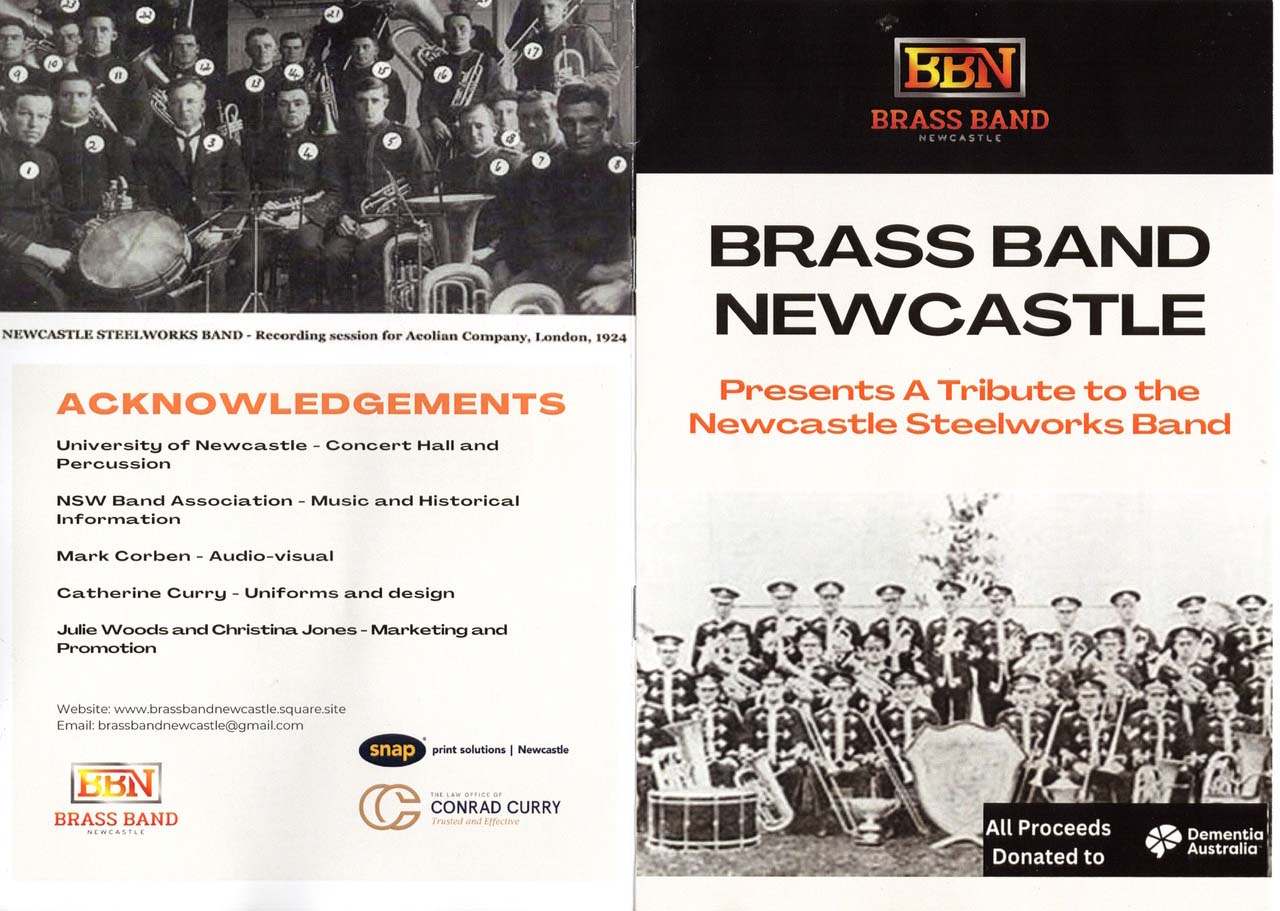
Brass Band Newcastle (2024) Tribute to the Steel Works Band Program pages 1&8
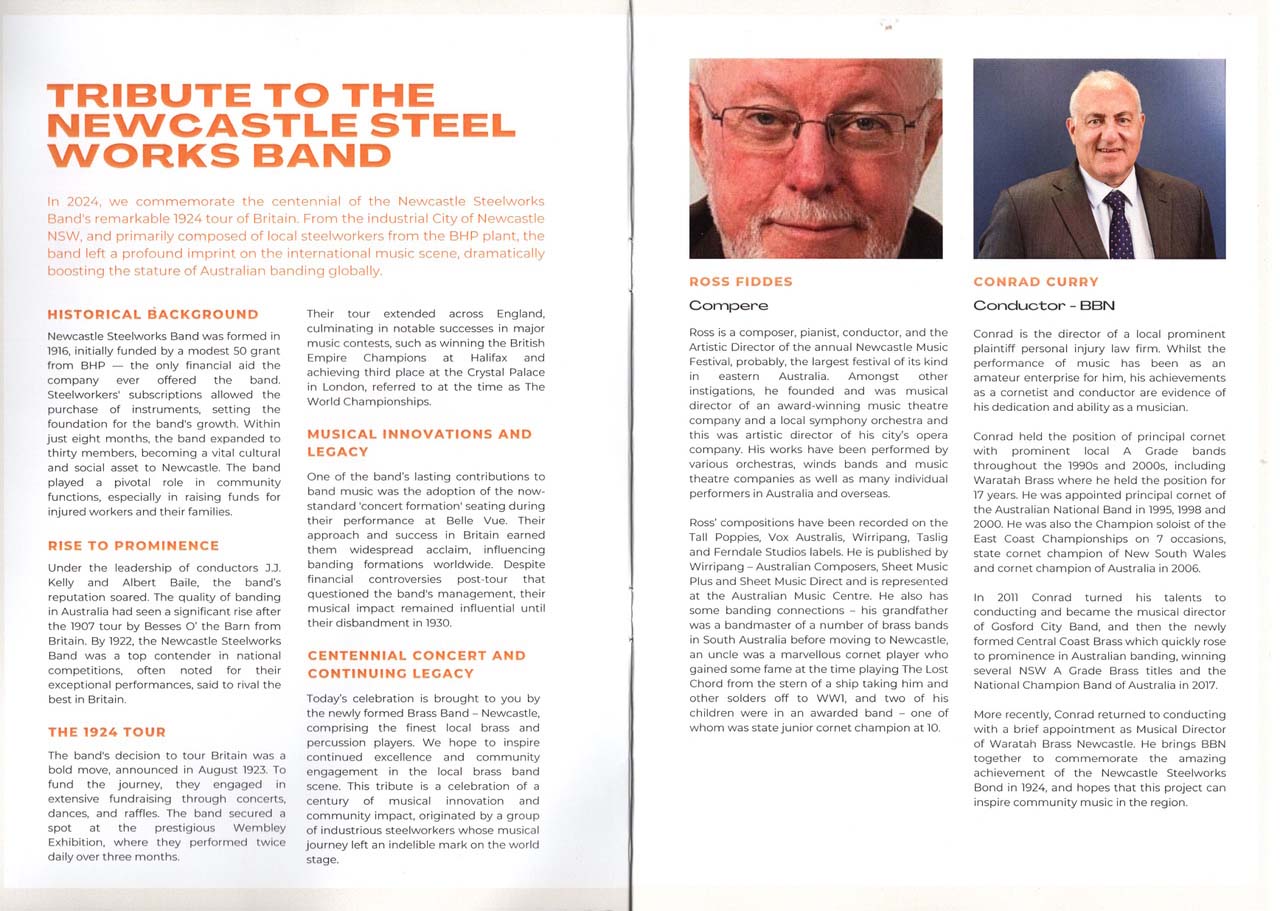
Brass Band Newcastle (2024) Tribute to the Steel Works Band Program pages 2&3
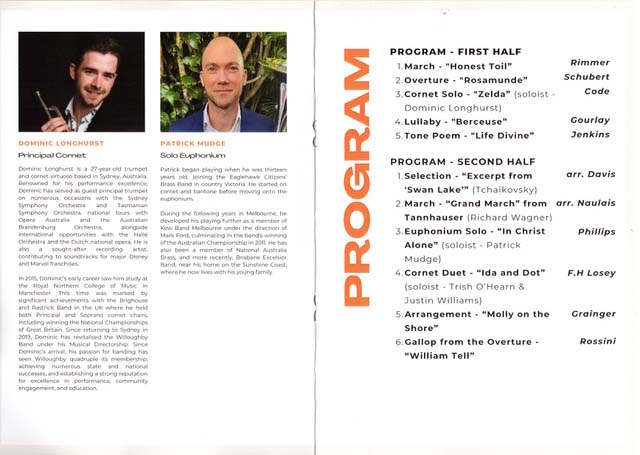
Brass Band Newcastle (2024) Tribute to the Steel Works Band Program pages 4&5
Brass Band Newcastle (2024) Tribute to the Steel Works Band Program pages 6&7
Notes
[1] Images of the 8-page program will appear at the end of this article.
[2] Greaves, Jack (1999) A Musical Mission of Empire: The Story of The Australian Newcastle Steelworks Band, Peters 4 Printing, Berowra Heights
[3] Helme, Chris (2017) The Newcastle Steelworks Band from Australia and Its 1924 Visit to the UK. Accessed 21 June 2024. Available at: <https://www.chrishelme-brighouse.org.uk/index.php/sunday-bandstand/bandstand-memories/item/229-the-newcastle-steelworks-band-from-australia-and-its-1924-visit-to-the-uk>
[4] The Broken Hill Proprietary Coy. Ltd. (n.d.) Visit of H.R.H. The Prince of Wales K. G. to the Steel Works: Newcastle 25th June 1920 (unpub.)
[5] see Newcastle Steel Works Band Poster c.mid 1920s, below