



We acknowledge and pay our respects to the traditional Aboriginal owners of the lands on which our compuses are located, as well as other Aboriginal and Torres Strait Islander nations from which our students, staff and community are drawn.
Project Description and Context
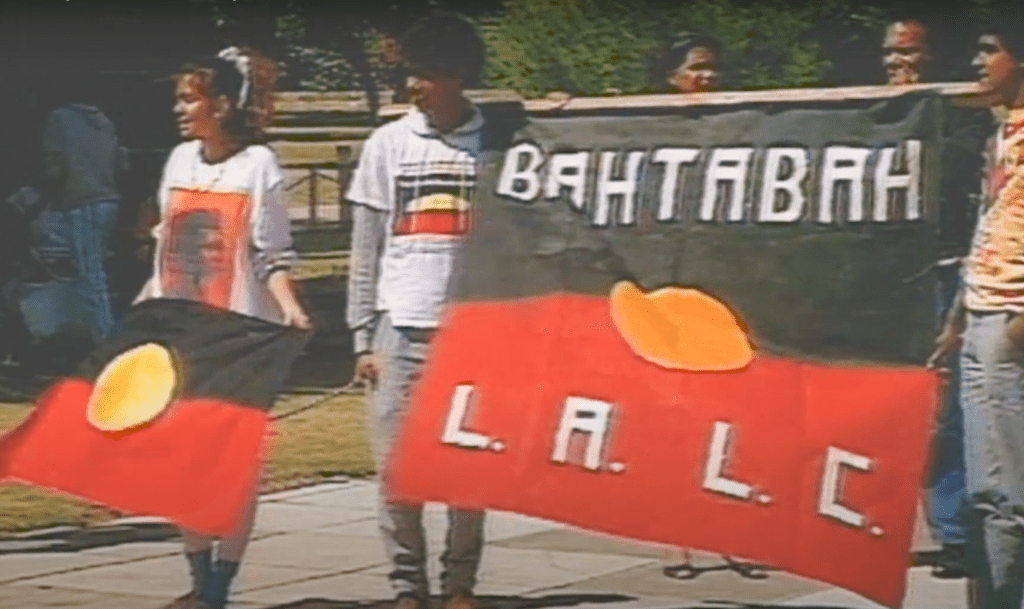
The University archives already has a substantial listing of sources relating to Aboriginal history and culture and this project enhances previously undertaken work. The aim of this project is to review archives and collections held in Special Collections to identify important cultural knowledge associated with Aboriginal history and culture and enhance access to those resources for researchers and the community. The aim is to locate Aboriginal content (not otherwise obvious in names of collections/archives but in general archives) so that is searchable.
This project enhances the ‘Aboriginal Dreamtime of the Hunter Region’ project (1996) that reviewed the original finding aid list of archival web resources. It will for the first time locate, contextualise and credit AV audio and audio-visual formats from the recently digitised NBN Television archive to be enable searchable Aboriginal content.
PROCESS – SCREEN CAPTURE AND FILM CLIP PROCESS
- Review and assess existing archives/collections to identify content containing information associated with Aboriginal history and culture.
- work with Special Collections staff and other users to create associated metadata and finding aid.
- reproduce and recontextualise found sources (to improve accessibility)
- update existing online and archival sources with new information and metadata relating to Aboriginal history and culture
- review existing terms and keywords (used in metadata) and develop procedures around consistency and accurate terms associated with Aboriginal culture and history (Newcastle, Hunter and Port Stephens areas).
RESEARCH PROJECT (REVITALISING INDIGENOUS CULTURE AND KNOWLEDGE PROJECT) – INITIAL GOALS, AIMS AND TRAJECTORIES
The initial goals of the project were quite broad in terms of scope. Viewing the NBN Television Archive’s ‘News and Roving Eye’ tapes to identify Indigenous content and interpret place, the context of individual clips, the people involved and the areas the footage is shot or discussed. The overall aim of the larger digitisation project is to reach the National Sound & Film Archive of Australia’s Deadline 2025.
The aim was to create a ‘finding aid’ that would allow for elaboration on the stories, and better categorisation off the stories related to Indigenous Australian events/people and place.
FINDING AID AVAILABLE HERE [797 KB]
PROCESS – IDENTIFICATION OF INDIGENOUS GROUPS AND NATIONS WITHIN FOOTAGE
• NBN Television during its heyday was the primary Television provider to much of the Upper and Lower Hunter, as well as Port Stephens shire to as far away as Taree on the Mid North Coast; Gosford on the Central Coast to as far as The Hawkesbury River (effectively a demarcation border between Sydney and the Hunter region). This also included rural areas of Wollombi and parts of the Putty Road between Windsor and Singleton (which is a bit of a geographical oddity in terms of isolation from local councils and the functional independence of its residents).
• Considering the broad capture of content from NBN it was presumed from the get go that the Indigenous nations of Wonnarua in the Upper Hunter, Darkinjung (there is no definitive pronunciation or spelling) of the Mountains beginning at the foot of Milbrodale and encompassing the areas around Wollombi, Putty, Colo all the way to the North Western boundary of the Hawkesbury river near present day Wilberforce and then East following the river toward Broken Bay, Awabakal nation surrounding present-day Newcastle, Lake Macquarie and other coastal areas, Worimi nation and finally Birpai nation surrounding Taree all the way to present day Port Macquarie.
• This is a large area and, unfortunately, the televised footage does not actively identify Indigenous people and speakers as belonging to specific nations. Instead, reporters rely on ambiguous and broad generalising terms such as ‘Aborigine, Aboriginal’ and in some instances, ‘Indigenous’.
• ‘Aborigine’ is an archaic term that is no longer in scholarly use nor should it be used on casual conversation. It is also now insufficient as a cultural identification in the present day, given the recent surge in both identification and cultural revival of Indigenous nations.
• It would be difficult to ascertain purely from the footage, someone’s cultural background therefore, unless the speaker or person in the footage is identified as specifically from a certain nation, it would be best to stay with generalised written terms such as Indigenous.
• Wherever possible, if someone was known to me as being from that nation, or identified themselves, I have specified. Though again, in most instances, I have relied on a generalising term.
PROCESS – SCOPE OF NBN ARCHIVE, METHODOLOGY OF IDENTIFICATION, AND REVIEW OF FOOTAGE.
• The scope at the beginning of the project was to work through as much of the content within the archive as physically possible within the working timeframe between August and December 2020
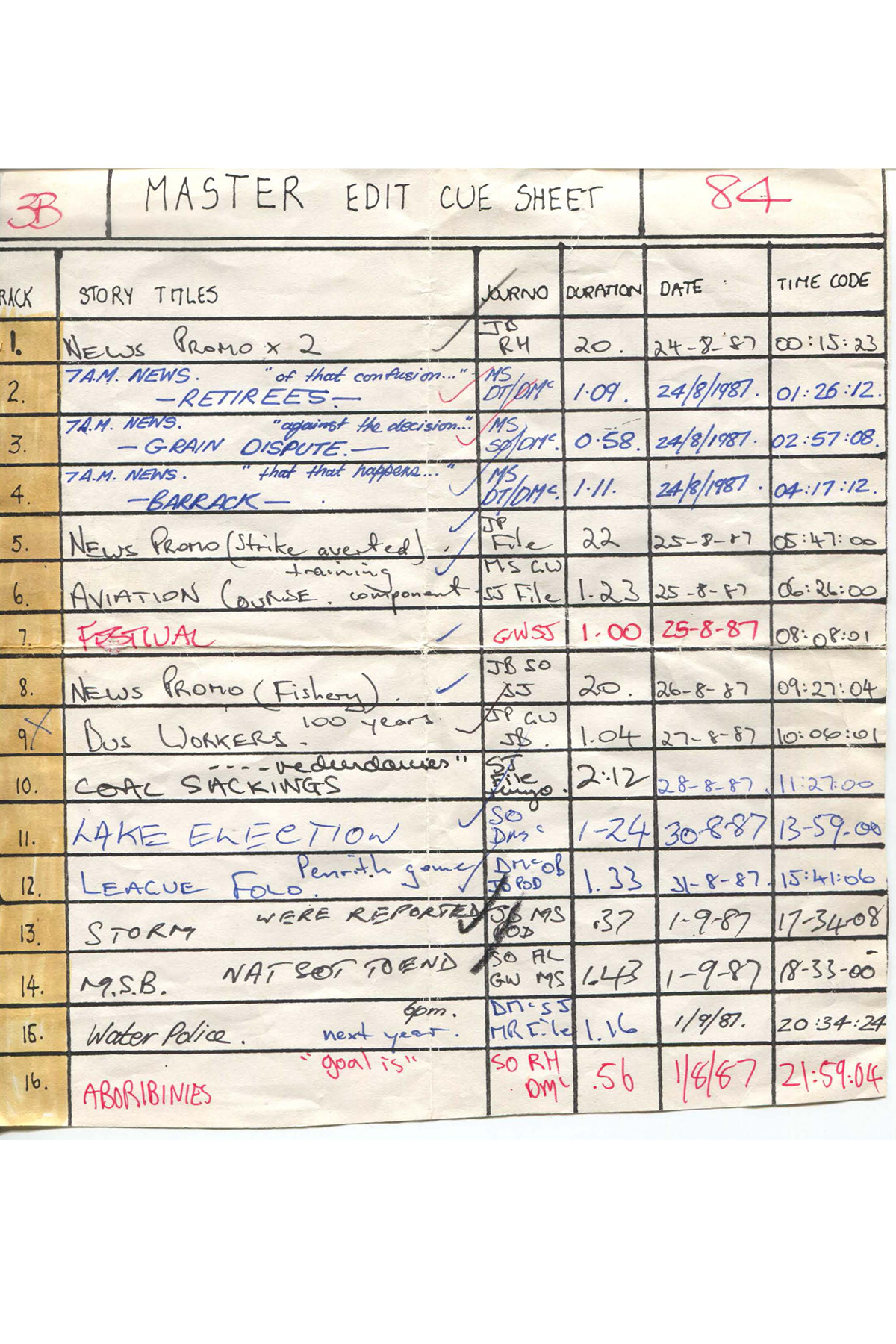
• The initial work would revolve around going through an Excel spreadsheet of the tape cue information and adding more info, offering corrections where necessary and so on – starting at the first sequence of tapes 1B_01 dating from 19/3/1986.
• This process was time consuming and inefficient. However, there was an existing catalogue of information regarding the content on file and this was a good starting point
• We therefore moved to a more ‘user friendly’ format: a ‘finding aid’ created through Microsoft Word in which Indigenous content would be readily categorised, dates given and cue information provided. This freed up time to review footage and collate as much metadata in the 3-4 month period
A relatively simple historian’s outlook was employed to ‘identify the surroundings’ if not specified, the participants, the general mood of the story, timbre of speech regarding subjects and of course attempting to provide as much information on the people named (or unnamed) within the footage. Also included was an ‘archivist’ perspective in ‘transcribing’ the voice overs (V/O) of journalists and the speakers themselves and if possible, the speech underneath the V/O.
• An attempt to gain as much information from the footage as possible, often involving a desktop search to identify relevant content that could provide context around events or people. For example, on 3B_84 story 16, a man named ‘Ross Ingram’ was awarded the NSW Aboriginal Youth of the Year award in 1987. At the time of my recording in the finding aid, I was unaware that Ingram was the first Wiradjuri to become a medical doctor, coming through the University of Newcastle’s Medical faculty, the story did not make clear that he was studying to become a doctor nor identify his nation. It was not until coming to a story on 4B_30 story 17, in which a speaker (Aunty Beve Spiers, speaking as an Elder of Darkinjung) is mentioned and upon doing contextual research, she was awarded the ‘Ross Ingram Memorial Prize’, creating a link between the two stories and, more importantly, a link within NSW nations and Aboriginal Health Work.
• When footage was located of Indigenous people and place, it was necessary to include screen captures in order to provide visual identification. Both for a profile and for communal engagement and outreach.
• Short film clips were created in order to cross check with others who may have more information regarding the topic in question. ‘Adobe Premiere Pro’ software was used in order to ‘clip’ certain footage from the movie file.
PROCESS – ROADBLOCKS AND ISSUES
- some tapes were missing or general poor quality
- following the encoding on Adobe Premiere Pro, and during upload to YouTube, clips were often ‘rendered down’ to the platform’s preferred settings. The settings on YouTube cannot be changed and therefore we instituted a workaround.
- Some tapes would often be reused with content and taped over.
- The video quality was often an issue for the purpose of screen captures. Simply put, when going through a tape frame-by-frame, should the subject or an object be in motion, their ‘shadow’ would blur themselves making it unusable for the purpose of identification.
- Eventually it was noted that following the encoding on Adobe Premiere Pro, and during the upload onto YouTube that the clip was ‘rendered down’ to whatever was deemed to be the platform’s preferred settings. The settings on YouTube cannot be changed and therefore we in the lab decided to institute a workaround.
ANCILLARY INVESTIGATIONS – MATTERS OF INITIATIVE
There were some unusual discrepancies or strange inclusions of material that did not fit into Newcastle and the Greater Hunter’s history. Some examples of content that may require further investigation of footage are:-
- the still of a photograph during a story titled: “2B_15 Union Photos Recut” in which two neo-nazis holding placards are protesting ‘Chilean Reds’ along with a racial ideology and a common Nazi phrase ‘Smash Communism’.
- death of content relating to Indigenous Australians throughout the tapes, I instead kept busy creating separate finding aids for Industrial actions and other themes within the footage.
- Industrial actions and Unionism in Newcastle, the other is simply footage that I thought was interesting and showed either the development of Newcastle, the reaction of events within it or the region’s relationship with the world at large.
- prevalence of persons in ‘Blackface’ that is, as a distinctly Australian representation of Black and Indigenous Australians. ‘Blackface’ itself, is a cultural transplant from the United States, derived from Minstrel shows and growth of the ‘Old Jim Crow’ as a pejorative terminology, then as a legal mandate for segregation of Black Americans from the white majority.
- Archaeological dig of the Newcastle Convict Lumberyard and Stockade in 1987. The story titled: 3B_58 ‘Dig Filled’ discusses the ‘race against time’ to prevent the sale of the site in question and possible destruction. Upon further investigation, it appeared that both State Heritage listing indicates that an Aboriginal site of significance was also uncovered.
EXTERNAL LIAISING – WOLLOTUKA INSTITUTE AND AWABAKAL NEWCASTLE ABORIGINAL CO-OPERATIVE LTD
Liaised between Wollotuka Institute and the GLAMx Lab. Some colleagues and visitors are long-time residents of the area and were often evident in archival footage.
RESULTS – STATISTICS AND METRICS
- 12 Nov 2020 – Betamax sequences located in the NBN Television Archive ‘Roving Eye and News Stories’ that comprised two years’ worth of content between March 1986 and March 1988.
- Each sequence included one hundred separate tapes starting for example ‘1B_01’ and finishing on ‘1B_100’. This equates to a total of four hundred separate tapes that were reviewed.
- Each tape would hold roughly fifteen to twenty stories, sometimes the number would be larger or fewer. As a median, there would be about seventeen stories on each tape.
- With this metric in mind, 6,800+ stories were reviewed that comprised the years between March 1986 and March 1988. That number would roughly equate to around 18.6 stories shown per day for 365 days.
- Review was completed within twenty five days at a rate of 272 stories per day (not including ancillary investigations, creation of finding aid material and research)
- A total of 66 stories were identified relevant to the project. These are included on the “Aboriginal Footage” Finding Aid – and are discussed at length. Of those, 19 did not feature any Indigenous Australians or only briefly mention Indigenous people, place and concept. A total of 47 stories specifically relate to Indigenous Australians.
- Considering the median average of seventeen stories per tape and the final total being around 6,800 stories across all four hundred tapes; we are left with a result of forty seven stories out of that 6,800. As a percentage, this equates to a dismal 0.69%. If we exempt stories relating to sport, the total being thirty two, the percentage is 0.47%.
SKILLS
research skills – knowledge of GLAM sector profession – creation of metadata and use of Excel spreadsheet – cultural safety practices – standards associated with media content – technical skills – Use of Adobe Premiere Pro & imovie – creation of digital assets for upload to digital platform – web & social media publishing – effective communication – teamwork skills
RESULTS – FINDINGS
The overall number of stories associated with Indigenous Australians is very low. Content that has been located is documented at great length in order to improve their visibility and, scholarly worth. In some instances, the stories relating to Indigenous Australians would take up less than fifty seconds of airtime, with that being principally taken up by voiceover, stock footage or brief establishing footage to indicate what is occurring. It was rare to come across footage that included an interview with a principal subject to indicate their work and what is going on in the footage. Even rarer were two stories on the same tape.
A comparative between Indigenous stories and other ‘mainstream’ ones in the NBN Television archive looked at was 99.53% non-Indigenous to 0.47% Indigenous stories.
Recommend maintaining this model of reviewing in two year intervals until the present day, this will also provide a comparative base for all other metrics of Indigenous content found. It is hopeful for this metric will increase following Bicentennial because after some discussions with mob : ‘there was a lot more black faces on the tele after Bicentennial’. However, that remains to be seen from the content.
Initially, it was assumed there would be an influx of stories relating to Indigenous responses and reactions to Bicentennial. Surprisingly there were only two stories relating to such response and only one other that mentioned ‘Aborigines’ on the day in question. Footage features no Indigenous Australians. The total of stories however, do make clear that Indigenous culture, political, medical, academic and communal activity are happening in the background of a White Australia.
To close, this research project should not conclude. If anything, it has barely started. The amount of material in the film archive is staggering and will require years to fully transcribe, contextualise and order. It is not something that a four month internship per year is capable of fulfilling satisfactorily.
RECOMMENDATIONS
• Digitisation Project continued to meet the NFSA Deadline 2025.
• GLAMx Lab promoted as the ‘communal arm’ of the University Library system. The lab should be considered an aspect for communal engagement with the rest of the Newcastle-Hunter residents and its history, for Indigenous as well as non-Indigenous communities. This would create a ‘hometown connection’ between staff and students at the university, community at large. The GLAMx Lab is the perfect conduit for that community engagement through shared heritages.
• A stronger liaison with Wollotuka Institute to create a greater working relationship on campus, and encourage more mob to become involved in heritage, finding it and, preserving it.
• continuation of this project about Indigenous people, theme and place within the Library and the Archive to identify content and context. Consider a ‘team of two’ approach rather than a single individual person of scope of project.
Internship role at the Library is a great way to advocate for more Indigenous involvement in the Archives and may break down barriers between the community and the university as an institution. A liaison role between community- University engagement with a support network in place would mean that specialised experiences and knowledge can be readily conveyed between all stakeholders .
Once again, I want to thank all of the staff at Auchmuty Library that welcomed me to the role, helped me pursue my interests and encouraged the work on this project. I especially want to thank Gionni di Gravio and Ann Hardy who were more than happy to offer their knowledge to improve my understanding of both the GLAMx Lab and the Archive in the work they do, but also in identifying key figures that they are/were aware of, and then placing me into contact with them. You have both helped push me into communities that otherwise might not have been aware of my existence and made my time here incredibly memorable. Thank you.
Didjurigura Yanu (Thanks and see you later in Dharug)
Bradley Cunningham
Library Intern (Revitalisation of Indigenous Culture and Knowledge Project)
GLAMx Lab
Compiled December 2020